

Next Year, the Fight for a Good Life Continues
December 19, 2025
We’re building the economic agenda to get there.
The Roosevelt Rundown features our top stories of the week.
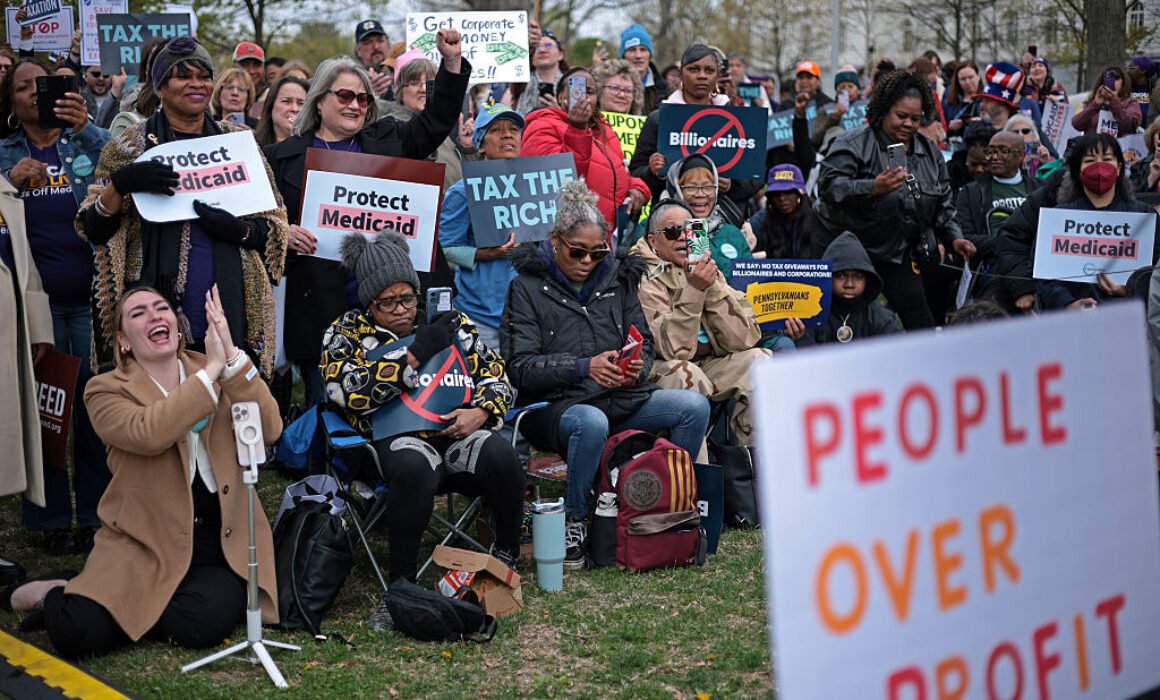
Activists gather for a "Rally to Say No to Tax Breaks for Billionaires and Corporations" at the Upper Senate Park on Capitol Hill on April 10, 2025 in Washington, DC. (Photo by Alex Wong/Getty Images)
A Year in Review and an Agenda for the Future
It’s been a chaotic year, and the consequences of concentrated wealth and power have never been clearer. Slashing the safety net while giving tax cuts to the ultra-wealthy isn’t exactly the kind of economic change people have been demanding. This year and into the next, we’re envisioning a good life for all: an agenda that builds power for people, not corporations, and an effective government that boldly delivers for and with the public.
In her first full year as Roosevelt’s president and CEO, Elizabeth Wilkins outlined a vision of governance and policymaking that gives people agency over the conditions of their lives and builds an economy people actually want. In a report informed by interviews with more than 45 recent federal officials, authors Hannah Garden-Monheit and Tresa Joseph made 161 practical suggestions for how to refresh our anemic government institutions to be more responsive to the economic concerns of everyday people—and less to those of corporate lobbyists. And we began this year with a collection of ideas for building economic democracy, with experts tackling topics like the cost-of-living crisis and monopoly power.
As pressing crises dominated news headlines, our research responded by pushing forward clear-eyed, long-term thinking. We laid out the principles of a vision for public, universal childcare, explained the financial risks of ill-informed crypto regulation, and looked at how Detroit created a roadmap for cities fighting neglectful landlords. We cautioned that progressives shouldn’t discount important marketcrafting tools like tariffs and public ownership just because of the Trump administration’s erratic, antidemocratic use of them. And, we explored how concentrated wealth has corrupted democracy, breaking down the media industry and pumping money into elections.
A corporate-captured state, a disillusioned public, and an ever-widening wealth gap define the current landscape. Roosevelt is working hard not just to understand this harrowing moment, but to build the vision for a good life that can lead us out of it.
Preventing Inequality Through Predistribution
Redistributive policies, like wealth taxes or cash transfers, are important tools for reducing inequality. But to ensure inequality isn’t built into the system in the first place, we can’t overlook predistributive tools: policies like fully funding public schools and infrastructure, or boosting the bargaining power of workers by protecting unions. In a new brief, political economist Steven K. Vogel and Roosevelt alum Sunny Malhotra argue for policymakers to revive the predistributive approach.
“The predistribution agenda does not accept labor exploitation and value extraction and then compensate for it, but rather strives to give workers fair wages and consumers fair value in the first place,” the authors write.
Read the brief: “The Predistribution Solution”
What We’re Talking About
What We’re Reading
- On surveillance pricing: The Federal Trade Commission is investigating grocery-delivery app Instacart over its use of AI-driven pricing after a report by Groundwork Collaborative, More Perfect Union, and Consumer Reports found that the company is experimenting with charging different families different prices for the same products.
- Roosevelt’s Brad Lipton wrote earlier this year about how legislators are beginning to pay attention to and introduce limits on surveillance-based price- and wage-setting.
- On carbon taxes vs. green industrial policy: Why not both? That’s what Roosevelt Fellow Daniel Driscoll suggests in a new brief exploring how adopting climate policies in sequence is critical to decarbonizing a consumption-driven economy like the United States.
- “[S]equencing policies to align with growth drivers can reduce social, economic, and political backlash,” Driscoll writes. “[I]nvestments targeting clean consumption create the ideal conditions for potential future carbon pricing.”
- On the media crisis: Victor Pickard joined Right Now With Perry Bacon to discuss the key crises facing the news media: the decline of local news, defunding of public media, and runaway consolidation of media companies.
- Roosevelt’s Bilal Baydoun and Shahrzad Shams spoke with Pressing Issues about the importance of media as democratic infrastructure: “Too often our media debates are about the editorial decisions of individual newsrooms, or the messaging of certain political actors—like who is the Joe Rogan of the left?” they said. “We can often lose sight of the fact that our media system operates in a specific policy context that is shaped by extremely powerful actors.”
- Earlier this month, Baydoun, Shams, and Pickard released a comprehensive report about the roots of the current news crisis.
- On Trump’s attempt to ban state AI regulations: Roosevelt Fellow Samatha Shorey spoke with ABC affiliate KVUE about the recent executive order placing a moratorium on state-level AI laws.
- “If there isn’t some sort of institutional body that is helping us decide and creating enforceable guardrails around what appropriate AI use looks like, then the imperative really just pushes us towards greater profit,” Shorey said. “The last thing that we should be doing is creating a void. . . . Especially at the rapid pace of development we currently are seeing from AI.”
The Roosevelt Rundown will return on January 9.