

Virginia’s Data Center Alley Is a Cautionary Tale for Equity and Climate
July 15, 2026
By Daniel Driscoll
Data centers have come to dominate public discourse in the United States, uniting people across the political spectrum in opposition and raising pressing questions: Are data centers fueling an AI innovation boom or a bubble? Are they promoting employment in construction sectors or contributing to entry-level corporate layoffs? Will their computing power enable human society to identify and implement decarbonization solutions, or will they simply increase energy demand and, by proxy, carbon emissions? While many of these questions remain open, we have some clues based on what has rapidly developed in one state in particular.
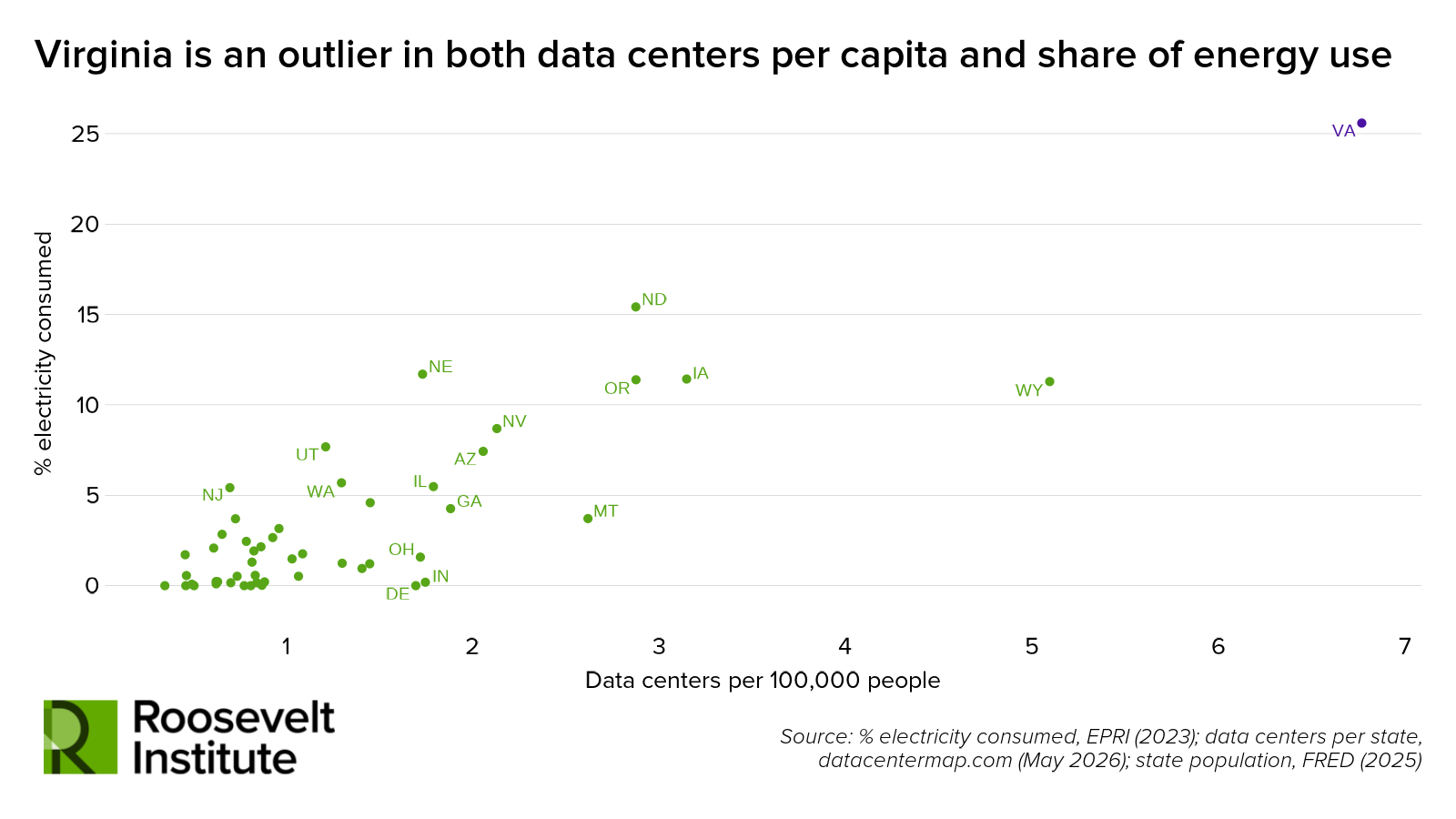
Roughly 70 percent of internet traffic from around the world flows through the state of Virginia, concentrated in an area near the nation’s capital nicknamed “Data Center Alley.” Currently, Virginia is an outlier, with more data centers than any other state and the highest rate of data centers per capita. Not only that, but Virginia also boasts the highest share of statewide electricity consumption going to data centers themselves, at roughly 25 percent of total consumption, nearly double the next state in line, North Dakota, at 15 percent.
Figure 1 compares Virginia with the rest of the United States, plotting the share of electricity consumed on the y-axis and data centers per capita on the x-axis.
Figure 1
Why Virginia of all states? How did this come to be? The answer comes in a word: geography. Having nearby data centers affords the US government and defense industry (which are massive data customers) globally optimized processing speeds, reducing the microseconds needed to make intelligence decisions and financial transactions. Furthermore, with adjacency to the coast, Northern Virginia’s data centers are conveniently plugged into the submarine transatlantic cables that connect the world. Finally, early on, Virginia tempted firms with comparatively cheap electricity, lower exposure to natural disasters, and state and local tax exemptions.
So, how has it been going for the data center hub of the United States? There are two primary future challenges with the concentration of data centers in Virginia: ensuring consumer equity and combating climate change.
Challenge 1: Equity and Consumer Costs
In 2021, Virginia electricity demand was projected to grow by 1 percent a year. With data center growth, by 2026 those projections rose to over 5 percent. The increase in demand is also accompanied by increases in consumer utility bills. In February 2026, the District of Columbia’s retail electricity prices rose 23.7 percent when compared to that same month in 2025, the highest increase in the country. And now, thanks to a ruling passed last fall, Virginia residential consumers will also pay for 55 percent of Dominion’s near 8-billion-dollar infrastructure plans. And data center energy demand is not just affecting Virginia—the state is a net energy importer, also driving up energy prices in surrounding states.
The reality with electricity bills is that residential household demand is often inelastic. In other words, people at all income levels need to heat and cool their homes for daily life—no matter the cost. The greatest variation of cost burden among income groups is in the share of household monthly budgets spent on electricity bills. One study from the American Council for an Energy Efficient Economy found that 25 percent of low-income households spend over 15 percent of their budget on energy bills. For the average household, on the other hand, it’s closer to 3 percent. That inequity at present is concerning enough without the projections of future electricity bills.
Finally, residential energy prices are further compounded by the fact that, as revealed by a recent Harvard study, utility companies (who have a monopoly on electricity) give preferential rates to tech firms, the costs of which are often pushed onto residents. The utility company expands sales, the tech firm gets subsidized, and residents pay.
As revealed by a recent Harvard study, utility companies (who have a monopoly on electricity) give preferential rates to tech firms, the costs of which are often pushed onto residents. The utility company expands sales, the tech firm gets subsidized, and residents pay.
Challenge 2: Climate
One would initially think that Virginia was the ideal geographic home for data centers because it is comparatively decarbonized, with a nontrivial share of electricity coming from nuclear power. However, due to the sharp increases in demand for energy spurred by data center development, Virginia is importing energy from more carbon-intensive states like West Virginia and has delayed the decommissioning of dirtier power plants. In 2022, Virginia’s Clover Power Station, a coal fire power plant, was set to be retired in 2025—now that decision has been reversed.
Data centers are considered critical infrastructure, relied on by everyone from governments with sensitive intelligence data to households with private information. That means data centers must always function. The way data centers guarantee staying “online” is through backup generators; specifically, diesel generators, which are highly polluting. Diesel generators increase CO2 emissions and also compromise the air quality of proximal communities. To support their use, regulators have even considered easing air quality standards.
Diesel generator–based emissions have been poorly accounted for and are difficult to monitor and report. Some analyses put real emissions from tech firm data centers at 662 percent higher than official reports. These diesel generators are not connected to the grid and can be utilized at any time, especially when tech firms want to avoid utility rates. They are currently exempt from regulations under the Clean Air Act during designated “emergencies,” when they can be used with no federally recognized time limit.
Looking Elsewhere in the United States
Virginia is not alone. Nearly 80 percent of Americans are stressed about their energy bills, facing projections of 8–25 percent increases in costs. Polls show that people connect local data center construction to increases in electricity prices, and the majority oppose data centers being built in their communities. The Great Lakes Region is one among many US regions facing similar pressures to Virginia.
Some states are beginning to adopt more conservative regulations in response. For instance, Texas’s recent Senate Bill 6 blocks tech companies from shifting data center costs to residents by requiring that they finance grid upgrades to prevent overstressing existing systems. Maine’s state legislature went further and enacted a bill to halt the construction of new data centers for 18 months, to better understand the risks in such a fast-moving environment. Unfortunately, the governor vetoed the bill.
There is, at times, a mismatch between the concerns, struggles, and grievances of citizens and the choices of their leaders.
Given the Maine example and the majority opposition to data center construction in public opinion data, there is, at times, a mismatch between the concerns, struggles, and grievances of citizens and the choices of their leaders.
While it remains to be seen how AI and data centers will transform the economy, employment, and the environment in the long term, Virginia—the canary in the coal mine—offers a cautionary tale for moving too quickly: Residents are bearing unequal costs while unaccounted-for emissions increase.
For more on the risks AI poses and who bears them, watch our recent conversation between Roosevelt President and CEO Elizabeth Wilkins and former Deputy Director of the National Economic Council Sameera Fazili.
This blog post benefited from the comments of João Ferreira, Todd Tucker, Suzanne Kahn, and Aastha Uprety.
Author

Daniel Driscoll
Fellow, Climate PolicyAt Roosevelt, Daniel Driscoll works on climate and industrial policy.