

How Bad Policies Will Make This Winter More Expensive Than Usual
October 28, 2026
By Sarah Jane Glynn
This year’s weak wage growth and major energy shocks will make for a costlier heating and holiday travel season.
Winter weather may sound appealing to many of us, considering that we just finished the hottest summer ever recorded in the lower 48. But families are going to face some real challenges this holiday season. Real hourly earnings for workers have been down from a year ago in every month of 2026 since April, and utility prices will be higher for everyone this winter.
Vulnerability to this price spike is a policy choice—the result of not only Trump’s war with Iran, but also his deliberate decision to step away from the green industrial policy meant to guard against this exact energy security threat.
One group is likely to be especially hard hit—the 5 million households relying on fuel oil to heat their homes. But the rising cost of oil will also push up costs for holiday travel and meals. Vulnerability to this price spike is a policy choice—the result of not only Trump’s war with Iran, but also his deliberate decision to step away from the green industrial policy meant to guard against this exact energy security threat.
Why Oil Prices Are Rising
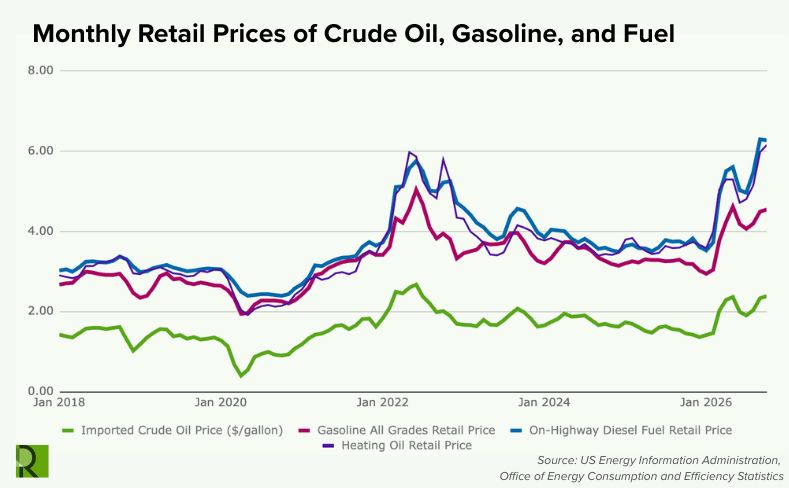
The price of fuel oil has increased dramatically since last year. Over the first half of 2026, prices were about one-third higher than they averaged in 2025 and continued to rise over the summer, increasing by 25 percentage points between June and September. There are many reasons to suspect prices may rise further as households fill their fuel tanks for the season.
Part of this has to do with normal seasonal fluctuations. As demand increases in the fall and winter, prices for heating oil increase too. But factors beyond normal seasonal variations are causing higher inflation too.
Domestic fuel oil prices rise and fall in tandem with international crude oil prices, which are set based on global conditions. In a normal year that’s the end of the story, but Trump’s ongoing war with Iran has caused crude oil prices to spike. The US Energy Information Administration forecasts that ongoing war-related disruptions to global shipping and oil production, combined with low inventories in the US, will cause crude oil, diesel fuel, gasoline, and fuel oil prices to remain high well into next year.
Trump’s tariffs are also a factor, albeit a smaller one. The vast majority of crude oil and heating oil imported into the United States comes from Canada, and the Trump administration has subjected at least some Canadian energy imports to an additional 10 percent tariff since last spring.
What High Prices Mean for Consumers Who Rely on Oil for Heating
About 4.8 million households primarily use heating oil for heat. Fuel oil users tend to be older, whiter, and are more likely to live in rural areas, typically in places with frigid winters where home heating needs are greater. Usage is most common in the Northeast and in rural areas, partially due to a lack of natural gas infrastructure but also because of its innate properties: Heating oil burns hotter than natural gas and can heat a home more quickly in frigid weather. However, it is also much more expensive.
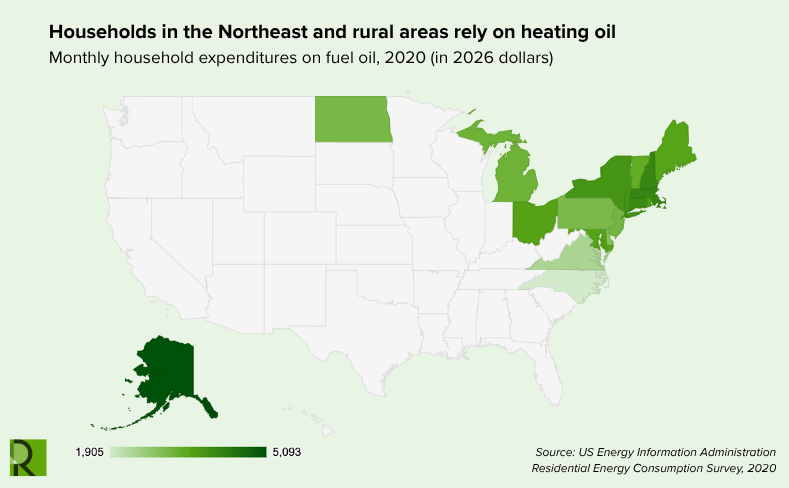
In 2020, the last year with published data, the average household using fuel oil spent just over $1,200 to heat their homes and water heaters. But as of September, prices for fuel oil have increased by 190 percent since 2020 (and 74 percent from last September). Adjusted for inflation, those costs today would be over $3,500, ranging from more than $5,000 in Alaska to $1,900 in North Carolina. (The rest of us will be hit with higher prices for electricity and piped natural gas service, although these have increased by much less: 43 percent for electricity and 56 percent for natural gas.)
Why Holiday Travel and Meals Will Also Be Pricier
If heating oil costs will hit older people living in the coldest states harder, the holidays will strain budgets for everyone who has to travel to be with their loved ones.
Thanksgiving is typically the busiest travel holiday of the year, but increased fuel prices may have some families rethinking their plans. Airfares in September were 22 percent higher than one year ago; drivers aren’t faring any better, with gasoline prices up by 34 percent. Just like with fuel oil, Trump’s ill-considered war against Iran is responsible for these increases. Since the administration shows no sign of learning from its mistakes and reversing course, these prices are likely to increase even further as we get closer to the end of the year.
Higher crude oil prices mean higher prices for all transportation, whether powered by jet fuel, diesel, or gasoline. And these effects hit everyone, not just those of us buying plane tickets or filling up our cars and trucks. Most of the goods we buy aren’t locally produced, so higher fuel prices can push up the cost of transporting products to stores or shipping them to homes.
It can also make things more expensive to produce in the first place: Farmers are especially likely to rely on diesel fuel, which is refined using the same process as heating oil. When prices are high for one they tend to be high for the other—in September, the average price per gallon of diesel fuel was 70 percent higher than last year. Eventually these increased costs get passed on to consumers, though there is often a lag, and it can happen unevenly.
Inflation has cooled on groceries overall, but that just means prices aren’t continuing to increase at the same rate they were before. Unfortunately it doesn’t mean that prices have come down, and holiday meals will still be more expensive to prepare this season. The price of turkey is up more than 8 percent compared to last year, and since the administration’s vaccine skepticism apparently extends to poultry too, hopefully avian flu doesn’t push them even higher.
My family has been preparing beef roast for Christmas dinner since before I was born; luckily price increases have slowed lately, but a roast today is 19 percent more expensive than it was just two years ago. And for any Italian Americans looking forward to the Feast of the Seven Fishes on Christmas Eve, prices on seafood have gone up 7 percent in the last year alone (even switching from fresh to frozen won’t help much, since those prices are up by nearly 9 percent). At least those of us who drink will feel some relief when we ring in the New Year—prices for wine at home have declined by 0.7 percent over the last 12 months.
Reliance on fossil fuels will only continue to drive price volatility, making a transition to renewable energy the ultimate way to help families gather over holidays and stay warm all winter.
Clean Energy Independence Is a Cost-of-Living Issue
Our dependence on global energy markets every travel holiday and our reliance on heating oil to keep warm all winter are not inevitable. These conditions are the result of policy choices.
A generation ago, oil-heat users had few options—electric heat was expensive and domestic natural gas distribution infrastructure was nearly nonexistent in their communities. Today, heat pumps have overcome the operating cost and cold temperatures problems, but converting households to less costly fuels is an industrial strategy, and one the US has explicitly abandoned.
A similar mistake applies to decoupling holiday costs from global oil prices. Federal rebates would have left families better able to bear the costs of a war that has driven inflation across the economy, and in energy specifically would give other countries less leverage over our economy.
Reliance on fossil fuels will only continue to drive price volatility, making a transition to renewable energy the ultimate way to help families gather over holidays and stay warm all winter.
RELATED RESOURCES
Author

Sarah Jane Glynn
Former FellowAs a former Roosevelt Institute fellow, Sarah Jane (SJ) Glynn researched workers’ experiences in the labor market, particularly the experiences of women, all workers of color, and workers in low-paid jobs.