

Applying a “Surgical Rigor” to Policy Implementation
June 22, 2026
By Lena Bilik
Ensuring universal access to childcare is an ambitious policy goal. But ambitious does not mean impossible. Public access to high-quality, affordable childcare is a necessary part of a good life for American families. In this interview series, we speak with childcare implementers and system builders around the country to help shed light on what it takes to make a public childcare system work—not just the concept of it, but the nuts and bolts. These implementers show us that it is possible to make progress toward childcare as a public good; it simply takes resourced public infrastructure and a government that is committed to actually improving the lives of its people.
In this first installment of How Childcare Happens: Lessons from Frontline Implementers, Roosevelt Senior Program Manager Lena Bilik speaks with Kristin Spanos, Chief Executive Officer at First 5 Alameda.
The US has failed to invest in childcare as a public good on a national scale. But as the breadth and depth of the childcare crisis becomes more impossible to ignore, in recent years we’ve seen unprecedented early childhood policy innovations at the state and local level. These are partially a result of temporary pandemic-era federal investments in state early childhood systems, through which many states learned valuable lessons about the economic and community benefits of investing in childcare. Since that funding expired, many of those same states have made important strides to raise local revenue, consolidate and streamline early childhood departments, and spend time, money, and resources on early childhood education and the public infrastructure required to make things a little easier for working families.
State and local efforts to improve early childhood systems require political will, public revenue raising, and explicit policy commitments. But we also need to talk about what comes next: implementation. An oft-repeated concern in implementing early childhood systems change is, “it’s just too complicated!” And it’s true that underinvestment, means testing, and a lack of attention to supply-building has left US childcare systems fragmented, stymied by scarcity, and yes, even complicated.
But every day, state and local governments are showing that complicated does not mean impossible.
We desperately need significant federal-level investment in universal childcare, so that all children and families have access to it as a public good no matter where they live. In the meantime, people all around the country are building out small-scale innovative, responsive models for what public early childhood education can look like. These experts on the ground can and should inform federal public policy debates.
We speak with one of those experts, Kristin Spanos, Chief Executive Officer at First 5 Alameda and the administrator of recent significant public investments in early childhood education in California’s Alameda County, a county of 1.64 million people. First 5 is a public agency and system builder working to ensure every child—regardless of race, income, or neighborhood—has a strong start in life. It aligns public funding, partners, and data to build an integrated, equity-centered early childhood system that supports the whole child, whole family, and whole community.
But every day, state and local governments are showing that complicated does not mean impossible.
Lena Bilik: To start us off, can you tell us a little about yourself, your work, and First 5 Alameda?
Kristin Spanos: I grew up working class in rural New Hampshire and the Mission District of San Francisco. My career has been informed by those early experiences and seeing firsthand the importance of responsive public infrastructure for communities, families, kids. I’ve been with Alameda County First 5 for 11 years. Before that, I’d held different positions mainly in government, but have also worked in the nonprofit sector, working with place-based investments and economic development. I’ve done a little bit of work in housing, then work within the Federal Reserve as an examiner, and spent a lot of time within social services at the point of Temporary Assistance for Needy Families (TANF) implementation and Affordable Care Act (ACA) implementation. I have served as deputy director, policy and finance director, and now most recently as the chief executive officer for First 5 Alameda County. So I’ve had the benefit of being on different sides of things in the public sector, specifically on the financing side, and doing work where I have had to think deeply about how to bring in federal and state money, the design of economic development, and how to really center the community in what is being designed.
Lena: Can you tell the story of what’s been happening with childcare in Alameda County?
Kristin: Yes, it’s been really exciting. Alameda County is more populated than 11 states in the country, and we’re in the top 10 of the most diverse counties in the country. So I like to say that what we’re doing in Alameda County is akin to a statewide expansion in early childhood. It’s a huge new opportunity to evolve the early childhood system.
We have had two ballot initiatives that passed in Alameda County: one for the city of Oakland, which was a parcel tax that funds comprehensive cradle-to-career programming. That raises about $30 to $40 million annually, and two-thirds of the funding goes to early care and education. First 5 is a contractor with the city and is working with Oakland Unified School District and Oakland Early Childhood and Family Services on that early care and education funding from the parcel tax. After the parcel tax faced four years of litigation, we’ve finally been able to implement it the past three years.
In addition to the parcel tax with the City of Oakland, there was also a countywide, community-led ballot initiative called Measure C that passed in 2020. Measure C is a half-percent sales tax that generates about $150 million annually for early care and education. The legislation requires us to establish a minimum wage floor for early educators, as well as technology to support eligibility and enrollment into childcare programs. It includes professional development and apprenticeship programming, as well as facility investments in childcare programs, community spaces, shelters, and family resource centers. It’s very comprehensive. It also faced litigation, but it came out of that successfully in 2024.
First 5 is the named administrator for Measure C, as well as a contractor for the City of Oakland’s parcel tax early education funding. First 5 competed to become the contractor of the City funds to enable us to coordinate those two measures, in addition to engaging in revenue maximization analysis to ensure we’re maximizing the federal and the state funding that’s coming into the county. The intention is to have one administrator coordinate this funding to support the evolution of a comprehensive early childhood system. Better-coordinated, well-resourced programs means more families accessing childcare and supporting early educators, of course, but the funding also supports other public infrastructure focused on ages 0–5, including early identification and screening, care coordination to services, connection to social service programs to address socioeconomic needs, and other whole-child, whole-family, whole-community supports. We have successfully gotten $135 million out the door in the last 10 months, touching the care of over 20,000 children and 6,400 earlyeducators.
Lena: Political will, public revenue-raising, and policy commitments like the ones you describe are the first steps for government to address the childcare crisis—and these are the pieces we more often hear about. But we also need to talk about implementation. Can you talk about your experience administering the childcare funding in Alameda County?
Kristin: When you have this type of funding coming into a community, particularly in early childhood where it’s been woefully underfunded and there’s a level of scarcity and fragmentation, you are managing a big change. We have never treated early care and education like a public good, and we have never really had one entity holding that coordination. So that’s a lot to manage.
Social services in both the beginning of life and end of life have not been well funded and coordinated in the US. Despite the incredible amount of dedication and vision of the people locally and nationally that do this work, this means you have a sector with a lot of gaps in knowledge of how to do this—how to take multiple funding streams and create something new. How to leverage data based on questions like, what does the current landscape look like? Where are the gaps in care? How can we fill those gaps? And then there’s the important work of participatory facilitation with the community to interpret the data, get alignment, take input, and then turn around and operationalize it. The program design and implementation can’t just be siloed programming. You have to have intersectionality across functions—the programmatic data needs to be paired with the financial data, which needs to be understood within a political context, which needs to be understood within the context of the capacity of our staff, as well as the external capacity and readiness in the community. Instead of tweaking or monitoring what currently exists, you’re shifting to developing something new.
So we have had to apply a surgical rigor to implementation. In Alameda County there are something like 35 different funding streams that come in that fund early care and education. Sometimes we administer them; sometimes they go directly to the providers themselves. Figuring out how to make best use of the new and existing funding has required working with the state, setting up meetings with state leadership, mapping all of the funding, including mapping patterns of underspending over the last five years in order to prioritize where to direct funding.
Because we’ve approached our planning with administrative rigor, because we have worked closely with the community and complex systems to understand resource allocation and spending to make sure we have a sense of the landscape, and to make sure we’re listening to the community—we have experienced early success.
Lena: Because I don’t think it’s discussed enough, I want to really drive home the importance of being intentional about what comes after a successful policy change like this, really getting in the weeds on implementation.
Kristin: I often feel like what gets missed in this conversation about expanding childcare is that it’s one thing to have the legislation pass. But neoliberal economic thought has been very successful in dismantling or obscuring the role of public infrastructure in what comes next—why you need that infrastructure, why you need administrative staff, why you need sociological thinking combined with an economic analysis to implement something that’s going to be responsive to communities and families. And I feel like there’s been an erosion of both that understanding and faith that it can be done.
We believe in an equity-centered approach. That means that there’s participatory community partnership, and that requires an element of accountability. If you’re implementing something at this scale, implementers need a level of transparency, continued curiosity, and continued commitment to learning, evolving, and improving.
It is easier to talk about than it is to make it happen. Administrators have to be accountable about making policy actually happen. I have seen new revenue secured and yet the promise never materialized, because how the investments are implemented isn’t as responsive to community needs as it could be. And that can erode the whole sense of whether the government can do things at all.
Lena: From what you’ve learned, what would be your advice to other system builders and implementers to align the fiscal design with the administrative systems to make policies that truly work for people?
Kristin: A lot of time in government people will say that the funding is too categorical and very limiting, and I think that’s true. And, there’s opportunity there—administrators get to interpret legislation through program design, engage the public, and think about data and how to lift up remaining gaps to legislators, practitioners, department heads and people in positions of power and authority for more resources and to support the allocation and best use of existing funds. Building and changing is always more work than maintaining, but it can be done—everything that currently exists is a social construction, which tells me reimagining new and improved ways programming is also possible.
Building and changing is always more work than maintaining, but it can be done—everything that currently exists is a social construction, which tells me reimagining new and improved ways programming is also possible.
One example of this was when I was looking at growing and expanding our early identification and screening. I dove deep into the Social Security Act, which is the overarching legislation to understand what the requirements are in [Title XIX of the Social Security Act, the federal law that establishes Medicaid] and I found that care coordination is part of what’s supposed to be an entitlement. Understanding that piece of the entitlement allowed for a more effective way to work with folks at the local, state level as well as the managed-care plans. I have found it important in public policy to take time to understand all of the levers at your disposal—it levels the power dynamics that can exist with asymmetric information.
Lena: So you talked about this a little bit already, but I know that in Alameda County there was real work to involve the community in the rollout of the new childcare investments. Could you speak more about why that’s important, as well as what worked and what was challenging?
Kristin: This kind of thing cannot work if someone feels like whatever is being offered by the government is being imposed upon them. This is public money, to serve the public good, and the role of the public system is to take in what the public identifies as a need. Of course you’re not polling every single person, but if you are in a public agency you get to have a bird’s eye view of the system and communities, and you would be remiss to not take in the expertise that’s available. The benefit of this, concretely, is that it has informed how we’ve approached design, to inform both what we’re investing in and how we’re designing the program. By engaging the community at the start, there is a collective investment in what you’re doing, and you run into less opposition, which helps with efficiency in the long run. And that’s not to say you don’t make hard decisions, but in my experience, if you can provide a framework and an engagement process, people can settle into changes. There can be tough conversations along the way, but it makes the investment more useful and it makes the process more durable in the long run.
With some of the investments we’ll pose something to community advisory boards, have a participatory feedback process, get into community focus groups, gather that information, and then we will get to what we’re recommending for implementation. It takes being very disciplined and transparent every step along the way, which takes a lot of resources, but it’s also been incredibly beneficial. We hosted some folks that came from other states and localities to do a community session here, and all of them expressed that the support we have in the community is really impressive. And I think that really shows the work and investment that we’ve put in around how to resource and structure our community engagement.
And it’s all a work in progress. When you’re doing system building it is iterative all the time, because the hope is that you’re learning from what you’ve done previously.
Lena: We think a lot about the importance of state capacity at Roosevelt, meaning the ability of the state to deliver on public needs via a robust, functioning administrative apparatus. I think your experience in Alameda County really tells this story. What do state and local governments and administrators need to make public programs work for people?
Kristin: You need committed colleagues who are dedicated to the mission. As the organization has evolved into a financial intermediary—with hundreds of millions appropriated for design and contracting—the complexity has also grown. So in our case we have needed more people who can do financial forecasting, internal operational strategic thinking, data, contracts, finance, budgeting, program design, planning, participatory facilitation, and strategic communications through an equity system-building lens. All of those functions need to be resourced and staffed. We have partnered with outside organizations to help us run systems thinking and collective impact trainings, or provide consulting support as we grow, hire staff, and gain more bandwidth.
We have to build systems where the government is not just imposing what a few people think is needed, but instead structurally hearing what is needed, taking that information in, and then checking to make sure that we get it right before we just start implementing.
Another skill set you need underpinning government staff is a commitment to and a deep analysis of equity and structural issues, relating to race, class, gender, and disability. We need public administrators with a deep understanding of how harmful our public systems have been to some communities, particularly in communities of color. It’s going beyond, “let’s just build more public systems” to truly understanding that some public systems have done significant, lasting, unnecessary harm. And so you need implementers who will build public systems together with communities, which then can be part of the repair and the trust-building. We have to build systems where the government is not just imposing what a few people think is needed, but instead structurally hearing what is needed, taking that information in, and then checking to make sure that we get it right before we just start implementing.
Lena: In your experience, what are the limits of having to do this at the local scale in terms of revenue, capacity, and resources—and how does that make you think about the need for a national solution to the childcare crisis?
Kristin: I have thought about this so much. I’ve been in a community meeting on a Saturday morning, and been both totally honored and humbled to be in the position of architecting with community and colleagues, while also thinking to myself: This is crazy. This is something that is so big and foundational—to the health of our communities, workforce, and kids—and we’re a small group of people building this on a Saturday morning in a local church. This is not the way to do this. To have so much fragility for something so important, to be at the level of holding the work and designing the work through so many complex layers of execution, community input, and more, but also not having the resourcing . . . And this is happening in different ways in different counties or cities or states across the country, as opposed to a public political will that commits to all families and children.
At the local level, it’s way more complicated and way more fragile than it needs to be. This is because of both the lack of operating guardrails through a legislative regulatory perspective, as well as the lack of resources and blindsides in implementation that can exist due to structural inequities and who sits in seats of power to decide funding levels and make programmatic decisions.
Childcare is the perfect role for government involvement because you have a market failure. Government could design childcare as a public good for all, and we could design it to be about investing in each other—by paying the providers a wage commensurate with the value of the work they do, by investing in children and families. At the hyperlocal level, that’s been the commitment. We’re always asking: Is there a way to take this public good and be intentional about finding a way to invest in the very working families that have created some of the resources and the wealth that we have?
Lena: Lastly, if you had advice for a policymaker designing a national universal childcare system, what would be some of the top things you would want to tell them from what you’ve learned about implementation of public funding for early childhood care and education at the local level?
Kristin: First, we need to support infant and toddler care. And there needs to be support for apprenticeship programming that tiers early childhood educators, which can even start in high school. For the early childhood workforce, pay for early educators needs to be just, and we have to build career pipelines for early educators.
I would also say there’s a huge need for capital investment, and I would suggest thinking about how to utilize existing policies like the Community Reinvestment Act to support some of those investments, so that you’re enticing financial institutions not just to lend but to truly invest. There are also creative ways to use land use policies, to help with the thin margins of developing childcare spaces.
I would also note that the recent dismantlement of the Department of Education has led to elevated risks and negative impacts on families and kids with special needs. Every public forum that we go into in Alameda County, there is a discussion around inclusion and the supports needed for both parents and providers, particularly post-COVID. Our current systems are not resourced to be supportive, and there needs to be a real hard look at that.
And then I would say that as well as a pipeline for educators, we also need to support the pipeline of people into public systems and government work, including into higher education programs for this work—particularly to increase diversity in government and public policy and elected office. Because lived experience combined with technical bureaucratic training is what is really going to move the public system work to another level to be more responsive to what communities need.
Finally, I encourage a whole-community, whole-family, whole-child approach. Let’s imagine investments that lead to public resources like beautiful playgrounds where educators can do integrated child development. Let’s ask questions like: How can we fund public spaces for young children and their communities, including through libraries or parks and recreation departments? How can we fund family resource centers, to both ensure educators are getting paid what they should be paid, and serve as community hubs for getting resources to families, and are truly reflective of community needs? How can we creatively utilize land to have public spaces that are interactive, developmentally supportive, and safe, and can be used by a variety of caregivers and community members? How do we support parental leave policies and most importantly a living wage, or tax policies, that allow every family to live with financial stability? Imagine the progress, imagine the communities, imagine the joy.
Lena: I love these questions. I think that’s a perfect place to close. Thank you, Kristin.
Author
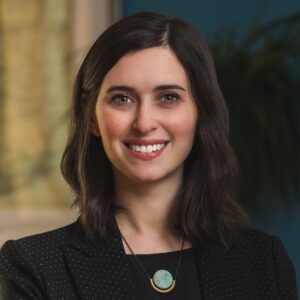
Lena Bilik
Senior Program ManagerAs senior program manager, Lena supports think tank staff and fellows with research and project management.