

Affordable Housing in Detroit: Prioritizing Community-Centered Development
July 21, 2026
By Breah Marie Willy
This publication is part of the 2026 Roosevelt Network Undergraduate Emerging Fellowship Journal.
Introduction
Detroit was once one of America’s most prosperous cities. The city created Motown, produced civil rights figures such as Malcolm X, nurtured corporate giants like General Motors, and even hosted one of Martin Luther King Jr.’s early renditions of the “I Have a Dream” speech (Detroit People’s Platform 2015). During the mid-20th century, Detroit ranked among the nation’s wealthiest cities, powered by the Ford Motor Company and the booming auto industry (PD&R Edge 2025). It once had the highest Black homeownership rate in the country and was known as a “15-minute community,” where residents could access schools, grocery stores, jobs, and neighborhood businesses all within walking distance.
Today, however, Detroit faces significant economic and housing challenges shaped by decades of population loss and disinvestment. According to the Detroit People’s Platform, a worker would have to earn $25 an hour to afford a two-bedroom apartment at fair market rent—but the minimum wage in Detroit is $13.73 per hour (Detroit People’s Platform 2015).1 Alternatively, workers making minimum wage would have to work 76 hours per week. Alongside labor battles and manufacturing jobs moving to outside the city’s core (Sugrue 2007), Detroit’s dramatic downturn is rooted in policy decisions and investment strategies that prioritized economic growth over neighborhood stability, a pattern that has fueled housing insecurity and deepened inequality (Detroit People’s Platform 2015).
The Beginnings of Housing Unaffordability
In the US, housing has been reshaped from essential shelter into a market asset used for investment and wealth-building. This shift, in which homes are treated less as places to live and more as vehicles for profit, is the commodification of housing (McLaughlin 2023), which has had profound consequences for cities like Detroit, shaping both the city’s decline and its current housing instability.
As housing became increasingly commodified in the 20th century, cities emerged as “growth machines”—places where leaders felt pressured to chase economic development above all else. This pressure exists because municipal success is measured through creditworthiness (how financially trustworthy they seem) rather than equity or democratic responsiveness (Norris 2023). Creditworthiness is determined by private rating agencies such as Fitch, Moody’s Investor Services, and Standard & Poor’s, whose assessments directly influence market activity and investment decisions (Norris 2023). When cities focus on their credit scores instead of community needs, they promote what is known as urban austerity: policies that reduce public spending, limit social services, shift decision-making away from local residents, and lower expectations of what city governments can provide.
Under conditions of urban austerity, housing came to be viewed as a market commodity rather than a human right. Families were encouraged to buy homes—often far from where they worked—as part of federal efforts that promoted suburban growth (Detroit Urbanism 2021). This suburban push was reinforced by the federally funded Interstate Highway System, which physically destroyed many thriving Black neighborhoods in the name of “progress” and mobility, cutting communities off from important social and economic networks.
Urban Austerity in Detroit
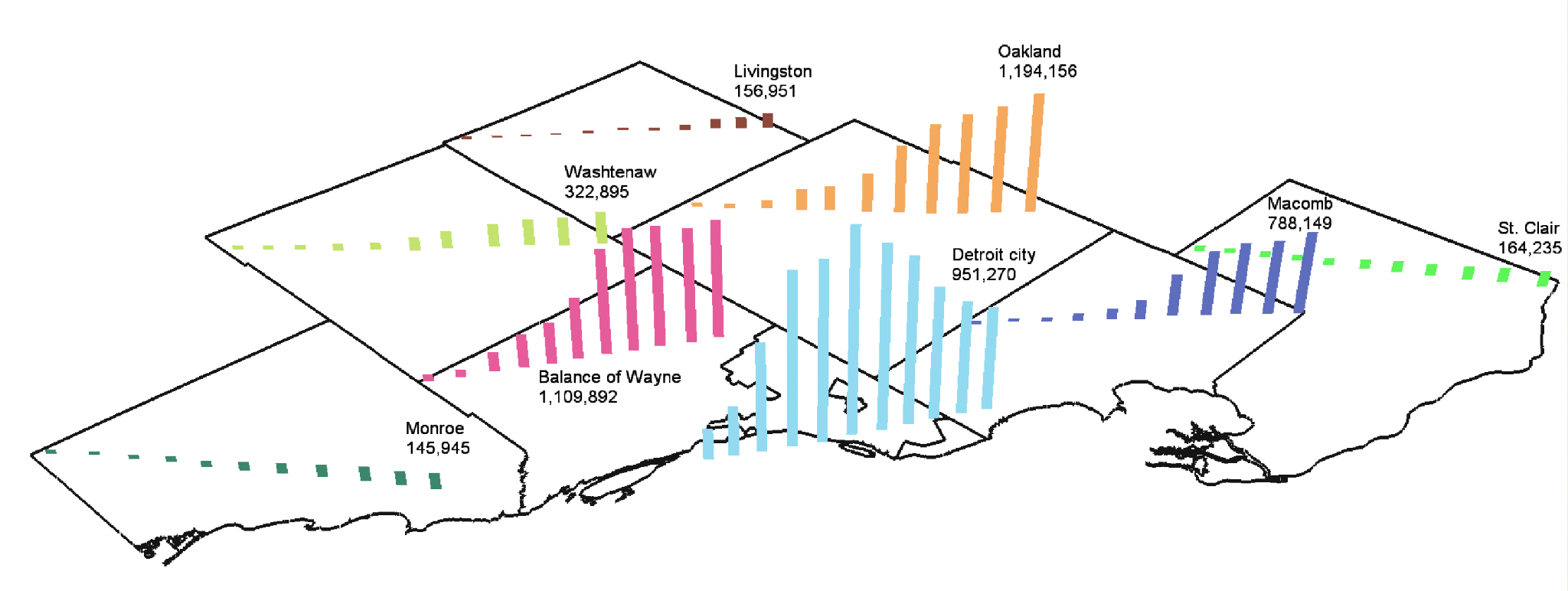
By the mid-20th century, these cultural and structural forces converged with broader racial and economic changes. Following World War II, Detroit experienced massive population loss and white flight to nearby suburbs, a process accelerated by deindustrialization and racially discriminatory lending (Detroit Urbanism 2021). As auto jobs disappeared and banks refused mortgages to Black families, white households settled in newly built suburbs like Levittown, taking tax revenue and political power with them. Detroit’s economic base, and thus its credit score, declined alongside its population (Detroit Urbanism 2021). These pressures intensified in the 1970s when cities across the country, even historically prosperous cities including Detroit and New York, confronted severe fiscal crises. Detroit’s leaders hoped President Gerald R. Ford would intervene, especially given his Michigan roots, but Ford and the federal Financial Control Board concluded that Detroit had “brought its problems on itself,” declining to provide any aid (Phillips-Fein 2018). Michigan’s own policies deepen the crisis: When Detroit receives a low credit score or defaults, the state withdraws funding rather than increasing support, locking Detroit into a downward spiral (Norris 2023).
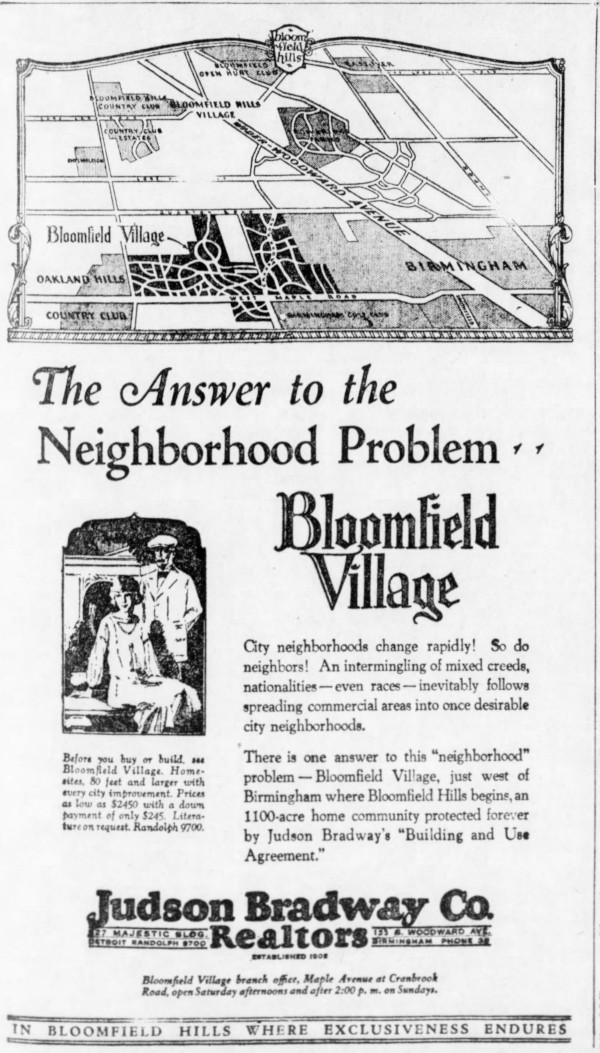
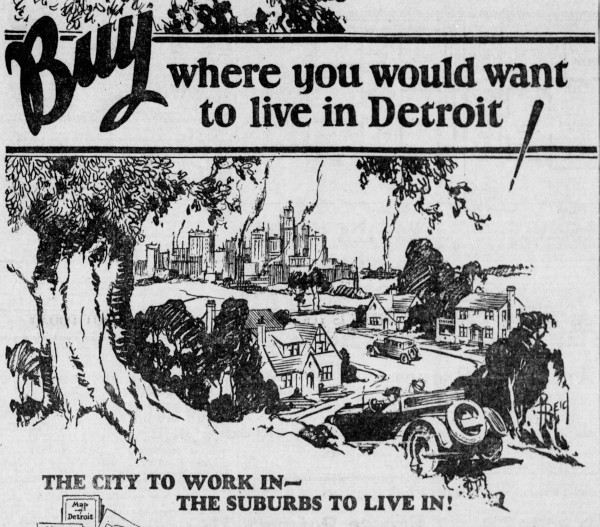
Source: Detroit Urbanism 2021
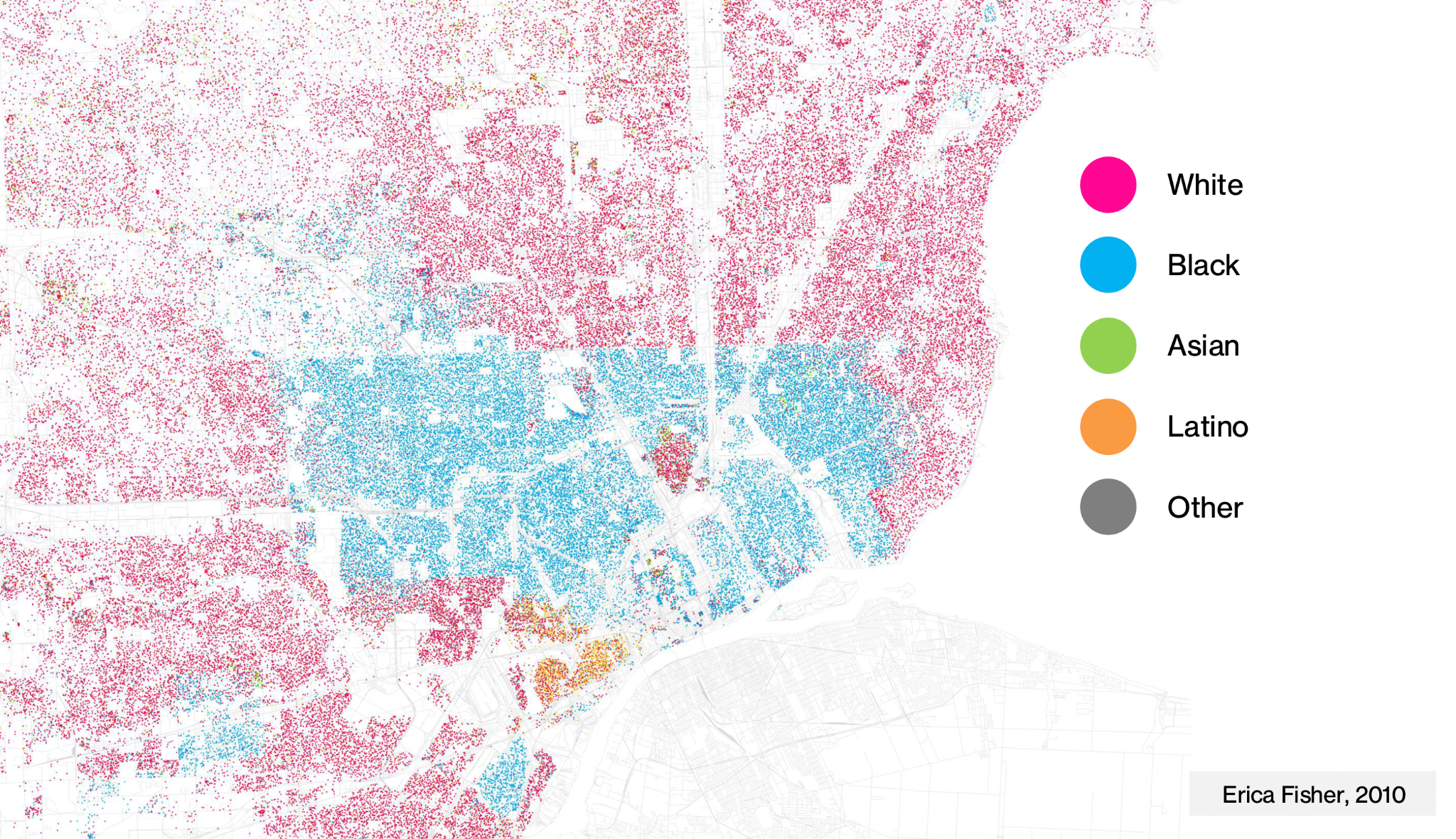
This policy framework has had especially harmful effects on majority-Black cities like Detroit. Davon Norris from the University of Michigan found that when controlling for non-racialized inputs in evaluation criteria, municipalities with larger Black populations are more likely to receive poor credit ratings. He identifies this pattern as embedded racism, which limits cities’ ability to borrow, invest, and provide essential services (Norris 2023). As Detroit’s population, tax base, and creditworthiness declined, the city adopted austerity measures to offset lost revenue, reducing its capacity to ensure stable and affordable housing. The city that once symbolized middle-class prosperity now illustrates how land commodification, racial exclusion, suburbanization, and urban austerity policies have reshaped life in Detroit, turning the promise of shared prosperity into a struggle for the human right to secure safe, affordable shelter.
Background and Current Structure Analysis
Detroit today is increasingly shaped by private capital and large-scale real estate investment. Billionaires and corporate developers have played a huge role in the city’s ongoing transformation, often supported by substantial public subsidies. For example, Dan Gilbert, the billionaire cofounder of Rocket Mortgage, has invested billions of dollars in downtown revitalization projects that have redefined Detroit’s economic and physical landscape (Williams 2013). Similarly, the Ilitch family’s development of Little Caesars Arena relied in part on public funds, channeling municipal resources toward private business deals (Detroit People’s Platform 2015).2 While these projects have generated visible economic activity and renewed life downtown, they have also deepened inequality and reinforced racial exclusion. Downtown and Midtown have increasingly become gentrified, or affluent, educated, and white. This leaves many of the city’s Black working-class residents feeling displaced, undervalued, and left behind in their own communities (Curry 2024).
Detroit’s housing shortage further compounds these inequities. In 2024, the city had only 2,300 active rental or purchase listings, representing a 6 percent decline from the previous year. Detroit faces a shortage of roughly 24,000 housing units across both rental and ownership markets (Agathangelou 2026). This imbalance of limited supply, rising costs, and stagnant wages creates a perfect storm for housing insecurity. The economic disruptions caused by the COVID-19 crisis have only intensified these pressures. According to the Urban Institute and the US Department of Health and Human Services, adults without stable housing are more likely to lose employment, while both adults and children face greater risks of poor health outcomes (Erb-Downward and Merchant 2020). The response to urban austerity has been the private market, driven by profitability rather than need, proving incapable of producing sufficient affordable units to meet demand. Without targeted public investment to expand Detroit’s affordable housing stock, the city’s economic and social stability will remain at risk.
Detroit faces the compounded challenge of historic underinvestment in public resources and the continued use of public funds to subsidize private developments that offer little return to local communities. With many Detroiters earning below a living wage despite full-time work, securing stable, affordable housing remains increasingly out of reach. The problem is clear: The current urban austerity model is failing the working-class people of Detroit. Since prioritizing developer-led public investment is negatively impacting housing justice, analyzing alternative approaches is necessary to better serve community needs.
Spatial Patterns of Investment and Inequality
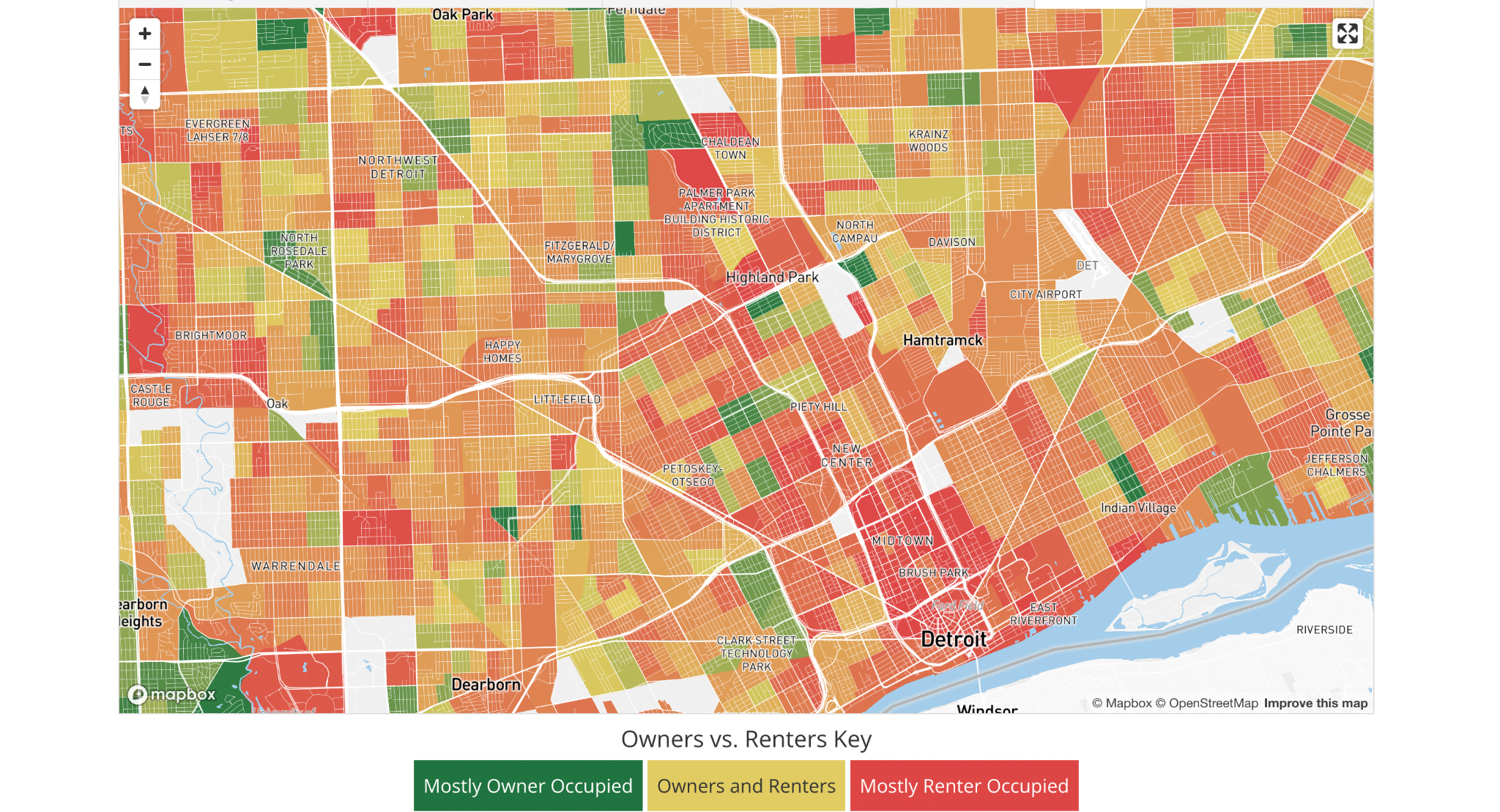
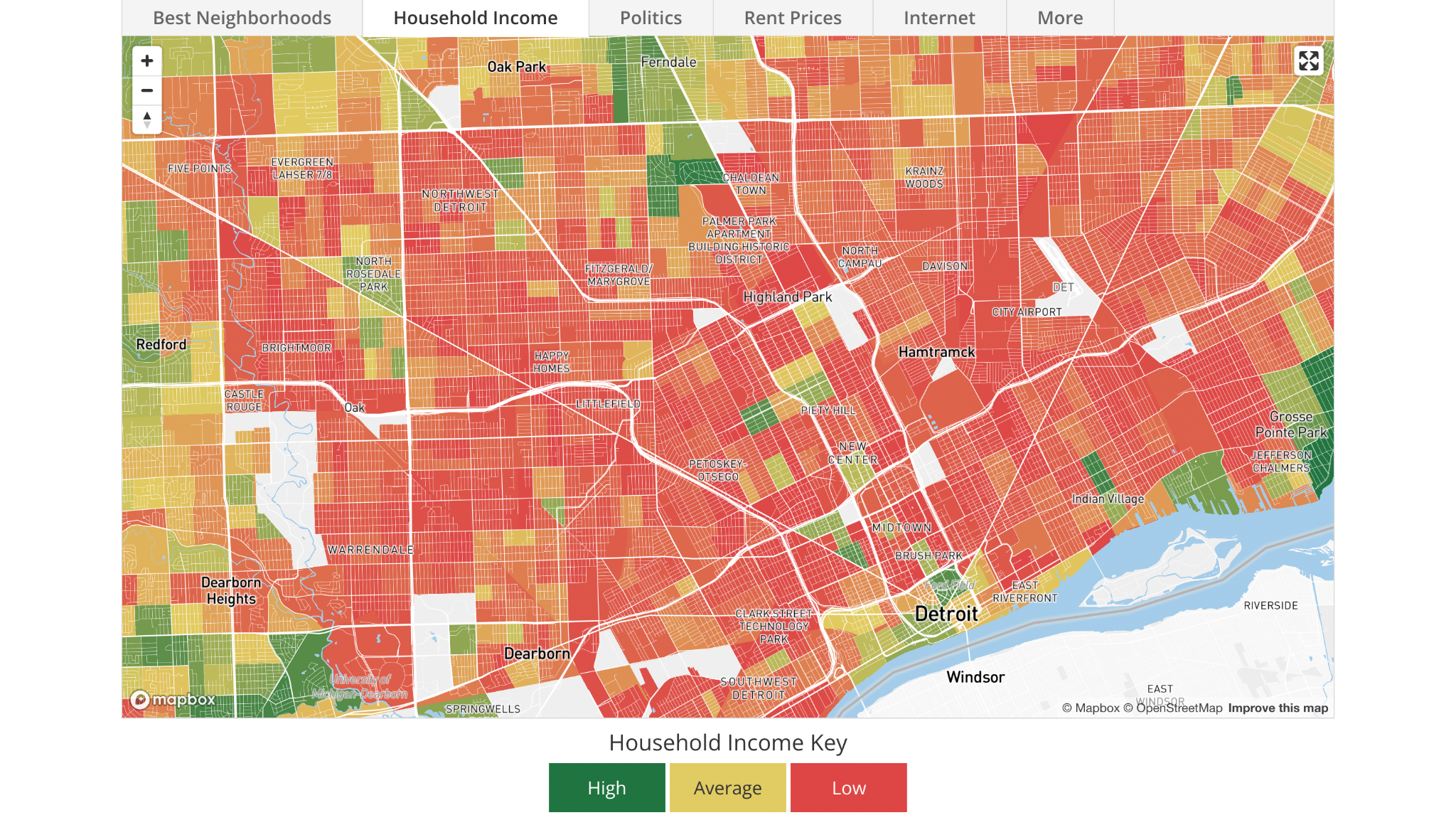
When looking at a map of Detroit, the city’s housing and economic divides become immediately visible. Nearly the entire city appears in red or orange, representing majority-renter neighborhoods. Just a short drive away, suburban communities like Troy, Michigan, are shaded in green, reflecting majority-homeowner areas with higher household wealth. Income maps show similar disparities: Median household income peaks in and around downtown and Midtown but falls dramatically across the rest of Detroit, including areas near Wayne State University (BestNeighborhood n.d.). Despite these gaps, the city’s cost of living index is now about 3 percent higher than the national urban average, and median rent downtown reached $1,763 in 2025, well beyond what most Detroiters can afford (Payscale n.d.).
Source: DetroitData 2025
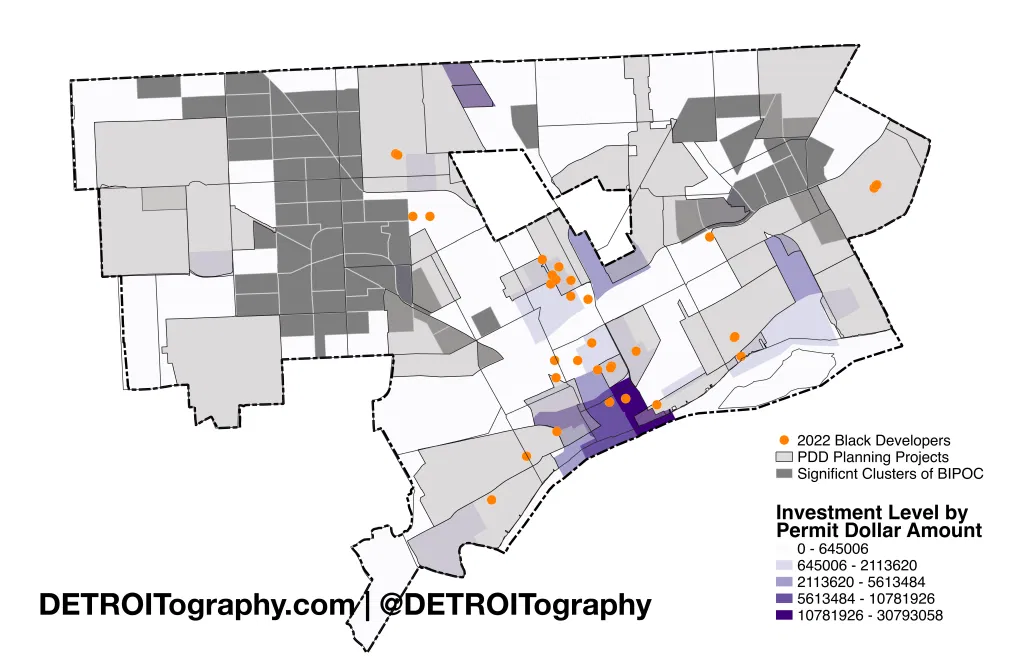
Data from Detroit’s Open Data Portal reinforce this pattern of unequal growth. Building permits are concentrated in economically strong areas such as Downtown, Midtown, Corktown, and the Riverfront—places with high property values, homeownership rates, and investment interest. By contrast, neighborhoods on the far east and northwest sides of the city see few approved permits, reflecting disinvestment and declining market appeal. While Detroit’s aging housing stock necessitates rehabilitation, demolition permits reveal an even starker divide. Demolitions are heavily clustered in neighborhoods with high vacancy rates and limited redevelopment, often erasing housing in the same majority-Black, lower-income areas that already face systemic neglect. Homes in these neighborhoods are demolished faster than they are rebuilt, perpetuating a cycle of clearance without renewal (DetroitData 2025; City of Detroit 2025a).
Source: DetroitData 2025
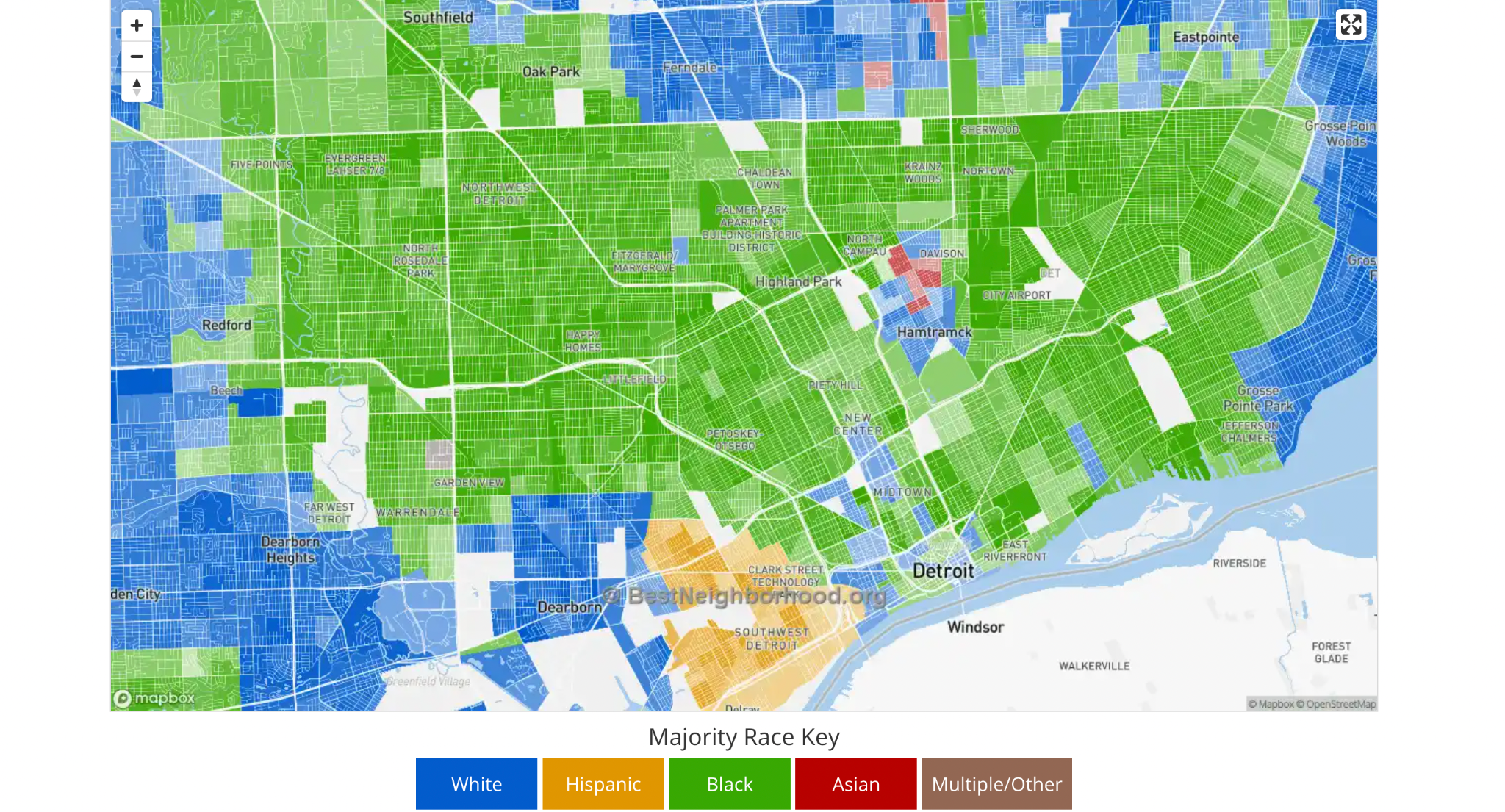
The geography of investment in Detroit reflects the enduring intersection of race, place, and inequality. Neighborhoods with the highest concentrations of demolitions and the least reinvestment are overwhelmingly those with the largest Black populations. Compounding this inequality is Detroit’s long-standing stigma as a “crime-ridden” city, a narrative that continues to shape policy and investor behavior. As sociologist Loïc Wacquant observes, “Whether or not these areas are in fact dilapidated or dangerous matters little in the end: The prejudicial belief that they are suffices to set off socially noxious consequences” (Wacquant 2007). These prejudiced assumptions discourage both public and private reinvestment in majority-Black neighborhoods, reinforcing cycles of racialized austerity and economic neglect.
Source: DetroitData 2025
Detroit’s current housing landscape thus reveals a dual city: one of concentrated growth and investment in its core, and another defined by disinvestment and demolition across its more suburban neighborhoods. Public spending, particularly the recent spike in demolition funding, underscores a pattern of prioritizing site clearance and downtown development over equitable housing production. Without a deliberate policy shift toward affordability, rehabilitation, and community-led development, Detroit risks reinforcing the very inequalities its revitalization efforts claim to address and worsening public trust in leaders who fail to respond. To advance a policy shift toward these goals, the following policy options aim to establish housing as a human right and that every Detroiter deserves a safe, stable, and affordable place to call home.
Policy Analysis and Challenges
Detroit has a long history of underinvestment and housing unaffordability—challenges that are compounded by the fiscal and political constraints of urban austerity. To address these issues, the city council and the Detroit Housing and Revitalization Department can implement a range of community-driven policy solutions that expand access to affordable housing and strengthen neighborhood stability.
One approach is the Community Benefits Agreement (CBA), a legally binding contract between community members and developers that ensures residents have a voice in shaping new projects. Through CBAs, communities can negotiate for specific benefits such as affordable housing units, local hiring, and neighborhood amenities (City of Detroit n.d.). In Detroit, these agreements have sometimes led to the creation of Community Land Trusts (CLTs), nonprofit organizations that acquire and hold land in trust to maintain long-term affordability. In a CLT model, the nonprofit owns the land while residents purchase homes at or below market prices, ensuring that housing remains affordable for future generations. This model helps stabilize communities by giving residents collective control over housing costs (Davis 2025). One example in Detroit is a CLT that developed a community garden benefiting all residents, showing how community ownership can promote both social and economic value (Fox 2025). However, within a broader political and fiscal system defined by urban austerity, CLTs face clear limitations. While still an important piece of the equation by providing deeply affordable housing and strengthening neighborhood stability, their scale remains too small to address Detroit’s overall housing shortage.
Another key tool is the Housing Trust Fund (HTF), a public funding mechanism that supports affordable housing at the state, county, or city level. In Detroit, HTFs have been used to finance developments that reserve units for households earning below 30 percent of the Area Median Income (AMI) (CDAD n.d.). Advocates, organizers, and policymakers widely agree that housing trust funds are valuable tools for expanding affordability. Yet, current funding levels remain too limited to meet the scale of need. Much of the city’s HTF budget supports incentivizing developers to include affordable units in market-rate projects rather than investing directly in community-led housing or preservation initiatives. As a result, while HTFs have supported progress, they have not yet been able to rebuild or revitalize Detroit’s most underinvested neighborhoods.
Several policy ideas have gained momentum among researchers, advocates, and city leaders seeking to transform Detroit’s housing landscape and challenge urban austerity. One such proposal involves lowering the AMI threshold for determining eligibility for affordable units. Many development projects, including those tied to CBAs, currently allocate units to residents earning up to 60 or 80 percent of AMI (City of Detroit 2025b). This approach excludes Detroiters with the greatest need. By lowering the threshold so that more units are reserved for residents earning below 30 percent of AMI, the city could make affordability reach those most at risk of housing insecurity. However, this policy is difficult to implement without additional public subsidies, since tighter affordability requirements can make projects financially unappealing to developers. Lowering the AMI threshold could improve equity, but it is costly to implement and cannot close the city’s housing gap on its own.
Another idea receiving attention from researchers and advocates is expanding federal investment in the Housing Choice Voucher Program. Currently, only one in four eligible families receives a voucher, leaving many low-income households without assistance (Rosen 2020). Radically expanding the program to ensure that all eligible households receive support would greatly reduce housing insecurity and shorten long waitlists. Yet, more funding alone would not solve the program’s deeper issues, including landlord discrimination, limited housing supply in high-opportunity neighborhoods, and lack of administrative communication between jurisdictions. Without complementary reforms to increase landlord participation and improve neighborhood conditions, additional funding could unintentionally reinforce existing patterns of gentrification and segregation.
A third approach gaining traction is the Housing First model, which aims to address chronic homelessness and instability by providing permanent housing without preconditions, paired with voluntary supportive services. Research from the National Low Income Housing Coalition and other studies shows that Housing First significantly reduces homelessness and improves long-term stability (Kerman et. al. 2018). For Detroit, where vacancy rates remain high but deeply affordable units are scarce, Housing First could make efficient use of existing housing stock while reducing reliance on emergency shelters and hospitals (Calabro 2025). Evidence from other cities and research studies demonstrates that the model not only improves individual well-being but also reduces public spending on crisis systems by lowering hospitalization, incarceration, and shelter use (Kerman et. al. 2018). Implementing Housing First at scale in Detroit would still require overcoming serious barriers. Many of the city’s vacant units need substantial rehabilitation before they can be used, and local supportive services such as mental health care and case management remain underfunded. Without parallel investments in affordable housing development, infrastructure repair, and neighborhood stabilization, Housing First alone cannot fully address the scope of housing insecurity or poverty. To be effective, it would need consistent funding, coordination among city agencies, and strong partnerships with local service providers.
Detroit’s experience shows that no single policy can solve the housing crisis. Community Benefit Agreements, Housing Trust Funds, vouchers, and Housing First initiatives all contribute important pieces of the solution, but must work together to be effective. The city needs policies that combine immediate relief for residents with long-term investment in neighborhood revitalization and infrastructure repair. Ultimately, these approaches share one essential goal: recognizing that every Detroiter deserves a safe, affordable home and reaffirming that housing is a human right, not just a commodity.
Policy Proposal for Transformative Change: Housing First
Ultimately, a Housing First model offers Detroit a transformative, community-centered approach to addressing housing unaffordability and homelessness. Unlike market-driven or developer-led strategies that often reinforce existing inequalities, Housing First recognizes housing as a human right rather than a commodity. It begins from the principle that stable housing is the foundation for individual and community well-being. Instead of requiring people to meet certain conditions before receiving assistance, the model provides permanent housing first, followed by voluntary wraparound services such as mental health care, job training, addiction treatment, and case management (Calabro 2025). This approach directly invests in people and communities rather than relying on developers and investment, which has historically funneled resources into downtown and higher-income neighborhoods while neglecting areas most in need of support.
Implementing Housing First at scale in Detroit would mark a fundamental shift in how the city allocates its resources. For decades, public funds have often been used to subsidize private development projects that offer little long-term return to residents. Redirecting a portion of these investments toward permanent supportive housing and the rehabilitation of vacant properties would not only address homelessness but also activate Detroit’s extensive vacant housing stock. By converting these properties into livable homes, the city could begin to reverse the cycle of demolition without redevelopment that has characterized many low-income neighborhoods. Housing First would therefore serve a dual purpose: stabilizing individuals and families while directing economic flow to underinvested parts of the city. With urban austerity driven by population loss and a shrinking tax base, implementing a Housing First approach can help Detroit retain residents and maintain economic stability, rather than displacing them through subsidies for private development.
For this policy to succeed, Detroit’s leadership must take a coordinated and sustained approach. City Council and Mayor Sheffield should allocate municipal and federal housing funds specifically toward permanent supportive housing and neighborhood-level rehabilitation. Additionally, Detroit must partner with local service providers to ensure consistent case management and supportive care for residents. This includes working closely with nonprofit organizations, mental health providers, and community-based organizations that already have been engaging in this work and understand the problems facing Detroiters. If the Detroit City Council or the Department of Housing and Revitalization formally adopted this strategy, it would demonstrate responsiveness to the real challenges residents experience and begin to restore trust in local government. Long-term success will depend on maintaining partnerships and ensuring equitable service coverage across neighborhoods, particularly in areas that have historically lacked access to social infrastructure.
Another essential component is developer accountability. As part of a broader Housing First strategy, the city should strengthen Community Benefits Agreements (CBAs) to include enforceable commitments from developers to create and preserve affordable housing. These agreements should also require reinvestment in low-income neighborhoods and ensure that public subsidies for private projects produce tangible community outcomes (Detroit People’s Platform 2015). Stronger CBAs would help shift Detroit’s economic development model away from short-term, growth-oriented deals and toward equitable, people-centered investment.
Housing First is not only an ethical and community-driven policy but also a cost-effective and evidence-based solution. Research from randomized controlled trials across the US shows that Housing First produces the largest and most sustained reductions in homelessness of any known model. It also reduces strain on emergency systems by lowering hospitalizations, incarcerations, and shelter use (Kerman et. al. 2018). For a city like Detroit, where fiscal stability and creditworthiness are major political concerns, these savings are significant. Evidence from Vienna, Vancouver, and Medellín demonstrates that affordable housing initiatives not only reduce poverty and homelessness but also strengthen workforce stability and economic mobility (Ariaee and Takalloo 2024), reinforcing that investments in housing justice can also advance long-term economic stability.
While the precise mechanisms for generating revenue to support Housing First are beyond the scope of this paper, Canada demonstrates a successful funding model that draws on all levels of government, particularly federal support through the Reaching Home Initiative (Government of Canada 2026). Additionally, with Detroit spending over $41 million on homelessness in the 2026 fiscal year through its new Department of Human, Homeless, and Family Services (Barrett 2026), a Housing First approach could reduce long-term costs by shifting reactive resources to permanent housing solutions, improving both fiscal health and residents’ quality of life. Stable housing promotes workforce participation, improves educational outcomes, and strengthens public health, creating a positive feedback loop that benefits both residents and Detroit’s broader economy.
Finally, Housing First represents an opportunity to bridge community priorities and municipal interests. It responds to residents’ demands for genuine public investment while aligning with policymakers’ goals of economic growth, fiscal responsibility, and neighborhood revitalization. More importantly, it redefines what it means for Detroit to thrive, not by the number of new luxury developments or the pace of downtown growth, but by the security and dignity of its people. By centering human well-being and accountability, a citywide Housing First initiative would not only reduce homelessness but also transform Detroit’s approach to growth itself. It would demonstrate that equitable and economic development are not opposing goals, but outcomes of a city that chooses to invest in its people first.
Conclusion
Detroit’s housing crisis is not the result of individual failure but of structural priorities that have long favored capital growth over community well-being. Decades of urban austerity, disinvestment, and developer-led investment have deepened inequality, leaving Detroiters with burdensome costs of a system that treats shelter as a market asset rather than a human right. As the city continues to channel significant public funds into demolition and private development while affordable housing supply remains stagnant, it risks perpetuating a cycle of instability for its residents, particularly in historically Black neighborhoods that have borne the brunt of economic restructuring and racialized disinvestment.
A Housing First approach offers Detroit a genuine alternative: one that invests directly in people rather than profit. By providing permanent housing without preconditions and pairing it with consistent, community-based support, Detroit can begin to rebuild its social safety net from the ground up. Partnering with local service providers to ensure stable case management and supportive care not only sustains housing outcomes but also restores trust between residents and the city. At the same time, enforcing stronger Community Benefits Agreements would ensure that any public investment in development also produces public benefits, closing the gap between downtown prosperity and neighborhood neglect.
Ultimately, housing justice and economic stability are not competing goals; they are mutually reinforcing. A Detroit where every resident has a safe, affordable home is also a Detroit with a stronger workforce, healthier communities, and a more resilient local economy. Future research should further explore the intersections between wages, worker power, and housing affordability, illuminating how fair labor practices and robust public investment together form the foundation of a truly thriving city. By reimagining growth not as the accumulation of capital but as the advancement of human dignity, city leaders can redefine what equitable, sustainable progress looks like in Detroit.
References
Agathangelou, Savvas. 2026. “Inside Detroit’s Property Market in 2026.” The Luxury Playbook, April 11. https://theluxuryplaybook.com/detroit-housing-market-analysis-forecast-2024-2025.
Ariaee, Atefeh Moghadam, and Shahrzad Takalloo. 2024. “Impact of Affordable Housing Programs on Social Equity and Economic Development.” International Journal of Management and Accounting 6 (5): 108–17. https://doi.org/10.34104/ijma.024.01080117.
Barrett, Malachi. 2026. “Detroit Redirects Nearly Half of Housing Budget to Fund New Department.” BridgeDetroit, March 2. https://bridgedetroit.com/detroit-redirects-nearly-half-of-housing-budget-to-fund-new-department.
BestNeighborhood. n.d. “Detroit, MI Housing Data.” Accessed October 27, 2025. https://bestneighborhood.org/housing-data-in-detroit-mi.
Calabro, Alayna. n.d. “The Evidence Is Clear: Housing First Works.” NLIHC. Accessed October 27, 2025. https://nlihc.org/sites/default/files/Housing-First-Evidence.pdf.
City of Detroit. n.d. “Community Benefits Ordinance.” Accessed October 26, 2025. https://detroitmi.gov/departments/planning-and-development-department/community-benefits-ordinance.
_____ 2025a. FY 2026 Adopted Budget. https://detroitmi.gov/document/fy-2026-adopted-budget.
_____ 2025b. “City’s New Pilot Ordinance Unlocks Massive Wave of Affordable Housing Development; 2,400 Units Approved, Applications for 6,000 More in Approval Process.” October 8. https://detroitmi.gov/news/citys-new-pilot-ordinance-unlocks-massive-wave-affordable-housing-development-2400-units-approved.
Community Development Advocates of Detroit (CDAD). n.d. “CDAD Advocates for Homes for All Detroiters.” Accessed October 26, 2025. https://cdad-online.org/affordable-and-accessible-housing.
Curry, Ebony JJ. 2024. “Ensuring Equity in Detroit: Strategic Neighborhood Fund’s $40M Investment Must Reach All Communities.” Detroit Regional Chamber, October 10. https://detroitchamber.com/ensuring-equity-in-detroit-strategic-neighborhood-funds-40m-investment-must-reach-all-communities.
Davis, Tamia. 2025. “Detroit Farmers Find Stable Ground in Detroit’s First Community Land Trust.” Planet Detroit, February 19. https://planetdetroit.org/2025/02/community-land-trust-detroit.
DetroitData. 2025. “Building Permits.” DetroitData, updated January 30, 2025. https://detroitdata.org/dataset/building-permits.
Detroit People’s Platform. 2015. “A People’s Story of Detroit.” YouTube, September 12. https://youtu.be/qcAvvr6yYjM.
Detroit Urbanism. 2021. “7 Historical Facts about Detroit’s Suburban Sprawl.” Detroit Urbanism, May 24. https://detroiturbanism.blogspot.com/2021/05/7-historical-facts-about-detroits.html.
Erb-Downward, Jennifer, and Safiya Merchant. 2020. “Losing Home: Housing Instability & Availability in Detroit.” Poverty Solutions. https://poverty.umich.edu/files/2020/05/200358_Poverty-Solutions_Detroit-Housing-Instability-policy-brief_051120.pdf.
Fox, Genevieve. 2025. “Community Land Trusts: ‘We’re Rising from the Ashes, and This Is Our Vehicle.’” Model D, April 30. https://modeldmedia.com/communitylandtrust-genesishope.
Government of Canada. 2026. “Funding Programs.” Government of Canada. April 6. https://housing-infrastructure.canada.ca/prog/index-eng.html.
Kerman, Nick, John Sylvestre, Tim Aubry, and Jino Distasio. 2018. “The Effects of Housing Stability on Service Use among Homeless Adults with Mental Illness in a Randomized Controlled Trial of Housing First .” BMC Health Services Research 18 (190). https://link.springer.com/article/10.1186/s12913-018-3028-7.
McLaughlin, Henry. 2023. “Growth Machine.” Keywords in Political Economy (blog). University of California Santa Cruz. October 25. https://keywords.sites.ucsc.edu/2023/10/25/growth-machine.
Norris, Davon. 2023. “Embedding Racism: City Government Credit Ratings and the Institutionalization of Race in Markets” Social Problems 70 (4): 914–34. https://doi.org/10.1093/socpro/spab066.
PayScale. n.d. “Cost of Living in Detroit, Michigan.” Accessed October 21, 2025. https://payscale.com/cost-of-living-calculator/Michigan-Detroit.
PD&R Edge. 2025. “A History of the Rise of Homeownership in the United States.” Office of Policy Development & Research, July 10. https://huduser.gov/portal/pdredge/pdr-edge-housingat250-article-071025.html.
Phillips-Fein, Kim. 2018. Fear City: New York’s Fiscal Crisis and the Rise of Austerity Politics. New York: Picador.
Rosen, Eva. 2020. The Voucher Promise: “Section 8” and the Fate of an American Neighborhood. Minneapolis, MN: Highbridge Audio.
Sugrue, Thomas J. 2007. “Motor City: The Story of Detroit.” History Now. Gilder Lehrman Institute of American History. https://gilderlehrman.org/history-resources/essays/motor-city-story-detroit.
Wacquant, Loïc. 2007. “Territorial Stigmatization in the Age of Advanced Marginality.” Thesis Eleven 91 (2007): 66–77. https://doi.org/10.1177/0725513607082003.
Williams, Michael. 2013. “ Untapped Detroit: Michael Williams at TEDxUofM.” Tedx Talks. YouTube, May 4, 2013. https://youtube.com/watch?v=mTauQaF_QTY.
Acknowledgments
First, I would like to thank the Roosevelt Institute for the opportunity to write about an issue I am deeply passionate about. This paper would not have been possible without the incredible support of the Roosevelt Network staff, especially Eric A. Paul, whose constant encouragement and guidance supported me throughout both the writing process and my broader career journey. I am also grateful to Toyosi Odusola and Leila Pedersen for their thoughtful feedback and for the time they dedicated to supporting my growth as a writer and emerging policy professional. I would also like to thank the Detroit People’s Platform, Detroit Future City, Community Development Advocates of Detroit, and the Detroit City Council. Speaking with community leaders, housing experts, and public officials grounded this paper in lived experience and practical expertise, and I am deeply grateful for that opportunity.
AUTHOR

Breah Marie Willy graduated in May 2026 from the University of Michigan Ford School of Public Policy, where she focused on urban inequality and development and minored in quantitative methods in the social sciences. As a Forge Fellow in 2024, she was honored to continue her policy work as part of the Roosevelt Network Emerging Fellowship in 2025. Drawing on her experience living in communities across Michigan, including Detroit, Breah focused her fellowship research on policy solutions to expand affordable housing in Detroit. She is passionate about housing affordability, equitable urban development, and advancing policies that strengthen working-class communities through equity-centered, human rights–based approaches. She hopes to build a career dedicated to advancing equitable development in Michigan and beyond.