

Breaking The Silence: Eliminating Prison Phone Fees to Help Communities and Restore Families in North Carolina
July 21, 2026
By Melanie Cabrero
This publication is part of the 2026 Roosevelt Network Undergraduate Emerging Fellowship Journal.
Introduction
The consensus among criminal justice advocates is that the prison industry unjustly and disproportionately impacts historically marginalized groups. When considering issues that plague the prison industry, telecommunication policies are not usually front of mind. Telecommunication guidelines allow for incarcerated individuals and their loved ones to be unfairly and intentionally exploited by exorbitant costs. These policies are the product of decades of capitalism, privatization, and neoliberal policy, which have turned prisons into markets and people into sources of revenue, with rehabilitation as an afterthought. Corporations like ViaPath and Securus profit from these prison/inmate calls, while the state itself takes a share through commission-based contracts, often referred to as kickbacks. Every minute a mother spends talking to her son, every time a child hears their father’s voice, the state earns money. The allegiance between the state and corporations has demonstrated the state’s loyalty to those corporations rather than to its constituents. With over 30,000 people making up the incarcerated population in North Carolina (Kraemer 2024), the prison phone fee structure, just like in other states around the country, imposes unjust financial burdens on incarcerated people and their families, disrupting access to legal counsel, weakening family ties, and hindering rehabilitation, all while deepening racial and economic inequality.
This brief argues that eliminating prison phone fees in North Carolina is not only a moral imperative but also a policy necessity. Ending these fees would represent a fundamental shift away from the neoliberal policies that have enabled the privatization of the prison industry, positively impacting rehabilitative efforts by providing an opportunity for incarcerated people to continue to build upon their networks to support a successful reentry. The relationships incarcerated people have with anyone on the outside, combined with the mere ability to communicate, can be representative of a low-cost rehabilitative framework. Through interviews with incarcerated individuals, formerly incarcerated advocates, and nonprofit leaders, this brief explores how communication has become a site of profit and control and how North Carolina can instead make it a cornerstone of rehabilitation and justice, breaking from the neoliberal logic that commercializes human connection. What emerges from this brief is a simple truth: Communication is not and should not be a luxury. It is a lifeline that no one should have to buy.
Background
The story of prison phone fees in North Carolina mirrors a broader national trend in which neoliberal policies turn incarceration from a public responsibility into a profit-generating enterprise. Incarceration and the prison industry are sites of profit and racial control. Since the late 20th century, neoliberalism has reshaped public policy, introducing market-driven approaches to services once seen as social responsibilities (Gottschalk 2015). This ideological shift emphasizes privatization, deregulation, and profit maximization, transforming prisons from public institutions focused on rehabilitation into engines of revenue. Under a neoliberal framework, incarceration is no longer just about punishment; it becomes about production and profits.
Until the 1980s, the American Telephone & Telegraph Company (AT&T) was leading the charge in providing phone services, and the cost of communication inside prisons was equivalent to rates outside. In the 19th and 20th centuries, AT&T was one of the most powerful monopolies in the country, leading the nationwide telephone system throughout the 20th century and becoming the target of several monopoly and antitrust lawsuits (Gianforti 2022). In 1974, the Justice Department filed a lawsuit to break up the organization, as it was considered a barrier to the innovation that the computer industry was bringing (Gianforti 2022). At this time, incarceration rapidly increased due to the War on Drugs, and there was a federal breakup of the AT&T monopoly, which allowed for-profit telecommunications companies to emerge (Ubel 2024). As states increasingly privatized prison operations during the prison boom of the 1980s, a new industry emerged, and telecommunications companies became dominant providers within correctional systems. Corporations such as Securus Technologies, ViaPath (formerly known as Global Tel*Link), and ICSolutions gained monopolistic control over prison communication and began offering exclusive, no-bid contracts and sharing their revenue with correctional institutions (Kukorowski, Wagner, and Sakala 2013). Incarcerated people and their families were not the intended beneficiaries; instead, these contracts were structured to maximize revenue through kickbacks that benefited states for selecting higher-cost providers.
Soon after, North Carolina followed suit, as the NC Department of Public Safety entered into agreements that allowed prisons to profit directly from the volume of calls made by incarcerated individuals. Policymakers aligned with tough-on-crime approaches often justify this revenue as necessary to sustain prison conditions and programming, reinforcing the economic cycle of extraction. By 2021, North Carolina had reportedly collected $7,627,426.11 in commissions from prison telecommunications contracts (Prison Phone Justice n.d.), demonstrating the capitalistic nature of telecommunication contracts, in which big corporations benefit while families struggle to maintain a connection.
The racial and economic implications of this system are evident. Incarceration is heavily concentrated amongst marginalized groups, specifically young Black and Latino men with low educational attainment (Pettit and Gutierrez 2018). The high cost of communication reinforces a type of racialized social control, where poverty and race are determinants of who can afford to stay connected and who disappears behind prison walls.
Longstanding racial and economic disparities fuel the prison industry, making this far from a modern phenomenon. Historical studies, like Martha Myers’s examination of postbellum Georgia, reveal how incarceration has long been used as a way to reinforce racial hierarchies and manage economic “threats” (Myers 1990). As Black communities gained economic ground, although very limited, white policymakers and employers weaponized incarceration as a form of social control. The intent is the same for the North Carolina prison industry, which is state power to extract wealth and restrict agency from marginalized populations under the guise of “order” and “security.”
The introduction of technology has impacted the exploitation and oppression experienced by incarcerated people. Technology is a form of limited freedom that incarcerated people can benefit from, but prisons have used that knowledge to harm low-income families and families of color. Companies like JPay and GTL advertise digital communication as an advanced convenience while simultaneously charging exorbitant prices for basic digital services, such as messaging and video calls (Arguelles and Ortiz-Luis 2021). These arrangements embed profit motives within systems of punishment, positioning basic human communication as a paid service rather than a right.
The commodification of human connection is not solely economic; it reaches far beyond the confines of the prison walls. Sociologist Lindsey Raisa Feldman (2024) calls this phenomenon “punishment drift,” which describes how the suffering of incarceration extends beyond prison walls and falls onto families, and more specifically onto women, who happen to bear both emotional and financial burdens. Being forced to choose between maintaining family connections and meeting basic financial needs, combined with limited in-person visitation, imposes harm on both incarcerated people and their families. Incarceration causes this “deep despair felt by both parent and child” as a “colossal but largely invisible crisis” in which over 1 million children experience the punishment of their parents’ incarceration (Wang 2022). Those behind bars may be the intended targets of the system’s discipline, but their families are caught in the web of punishment.
These consequences make it evident that prison phone fees are not just a matter of economics; criminal justice advocates may see phone fees as a story of numbers, something clean-cut, but in reality, they are a matter of justice. In North Carolina’s prison phone system, private markets manage what should be public goods, reflecting a neoliberal belief that profit can justify the exploitation of poor and historically vulnerable communities. As a 2023 report from the Roosevelt Institute reminds us:
We must keep foremost in mind that this is not a fight over individual policies. It is a contest for a new mindset—the idea that democratic governance must structure our economy toward the public good. Otherwise, private, profit-seeking actors operating in unconstrained markets will exacerbate economic and racial inequalities simply by doing what they are designed to do best (Wong et al. 2023, 11).
Through this outsourcing and monetization of communication, North Carolina’s state government has allowed private corporations to stay in control, dictating access to one of the most basic forms of rehabilitation for an inmate—simply staying in touch.
As a swing state, often referred to as a purple state, North Carolina is considered interesting in the world of politics (Fowler and Simon 2025), having a greater susceptibility to swing either way on criminal justice policy. At the national level, most states continue to charge incarcerated individuals for prison phone calls, with only a small number having eliminated these fees. This means that fee-based systems remain the dominant model across the US, including throughout the South. North Carolina ranks 24th in affordability for prison phone fees (Prison Phone Justice 2021). Comparatively, in other southern states, it prevails as one of the more affordable options for incarcerated individuals. As seen in the graph below, southern states such as Oklahoma and Arkansas are on the higher end—there, a 15-minute phone call can cost almost $4. While the graph only reflects 2021, it can be assumed that prices have increased in these states. The states that have eliminated prison phone fees have been on the more liberal end of the political spectrum, often supporting reform efforts. The North Carolina legislature has the opportunity to influence how the South navigates justice.
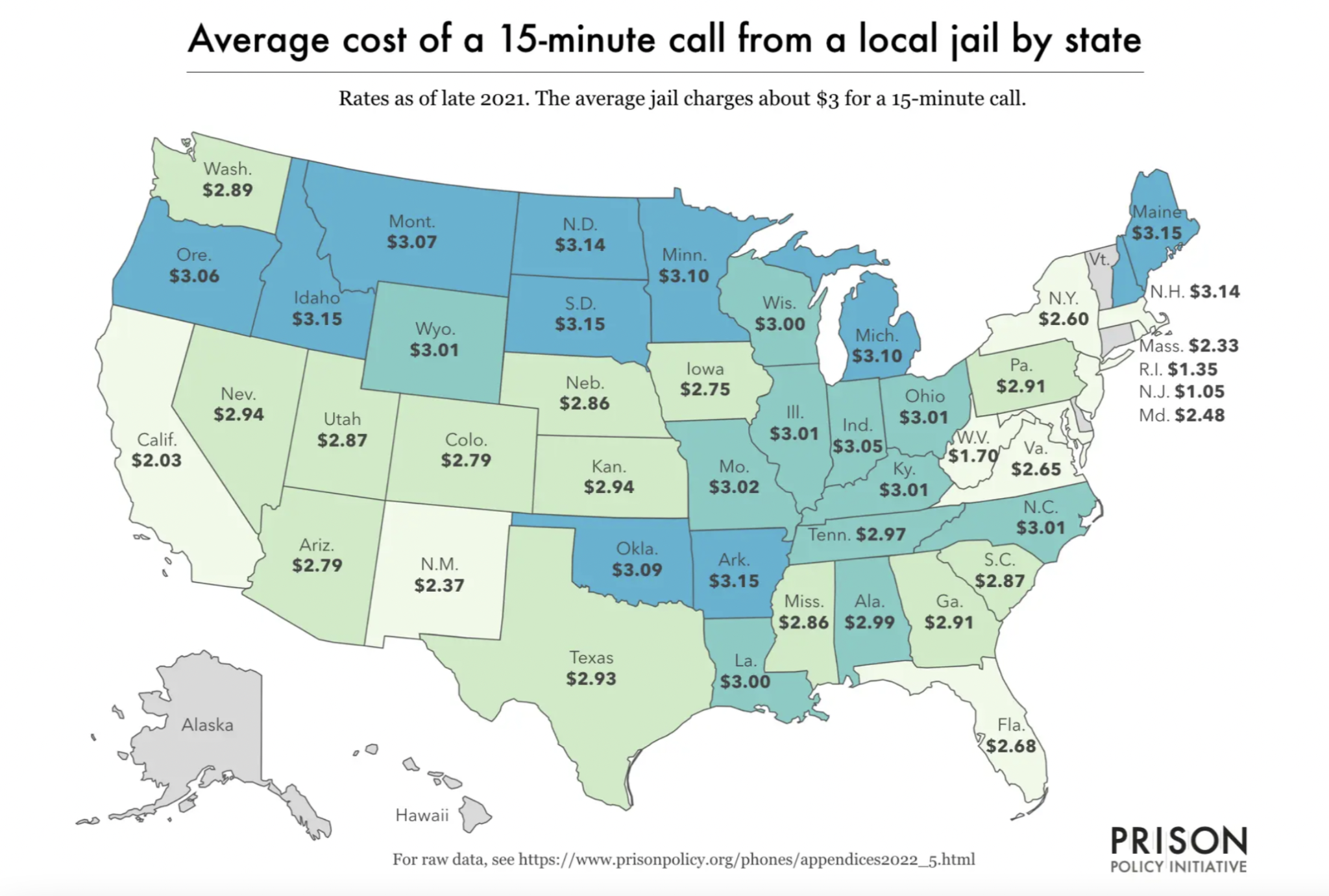
Connecticut, for example, has shown that eliminating prison phone fees is a feasible solution and can be done effectively and equitably. Connecticut’s Senate Bill 972, enacted in 2021, abolished all charges for phone and video communication in correctional facilities and prohibited the state from collecting commissions. Instead, the state funds these services through general revenue, which frames communication not as a privilege but as a right (Connecticut SB 972). When the state is guided by political will and community knowledge, reform replaces profit motives and produces tangible improvements for incarcerated people and their families.
North Carolina stands at a similar crossroads. The persistence of high phone fees is not due to a lack of alternatives but rather to outdated ideologies and economic interests that only benefit groups that have always been prioritized by policy. The same logic that has allowed prisons to oppress groups continues to justify monetizing human connection. Understanding the historical, racial, and economic roots of this system reveals a deeper reality that prison phone fees are not a byproduct of bureaucracy but rather a deliberate policy choice that enables inequality and disconnection.
Policy Analysis
North Carolina’s current prison phone fee structure reflects an overall ideological commitment to market-driven governance. The North Carolina Department of Public Safety (NCDPS) maintains contracts with ViaPath/GTL, which charges high rates for calls while sharing a portion of the profits with the state. North Carolina charges 10 cents per minute for local and long-distance calls. This practice and the maintenance of these contracts create what economists call a perverse incentive, a structure in which maintaining inequity benefits those in power. In terms of prison phone contracts, both the state and the corporation profit from this exploitative practice.
There is an unrealistic expectation placed on incarcerated individuals and their families, as prisons have comparatively low minimum wage prices. In North Carolina, incarcerated individuals cannot be paid more than $1 per day for their jobs (NC G.S. § 148-26). When the price of a 15-minute phone call in the state of North Carolina amounts to approximately $3, an unfair burden is placed on the incarcerated person and their families, leading to a decision between sacrificing, say, hygienic products, and talking to one’s family or friends—both extremely important forms of self-care.
When I spoke with Kerwin Pittman, a formerly incarcerated advocate who is the executive director of Recidivism Reduction Educational Program Services, Inc. (RREPS) and policy and program director for Emancipate NC, he described the psychological and social damage that these costs inflict:
From what I’ve seen physically, with my own own eyes, for those who was able to stay in contact with their loved ones while incarcerated, so a good portion of those come home and kind of have have everything kind of set up for them, but those who weren’t, they kind of had to come home and try to find their own find their own way and try to figure it out, which we know ultimately, a lot of the times that lead back into them being rearrested.1
Communication is not merely contact; it is a form of rehabilitation. Eliminating phone fees benefits the public by actively providing connections that will be helpful post-release. Without the ability to communicate with loved ones, friends, or former colleagues, incarcerated people may have difficulty preserving their connections outside the prison walls. Allowing incarcerated people to maintain contact with their friends and families allows them to see an actual future on the outside, where reoffending is an afterthought.
This reality stands in sharp contrast to the state’s public narrative about rehabilitation and reentry. North Carolina’s Department of Public Safety (NCDPS) claims to promote successful reintegration into society and has hopes to reduce recidivism, yet its phone contracts directly undermine that mission. Reducing prison phone fees or eliminating them aids in reducing recidivism. Any effort to promote successful reintegration into society is a recidivism reduction method. According to the NCDPS website, its mission is to “help to ensure North Carolina is a safe place to live, work, and visit” (NCDPS n.d.). The safety of all citizens is important, including those who have been incarcerated, and providing the tools necessary to be able to live safely without fears of being unhoused or exposed to potentially triggering environments is important for all North Carolina citizens. Therefore, by depending on the kickbacks received from these calls, the state allows a model where isolation generates income.
Ameelio, a nonprofit that helps provide free prison communication tools, has demonstrated a different model, one that genuinely prioritizes creating a system that is more humane and rehabilitative. April Feng, Ameelio’s chief executive officer, emphasized that the organization’s approach works across political lines. “I think this is actually why Ameelio is such a bipartisan thing,” Feng said. “In all the states that we’ve deployed in, it’s a pretty even split of red and blue.”2 She described three main narratives that resonate with policymakers: public safety, correctional safety, and workforce opportunity. “The idea of increasing public safety,” Feng explained, “is that when our users can talk with their loved ones on the outside, they come out, and then they have a place to go, they have a place to return to. They’re not wandering on the streets and basically reoffend a lot of times.”
Feng also discussed a quantitative study conducted with the University of Chicago Crime Lab, which found that the rollout of Ameelio’s free call and video platform in Iowa led to a 55 percent decrease in violent incidents inside prisons (Abdul-Razzak et al. 2024). The research also identified improvements in reentry outcomes and workforce participation. As Feng put it, “This is safer prisons and safer communities for all of us.” Her insights illustrate that reforming prison communication isn’t a partisan issue; it’s a question of safety, humanity, and smart governance. Ameelio’s mission to combat mass incarceration is one that should be supported by the federal government.
Despite such evidence, federal reform has been delayed. The Martha Wright-Reed Just and Reasonable Communications Act (2022) granted the Federal Communications Commission (FCC) new authority to regulate all prison and jail phone rates. With this act, phone fees are capped at 6 cents per minute, less than what North Carolina currently charges (10 cents), but still exploitative compared to how much incarcerated individuals get paid (NCDAC n.d.; Fines and Fees Justice Center 2025). However, there must be an acknowledgment of how much of a milestone this is in the fight to remedy the market dysfunction that has disproportionately targeted incarcerated individuals and their families since the ’80s. Still, repeated administrative delays have postponed implementation until 2027. These delays are caused by backlash from a group of sheriffs and prison telecom companies. For example, Baxter County, Arkansas, has responded to the FCC’s ruling by saying that it will no longer offer phone calls at all. Prison telecom companies are claiming that services cannot be provided unless families cover the costs. This rhetoric has influenced lawsuits by Republican state attorneys claiming that the order has harmed police investigations (Bertram 2025).
This uncertainty makes it clear that North Carolina cannot wait for federal action. Nothing is preventing this act from getting postponed even further. The path to justice should not be dictated from Washington, DC, but from within the state. Connecticut’s 2021 law eliminating prison phone fees (Connecticut SB 972) demonstrates that courageous and compassionate state leadership is both possible and effective. By following that model, North Carolina can set a precedent for other southern states, ensuring that communication is treated as a public good, not as a means to profit.
Phillip Vance Smith, who has spent more than 20 years incarcerated, sees the impact of this ideology every day. In our conversation, he reflected on the barriers that are put not only in front of him but in front of many other incarcerated individuals. “We make a lot of noise about solitary confinement and putting people in a box by themselves, but the lack of communication is, in a sense, another form of solitary confinement, because you can’t reach out, you’re stuck, and you can’t benefit from what’s going on in the world.”3 His words highlight the lack of knowledge we are all victims of: We do not truly know what goes on behind prison walls, but when we hear stories, we must listen and push for change.
Moreover, the state’s reliance on these private contracts undermines its own stated goals of reducing recidivism and promoting public safety. Not only is the reduction of recidivism important, but building family units and supporting families are important as well. Children of incarcerated parents who maintain consistent communication are also more likely to succeed academically and less likely to experience behavioral health issues (deVuono-powell et al. 2023). By continuing to uphold these commission-based contracts, North Carolina is choosing short-term profit over long-term safety and community stability.
The policy failure is therefore twofold: structural and moral. Structurally, we see how state contracts show a dependency on corporate revenue streams rather than an investment in public rehabilitative infrastructure. Morally, they allow for the exploitation of those who experience poverty under the guise of fiscal prudence. In practice, this means that the families who are already struggling with the financial and emotional damage that incarceration brings are further penalized for their loyalty and need to maintain contact.
Policy Proposals
North Carolina has the opportunity to lead the South in redefining and expanding the definition of justice—one that prioritizes restoration over profit. The state’s current system allows private corporations to profit from human connection, which is representative of the worst aspects of neoliberal ideology. If communication is used as a form of rehabilitation and a tool to increase public safety, then it must be treated as a public good, not a commodity. This transformation can begin with three key proposals.
1. Eliminate Prison Phone Fees Through a Publicly Funded Model
The most immediate and impactful reform would be to abolish all costs associated with prison and jail communication. North Carolina should follow suit with the model presented by Connecticut’s Public Act No. 21-54, which has made all phone and video communication free of charge for incarcerated individuals and their families.
Connecticut projected an estimated $6.5 million annually to be spent on this new initiative—a number that North Carolina can reference when deciding the cost to implement this model (Miller 2024). This cost is minimal compared to its more than $2 billion annual budget, which is spent on corrections. Moreover, the long-term benefits, lower recidivism rates, reduced violence, and stronger family ties generate measurable savings and create healthier communities.
2. End Commission-Based Telecom Contracts and Establish a State-Operated System
North Carolina’s contract with private vendors currently relies on commission payments that create a profit motive for disconnection. These contracts should be terminated and replaced with a state-operated telecommunications system or a partnership with nonprofit providers like Ameelio.
As April Feng explained, “When our users can talk with their loved ones on the outside, they come out, and then they have a place to go, they have a place to return to.”4 The evidence supports her claim: Facilities using Ameelio’s model experienced a 55 percent decrease in violent incidents and improved reentry outcomes (Abdul-Razzak et al. 2024). A publicly run or nonprofit-based system would not only ensure fair pricing but would also align communication policy with public safety goals. Utilizing community input creates spaces where representation actively occurs. Publicly run or nonprofit organizations depend on the voices of community members to inform initiatives, and North Carolina’s government needs to follow suit. Aligning communication policy with public safety shows that there is a connection with reform-based policy. Communication is a facet of recidivism reduction and needs to be prioritized as such. A system like this could reinvest potential savings into reentry and family support programs that create a new system of stability and restoration. Ending commission-based contracts sends a clear message that they should not be dependent on how much they can afford to pay to stay connected.
3. Partner with Local Communities and/or Nonprofits to Reinvest in Families
The elimination of phone fees should be paired with reinvestment into the communities most harmed by incarceration. There needs to be an assurance that incarcerated individuals and their families are not left behind when it comes to developing an initiative that directly impacts them. There also needs to be a societal shift in the way that incarcerated individuals are viewed. The state has the best opportunity to lead that shift. With the funds that would have been generated through telecommunications commissions, there should be an allocation of support to mobile recidivism reduction programs, particularly ones similar to the program provided by RREPS. Creating more programs like this one helps to make tangible, direct community impact.
North Carolina can work with organizations like Emancipate NC, the ACLU of NC Smart Justice Initiative, RREPS, and Ameelio to implement these programs. These partnerships ensure that reform is cocreated with those directly impacted, not imposed from above.
Conclusion
Fifteen minutes is all you get. For many families in North Carolina, those 15 minutes are not just an ability to talk; they are an opportunity to survive. They are a lifeline.
Through voices like those of Phillip Vance Smith and Kerwin Pittman, we are reminded that incarceration does not solely impact the individual; it manifests itself in ways that are unknown to broader society. We see the impacts of this when basic communication comes at a cost. When a price is placed on a basic human right, profit replaces humanity. Justice is no longer the goal; abuse and power are what drive these exploitative contracts.
Eliminating prison phone fees is not merely about affordability but about holding these neoliberal institutions accountable. It is about redefining justice as something measured by restoration and rehabilitation, not by punishment. Each policy proposal in this brief is a step toward that vision—a state that values compassion but, more importantly, values connection as a public good, not private revenue. A state that sees family communication and connection not as a privilege but as a right.
Change is possible. Change is necessary. Change will rehabilitate, aid families, and increase public safety. And the change necessary for this is not known. In fact, many states are changing their policies, eliminating telecommunication fees for incarcerated individuals and their families. The role of the state is to protect its citizens and ensure that everyone, not only a select few, can receive justice. The state is responsible for providing awareness of issues that the public may not be aware of. The federal government’s delays in implementing the Martha Wright-Reed Act make one thing clear: North Carolina cannot wait for others to lead. The time to act is now. North Carolina has a chance to join these groundbreaking states and to turn the promise of rehabilitation into practice.
Making communication free is not solely about cutting costs; it is about restoring relationships, rebuilding trust, making communities safer, and repairing communities that have been fractured by incarceration. It is about finally giving time back to those who have already lost too much of it. The question now is not whether we can afford to eliminate prison phone fees, but whether we can afford not to.
Footnotes
- Kerwin Pittman (Founder and Executive Director of Recidivism Reduction Educational Program Services, Inc (RREPS), video interview with author, August 6, 2025. ↩︎
- April Feng (CEO, Ameelio), video interview with author, August 20, 2025. ↩︎
- Phillip Vance Smith (journalist), phone interview with author, August 12, 2025. ↩︎
- Feng, in discussion with author. ↩︎
References
Abdul-Razzak, Nour, Ashna Arora, Omair Gill, and Panka Bencsik. 2024. “Calls and Conduct: The Impact of Free Communication on Prison Misconduct.” Working paper, December 2024. https://legislature.vermont.gov/Documents/2026/Workgroups/Senate%20Institutions/Bills/H.294/Witness%20Documents/H.294~April%20Feng~Research%20Paper~5-22-2026.pdf.
Ameelio. n.d. “About Us.” Accessed May 4, 2026. https://ameelio.org/about-us.
Arguelles, Paolo, and Isabelle Ortiz-Luis. 2021. “Bars Behind Bars: Digital Technology in the Prison System.” Available at SSRN. https://dx.doi.org/10.2139/ssrn.3812046.
Bertram, Wanda. 2025. “FCC Postpones its Groundbreaking 2024 Rules, Allowing Excessive Phone and Video Rates to Continue.” Prison Policy Initiative, July 2. https://prisonpolicy.org/blog/2025/07/02/fcc-reversal.
Connecticut SB 972. Public Act No. 21-54 (2021). https://cga.ct.gov/2021/ACT/PA/PDF/2021PA-00054-R00SB-00972-PA.PDF.
deVuono-powell, Saneta, Chris Schweidler, Alicia Walters, and Azadeh Zohrabi. 2015. Who Pays? The True Cost of Incarceration on Families. Oakland, CA: Ella Baker Center for Human Rights. https://ellabakercenter.org/who-pays-the-true-cost-of-incarceration-on-families.
Emancipate NC. n.d. “Home.” Accessed May 4, 2026. https://emancipatenc.org.
Feldman, Lindsey Raisa. 2024. “Profiting from Punishment Drift: The Case for Abolishing For-Profit Prison Communication.” Hooks Institute Policy Papers (7). https://digitalcommons.memphis.edu/hookspolicypapers/vol2024/iss1/7.
Fines and Fees Justice Center. 2025. “Guide to New Low Rates and Consumer Protections for Incarcerated People’s Communication Services.” April 1, 2015. https://finesandfeesjusticecenter.org/articles/guide-to-new-low-rates-and-consumer-protections-for-incarcerated-peoples-communications-services.
Fowler, Stephen, and Scott Simon. 2025. “A Look at 2 States That Are Becoming Increasingly Rare Purple in Politics.” NPR, September 20, sec: Weekend Edition Saturday. https://npr.org/2025/09/20/nx-s1-5481314/a-look-at-2-states-that-are-becoming-increasingly-rare-purple-in-politics.
Gianforti, Adrian. 2022. “This Month in Business History: AT&T Monopoly & Breakup of the Bell System.” History Factory, January 24. https://historyfactory.com/insights/this-month-in-business-history-bell-system.
Gottschalk, Marie. 2015. “The Folly of Neoliberal Prison Reform.” Boston Review, June 8. https://bostonreview.net/articles/marie-gottschalk-neoliberal-prison-reform-caught.
Kraemer, Brianna. 2024. “NC Prison Population Exceeds Forecasts as State Works to Comply with New DOJ Ruling.” Carolina Journal, April 9. https://carolinajournal.com/nc-prison-population-exceeds-forecasts-as-state-works-to-comply-with-new-doj-ruling.
Kukorowski, Drew, Peter Wagner and Leah Sakala. 2013. “Please Deposit All of Your Money: Kickbacks, Rates, and Hidden Fees in the Jail Phone Industry.” Prison Policy Initiative, May 8. https://prisonpolicy.org/phones/pleasedeposit.html.
Martha Wright-Reed Just and Reasonable Communications Act of 2022, S.1541, 117th Cong. (2022). https://congress.gov/bill/117th-congress/senate-bill/1541/text.
Myers, Martha A. 1990. “Economic Threat and Racial Disparities in Incarceration: The Case of Postbellum Georgia.” Journal of Research in Crime and Delinquency 28 (4): 627-56. https://doi.org/10.1111/j.1745-9125.1990.tb01341.x.
North Carolina Department of Adult Correction (NCDAC). n.d. “Telephone and Tablet Services.” Accessed May 4, 2026. https://dac.nc.gov/divisions-and-sections/institutions/telephone-tablet-services.
North Carolina Department of Public Safety (NCDPS). n.d. “Home.” Accessed May 4, 2026. https://ncdps.gov.
NC G.S. § 148-26. https://ncleg.gov/EnactedLegislation/Statutes/PDF/BySection/Chapter_148/GS_148-26.pdf.
Pettit, Becky, and Carmen Gutierrez. 2018. “Mass Incarceration and Racial Inequality.” American Journal of Economics and Sociology 77 (3-4): 1153–82. https://doi.org/10.1111/ajes.12241.
Prison Phone Justice. n.d. “Home.” Accessed May 4, 2026. https://prisonphonejustice.org.
Recidivism Reduction Educational Programs Services, Inc. (RREPS). n.d. “Home.” Accessed May 4, 2026. https://rreps.net.
Ubel, Marleina. 2024. “Prison Profiteers: How Private Companies Profit from Prison Phone Calls and Harm New Jersey Residents.” New Jersey Policy Perspective, August 19. https://njpp.org/publications/report/prison-profiteers-how-private-companies-profit-from-prison-phone-calls-and-harm-new-jersey-residents.
Wang, Leah. 2022. “Both Sides of the Bars: How Mass Incarceration Punishes Families.” Prison Policy Institute, August 11. https://prisonpolicy.org/blog/2022/08/11/parental_incarceration.
Wong, Felicia, Suzanne Kahn, Mike Konczal, Matt Hughes. 2023. Sea Change: How a New Economics Went Mainstream. New York: Roosevelt Institute. https://rooseveltinstitute.org/publications/sea-change.
Acknowledgments
I would like to extend my gratitude to the entire Roosevelt Institute and Network for the opportunity to be both a Forge and Emerging Fellow. The Roosevelt Network has been with me since my freshman year and has pushed me to be better in all of my endeavors. They have treated me with extreme care and grace through some of the most difficult experiences of my life. I also want to thank all of the people who were willing to let me interview them and saw my vision with this project. Additionally, I would like to thank my support system, my sister Destiny, my dad Angel, my friends, and my line sisters for constantly supporting me through my journey. I would like to give thanks to my faith as well for allowing me to have strength and persevere through some of the most difficult moments in my life. Lastly, I would like to thank my cohort, some of whom I have been with since my freshman year. You all are truly going to change the world, and I am honored to have gotten to know you all.
AUTHOR

Melanie Cabrero is a senior political science and English student and a Morehead-Cain Scholar at the University of North Carolina at Chapel Hill. Her academic and professional work centers on critically examining the criminal legal system and advancing equity-driven reforms for communities of color. Drawing on experience in investigative research, qualitative analysis, and policy evaluation, Melanie focuses on uncovering systemic patterns and translating complex findings into actionable insights for advocacy and reform.