

Estimating the Cost and Impacts of the SSI Restoration Act
March 3, 2026
By Stephen Nuñez, Jack Landry
This is a web-friendly preview of the report.

Key Takeaways
- SSI serves approximately 7.4 million people who are disabled or elderly, yet its maximum monthly benefit (just under $1,000 for individuals in 2026) frequently leaves recipients living below the poverty line.
- The program’s core financial rules are functionally frozen; income disregards have not been updated since 1972, and asset limits—currently capped at $2,000 for individuals—have remained unchanged since 1989.
- The SSI application process is so demanding and slow that initial disability determinations typically take over eight months—and much longer with appeals. In fiscal year 2023, more than 30,000 individuals died while waiting for a decision on their benefits.
- The SSI Restoration Act of 2024 aims to modernize the program by raising benefits to the poverty line, eliminating burdensome rules like the in-kind support and maintenance provision, ending the asset limit marriage penalty, updating disregards, and indexing all numbers to inflation.
- Our analysis shows that fully funding these reforms would reduce poverty among SSI recipients by 60 percent at a cost of roughly $61 billion per year—about the cost of a single tax provision in last year’s reconciliation bill.
Introduction
Supplemental Security Income (SSI) is a cash benefit program administered by the Social Security Administration that provides vital aid to more than 7 million adults and children with disabilities and older adults with little to no income or assets. At its inception in 1974, SSI represented a major advance over the patchwork of state disability benefits that preceded it, creating a financial baseline that states could build upon to serve their residents. Since then, however, state aid has largely withered away, and SSI has not evolved to meet the financial needs of its recipients. While its monthly benefit is regularly adjusted for inflation, other aspects of the program—including its asset limits and income disregard—are not. And while the monthly benefit could, with state supplements, pull recipient households out of poverty, it is woefully inadequate on its own. As a result, 50 years since its launch, most SSI recipients live at or below the federal poverty line.
After decades of neglect, and as a result of the concerted efforts of disability advocates, federal lawmakers have finally started to pay attention. Over the last few years they have put forth bills to repair and modernize the ailing program. Most prominent among these is the SSI Restoration Act, which was first introduced in the House in 2013 and more recently reintroduced in the Senate in 2021 and the House in 2024. The bill would reform SSI’s outdated asset limits, streamline benefit calculations, remove the SSI “marriage penalty,” and increase the maximum benefit. The proposed reforms could both improve the material conditions of SSI recipient households and reduce the complexity and expense of administering the program.
However, little research has been done on the potential impact or cost of the SSI Restoration Act, or on any changes to SSI more broadly, given both the complexity of the program and limitations in available data. This paper attempts to rectify this. We use a methodology called microsimulation applied to data from the Current Population Survey Annual Social and Economic Supplement (CPS-ASEC) to analyze current conditions and then model how the SSI Restoration Act as a whole and each of its individual components would affect incumbent SSI households and the households of those who would become eligible for the program should the legislation go into effect. We find that the SSI Restoration Act would reduce the SSI household poverty rate (inclusive of new recipients) by about 60 percent at a cost of about $60 billion per year. We also analyze the impact of the legislation across a variety of subgroups including by age (children, 18–64, and 65+ recipients), marital status, and race/ethnicity and find particularly strong impacts for married couples where both individuals receive SSI. This analysis will be useful to lawmakers if and when they take up SSI reform again and provides crucial information about poverty impacts and cost that will be useful in “scoring” similar proposals.
Before we turn to the analysis of the bill, we review the history of SSI to explain its current state and why it is inadequate to meet the needs of its recipients. We then describe the reform proposals we are evaluating and briefly review our methodology before providing estimates of both the status quo for SSI households and how that would change under the analyzed provisions.
Methodology
This paper uses a methodology called microsimulation to evaluate the impacts and costs of the major provisions of the SSI Restoration Act of 2024. This methodology is commonly used to evaluate policy proposals, such as during the debate around the child tax credit expansion in 2021. Data on SSI is, however, harder to work with than data on federal tax rates in part because of the complexity of the program. As a result, there are many fewer analyses of SSI reform proposals or indeed of the status quo for SSI recipients. What exists typically relies on administrative data releases and paints a picture several years out of date.
We use the CPS-ASEC, a nationally representative survey that provides details about individuals’ sources and amounts of income, including earnings from work as well as income from benefits programs like SSI. The survey is conducted at the household level, so it contains details on household members’ relationships to one another.1 With this information, for any given individual, we can also compute their parent or spouse’s income as relevant. This data, combined with some assumptions about the tax filing units generated from the individuals and households within, allows us to estimate baseline economic conditions for SSI households (and households in general). We can also estimate to first approximation the impacts of a policy shift by computing recipients’ benefit amounts under current and proposed rules. For instance, if in the survey an SSI recipient lives in a single-person household, gets $700 per month from Social Security (specifically, Old-Age and Survivors Insurance) benefits, and has no other income, their 2025 SSI benefit would be $287 per month. This comes from computing the person’s unearned income ($700 minus the earned income disregard of $20, which is $700 – $20 = $680). Unearned income is then subtracted from the benefits standard for a single person to get the person’s benefit level ($967 – $680 = $287). The same basic methodology can compute a person’s SSI benefit under alternative SSI benefit rules. For instance, under the SSI Restoration Act, the benefits level is increased to $1,304 and income disregard is increased to $150, increasing that same recipient’s benefit to $778.
Calculating the Restoration Act’s impact on poverty involves comparing people’s income to a poverty line threshold. For instance, the single person referenced before would have a total annual income of $11,844 from their Social Security and SSI benefits. In 2024, the official poverty line for a single person is $15,060, so they would be counted as below the poverty line. However, under the SSI Restoration Act, their annual income would increase to $17,736, which would put them above the SPM poverty threshold. Aggregating this process over thousands of survey responses allows us to calculate the change in poverty rates under the SSI Restoration Act.
Rather than the official poverty line, we use the Census’s Supplemental Poverty Measure (SPM). This metric is almost universally preferred by researchers as a more accurate measure of poverty because it implements several improvements to the official poverty line. The two most notable differences are that it counts safety net benefits like the Supplemental Nutrition Assistance Program (SNAP) as income (whereas the official poverty line only counts pretax cash income and thus leaves out vouchers like SNAP or credits like the earned income tax credit) and it adjusts the poverty line for an individual’s local cost of living based on housing costs (whereas the official poverty line is the same for the 48 contiguous states).
Impacts
We first estimate the overall impacts of the SSI Restoration Act of 2024 on household and individual-level poverty. Table 5 and Figure 2 present overall impacts on household-level SPM poverty. The first row of Table 5 presents SPM poverty and deep poverty statistics under the status quo for SSI households specifically and for US households in general. The second row of Table 5 estimates the impact on each measure for each population. We estimate that the SSI Restoration Act would generate an additional 2.58 million SSI recipient households (meaning one or more newly enrolled SSI recipients in the household). The SSI household poverty rate would drop by 17.4 percentage points to 11.8 percent. Deep poverty in SSI households would drop by 3.4 percentage points to 1 percent. Overall household poverty would drop by 0.9 percentage points to 12.4 percent. And deep poverty would drop by 0.2 percentage points to 4.6 percent.

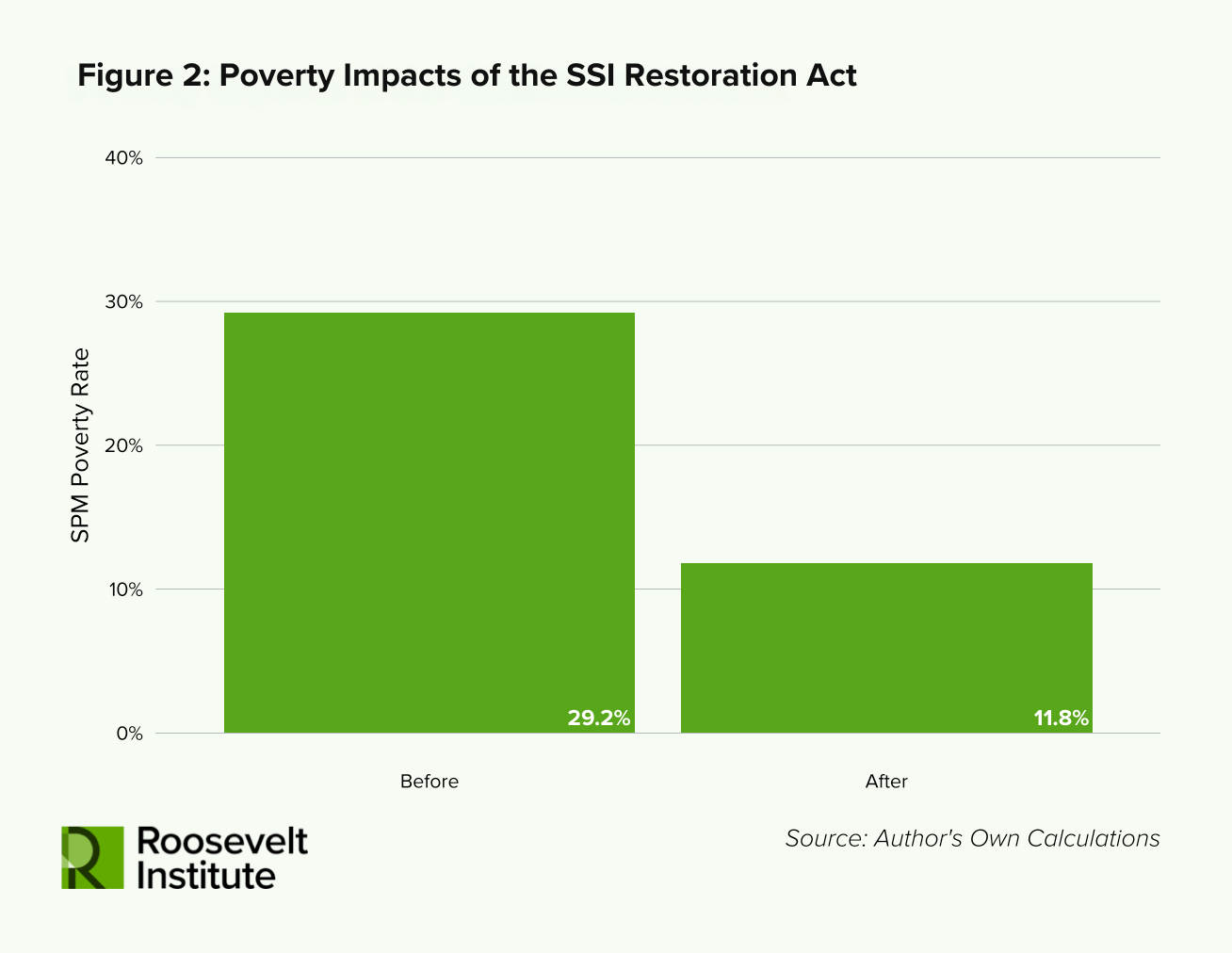
Table 6 presents the impact of the SSI Restoration Act at the individual rather than household level. The results are broadly similar. We estimate that the SSI Restoration Act would generate an additional 2.8 million SSI recipients.2 The SSI recipient poverty rate would drop 18.1 percentage points from 29.3 percent to 11.2 percent. Deep poverty among SSI recipients would drop 3.5 percentage points from 4.3 percent to 0.8 percent. Overall poverty would drop 0.7 percentage points from 12.6 percent to 11.9 percent. This represents 2.21 million people lifted out of poverty: current SSI recipients and members of their households as well as new SSI recipients and members of their households. And overall deep poverty would drop by 0.1 percentage points from 4.2 percent to 4.1 percent, lifting 480,000 individuals, including current and new SSI recipients and members of their households, out of deep poverty.

Overall, we conclude that the SSI Restoration Act would bring SSI household and individual poverty rates largely in line with overall poverty rates. In fact, accounting for new beneficiaries, SSI poverty rates would be slightly lower than the overall averages. Under the status quo, SSI household and individual deep poverty rates are already broadly similar to overall averages, reflecting a success of the program. Under the SSI Restoration Act, deep poverty among SSI recipients would be almost entirely eliminated: Less than 1 percent of households and only about three-quarters of a percent of recipients would live in deep poverty.
Component Analysis
We also estimate the impacts of the SSI Restoration Act of 2024 by component to provide a sense of the contribution of each part of the bill if it were to be enacted in isolation. Specifically, we ask what the impact would be if we only increased the earned and unearned income exclusions, only removed the “income support and maintenance” component of the benefit means test, or only increased the maximum monthly benefit (including changes to both single and married couple benefit calculations).
Table 7 and Figure 3 analyze the impact of introducing each component of the SSI Restoration Act separately on poverty and deep poverty. When reading this table, note that these changes are not additive. In other words, the overall impact of the SSI Restoration Act is not the same as the sum of the impacts of each provision if implemented separately. This is because, for example, two separate provisions might lift a household over the poverty line, and implementing both simultaneously would not change the result: The household is lifted over the poverty line regardless.

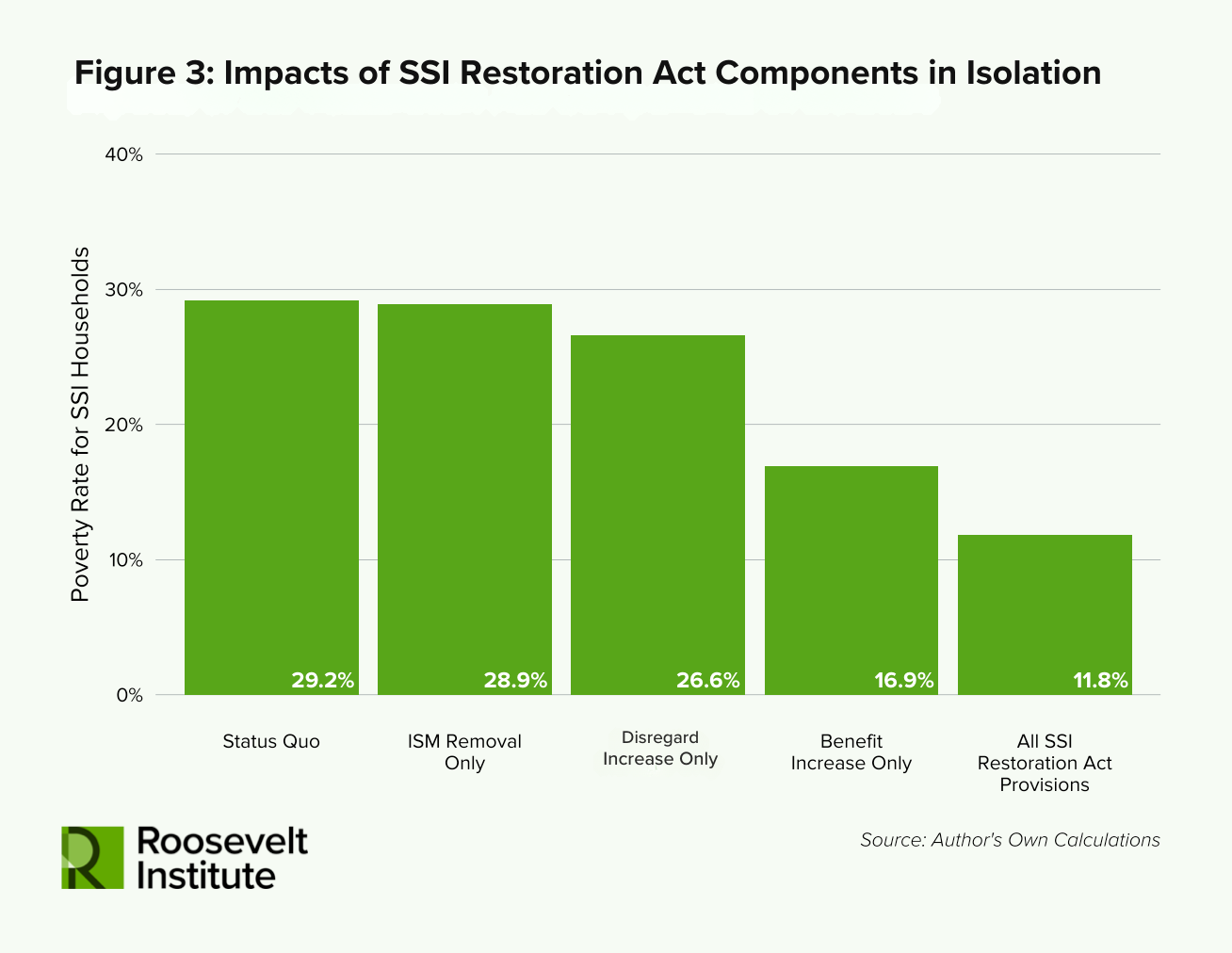
The impacts by provision show that we could derive an impact roughly 71 percent as large as that of the full legislative package from increasing the maximum monthly benefit alone. Conversely, changes to the increases in the earned and unearned income disregards alone would have an impact only about 15 percent as large as the impact of the full bill on SSI household poverty. And removing the “in-kind support and maintenance” component of the benefit means test alone would barely reduce SSI household poverty, producing an impact only about 2 percent as large as that of the full bill. Recall that only roughly 9 percent of SSI households are currently impacted by that rule. In other words, making a substantial dent in poverty will require more than updates to calculations about how much of the existing benefit one may receive; the benefit must also increase in value.
Footnotes
- Some SSI recipients living in institutions are not surveyed by the CPS. Using prior research that linked CPS survey respondents to administrative records, we estimate that about 7 percent of senior SSI recipients are not in the CPS sampling frame—lower age groups are not significant. ↩︎
- This number is slightly higher than the number of new SSI households because households may have more than one SSI recipient (e.g., a parent and a child or a married couple that each receive the benefit). ↩︎
Acknowledgments
The authors would like to thank Kathleen Romig, Jack Smalligan, Michael Madowitz, Katherine De Chant, Ijeoma Ogbonna, and Toyosi Odusola for their feedback, insights, and contributions to this paper. Any errors, omissions, or other inaccuracies are the authors’ alone.
Suggested Citation
Stephen Nuñez and Jack Landry. 2026. “Estimating the Cost and Impacts of the SSI Restoration Act.” New York: Roosevelt Institute.
RELATED RESOURCES
Authors