

Examining the Urban Revitalization to Gentrification Pipeline: The Case of the Atlanta Beltline
July 21, 2026
By Sonali Dade
This publication is part of the 2026 Roosevelt Network Undergraduate Emerging Fellowship Journal.
Introduction
Atlanta’s rapid growth has long been framed as a national success story of urban revitalization driven by collaboration between government, business, and philanthropy. Yet for many longtime residents, particularly low-income Black Atlantans, this growth has coincided with rising housing costs, displacement, and declining access to political and economic power. These tensions are most visible in the neighborhoods surrounding the Atlanta Beltline, a flagship redevelopment project that has reshaped land use, real estate markets, and demographic patterns across the city.
This paper examines gentrification in Atlanta through the lens of the Beltline and the Beltline Atlanta Housing Authority Board (BAHAB), the institution charged with mitigating displacement through affordable housing development. While the Beltline has delivered parks, trails, and significant economic investment, its affordable housing framework has fallen short of protecting the low-income and predominantly Black communities most affected by rising property values and rents. These failures threaten Atlanta’s historic identity as a “Black Mecca” and strain the political coalition that has underpinned the city’s growth since the civil rights era.
By situating the Beltline within Atlanta’s broader history of racial inequality, spatial segregation, and growth-oriented governance, this analysis argues that the shortcomings of the BAHAB are structural rather than incidental. The paper concludes with policy recommendations aimed at realigning Beltline development with its stated equity goals, emphasizing expanded affordable housing funding and stronger community accountability mechanisms.
Gentrification in Atlanta
Atlanta ranks fourth among US cities where gentrification has eliminated majority-Black areas (Dixon 2025). Gentrification is the process whereby an influx of relatively high-income residents and businesses move into a historically disinvested and/or low-income neighborhood. It is more common in white neighborhoods, with the exception of places where most low-income neighborhoods are predominately Black. The increased investment raises property values and taxes, pricing out and displacing the original residents. Between 1980 and 2020, Atlanta lost 13 of its 31 majority-Black areas, known as census tracts, which amounts to an over 40 percent population decrease in Black residents. Nine tracts became majority-white, and the other four became mixed with no majority. During the same period, 16 majority-Black tracts gentrified, the fifth-most among US metro areas, as these neighborhoods lost over 22,000 Black residents while gaining nearly 23,000 white residents (Raymond 2025). From 2000 to 2012, Atlanta ranked as the most intensely gentrifying metro area in the nation (Mitchell et al. 2025).
These shifts have greatly changed the character of Atlanta, which has for decades been known as the Black Mecca—a cultural, historical, and economic hub for African Americans. In fact, the city is relatively unique for its distribution of Black people across the socioeconomic spectrum and for its large Black middle class in particular, with many African Americans able to obtain top-tier educations, accumulate wealth, and amass significant political power without ever having to leave the metro area (Hobson 2018). However, the 2020 census revealed that, for the first time since 1960, the city of Atlanta is no longer majority-Black, as the African American population dropped from 61 percent to 47 percent from 2000 to 2020 (Richards 2021). During the same period, the white population increased from 31 to 38 percent. Many Black people moved to suburbs, especially as housing prices in the city proper increased––by the 2010s, 87 percent of all Black metro residents lived in the suburbs (Rhone 2023).
The drop in Black residents could result in significant changes to Atlanta’s political and economic power distribution. Since the 1960s, Atlanta politics has been characterized by an informal agreement between the largely Black political elites and largely white business elites. In the midst of the Civil Rights Movement, the city sought to distinguish itself from other Southern cities like Birmingham and Little Rock, where nationally publicized conflicts over desegregation stained their reputations. Realizing that overt racism was bad for business, local government leaders like Ivan Allen and flagship businesses like the Coca-Cola Company recognized that strengthening relationships with the city’s Black elite—characterized by activists like Martin Luther King, Jr. and intellectuals like W. E. B. DuBois—would be critical for Atlanta’s continued economic development. Atlanta became “The City Too Busy To Hate,” a marketing slogan that framed itself as racially progressive while prioritizing business and economic growth. As former Atlanta mayor and United Nations Ambassador Andrew Young noted, “it was understood that Atlanta was about business. It didn’t have time for racism and for keeping anybody down” (Croll 2023). The agreement has held firm in the succeeding decades. Atlanta has had only Black mayors since 1973 and is a major economic hub in the United States, home to the eighth highest concentration of Fortune 500 companies nationwide such as Home Depot, Delta Airlines, the United Parcel Service, and the aforementioned Coca-Cola Company (Saporta 2024; Metro Atlanta Chamber 2024).
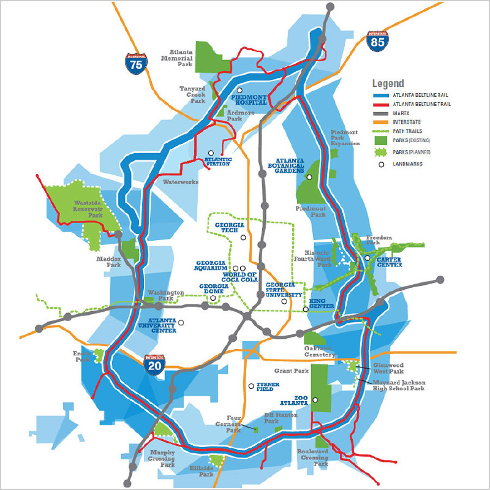
However, this prosperity masks the harsh economic reality faced by thousands of Atlantans. Atlanta has the highest income inequality in the country, driven by massive disparities between white and Black residents. As of 2024, white families have a median household income of $83,722, while Black families’ median income is $28,105. The gap only grows when measuring total wealth, which is the total sum of one’s assets minus one’s debts. White households have 46 times more wealth than Black households at $238,555, compared to $5,160 for Black households (Glynn 2024). For many Americans, homeownership is the greatest asset for generating long-term wealth. Yet in Atlanta, Black households comprise 17 percent of the city’s housing wealth despite making up 48 percent of the population, and Black homeownership is at 33 percent, 12 points beneath the city average and the lowest mark of all racial groups (Camardelle and Bethea 2023). The remaining two-thirds of Black Atlantans rent their homes, and 13 out of 15 majority-Black neighborhoods have over 50 percent of occupants renting. This is much higher than the average renter rate in the city, which is around 32 percent (Best Neighborhood n.d.a). Additionally, in these majority-black neighborhoods, 45 percent of residents classify as cost-burdened, meaning they spend over 30 percent of their income on housing (Camardelle and Bethea 2023). Wealth in the city is both racially and geographically segregated. Interstates 75 and 85 form a dividing line between the high-earning majority white neighborhoods like Buckhead and Virginia Highlands in the north, and the low-earning majority-Black neighborhoods like Mechanicsville and Vine City in the south (Best Neighborhood n.d.b).
The Atlanta Beltline
The Atlanta Beltline, a 22-mile loop of multiuse trails that circles the heart of the city, is one of the major symbols of gentrification in Atlanta today. Once complete, the loop will connect 45 different neighborhoods. The Beltline is, at its core, an urban revitalization project. The loop is built on repurposed railroad tracks, once central to Atlanta’s industrial development and its status as a major railroad hub, but since abandoned and unused. A sweeping, ambitious endeavor, the project promises 33 miles of Beltline and connector trails, 22 miles of light rail transit, 1,300 acres of new or restored greenspace, $10 billion in economic development, 50,000 permanent jobs, 28,000 new housing units and 5,600 affordable housing units, and public art exhibits and galleries (ABI 2025). While not scheduled to be completed until 2030, the Beltline’s development has made significant progress, with 85 percent of the mainline trail either complete or under construction and over 70 percent of affordable housing units created or preserved (ABI 2025). However, the light rail system has yet to begin construction.
Proponents of the Beltline frame the project as an opportunity to transform Atlanta for the better, improving infrastructure, equity, and connectivity. Current Mayor Andre Dickens stated that the Beltline reflects Atlanta’s “unique culture of nourishing partnerships between government, businesses, philanthropic communities to unite us behind one shared vision” (ABI 2025). The Beltline has indeed become a testament to the potential of urban revitalization. Its trails are hotspots for various restaurants, bars, skate parks, running and biking paths, and multiuse venues like Ponce City Market. The latter was converted from an old Sears catalogue facility to a vibrantly popular destination with shops, restaurants, business offices, apartments, outdoor space, and direct access to the Eastside Trail.
However, neighborhoods close to the Beltline have seen massive changes in affordability and demographic composition, despite the project not being completed, due to large-scale investment projects. In the historic Old Fourth Ward, for example, median home prices went from $345,000 in 2010 to over $1.7 million in 2020. During the 2010s alone, the Black population dropped from 4,500 to 1,500 between 1970 and 2020, while the white population tripled from 1,000 to 3,000 (Raymond 2025).
The Beltline Atlanta Housing Authority Board
The Beltline Atlanta Housing Authority Board (BAHAB) is responsible for affordable housing initiatives. It makes investment recommendations for money from the Beltline Authority Housing Trust Fund (BAHTF), monitors locations and availability of affordable housing throughout the Beltline, and coordinates with other affordable housing initiatives throughout the city. In the 2007 ordinance that established the BAHAB, the Atlanta City Council set the goal of constructing 5,600 rental and owner-occupied units of affordable housing over a 25-year period, amounting to 224 units annually, through down payment assistance, developer incentives, and property acquisition. To fund this development, the ordinance declared that 15 percent of each Beltline construction bond would be set aside for affordable housing and held in the BAHTF (ABI 2025). The bonds come from the Beltline Tax Allocation District (TAD), established in 2005. TADs are economic tools to promote major development in Atlanta, and have been used to fund large projects like Centennial Olympic Park in preparation for the 1996 Olympic Games. These districts freeze the base property tax value at its creation date. All increases in property tax value over the base are then directed toward development, while the base property tax revenue continues to go to public services like schools or local government (Xu 2026).
The BAHAB’s latest annual report, published in April 2025, claims 6,241 total affordable units have been built. However, only 4,166 units are in the TAD, and out of those, only 2,544 units were supported by Atlanta Beltline, Inc. (ABI), the implementation agent for the Beltline project (ABI 2025).
BAHAB Shortcomings
The first major issue with the BAHAB stems from its housing goal: 5,600 units in a city where nearly 17 percent percent of the population, or around 88,000 people, live below the federal poverty line (US Census Bureau n.d.). Additionally, for their first 10 years, the BAHAB struggled to implement its stated goals. According to a 2017 exposé by the Atlanta Journal-Constitution, conservative estimates put the Beltline’s affordable housing needs at 10,000 units, well above the 5,600 goal. The BAHTF, through its TAD bonds, was expected to raise $120 million over 25 years, but by 2017 it had raised less than 17 percent of that. That same year, only 785 affordable units were funded, with more than 200 under construction. This was a result of years of neglecting affordable housing spending. For instance, in 2013, ABI spent $5.3 million on affordable housing versus $127 million on parks and trails. In a quote to the Atlanta Journal-Constitution, former Beltline Partnership board member Nathaniel Smith said the main problem of the Beltline was “that the people have been overshadowed by profit” (Mariano, Conway, and Ondieki 2017). The ABI CEO stepped down as a result of the article (Immergluck 2022).
The second major issue stems from the limitations with the provision requiring 15 percent of TAD bonds go to the affordable housing trust fund. According to Dan Immergluck, professor emeritus of Urban Planning at Georgia State University, the TAD was never intended to make up the bulk of Beltline funds. Over the first five years of the project, the TAD comprised only 35 percent of spending. Today, 49 percent of spending comes from the TAD, a significant increase but still less than half of the total budget. Additionally, TAD dollars can only be spent in the district itself, not in the surrounding Beltline Planning Area where a large portion of real estate development has occurred. Most notably, the BAHTF was designed to support new housing development, but had little to no provisions meant to assist renters and homeowners who saw their rents and property taxes skyrocket as a result of Beltline development (Immergluck 2022). The AJC article highlighted Helene Mills, an elderly longtime Old Fourth Ward resident who saw her tax bill double in a single year (Mariano, Conway, and Ondieki 2017).
Policy Recommendations
The first recommendation concerns funding for affordable housing. Given the limitations of the TAD, ABI should dedicate 15 percent of total Beltline spending to affordable housing, encompassing philanthropic donations and federal, state, and local funding. If that was the funding metric from the start, the project could have raised between $420 and $700 million for affordable housing over 25 years (Immergluck 2022). This would have prevented the BAHTF from relying on a single source for funding, and allowed the project to build more units from the start in areas that are outside of the TAD but still experiencing real estate development booms.
The second recommendation concerns community accountability. A large reason affordable housing construction fell to the wayside compared to parks and trails development is due a lack of political will (Hochschild 2025). One solution to that is to directly involve community members into the decision-making and oversight process. The BAHAB has various stakeholders representing the Atlanta City Council, Atlanta Public Schools, the Mayor’s Office, the Fulton County Board of Commissioners, and two community-based organizations in the Atlanta Housing Association of Neighborhood-based Developers and the Atlanta Neighborhood Development Partnership (Maddox and Mitchell 2007).However, the board lacks residents and community members who have lived in the TAD for years and could testify to stories like Helene Mills’s and ensure policymakers in power respond to community needs.
Conclusion
Atlanta’s experience with gentrification reveals the limits of growth-centered urban revitalization when equity is treated as an aspiration rather than a binding commitment. The Atlanta Beltline has undeniably reshaped the city’s physical landscape and attracted billions in investment, but its benefits have been distributed unevenly. For many Black and low-income residents, especially those living in historically disinvested neighborhoods, the Beltline has accelerated displacement, eroded housing security, and narrowed access to the very city they helped build.
The shortcomings of the Beltline Atlanta Housing Authority Board underscore how institutional design and political priorities shape outcomes. An affordable housing target that was insufficient from the outset, reliance on a constrained funding mechanism, and limited protections for existing residents allowed market forces to outpace public accountability. As a result, the Beltline’s equity promises have failed to meaningfully counteract the racial and geographic inequalities that define Atlanta’s housing landscape.
Yet these outcomes are not inevitable. Expanding affordable housing funding beyond the Tax Allocation District and embedding long-term community residents directly into decision-making processes would represent a shift from symbolic inclusion to structural reform. Without such changes, Atlanta risks undermining both its legacy as a Black political and economic center and the durability of the coalition that once made growth without overt racial conflict possible. Whether the Beltline ultimately becomes a model of equitable development or a case study in displacement will depend on whether the city is willing to align its redevelopment ambitions with enforceable commitments to housing justice.
References
Atlanta Beltline, Inc. (ABI). 2025. ABI Annual Report-Out. Atlanta, GA: ABI. https://a-us.storyblok.com/f/1020195/x/36897c1bb8/bahab-tadac-annual-report-out-_-23-april-2025.pdf.
Atlanta Beltline, Inc. (ABI). n.d. “Learn about the Atlanta Beltline’s Ambitious Project Goals.” Accessed April 30, 2026. https://beltline.org/learn/progress-planning/goals.
“Atlanta Beltline TAD.” n.d. Invest Atlanta. Accessed April 30, 2026. https://investatlanta.com/developers/opportunities-incentives/tax-allocation-district-financing/atlanta-beltline.
Best Neighborhood. n.d.a “Atlanta, GA Home Owners and Renters Map.”Accessed April 30, 2026. https://bestneighborhood.org/housing-data-in-atlanta-ga.
Best Neighborhood. n.d.b “Where Racial Segregation and Income Disparity Align: Atlanta.” Accessed April 30, 2026. https://bestneighborhood.org/where-racial-segregation-and-income-disparity-align-atlanta.
Camardelle, Alex, and Jarryd Bethea. 2023. Building A Beloved Economy: A Baseline and Framework for Building Black Wealth in Atlanta. Atlanta Wealth Building Initiative. https://buildblackwealth.info/#start.
Croll, Dylan. 2023. “Andrew Young: How Atlanta Became the ‘City Too Busy to Hate.’” Yahoo! Finance, updated February 13, 2023. https://finance.yahoo.com/news/andrew-young-how-atlanta-came-the-city-too-busy-to-hate-123327490.html.
Dixon, Kristal. 2025. “Atlanta Ranks Fourth in Gentrification Wiping out Majority-Black Areas.” Axios Atlanta, May 19. https://axios.com/local/atlanta/2025/05/19/atlanta-gentrification-displacement-black-residents.
Glynn, Kendall. 2024. “White Atlanta Families Have 46 Times More Wealth than Black Ones. How Do We Fix That?” Atlanta Civic Circle, January 17. https://atlantaciviccircle.org/2024/01/17/atlanta-racial-wealth-gap-solutions.
Hobson, Maurice. 2018. “Atlanta’s ‘Black Mecca’ Status Is More Complicated than It Seems.” Atlanta Magazine, April 5. https://atlantamagazine.com/list/race-atlanta/atlanta-black-mecca-complicated.
Hochschild, Jennifer L. 2025. “Race, Class, and Development: The Atlanta Beltline.” In Race/Class Conflict and Urban Financial Threat. Russell Sage Foundation. https://jstor.org/stable/10.7758/9781610449281.8.
Immergluck, Dan. 2022. “The Beltline as A Public-Private Gentrification Project.” In Red Hot City: Housing, Race, and Exclusion in Twenty-First Century Atlanta. University of California Press. https://doi.org/10.2307/j.ctv2vr8vbb.
Maddox, Jim and Caesar C. Mitchell. 2007. “City Council Establishing BAHAB.” Atlanta City Council. https://a-us.storyblok.com/f/1020195/x/61d7310d56/city-council-establishing-bahab.pdf.
Mariano, Willoughby, Lindsey Conway, and Anastaciah Ondieki. 2017. “How the Atlanta Beltline Broke Its Promise on Affordable Housing.” Atlanta Journal-Constitution, July 13. https://ajc.com/news/local/how-the-atlanta-beltline-broke-its-promise-affordable-housing/0VXnu1BlYC0IbA9U4u2CEM.
Metro Atlanta Chamber. 2024. “Fortune 500 and 1000 Companies in Georgia.” Accessed April 30, 2026. https://metroatlantachamber.com/wp-content/uploads/2024/07/FORTUNE-500-Companies-1.pdf-1.pdf.
Mitchell, Bruce C., Jad Edlebi, Helen C. S. Meier, Jason Richardson, Joseph Dean, and Liang Chen. 2025. Displaced by Design: Fifty Years of Gentrification and Black Cultural Displacement in US Cities. Washington, DC: National Community Reinvestment Coalition. https://ncrc.org/displaced-by-design.
Raymond, Jonathan. 2025. “New Report Says Atlanta Lost More than 40% of Its Majority-Black Census Tracts between 1980-2020.” 11Alive, May 15. https://11alive.com/article/news/local/gentrification-black-displacement-report-ncrc-atlanta/85-e5bb622b-e0f0-4ba8-af20-e3924815a663.
Rhone, Nedra. 2023. “Opinion: Black Mecca More a Work in Progress than a Promised Land.” The Atlanta Journal-Constitution, January 25. https://ajc.com/life/opinion-black-mecca-more-a-work-in-progress-than-a-promised-land/ONS5TER2LBDHRMAIE57CIV4LM4.
Richards, Doug. 2021. “Census: No More Black Majority in Atlanta.” 11Alive, updated August 29. https://11alive.com/article/news/local/census-no-more-black-majority-in-atlanta/85-645bed51-b9bd-4263-bbd3-40c1a97ded61.
Saporta, Maria. 2024. “Metro Atlanta’s Position as a Fortune 500 Company City Finally Clear.” SaportaReport, July 1. https://saportareport.com/metro-atlantas-position-as-a-fortune-500-company-city-finally-clear/columnists/maria_saporta.
US Census Bureau. n.d. “U.S. Census Bureau QuickFacts: Atlanta City, Georgia.” Accessed April 30, 2026. https://census.gov/quickfacts/fact/table/atlantacitygeorgia/PST120224. Xu, Meimei. 2026. “What Are Tax Allocation Districts and Why Are They Contested in Atlanta?” WABE, January 13. https://wabe.org/what-are-tax-allocation-districts-and-why-are-they-contested-in-atlanta.
Acknowledgments
I would like to thank the Roosevelt Network for this amazing opportunity and my mentors Eric Paul, Robert-Thomas Jones, and Shruti Lakshmanam for guiding me through the writing process and providing me with great feedback and advice. I would also like to thank my fantastic professors at Wellesley for encouraging me to always think critically about the world around me and giving me the confidence to relentlessly pursue my academic and professional goals. Finally, I want to thank my home, the city of Atlanta, for nourishing me and instilling in me a deep appreciation for advocacy and positive change.
AUTHOR

Sonali Dade is a 2026 graduate of Wellesley College, where she majored in American studies and political science. Her time at Wellesley encouraged vast academic exploration and culminated with her winning the Edward Stettner Prize, awarded annually for outstanding political theory papers. Through her fellowships with the Roosevelt Network and internships at Atlanta City Hall and Senator Raphael Warnock’s office, she has been able to deeply explore the world of policymaking. Sonali hopes to attend law school and pursue international law with the ultimate goal of redistributing economic and political power between historic imperial countries and their former colonies.