

The Receipts: The Untold and Underappreciated Outcomes of Biden’s Clean Energy Strategy
April 16, 2026
By Betony Jones and Joe Peck

This is a web-friendly preview of the report.

Key Takeaways
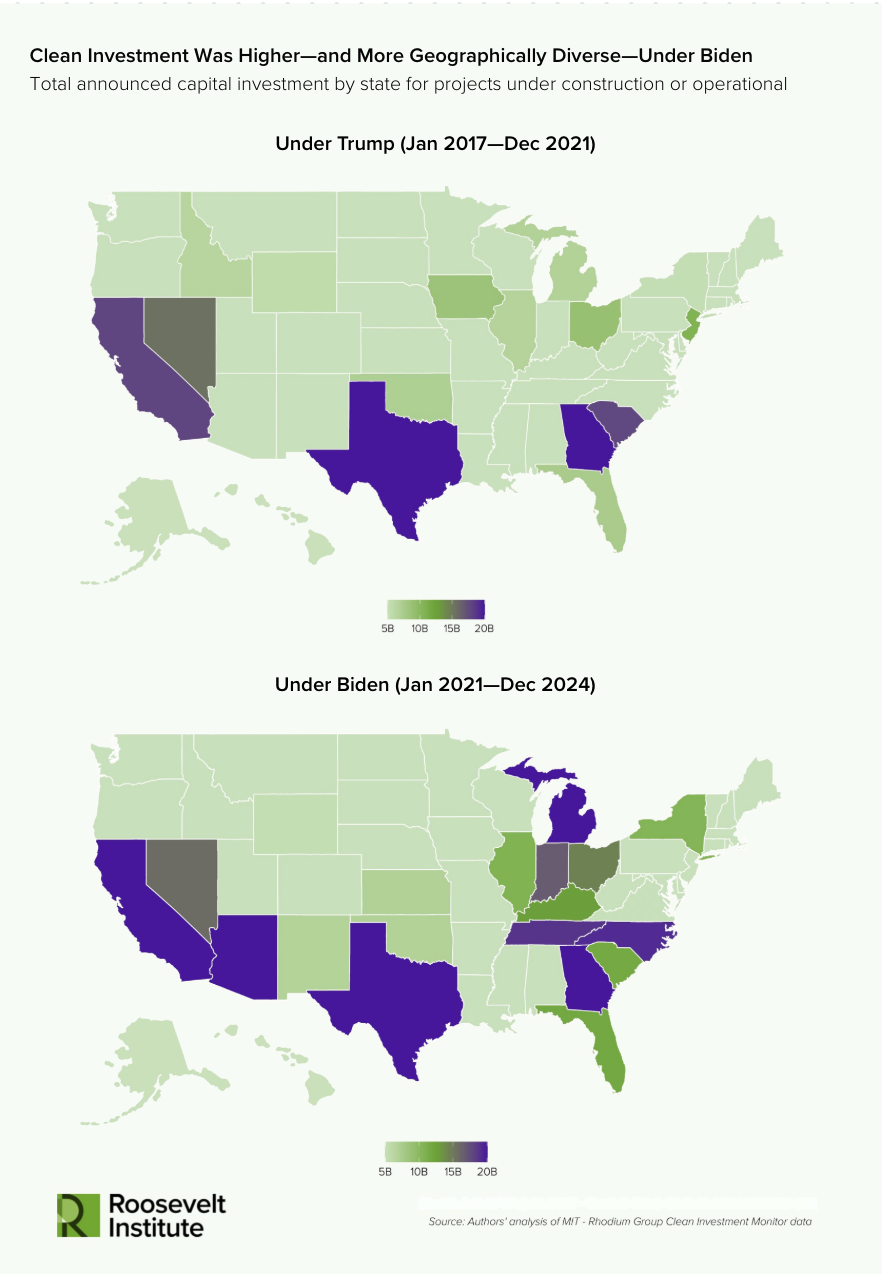
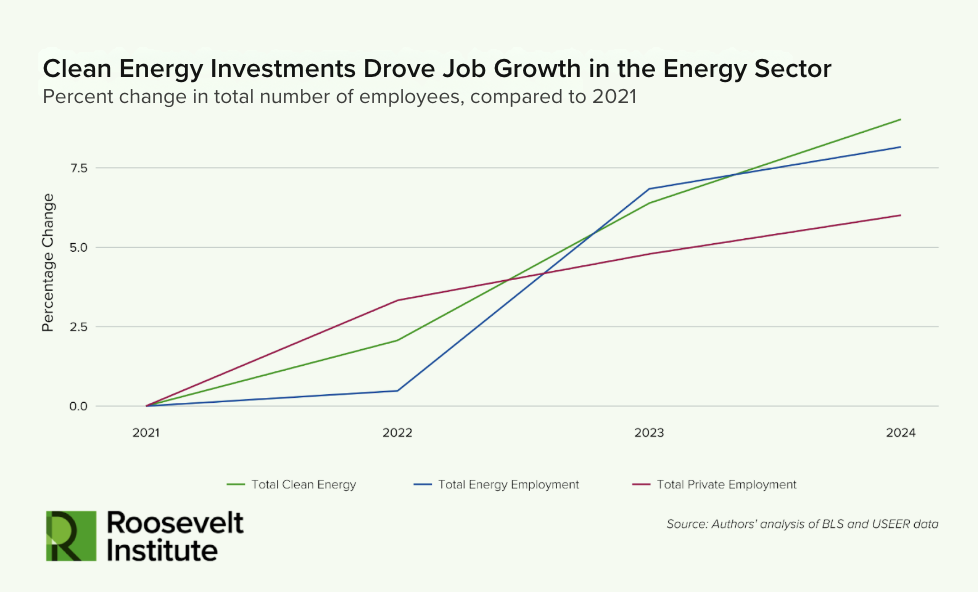
- Historic Investment and Job Growth: The Biden administration’s industrial strategy unleashed a historic surge in clean energy investment and sustained strong wage growth. Clean energy manufacturing investments grew from less than $5 billion in 2019 to nearly $60 billion in 2023—an exponential increase driven by “steel in the ground” construction. Clean energy manufacturing grew at a rate of 9.5 percent, which is five times higher than the broader industry average of 1.8 percent.
- Labor and Community Agreements: The Department of Energy’s procurement requirements successfully tied 74 percent of major project funding ($91 billion) to legally binding labor or community agreements. This included 110 major projects, with 32 projects committing to both community and labor agreements. Projects with these agreements had a much larger average award size—$824 million—compared to the $323 million average for projects without them.
- Reducing Risk and Avoiding Delays: Contrary to skeptics’ predictions, Community Benefit Plans (CBPs) did not cause significant delays; instead, they created structured pathways for navigating trade-offs and reducing project risk. Private-sector executives cited permitting delays, supply chain constraints, and government contracting timelines as the actual primary sources of friction. Upfront engagement through CBPs was found to frequently accelerate deployment by reducing friction during construction and long-term operations.
- Wage Growth and Inflation: In key clean energy roles, wage growth significantly outpaced the 21 percent inflation rate seen between 2021 and 2025. For example, weekly earnings for power and communication line workers saw a 43 percent boost, while oil and gas pipeline workers saw a 38 percent increase. For manufacturing, production and nonsupervisory wages grew by 22.9 percent, successfully preserving and expanding worker purchasing power despite inflationary pressures.
- Shifting Corporate Strategy: Federal policy moved labor and community standards from peripheral compliance exercises to core project development strategies. This shift resulted in many firms changing their core business assumptions and practices even for projects not receiving federal funding. For companies already utilizing high-road models, the federal incentives validated and reinforced their existing strategies, making high-standard deployment the new industry benchmark.
Executive Summary
The Biden administration’s industrial strategy unleashed a historic surge in clean energy investment, sustained strong wage growth, and contributed to historically low unemployment. Through the CHIPS and Science Act, the Infrastructure Investment and Jobs Act (IIJA), and the Inflation Reduction Act (IRA), the federal government paired large-scale financial incentives with statutory labor standards, tax incentives, and community benefits requirements to shape how firms invested in workers and communities.
Although this strategy did not translate into electoral success in 2024 and faced retrenchment under the second Trump administration, it was more economically successful, had more impact on US climate progress, and led to greater labor and community benefits than has been recognized. The Community Benefits Plan framework created by the Department of Energy (DOE) was remarkably effective in ensuring that the public would share in the rewards of historic federal industrial investments, with 74 percent of IIJA and IRA dollars invested in major clean energy projects tied to commitments to use formal labor and/or community agreements.
Prevailing wage and apprenticeship requirements and Community Benefits Plans embedded workforce, equity, and community considerations into project design and implementation. These mechanisms did not eliminate conflict. Instead, they created structured pathways for navigating trade-offs among speed, standards, workforce capacity, and community acceptance—often reducing implementation risk rather than increasing it.
This paper combines original data analysis with in-depth interviews of more than a dozen private-sector actors to assess how Biden-era clean energy policy affected firm decision-making and workforce and community strategy. This quantitative and qualitative data illustrates the effects of statutory labor standards, tax incentives, and the DOE’s Community Benefits Plans with a focus on employment and wage data, apprenticeship expansion, and collective bargaining agreements.
On balance, the private sector was more receptive to Community Benefits Plan provisions than skeptics predicted. Many firms were willing to form labor partnerships, invest in new community engagement strategies, consider how to measure and mitigate harms of their projects, and make meaningful workforce investments. In addition, companies already operating under high-road models found that federal incentives validated, aligned with, and reinforced existing practices. DOE’s Community Benefits Plan framework both catalyzed and expanded responsible project deployment—embedding labor standards and community engagement into core project development strategies rather than treating such standards as peripheral compliance exercises.
The focus on labor and community benefits proved a less consequential source of friction than widely assumed, with funding recipients citing primarily the issues of a steep learning curve and lack of expertise. More significant bottlenecks included permitting delays, US supply chain constraints, and the timelines of government contracting. Labor and community benefits did not impose excessive hardship on funding recipients and often resulted in previously unrealized project benefits as well as changes to core assumptions and business practices, even beyond the projects receiving funding. These are important lessons for future industrial policy design: Building in mechanisms to share benefits of industrial and infrastructure investments with workers and communities has more upside than downside potential.
The efforts of the Biden administration to tie climate investments to good jobs and broadly shared prosperity showed promising signs of success, but faced an attribution problem. Ignoring the successes, reverting back to technocratic approaches to climate policy, or chasing the new angle of affordability—without continuing to invest in coalition-building, organizing, state and local policy efforts, and successful project implementation on the ground—would be a mistake. In this period of policy retrenchment, there is an opportunity to rebuild the social and civic infrastructure that has frayed—expanding the organizing capacity needed to secure community and labor agreements, proving that such partnerships can accelerate project delivery, and reinforcing participatory democracy from the ground up.
Durable climate progress depends not only on capital investment but on organized constituencies capable of shaping and sustaining it. In a period where many advocates, funders, and policymakers are going back to the drawing board on climate strategy, this paper provides new data about what worked alongside insights about what could have worked better.
This paper is the second in a series of three papers. The first examined how the Biden administration steered the private sector toward clean energy and shared prosperity. The third will focus on strategic opportunities going forward.
The Results
The economic results of the Biden-era investments were larger and more significant than is commonly appreciated, and firms can and did navigate the requirements and incentives that the administration put in place, often even finding them helpful.
Federal policy succeeded in crowding in private capital, stimulating domestic manufacturing and supply-chain investment, and generating early employment and wage gains—particularly in construction and clean energy manufacturing. These outcomes reflect behavior change: Firms committed capital before full clarity on markets, workers entered expanding sectors, and investors treated federal signals as credible enough to support long-term bets. Construction activity, in particular, functioned as an early indicator that incentives to build up US productive capacity were working.
Prevailing wage and apprenticeship requirements and Community Benefits Plans embedded job quality, equity, and community considerations into project design and implementation. A labor representative reflected, “The Biden administration focused on the workforce as a core tenet of building of the full energy ecosystem. The breadth was terrific—it provided work for all the different trades. 2024 was our best year of growth since the 50s.”
These mechanisms did not eliminate conflict. Instead, they created structured pathways for navigating trade-offs among speed, standards, workforce capacity, and community acceptance—often reducing implementation risk rather than increasing it.
This is important because there is a risk of over-torquing, and it’s worth remembering why this approach was favored in the first place: the need to address economic insecurity after decades of offshoring and deunionization; repeated failed efforts to address climate change through sacrifice rather than opportunity; a long legacy of siting energy projects in disadvantaged communities where low-income communities and communities of color bear the costs while the rewards accrue to project owners and their investors; and an opportunity to harness the economic and security benefits of an emerging multitrillion-dollar clean energy economy.
At the same time, the analysis underscores the limits of policy design alone. Not all firms responded similarly; not all regions experienced the same outcomes; and governance gaps, coordination failures, and political volatility constrained results. Community Benefits Plans could not strengthen underlying technologies, generate buyers for new products, or stabilize markets. Prevailing wage and apprenticeship incentives expanded job quality in construction but did not extend equivalent standards to manufacturing. And the durability of many gains remains contingent on policy continuity, institutional capacity, and sustained political support.
A comment from a researcher who had conducted dozens of interviews with community stakeholders sums up the story: “The federal government catalyzed new models, new partnerships, new governance structures, new project ideas, new civic infrastructure. It did move the ball. It worked. It actually worked. It just needed more time.”
Acknowledgments
The authors wish to thank Todd Tucker for guidance and review, Bridget Bartol for helping secure interviews, Moneesha Kalamder for helping conduct them, Katherine De Chant for editorial feedback, Ijeoma Ogbonna for data visualization support, Data for Progress for archiving and maintaining Department of Energy data on community benefits plans, Tom Krieger for insights on the apprenticeship data and patterns, and the company executives and other stakeholders who candidly shared their experiences. The authors also thank the Hans-Böckler Foundation for supporting this research and specifically Christina Schildmann for asking excellent questions about the US experience and setting up so many meetings with individuals across government, labor, and civil society in Berlin whose questions and insights helped shape this report. All errors and omissions are the sole responsibility of the authors.
Suggested Citation
Jones, Betony and Joe Peck. 2026. The Receipts: The Untold and Underappreciated Outcomes of Biden’s Clean Energy Strategy. New York: Roosevelt Institute.
RELATED RESOURCES
Authors

Betony Jones
Senior Fellow, Economic Fellows ProjectBetony Jones is a senior fellow at the Roosevelt Institute. She served as the director of the Office of Energy Jobs and senior advisor for labor to Secretary Jennifer Granholm at the US Department of Energy (DOE), where she led the implementation of the Biden administration’s good jobs agenda and labor strategy.