
Social Security’s (Solveable) Problems
June 12, 2026
The 2026 Trustees Report shows Congress must take action, the sooner the better.
The Roosevelt Rundown features our top stories of the week.

Trust Fund Reserve Depletion Doesn’t Mean “Bankruptcy”
The Social Security Administration (SSA) released its annual Trustees Report on Tuesday.
What we knew going in: The Old-Age and Survivors Insurance (OASI) Trust Fund has been drawing down its reserves since the Great Recession, when a slow economic recovery and unprecedented levels of income inequality began to throw off actuarial projections from 1983, the last time Congress intervened to protect the Trust Fund reserve.
What we learned yesterday: The new report now projects that the reserve will be exhausted in 2032, a full quarter sooner than last year’s report projected.
As Roosevelt’s Stephen Nuñez reminds us, “This does not mean that Social Security is failing. It means the economy is failing to support Social Security.”
“Too much income now flows to the top, where it escapes Social Security taxation. Too many workers have faced weak wage growth,” Roosevelt President and CEO Elizabeth Wilkins said. “And the government’s poor response to the Great Recession damaged workforce participation and wages, and, in turn, weakened the reserve.”
The solution: Congress must act, as it did in 1983, to protect and expand Social Security. As Wilkins put it: “We should demand that the wealthy contribute more, recognize more of the work people do—including unpaid care—and strengthen Social Security for the next generation.”
Read the blog post: “Next Week’s Social Security Report Likely Brings Bad News. Here’s What It Really Means.”
Read Elizabeth Wilkins’s statement: “Strengthen Social Security. Don’t Cut It.”
What else we’re up to
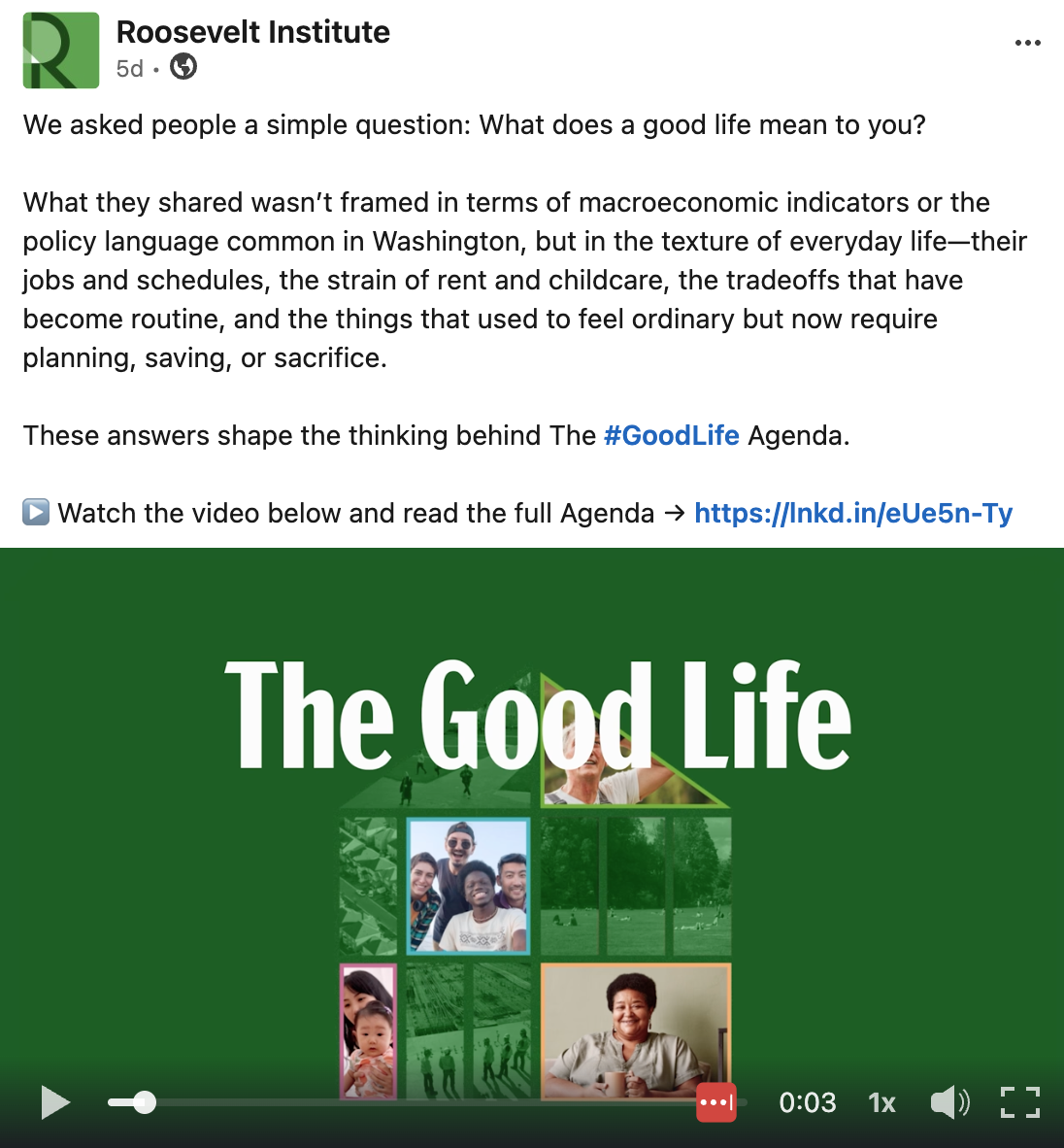
- The Good Life Agenda: Commentators continue to share thoughts on Roosevelt’s latest institutional report, The Good Life Agenda. “The Good Life Agenda is the first major policy suite I’ve seen that actually addresses the size and scope of the problem,” Zack Silk wrote for The Pitch.
- Your 401(k)’s exposure to the AI bubble: Amid the impending IPOs of SpaceX and Anthropic, Wilkins spoke with Fortune about the rules retirement fund managers are planning to subvert to capitalize on the volatile new stocks.
- “We put in place guardrails after the dot-com bubble for a reason. Because we remembered that there’s real downside risk to tying retiree savings to the fortunes of not only corporate America generally, but specifically the tech sector,” she said. “We are allowing the kind of insatiable hunger for capital to erode our safeguards for ordinary savers.”
- “We put in place guardrails after the dot-com bubble for a reason. Because we remembered that there’s real downside risk to tying retiree savings to the fortunes of not only corporate America generally, but specifically the tech sector,” she said. “We are allowing the kind of insatiable hunger for capital to erode our safeguards for ordinary savers.”
What we’re talking about