

Our Surprisingly Resilient Economy Could Use Some Backup from Policymakers
July 30, 2026
By Michael Madowitz
Welcome to the second half of 2026! The US economy has been weird in the first half of the year, but it’s been mostly a good weird. Despite a war that has zapped growth forecasts and raised costs across the world—and own goals like cutting immigration and scientific research, and tariff-ing ourselves again—the job market is probably doing slightly better than last year.
Why probably? Because the jobs data is a bit murky, again.
The Available Jobs Data Still Isn’t Perfect
The good news is the signal is improving on the payroll data—payroll revisions have been smaller and less consistently negative this year. But as shown in Figure 1, we still have real divergence between the trends depicted by the household and payroll surveys this year: The payroll data (solid lines) are a clear story of an improving job market—we’re adding jobs faster, and employment is much less concentrated in a few sectors than last year—but the household survey counts (dashed lines) don’t indicate the same.
Figure 1.
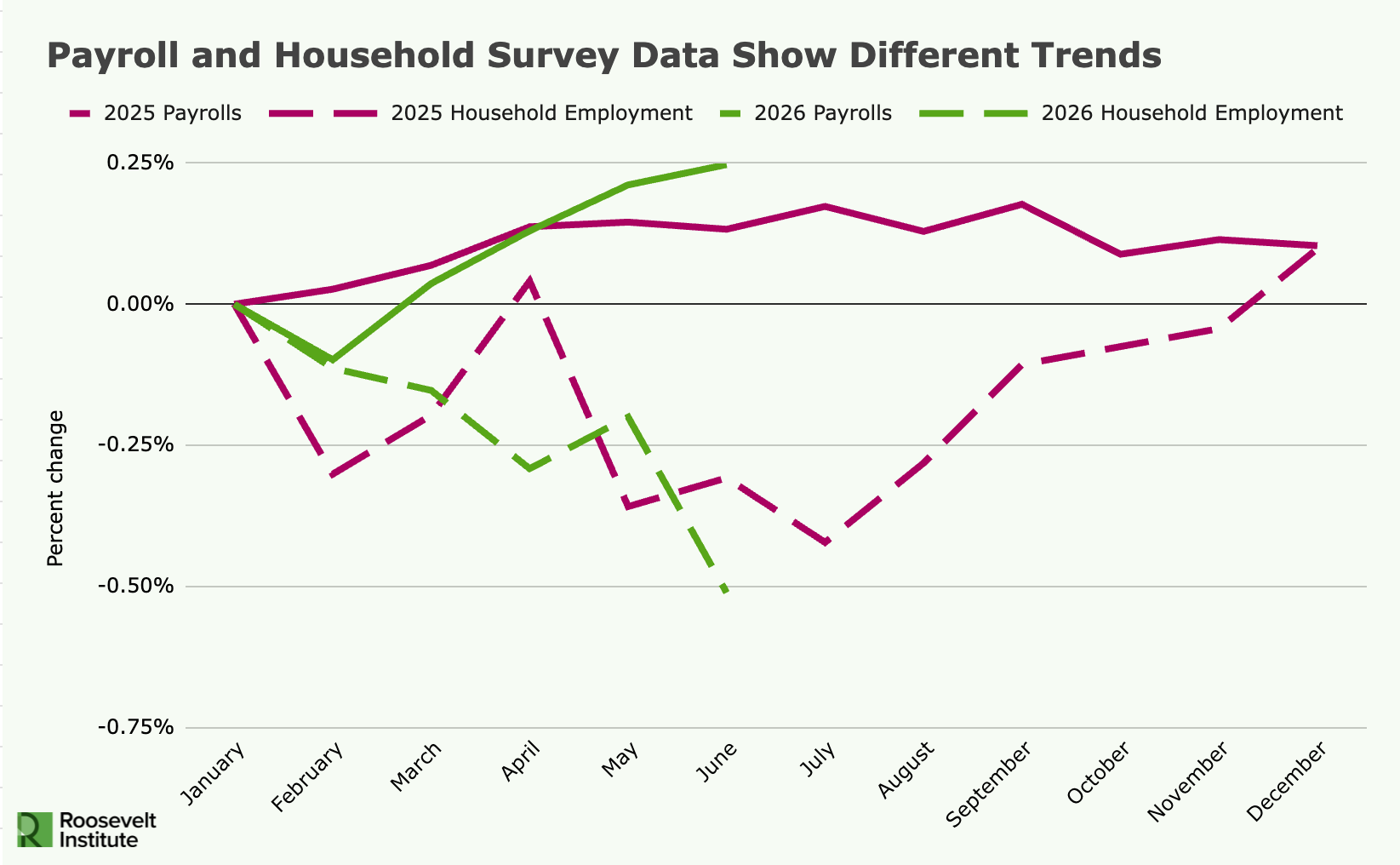
The household employment data reflected in Figure 1 are based on forecasted population growth, and that may misrepresent how strongly employment is growing. We could also look at the employment-to-population ratio, but that’s been trending down steadily, mostly due to an aging population. While narrowing the sample to 25–54-year-olds controls for aging, the trends there still don’t agree with the payroll survey. Until the data becomes more consistent, we may not be able to come to any hard conclusions.
The Economy Is Doing All Right, For Now
There remains a lot of momentum in the US economy—investment spending is strong, labor productivity is up, and the wealth effect from a stock market that has appreciated dramatically since the pandemic is providing tailwinds to demand. It would be nice to see that more clearly in the labor market, not because the economy is weak, but because the US is unusually poorly positioned to handle a downturn.
The Federal Reserve is still focused on controlling inflation that has accelerated over the last two years and especially since the economic shock from the closure of the Strait of Hormuz. And even if the Fed weren’t worried about inflation at all, interest rates are still too low for a typical monetary response to recession. The federal government is running deficits near 6 percent of GDP, reducing its ability to cushion the economy.
In other words, it’s great news the US economy has been so resilient recently, because we’ve needed it to be. But better positioning ourselves to respond if things stop going surprisingly smoothly should be a higher priority for policymakers at the moment.
Author