Creating a New US Public Media System: Normative Arguments and Policy Options
November 19, 2026
By Victor Pickard


Key Takeaways
- Taken together, the 2025 federal defunding of American public media, the ongoing collapse of local journalism, growing media oligarchy, a multitude of social harms arising from unregulated platforms and AI technologies, and other political and economic challenges to our media and democracy demonstrate the need for robust public media systems.
- Fundamental flaws—especially its funding mechanisms—are baked into the historical US public media model, and they must be structurally addressed.
- The current crisis presents a unique opportunity to create an entirely new kind of public media system based on a local “Public Media Center” model.
Introduction: The Collapse of US Media Systems
Media systems play a central role in democratic societies. As communication and information infrastructures, they are indispensable for self-governance. Yet only rarely is the development of these institutions considered subject to public policy. This is especially true in the United States, where far too often society has deferred to unfettered market forces to drive the development of key media systems. Today, this long-term erasure of public interest media policy has proven to be a major contributing factor to severe systemic market failures afflicting nearly every core information and communication infrastructure in the US.1
These failures are especially pronounced in the collapse of local media systems—a profound crisis for any self-governing society. Media institutions in general—and local journalism in particular—provide essential public services that democracy depends on for communication about everything from voting to vaccines. We all learn in school that democracy requires a free press, which is protected under the First Amendment. Today, however, much of the American news media landscape is controlled by a small number of corporations and right-wing oligarchs. This oligarchic capture coincides with the rapid collapse of local journalism across the country. Recent calculations show that the US has lost more than 40 percent of its newspapers and approximately 80 percent of its local journalists since the early 2000s, leaving tens of millions of Americans to live in news deserts with little or no access to local news media.2 According to the Local Journalist Index, whereas in 2002 the US had 40 journalists per 100,000 Americans, today it has just 7.8.3
Without action, these shocking numbers will only worsen for the foreseeable future. We must not, however, resort to fatalism. Just because the market no longer supports journalism does not justify allowing it to wither away as if society has no agency in sustaining the press. To the contrary, whether journalism collapses entirely or whether society musters the will to protect and enhance such core democratic infrastructure is a policy decision. If the media that democracy depends on has no commercial future, then we must fashion a noncommercial future through deliberate public policy that is democratically determined. For more than half a century, the closest approximation of this noncommercial infrastructure in the US has been its public media system. A key question for American society is whether this system can be repurposed to confront today’s media crises and, if so, what that might look like.
With this broader context as a backdrop, this brief has three general aims.4 First, it establishes normative arguments for why democratic countries in general, and the US in particular, must maintain and enhance robust public media systems. This argument takes on added urgency considering the 2025 federal defunding of American public media, the ongoing collapse of local journalism, growing media oligarchy, a multitude of social harms arising from unregulated platforms and AI technologies, and other political and economic challenges to our media and democracy. Second, this brief historicizes American public media, bringing into focus fundamental flaws baked into the US model, especially its funding mechanisms, that must be structurally reformed. Third, this brief argues for building an entirely new kind of public media system—one based on a local “Public Media Center” model—from the ashes of the old.
The coming post-Trump moment promises to be an especially opportune time to reconstruct American public media from the ground up, and this brief concludes with a preliminary analysis of what a strategic plan toward this objective might look like. An underlying assumption binding these elements together is that rebuilding public media must be a core plank within a broader US re-democratization movement.
Section I: Why Public Media Matters for Democracy
A long-standing truism among most modern democracies is that commercial media are incapable of providing for all of society’s informational, cultural, and educational needs. Healthy democracies have long understood that this systemic market failure necessitates robust public media systems, and the empirical record increasingly supports this assumption. A growing body of research demonstrates that, compared to commercial media outlets, public media produce news and information with both greater depth (that is, with more substance and higher quality) and breadth (for example, by prioritizing diversity and accessibility).5 This section outlines the relationship between public media and democratic health, explaining why the former is important for the latter.
Public media promotes equality in media provision. Unlike commercial media that must privilege returns on investments, public media are more likely to cover stories and engage audiences that are unprofitable, thereby reducing inequalities in media provision.6 For example, public media tend to produce programming that more broadly serves linguistic and ethnic minorities and other groups and regions that for-profit media often neglect.7 Indeed, most democratic societies take for granted that only well-funded public media systems can provide content suitable to all audiences, satisfying diverse needs within multiracial democracies. They have long understood that only public media can guarantee access to specific unprofitable yet necessary types of content and services that otherwise would remain underproduced, including high-quality children’s educational programming for poor households, emergency communications during natural disasters, and other vitally important—but commercially unviable—types of information and cultural fare. Accordingly, these countries tend to treat public media as vital democratic infrastructure, providing essential services that a commercial system will not.
Public media is dedicated to universal service. Strong public media anchoring the broader information ecosystem can help guarantee a baseline level of reliable news and communication for all members of society—a universal service mission to which commercial systems rarely adhere. Universal service is socially desirable but economically inefficient when considering how expensive it is for private firms to build out media infrastructures to rural and sparsely populated areas. Commercial operators also lack incentives to provide services to low-income neighborhoods—audiences that advertisers rarely covet. These economic biases often lead to urban centrism and other forms of market censorship in commercial media systems, including what I refer to as “informational redlining,” which disenfranchises communities along racial and class-based lines.8
A universal service mission is a core feature of public media systems, distinguishing them from their commercial counterparts. Even in the US, which has historically invested relatively little in public media compared to other countries, public media reportedly serve approximately 99 percent of the population.9 While not everyone actively engages with public media, NPR’s member stations, to give one key example, reach more than 40 million listeners every week.10 Moreover, public broadcasters typically offer programming to everyone for free—an especially valuable and scarce resource within our stratified information environment and economy that sees high-quality news and information increasingly paywalled. Serving democratic needs over profit imperatives is a first principle of public media systems.
Public media systems are associated with greater civic health.Accumulating research shows that public media outlets are more likely to provide diverse and critical media coverage of important social issues, and correlate with increased political knowledge and higher levels of civic engagement. Furthermore, studies show a positive correlation between strong public media systems and healthy democracies in general.11 This data suggests that “flawed democracies” such as the US tend to have weaker public media systems that rely more on commercial support.12
In general, countries with strong public media systems boast higher levels of political knowledge, democratic engagement, and voting in elections.13 Public media typically provide more high-quality coverage focused on international news and public affairs and less sensationalism compared to their commercial counterparts, resulting in a narrowed knowledge gap between higher and lower socioeconomic groups.14 Moreover, scholars have argued that public media institutions are critically important in combating both disinformation and misinformation.15 Research also shows that those who consume more commercial news tend to hold more negative views toward immigrants, indicating that public media consumption correlates with less extremist views.16
Public media outlets are a critical component of a broader mixed media system. Another key justification for supporting public media is the ideal of “media diversity” (often referred to as “media pluralism” outside the US). While ongoing debate persists among scholars about the precise relationship between different institutional arrangements (ownership, funding model, organizational design, etc.) and media content, it is safe to assume that a diversity of media structures—a mixed system—is optimal for democratic societies. Structural diversity in a media ecosystem ensures different operating logics can serve the needs of different audiences and provide a wide range of affordances.17 Public media should, however, be positioned at the center of this informational ecosystem given their emphasis on public service that encourages private/commercial media operators to adhere to higher democratic principles.18 Supporting a strong central role for public media within our broader information ecosystem can help guarantee reliable news and communication for all members of society.
Public media services are merit goods that produce positive externalities. Economic rationales for why democracies require public media include the argument that specific media services and products should be treated as “merit goods”—a kind of public good that the free market underproduces because it does not maximize profits in the short term, despite having long-term societal benefits.19 Merit goods can be thought of as satisfying essential public needs, like educational fare, as opposed to individual consumer wants, like entertainment media and sports coverage. While the latter can arguably be served to some degree through consumer choices based on traditional notions of supply and demand (though this assumption, too, deserves skepticism, especially since supply is dictated by a number of factors beyond demand, and demand itself is socially cultivated over time) governments have an affirmative duty to provide for social needs and public goods that the commercial market will rarely, if ever, support.20 Given that democratic self-governance depends on everyone in a society having free access to civic information, such an essential service should be considered a merit good that yields tremendous positive externalities—including spillover effects that encourage better media from commercial and nonprofit media sectors.
Public media offer independent and trustworthy news and information. Privileging public interest concerns over commercial imperatives helps explain public media’s relatively high levels of public trust. Unlike most media institutions, which are facing historically low levels of trust, survey data consistently demonstrate that public media are highly trusted across the political spectrum.21 Even during a moment when the Trump administration and congressional Republicans were constantly politicizing and attacking public media with charges of having a liberal and anti-American bias, a 2025 Pew Research Center poll showed that more Americans supported than opposed federal funding for public media.22 Furthermore, public media outlets are uniquely positioned to offer a source of human connection, community, and solidarity within an increasingly barren media landscape marked by social media commentary, clickbait, and “pink slime journalism”—low-quality content masquerading as legitimate local news, but secretly funded by corporate and political interests.23 Although critics regularly charge that government-subsidized media often morph into state mouthpieces, research shows that public media and government-subsidized private media are no less critical of government than nonsubsidized, privately owned media.24 The Nordic public media model in particular, for example, has demonstrated a high degree of political autonomy.25
Various contributing factors have prevented the kind of robust public media system that is taken for granted in many democratic nations around the world from taking root in the United States. Despite reformist attempts, commonsensical justifications, acute needs, and democratic rationales, the US public media system has failed to reach its full potential in providing for American society’s information and communication requirements. To understand why, we must turn to history.
The Historical Weakness of the American Public Media System
American broadcast media developed quite differently compared to systems in most democracies.26 Instead of building a predominantly public broadcasting system, in the early 1930s the US Congress made the fateful decision to surrender the public airwaves to private commercial broadcasters, especially NBC and CBS, whose primary aim was to maximize profit via advertising revenue and low-cost programming.27 The decision to privatize and commercialize American broadcasting essentially entailed handing over to a corporate duopoly (with little public compensation) monopolistic rights to a valuable public resource. Reformist attempts to carve out a viable public sector in the early days of radio continued but were mostly defeated by corporate interests and their allies.
By the mid-1940s, a media reform coalition composed of labor unions, civil rights organizations, consumer advocates, and progressive activist groups switched tactics to focus on pressuring profit-driven broadcasters to be more socially responsible, with a mandate to serve the public interest.28 These efforts were largely turned back throughout the decade but did result in some meaningful reforms such as the well-known (but often misunderstood) Fairness Doctrine,29 along with ongoing struggles to define the “public interest” and establish protections and obligations for public service programming.30 Eventually some meaningful set-asides for noncommercial spectrum also emerged, which later served as building blocks for constructing a public broadcasting system.
Indeed, a segment of media reformers—especially educators who believed that rampant commercialism would squander radio’s democratic potential—did not entirely abandon efforts to create a public alternative to the hyper-commercialized broadcast media system.31 They rightly understood that profit-driven broadcast media would never satisfy all of society’s diverse cultural and informational requirements. Assisted by major foundations, and following decades of advocacy and activism, these reformers were able to incubate and launch an alternative broadcasting system devoted to the kinds of educational programming that commercial media would never provide in sufficient quality or quantity.
The Public Broadcasting Act of 1967 passed by Congress and signed into law by President Lyndon B. Johnson concretized this alternative media system, declaring that it is “in the public interest to encourage the development of programming that involves creative risks and that addresses the needs of unserved and underserved audiences, particularly children and minorities.”32 The act erected a buffer between government and individual stations by establishing the Corporation for Public Broadcasting (CPB). Congress funded the CPB, whose board of directors comprised members from both major political parties, which then allocated funds to individual member stations.
Good intentions notwithstanding, the US public media system has always been politically and economically vulnerable due to its lack of adequate, permanent, and politically insulated funding.33 From its beginning, US public broadcasting came to depend on a revenue model that was strikingly different both from its original blueprint and compared to most other public media models around the world, which are far less dependent on private support.34 According to its original plan, which was based on an earlier Carnegie Commission report, an excise tax of up to 5 percent on television sets would generate a steady revenue stream paid into an insulated trust fund.35 That critical detail, however, was absent from the final 1967 act. Subsequently, President Johnson never delivered on promises to provide public broadcasting with more long-term funding. Instead, the American system was forced to rely on an annual (later amended to biannual with the Public Broadcasting Financing Act of 1975) appropriations process subject to endless political maneuvering and budget battles.
Indeed, conservative attacks against public media began in earnest from the system’s very inception. Richard Nixon did everything he could to limit public broadcasting funding, and the waves of assaults never ceased. But overt political impediments were dwarfed by economic constraints on US public media. This financial precarity forced stations to seek out various forms of private underwriting to fund their programming, from individuals to foundations to corporations.
This unhealthy dependence on private capital was by design and only intensified over the decades. In the 1980s, Congress further cemented this reliance on corporate support by directing public broadcasters to seek out nonfederal funding instead of relying on public subsidies.36 The Federal Communications Commission followed suit by loosening restrictions on on-air advertisements, thus paving the way for what is euphemistically called “enhanced underwriting.” For most casual listeners and viewers, such ads are indistinguishable from typical commercials even if public broadcasters are still prevented from directly promoting product purchases.
In global comparison, the US government has remained an international outlier for how little it funds its public media. Even before the 2025 rescission package that clawed back and entirely defunded federal support, US annual expenditures were approximately $1.60 per capita—almost literally off the chart compared to most leading democracies, including Norway, Sweden, and the United Kingdom, which devote nearly $100 or more per capita to fund strong public media systems such as the BBC.37 Even prior to the recent dismantling of the CPB, to even call our system “public” was a misnomer; it has long been funded primarily by private sources of capital from individual donations, philanthropic grants from foundations, and, increasingly, corporations. In recent years, NPR has relied on corporate sponsorships for more than a third of its overall funding.38 This predicament underscores a fundamental flaw in the US model: Government limits on public financing incentivize public media outlets to operate more like private businesses.
Making matters worse, Congress entirely defunded American public media at the federal level when in July of 2025 it rescinded more than a billion dollars in previously appropriated funding for the CPB ($535 million each from fiscal years 2026 and 2027). This funding covered roughly only 1 percent of NPR’s and 15 percent of PBS’s budget.39 However, these cuts disproportionately hurt rural stations, especially in states such as Alaska, Wyoming, and Texas, some of which depended on federal support for 25–50 percent or more of their funding.40 These public media outlets provide public safety alerts and general emergency communications, often serving as the lone source of potentially lifesaving information during natural disasters—a service that will only become more critical as the climate crisis worsens.
Ultimately, only a permanent and secure source of federal funding can shelter public broadcasting from political attacks and economic precarity. Historically, however, ideological and political opponents of public media have subjected it to the discipline of market pressures and commercial logics, internalizing the very values the new system was meant to supplant. This core structural contradiction—public media funded by private capital—has rendered the US system politically and economically weak. This failure to maintain a robust public alternative compromises the entire media ecosystem as well as democracy writ large.
At a time when the American media system is experiencing cascading layers of media capture—authoritarian, oligarchic, and capitalistic41—only an independent public system can counteract some of its most harmful effects on democratic society. However, this will require much more than simply giving more money to NPR and PBS. It calls for an entirely new public media system reconstructed from the ground up.
Section II: Policy Principles and Innovations for a New Era of US Public Media
Given the importance of a robust media system to democratic health, establishing independent public media is critical. The recent and ongoing assaults on this core democratic infrastructure pose obvious threats, but at the same time the media polycrisis, from growing media oligarchy to the ever-worsening local journalism crisis, offers a rare opportunity to entirely reimagine and rebuild our public media system. This section sketches out the structural conditions necessary for creating a new public media system by highlighting three policy principles—de-privatization, democratization, and localization—that can help guide the US toward reconstructing public media from the ground up. Lastly, it introduces what I call Public Media Centers (PMCs)—physical multimedia hubs subsidized and guaranteed by the federal government but fully owned and controlled by local communities—as one proposal that embodies these three principles and can help re-democratize and rebuild public media.
Beyond Existing Models: Policy Principles for Structural Media Reforms
We must advance the necessary structural reforms required for US re-democratization and long-term social health. Although many key details should be decided by communities themselves, several organizing principles can help guide PMC design and establish the structural conditions necessary for their replication across the US.42 These are de-privatization, democratization, and localization.
- De-privatization. Due to paltry government financing, American public media institutions were forced to seek out private capital from their inception. Most concerning, this financial support has increasingly taken the form of corporate sponsorships that resemble full-blown commercial ads. Such reliance on corporate money not only blurs important distinctions between commercial and public media but also can skew programming in antidemocratic ways. The first step toward creating a truly public media requires sufficient, permanent, and insulated funding to support high-quality and universally accessible media. Ballpark calculations based on international standards and historical precedents put this budget at roughly $30 billion per year to be drawn directly from the treasury and perhaps complemented by various levies on social media platforms, AI companies, and other sources.43 This money could be allocated via block grants to states and further devolved through public grant-making administered by an independent nonprofit structure, like that deployed by civic information consortiums aimed at supporting local journalism that is both insulated from political pressures and publicly accountable. For example, the New Jersey Civic Information Consortium operates through its own board made up of representatives from a wide range of constituencies that distributes governance and funding decisions across multiple institutions.44 Regardless of the precise details, any new funding model must shift away from relying on the highly flawed and insufficient congressional appropriations model that funded the CPB for more than 50 years, to one that is based on guaranteed support, political/economic/editorial independence, and long-term sustainability.
- Democratization. A common criticism of public media systems, ranging from otherwise healthy institutions like the BBC to more overtly captured systems like those during Viktor Orban’s Hungary, is their proximity to government and their elitist, top-down tendencies. Endeavoring to democratize public media institutions, therefore, is not only ethically sound but also strategic: Democratization can help ensure bipartisan trust, structural resilience, and journalistic independence. Toward this aim, a public media system should not be public in name only but actually owned and controlled by local communities. To encourage trust and community investment, this collective ownership and governance must translate to public participation in all stages of media production and dissemination. In fact, public media institutions are often cross-ideological islands of trust in an otherwise dismal landscape.45 This trust in public media can be further deepened through direct public ownership and participation, perhaps through community action programs, participatory budgeting, or some similar bottom-up model of democratic governance.46 Local media bureaus—rotating oversight boards that are locally elected or randomly selected—could help ensure additional public accountability. First and foremost, members of the public should never be seen as passive consumers, but as active participants and cocreators. A growing body of research empirically demonstrates that if residents are directly engaged in their local media—with meaningful opportunities to shape local news coverage, communicate with journalists, and see their concerns reflected in reporting—they tend to have higher levels of trust toward those institutions.47 Participatory journalism, therefore, holds strategic value for local journalism’s long-term sustainability.
- Localization. Despite being locally rooted, public media outlets often amplify national programming instead of local content. By becoming more localized in their coverage, public media outlets would realign their programming with the types of news, cultural fare, and information currently being under-provided in many communities. This refocusing would also return public media institutions to their historical roots. Prior to the Public Broadcasting Act of 1967, the system’s originators were primarily community-facing educators based at public universities. But once the public broadcasting network became consolidated and centralized, it typically broadcasted national programs produced in several urban centers instead of showcasing local culture and public affairs—at least partly because producing local media is costlier than syndicating national content. Some recent initiatives focus more on providing the local journalism that the contracting newspaper industry no longer produces, but this potential is yet largely untapped. To prevent undue federal control over the allocation process, public media funding could be devolved to the state and county levels—even municipalized—to better respond to community information and communication needs.
Policy Proposal: Public Media Centers

DEFINITION
Public Media Centers (PMCs) are proposed community-owned media hubs supported by federal funding and governed locally. They would provide journalism, broadcasting, digital media, and other information services based on community needs.
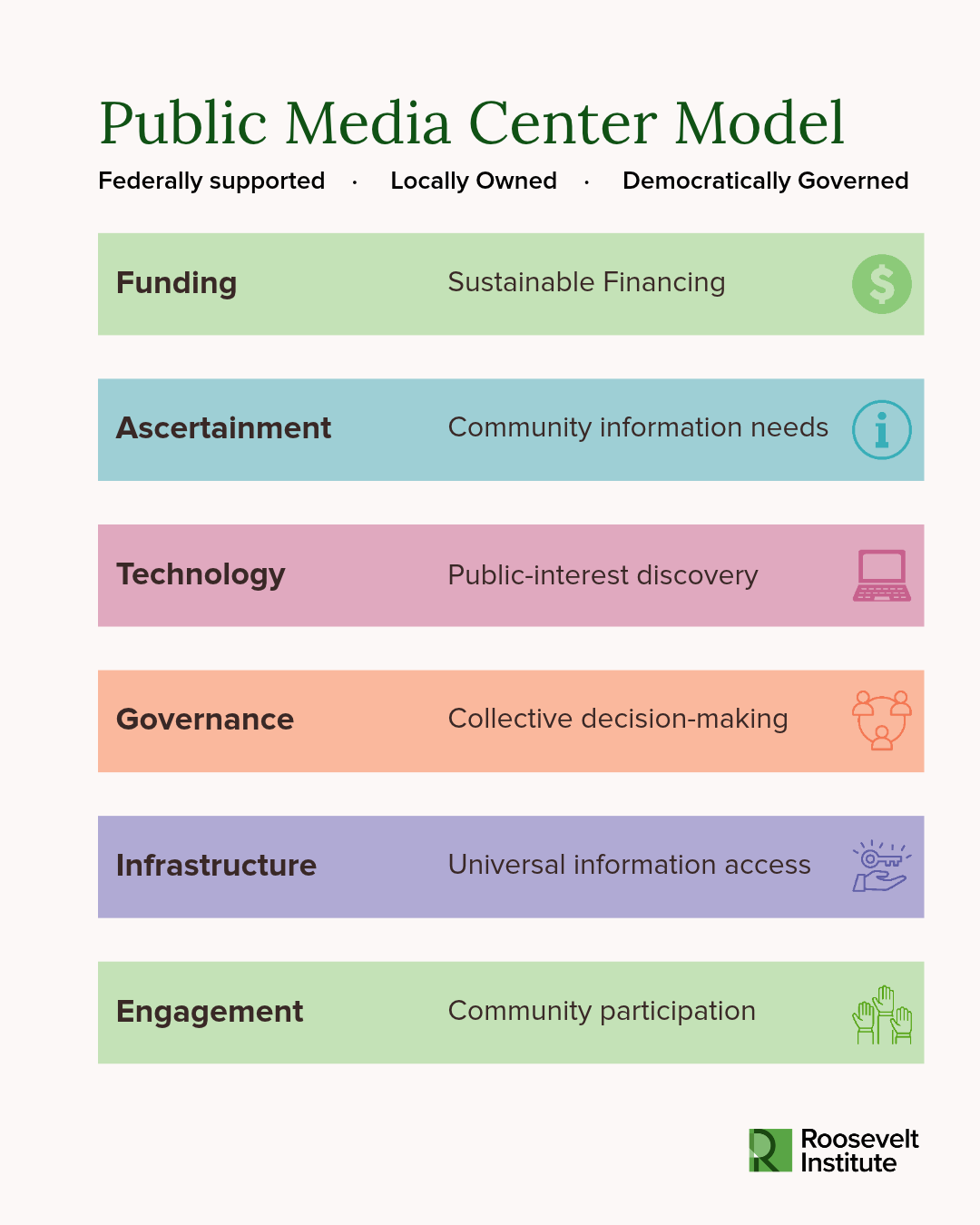
A potential model that ties together and reflects these principles and normative commitments is what I conceptualize as a Public Media Center (PMC). The basic PMC concept is straightforward: Every US county would have access to a population-proportionate PMC, defined as multimedia hubs that are federally guaranteed but locally owned and democratically governed.48 Although federal administrators would distribute resources via consortia at the federal, state, and regional levels, key governance decisions would be made by local representative media bureaus. Again, members of these institutions could be voted in during periodic elections for term-limited tenures, or composed of citizen juries that are randomly selected via a lottery system.
Housed in already-existing public spaces such as post offices, libraries, public access media outlets, universities, and public broadcasting stations, PMCs would provide a wide range of local media, including digital, broadcasting, traditional print, and community broadband services.49 We can conceptualize PMCs as comprising six discrete layers, each of which must be democratized: The funding layer determines how this system can be financially sustained; the governance layer ensures resource allocations and other key decisions are made collectively; the ascertainment layer assesses a community’s critical information needs; the infrastructure layer focuses on the material needs (including universal broadband service) for guaranteeing reliable access to information; the technological layer privileges public media in search and news feeds; and the engagement layer empowers local communities in making their own news and telling their own stories. These layers can be seen as part of a broader “public media stack.”50
Parts of the PMC model have roots in real-world experiments in innovative public media. The Urbana-Champaign Independent Media Center in Urbana, Illinois, for example, has run a model similar to a PMC for more than 20 years. In 2005, local media activists raised funds to purchase Urbana’s historic downtown post office building. Over the years, citizen journalists have gathered there to produce a wide range of media, including a newspaper, low-power radio broadcasting, community wireless services, and a local news website. A vibrant space for community activists and artistic programs, the center also houses an art gallery, a performance venue, a makerspace, public access computers, and a library.51 We could imagine PMCs fulfilling similar needs across the country.
Similarly, “community media centers” such as those operating on Public, Educational, and Governmental (PEG) access cable channels might serve as useful institutional exemplars. PEG cable channels have long served as public carve-outs within commercial television systems, often secured through local cable franchise agreements. Many of these stations have evolved into full-fledged community media centers.52 For example, PhillyCam based in Philadelphia exemplifies a community media center that was initially based on public access television infrastructure but has since evolved into a more expansive participatory media institution and space that provides production facilities, journalistic training, and community programming.53
Another complementary approach is a model first proposed by the late media scholar Robert McChesney, known as the Local Journalism Initiative (LJI), which enables people to vote on allocating funds to local news organizations of their choice via the US postal system, thereby guaranteeing competition between multiple newsrooms in every county.54 Even as new federal programs for publicly supporting local journalism are nonstarters for the immediate future, we can continue incubating alternative models at the state and local levels to establish proofs of concept that can eventually be scaled up nationally and globally. For example, two recent initiatives under consideration have been inspired by the LJI scheme, one in Seattle and one in Washington, DC; both are based on media voucher-type plans to fund local news.55
Despite the necessary emphasis on the supply side of media production, we should not assume that if we build a better media system, everyone will come. Nor should we, however, simply “meet audiences where they are”—a common mantra among well-meaning practitioners. Structural interventions can help cultivate the demand side by ensuring that communities are directly engaged in the entire process of building out PMCs. This kind of project can benefit from having political organizers in the field, which was a key part of the media reform group Free Press’s community organizing work toward establishing the New Jersey Civic Info Consortium, a program for subsidizing local media initiatives.56 This campaign relied on a combination of community-driven media projects with broad coalition-building and policy organizing. For several years prior to legislative success, organizers worked with communities to develop an understanding of what they wanted from local journalism and to cultivate an engaged constituency around supporting local media through policy interventions and public investments.57
The participatory aspect of PMCs’ design can help instill trust and community engagement. As noted earlier, a growing body of research suggests that when communities are encouraged to engage with their local media, they feel invested in those institutions, rely on them, and trust them. Relatedly, we should not overprescribe PMCs’ exact contours, but instead leave considerable room for local determination. These institutions must be perceived as a bottom-up endeavor, as opposed to a top-down formula passed down from distant policymakers onto presumably passive media consumers with little say in what their PMC should look like. Rather, people would likely feel more committed to public policies that they participated in formulating and advocating. Doing so also helps fortify policies against future attacks and backlashes. Most importantly, PMCs should look like the communities they serve, be in constant dialogue with local residents, and always go to where the silences are.
An emphasis on the local makes sense given that is where the needs are most acute and where there is rare bipartisan consensus regarding social value. Given how its diffuse network-based model provides a set of natural checks and balances, the system maintains structural resilience against potential for government capture. Such a structure does not have a centralized governing body that can editorially dictate news coverage across the entire network. Moreover, affording local communities considerable sway over what a particular PMC might look like encourages a degree of variability and pluralism within the network. A first step might be to test out a series of pilot institutions—perhaps establishing 10 PMCs—in a diverse range of community settings. Rigorous experimentation must be a key part of the process.
Conclusion: The Road Ahead
This brief summarizes the normative arguments necessary in the years ahead to establish the public media system that our democracy requires. The long-standing systemic problems afflicting our information and communication infrastructures—including media and tech oligarchy, exclusion from high-quality news and information, and the local journalism crisis—all stem directly from or are exacerbated by market failures and run-amok capitalist logics. Only a public media system, if properly designed, can avoid such predictable hazards.
In response to profound market failures, public media can serve as a ready-made infrastructure to provide local information and communication services, a potential function that has long been underutilized.58 With politically insulated financial support, public media outlets could ensure that dedicated journalists report on vitally important local issues that have long been abandoned in the wake of a contracting newspaper industry, including coverage of school boards, city halls, and statehouses. Public media institutions could also raise awareness of systemic problems and the necessary policy interventions to confront them. For example, they could support beat reporters dedicated to investigating how the climate crisis affects local communities, how tax policy perpetuates economic inequality, or how state and federal policies affect the quality of public schools.
Now may be a particularly opportune moment to push for structural alternatives to a failing commercial media system. We might be entering one of those rare historical periods when it is possible to fundamentally restructure our information and media systems. Therefore, it is paramount for pro-democracy advocates to push for an affirmative vision that directly confronts local journalism’s ongoing collapse and the abject failures of commercial media. A revitalized and reconstructed public media system should be rooted in the normative foundation that democracy requires journalists whose job it is to gather new information and report the news—we might think of them as “democracy workers” who provide an essential public service.
Ultimately, any project for revitalizing American democracy requires an information ecosystem with a fully funded and independent public media system at its core. Such structural media reform is not a silver bullet for all the wicked social problems facing us today, but these challenges are insurmountable without viable information and communication systems. Supporting such essential infrastructure must be a priority for those of us working toward a democratic future in the United States.
Footnotes
- For an in-depth analysis that historicizes these market failures see: Bilal Baydoun, Shahrzad Shams, and Victor Pickard, The Political Economy of the US Media System: Excavating the Roots of the Present Crisis (Roosevelt Institute, 2025), https://rooseveltinstitute.org/publications/political-economy-of-us-media-system. ↩︎
- Zach Metzger et al., The State of Local News 2025: Two Decades of Data, Deserts and Dynamic Change (Medill Local News Initiative at Northwestern University, 2025), https://localnewsinitiative.northwestern.edu/projects/state-of-local-news/2025; Zach Metzger et al., The State of Local News 2026: Growing Deserts, Urgent Challenges, and Promising Support (Medill Local News Initiative at Northwestern University, 2026), https://localnewsinitiative.northwestern.edu/projects/state-of-local-news/2026. ↩︎
- Matthew Baker and Matthew Albasi, Local Journalist Index 2026 (Muck Rack and Rebuild Local News, 2026), https://rebuildlocalnews.org/local-journalist-index. ↩︎
- This analysis draws from and further develops previous writings. See, for example: Victor Pickard, Democracy Without Journalism? Confronting the Misinformation Society (Oxford University Press, 2020), especially chapter 5 and the conclusion. Parts of this analysis expand on an earlier brief for the Knight First Amendment Institute: Victor Pickard, “Reimagining and Reconstructing U.S. Public Media,” Knight First Amendment Institute at Columbia University, May 19, 2026, https://knightcolumbia.org/blog/reimagining-and-reconstructing-us-public-media. See also: Victor Pickard, “We Must Save Public Media to Change It,” The Nation, April 15, 2025, https://thenation.com/article/society/public-broadcasting-media-democracy. ↩︎
- For an overview of this research, see: Timothy Neff and Victor Pickard, “Funding Democracy: Measuring Correlations Between Public Media and Democratic Health in 33 Countries,” International Journal of Press/Politics 29, no. 3 (2021), 601–627, https://doi.org/10.1177/19401612211060255. ↩︎
- Robert Picard and Victor Pickard, Essential Principles for Contemporary Media and
Communications Policymaking (Reuters Institute for the Study of Journalism, 2017), http://doi.org/10.60625/risj-kfr4-2t29. ↩︎ - Historically, this provision has been insufficient in the US in serving communities of color, at least in part due to its unusual funding model with a reliance on donors and higher socioeconomic audiences. ↩︎
- Victor Pickard, “From the Ashes: Imagining a Post-Commercial Future for Media,” Political Economy of Communication 9, no. 1 (2021): 79–83. See also: Victor Pickard, “Eroding the Market’s Hidden Hand: Toward a Post-Capitalist Media System,” Communication, Culture and Critique 18, no. 4 (2025): 282–5, https://doi.org/10.1093/ccc/tcaf045. ↩︎
- Sitara Nieves, “Public Media’s Make-or-Break Moment,” Poynter, September 16, 2025, https://poynter.org/local-news/2025/public-medias-make-or-break-moment-cpb-trump-defunding. ↩︎
- Benjamin Mullin and Jeremy W. Peters, “Inside the Crisis at NPR,” New York Times, updated April 25, 2024, https://nytimes.com/2024/04/24/business/media/npr-uri-berliner-diversity.html. ↩︎
- Much of the following is synthesized in Neff and Pickard, “Funding Democracy.” ↩︎
- Economist Intelligence Unit, Democracy Index 2024, updated March 5, 2025, https://ourworldindata.org/grapher/democracy-index-eiu. ↩︎
- Kees Aarts and Holli Semetko, “The Divided Electorate: Media Use and Political Involvement,” Journal of Politics 65, no. 3 (2003): 759–84, https://doi.org/10.1111/1468-2508.00211; Erik Albæk, Arjen van Dalen, Nael Jebril et al., Political Journalism in Comparative Perspective (Cambridge University Press, 2014); Frank Esser et al., “Political Information Opportunities in Europe: A Longitudinal and Comparative Study of Thirteen Television Systems,” International Journal of Press/Politics 17, no. 3 (2012): 247–74, https://doi.org/10.1177/1940161212442956; Stuart Soroka et al., “Auntie Knows Best? Public Broadcasters and Current Affairs Knowledge,” British Journal of Political Science 43, no. 4 (2013): 719–39, https://doi.org/10.1017/S0007123412000555. ↩︎
- Toril Aalberg and James Curran, How Media Inform Democracy (Routledge, 2012); James Curran, Shanto Iyengar, Anker Brink Lund, et al., “Media System, Public Knowledge and Democracy,” European Journal of Communication 24, no. 1 (2009): 5–26, https://doi.org/10.1177/026732310809894; Stephen Cushion, The Democratic Value of News (Palgrave Macmillan, 2012); Claes H. de Vreese, Susan A. Banducci, Holli A. Semetko, et al., “The News Coverage of the 2004 European Parliamentary Election Campaign in 25 Countries,” European Union Politics 7, no. 4 (2006): 477–504, https://doi.org/10.1177/146511650606944; Christina Holtz-Bacha, “The Kiss of Death. Public Service Media Under Right-Wing Populist Attack,” European Journal of Communication 36, no. 3 (2021): 221–37, https://doi.org/10.1177/0267323121991334; Shanto Iyengar et al., “Cross-National Versus Individual-Level Differences in Political Information: A Media Systems Perspective,” Public Opinion and Parties 20, no. 3 (2010): 291–309, https://doi.org/10.1080/17457289.2010.490707. ↩︎
- Annika Sehl, “Public Service Media as Pivotal in Combating Misinformation and Disinformation: Prerequisites and Approaches,” European Journal of Communication 39, no. 6 (2024): 582–94, https://doi.org/10.1177/02673231241294. ↩︎
- Laura Jacobs, Cecil Meeusen, and Leen d’Haenens, “News Coverage and Attitudes on
Immigration: Public and Commercial Television News Compared,” European Journal of
Communication 31, no. 6 (2016): 642–60, https://doi.org/10.1177/0267323116669456. ↩︎ - For in-depth comparative analysis that assesses how different media organizational logics correlate with different kinds of media output and democratic function, see: Rodney Benson, Mattias Hessérus, Timothy Neff, et al., How Media Ownership Matters (Oxford University Press, 2025). ↩︎
- For articulations of this necessary centrality, see work by James Curran, especially: James Curran, Media and Power (Routledge, 2002). ↩︎
- Christopher Ali, “The Merits of Merit Goods: Local Journalism and Public Policy in a Time of Austerity,” Journal of Information Policy 6 (2016): 105–28, https://doi.org/10.5325/jinfopoli.6.2016.0105. ↩︎
- Victor Pickard, Legal Foundations for Non-Reformist Media Reforms: A Positive-Rights Paradigm for Guaranteeing a Universal Press System (Knight First Amendment Institute at Columbia University, 2024), https://knightcolumbia.org/content/legal-foundations-for-non-reformist-media-reforms. ↩︎
- PBS Publicity, “PBS and Member Stations Are Named #1 in Public Trust and an ‘Excellent’ Use of Tax Dollars for Ninth Consecutive Year,” PBS, updated August 17, 2020, https://pbs.org/about/about-pbs/blogs/news/pbs-and-member-stations-are-named-1-in-public-trust-and-an-excellent-use-of-tax-dollars-for-ninth-consecutive-year; Christopher Ali, Hilde Van den Bulck, and Bo Lee, “PBS Could Help Rebuild Trust in US Media,” Columbia Journalism Review, March 9, 2021, https://cjr.org/tow_center/pbs-could-help-rebuild-trust-in-us-media.php. ↩︎
- Michael Lipka and Katerina Eva Matsa, “Americans More Likely to Support than Oppose Continuing Federal Funding for NPR and PBS,” Pew Research Center, March 26, 2025, https://pewresearch.org/short-reads/2025/03/26/americans-more-likely-to-support-than-oppose-continuing-federal-funding-for-npr-and-pbs. ↩︎
- For an overview of “pink slime journalism,” see: Scott A. Leadingham, “Pink Slime Journalism: Separating Ethical News From Propaganda,” Freedom Forum, April 2, 2024, https://freedomforum.org/pink-slime-journalism. ↩︎
- Rodney Benson, “Public Funding and Journalistic Independence: What Does Research Tell Us?,” in Will the Last Reporter Please Turn Out the Lights, ed. Robert McChesney and Victor Pickard (New Press, 2011), 314–9; Rodney Benson, Matthew Powers, and Timothy Neff, “Public Media Autonomy and Accountability: Best and Worst Policy Practices in 12 Leading Democracies,” International Journal of Communication 11 (2017): 1–22, https://ijoc.org/index.php/ijoc/article/view/4779; Daniel Hallin and Paolo Mancini, Comparing Media Systems: Three Models of Media and Politics (Cambridge University Press, 2004). ↩︎
- See, for example: Trine Syvertsen, Enli Gunn, Ole J. Mjøs, et al., The Media Welfare State: Nordic Media in the Digital Era (University of Michigan Press, 2014). ↩︎
- See, for example: Trine Syvertsen, Enli Gunn, Ole J. Mjøs, et al., The Media Welfare State: Nordic Media in the Digital Era (University of Michigan Press, 2014). ↩︎
- For the authoritative history of this period, see: Robert McChesney, Telecommunications, Mass Media, and Democracy (Oxford University Press, 1993). ↩︎
- Victor Pickard, America’s Battle for Media Democracy: The Triumph of Corporate Libertarianism and the Future of Media Reform (Cambridge University Press, 2015); Elizabeth Fones-Wolf, Waves of Opposition Labor and the Struggle for Democratic Radio (University of Illinois Press, 2006). ↩︎
- Victor Pickard, “The Strange Life and Death of the Fairness Doctrine: Tracing the Decline of Positive Freedoms in American Policy Discourse,” International Journal of Communication 12 (2018): 3434–53, https://ijoc.org/index.php/ijoc/article/view/5787. ↩︎
- Allison Perlman, Public Interests: Media Advocacy and Struggles over U.S. Television (Rutgers University Press, 2016). ↩︎
- Josh Shepperd, Shadow of the New Deal: The Victory of Public Broadcasting (University of Illinois Press, 2023). See also: Victor Pickard, “A Social Democratic Vision of Media: Toward a Radical Pre-history of Public Broadcasting,” Journal of Radio and Audio Media 24, no. 2 (2017): 200–12, https://doi.org/10.1080/19376529.2017.1362853. ↩︎
- 47 U.S. Code § 396 – Corporation for Public Broadcasting, https://law.cornell.edu/uscode/text/47/396. ↩︎
- Ralph Engelman, Public Radio and Television in America: A Political History (Sage Publications, 1996); Robert K. Avery, “The Public Broadcasting Act of 1967: Radio’s Real Second Chance,” Journal of Radio & Audio Media 24, no. 2 (2017): 189–99, https://doi.org/10.1080/19376529.2017.1362851; James Day, The Vanishing Vision: The Inside Story of Public Television (University of California Press, 1995). ↩︎
- Future Roosevelt Institute work will look more closely at public media systems through an international comparative lens. ↩︎
- Carnegie Commission on Educational Television, “Public Television: A Program for Action,” Current, January 26, 1967, https://current.org/1967/01/carnegie-i. ↩︎
- Eli Noam, Public Television in America (Brookings Institution Press, 1999). ↩︎
- Timothy Neff and Victor Pickard, Raising the Bar for Journalism (Media, Inequality & Change Center, n.d.), https://asc.upenn.edu/sites/default/files/2021-06/MIC_Infographic_Authors.pdf. ↩︎
- Darian Woods, Adrian Ma, Julia Ritchey, et al., “A Brief History of NPR Funding,” NPR, May 13, 2025, https://npr.org/2025/05/13/1250902337/npr-cpb-public-radio-funding-101; see also: “Public Radio Finances,” NPR, accessed October 28, 2026, https://npr.org/about-npr/178660742/public-radio-finances. ↩︎
- Benjamin Mullin, “Cutting Off NPR and PBS,” New York Times, April 1, 2025, https://nytimes.com/2025/04/01/briefing/public-broadcasters-republicans-npr-pbs.html. ↩︎
- Brooke Gladstone and Micah Loewinger, “Public Broadcasting Is In Danger (Again),” On the Media (podcast), WNYC, January 10, 2025, https://wnycstudios.org/podcasts/otm/articles/public-broadcasting-is-in-danger-again. ↩︎
- Victor Pickard, “The American Media Polycrisis: Cascading Layers of Capture,” LPE Project, February 17, 2026, https://lpeproject.org/blog/the-american-media-polycrisis-cascading-layers-of-capture. ↩︎
- An earlier articulation of these principles appeared in an essay for the Knight First Amendment Center essay: Pickard, “Reimagining and Reconstructing U.S. Public Media.” ↩︎
- Pickard, Democracy Without Journalism, 170; see also: Robert W. McChesney and John Nichols, The Death and Life of American Journalism: The Media Revolution That Will Begin the World Again (Nation Books, 2010), 206–8. ↩︎
- “New Jersey Civic Information Consortium,” accessed October 28, 2026, https://njcivicinfo.org. ↩︎
- Christopher Ali, Hilde Van den Bulck, and Jonathan Kropko, “An Island of Trust: Public Broadcasting in the United States,” Journal of Communication 75, no. 5 (2025): 371–84, https://doi.org/10.1093/joc/jqaf009. ↩︎
- Ryan LaRochelle, “Reassessing the History of the Community Action Program, 1963–1967,” Journal of Policy History 31, no. 1 (2019): 126–64, https://doi.org/10.1017/S0898030618000362. ↩︎
- See, for example: Andrea Wenzel, Community-Centered Journalism: Engaging People, Exploring Solutions, and Building Trust (University of Illinois Press, 2020); see also: Natalie Jomini Stroud and Emily Van Duyn, “Curbing the Decline of Local News by Building Relationships with the Audience,” Journal of Communication 73, no. 5 (2023): 452–62, https://doi.org/10.1093/joc/jqad018. ↩︎
- Earlier articulations of this model can be found in Victor Pickard, “The Local Rise of Public Media Centers,” NiemanLabs, December 10, 2021, https://niemanlab.org/2021/12/the-local-rise-of-public-media-centers; Victor Pickard, “Another Media System is Possible: Ripping Open the Overton Window from Platforms to Public Broadcasting,” Javnost: The Public 30, no.2 (2023): 284–97, https://doi.org/10.1080/13183222.2023.2201804. ↩︎
- For arguments such as these, see: Victor Pickard, “Instead of Killing the US Postal System, Let’s Expand It,” The Nation, May 7, 2020, https://thenation.com/article/society/usps-funding-local-media; Antoine Haywood and Victor Pickard, “Public Access Television Channels Are an Untapped Resource for Building Local Journalism,” NiemanLab, November 10, 2021, https://niemanlab.org/2021/11/public-access-television-channels-are-an-untapped-resource-for-building-local-journalism. ↩︎
- Sanjay Jolly and Ellen P. Goodman, A “Full Stack” Approach to Public Media in the United States(German Marshall Fund of the United States, 2021), https://gmfus.org/sites/default/files/Jolly%2520and%2520Goodman%2520-%2520public%2520media.pdf. ↩︎
- Pickard, “Instead of Killing”; Feven Merid, “The Promise of IndyMedia,” Columbia Journalism Review, November 22, 2024, https://cjr.org/business_of_news/local-news-indymedia-network-25-anniversary.php. ↩︎
- For general information about this model, see: “Alliance for Community Media,” accessed October 28, 2026, https://allcommunitymedia.org/ACM/ACM/Home.aspx. ↩︎
- Haywood and Pickard, “Public Access Television.” ↩︎
- Robert W. McChesney and John Nichols, “The Local Journalism Initiative: A Proposal to Protect and Extend Democracy,” Columbia Journalism Review, November 30, 2021, https://cjr.org/business_of_news/the-local-journalism-initiative.php. ↩︎
- For descriptions of these initiatives, see: “Save Seattle News,” accessed October 28, 2026, https://saveseattlenews.org; Mark Histed, Local News Dollars (Democracy Policy Network, 2026), https://democracypolicy.network/agenda/strong-people/strong-communities/local-news-dollars; B26-0314 – Local News Funding Act of 2025, https://lims.dccouncil.gov/Legislation/B26-0314?ref=51st.news. ↩︎
- For an in-depth case study of this campaign, see: Kevin Davis, Amy Kroin, and Mike Rispoli, New Jersey’s Civic Information Bill: The Story of the Campaign to Transform Local Media (Free Press, 2022), https://freepress.net/sites/default/files/2022-09/nj_civic_info_bill_case_study_september_2022.pdf. ↩︎
- Mike Rispoli, “New Jersey Journalism Project Offers Hope Amid Local-News Crisis,” Free Press, June 3, 2021, https://freepress.net/blog/new-jersey-journalism-project-offers-hope-amid-local-news-crisis. ↩︎
- Louisa Lincoln and Victor Pickard, “Reimagining American Public Media: A Key Infrastructure for Local Journalism,” Journalism: Theory, Practice and Criticism 26, no. 2 (2024): 269–87, https://doi.org/10.1177/14648849241248018. ↩︎
Acknowledgments
The author would like to thank Shahrzad Shams, Suzanne Kahn, Elizabeth Wilkins, and members of the 2026 Roosevelt writing retreat for their excellent feedback on this paper. Any errors, omissions, or other inaccuracies are the author’s alone.
Suggested Citation
Pickard, Victor. 2026. “Creating a New US Public Media System: Normative Arguments and Policy Options,” Roosevelt Institute, November 19.
RELATED RESOURCES
Author