
Curating Carolina’s Finest: The Case for a Statewide Guaranteed Income Program in North Carolina
July 21, 2026
By Olu Rouse
This publication is part of the 2026 Roosevelt Network Undergraduate Emerging Fellowship Journal.
Introduction
Guaranteed Income (GI) and Universal Basic Income (UBI) programs provide citizens with basic financial packages that can be used toward expenses of their choosing. UBI is paid out to all individuals within a society unconditionally, while GI is paid out to a targeted population (Lewis and Noguchi 2025). Case studies from around the world show that basic income leads to lower inequality, poverty, infant mortality rates, healthcare costs, and crime rates, as well as better education outcomes and even increased economic growth (Bregman 2014).
With the freedom to choose how to utilize this income, people might use these financial packages to pay for sudden car maintenance fees, unexpected medical costs, or even sudden rent increases. They might also use the income toward investing into home ownership, purchasing an annual membership to a local gym, or cooking a nutritious meal for family and friends that may have been too expensive otherwise. Ultimately, people are free to choose what they think the financial package is best spent on. The no-strings-attached structure of GI contrasts with current US social safety net programs such as Housing Choice Vouchers, the Supplemental Nutrition Assistance Program, and different tax credit programs, in that these programs are characterized by paternalistic attitudes that suggest the poor cannot be trusted with cash or in making own financial decisions (Balakrishnan, Lewis, and Nuñez 2020; Zwolinski 2015).
Beyond economic achievements, several frameworks of GI are also helping to advance racial justice. The poverty rate within the African American community is disproportionately higher than that of the white community (Census Data 2024). If GI programs continue to support those living below the poverty level, then they will also indirectly ease racial poverty disparities. Although the incarceration rate among all demographic groups is declining, the incarceration rate within the African American community is still higher than its white counterpart (Carson and Kluckow 2025). The disparate outcomes of poverty and incarceration are clearly not race-neutral, and these outcomes contribute to the perpetuation of the racial economic gaps all across the US. Thus, by investing money into communities suffering from poverty and mass incarceration, GI indirectly helps to alleviate disparate outcomes between racial minority groups and white people.
Additionally, GI actively changes the narrative around poverty and its disparate outcomes. First, GI emphasizes that poverty is not a choice (Bhattacharya 2019). By emphasizing this point, GI also rejects social safety net programs such as Temporary Assistance for Needy Families (TANF), which are not just paternalistic but are also racist and classist (Floyd et al. 2021). The history of programs like TANF emphasize the idea that only certain families and children who follow a specific moral standard are worthy of receiving economic support for their basic needs. Second, GI acknowledges that inequality and injustice do exist in American society. Lastly, GI rejects the rhetoric that individuals suffering from poverty, inequality, and injustice should be blamed for falling behind in a society in which they are not valued.
Evidence from GI programs implemented in recent years further highlights the positive impacts of this policy. Since 1982, Alaska’s GI program, the Alaska Permanent Fund Dividends (APFD), has alleviated extreme poverty and helped Alaskans to find employment opportunities (Bhattacharya 2019). The APFD is also unusual in that it is funded through the state’s profits from oil and natural gas. Similarly, the stimulus checks provided during the COVID-19 pandemic exemplified what a UBI could look like on a federal level. These two examples also show what GI could look like as a program that is fully funded through public dollars.
Public investments in GI are coupled with privately funded pilot programs. Namely, the Stockton, California SEED program found that its program encouraged recipients to find better employment, improved mental health outcomes among recipients, and decreased income volatility (Farooqui 2021). The program was wholly funded from private donations, but its success presents the case for GI to become a public investment (SEED n.d.). Another successful program in Flint, Michigan is Rx Kids, which provides a first-year fund to all families with newborn children (Shrivastava 2024). Flint’s program is funded through a combination of both public and private investments, which provides an example of how public funds can support economic opportunity through GI. In Jackson, Mississippi, the Magnolia Mother’s Trust, a privately funded GI program, provides funds to Black mothers in need. Across the US, municipal leaders are investing in GI programs to allow for more people to access opportunities for stability, mobility, and true economic freedom.
| Nationwide Guaranteed Income Programs | Nationwide Guaranteed Income Programs | Funding Method | Level of Government |
|---|---|---|---|
| Stockton Economic Empowerment Demonstration | People Below the Median Income Threshold | Private | Local |
| Rx Kids | Families of Newborn Children | Public & Private | Local |
| Magnolia Mother’s Trust | Black Mothers | Private | Local |
| Alaska Permanent Fund Dividends | Universal | Public | State |
| COVID-19 Federal Stimulus Checks | Universal | Public | Federal |
Historical NC Guaranteed Income Programs
North Carolina does have a precedent for GI programs. In 1997, the Eastern Band of Cherokee Indians (EBCI) created a UBI that gives members of the tribe between $4,000 and $6,000 a year from casino revenue on tribal land. Research has found that the GI implemented by the EBCI is linked to increased lifespan, decreased family stress, and an overall increase in well-being (Singh et al. 2020; Covert 2020). Since the implementation of this program, new GI programs have begun in other states. For example, after the success of the Stockton, California SEED program, Mayor Michael D. Tubbs founded Mayors for a Guaranteed Income (MGI) in June 2020, and in February 2023 Counties for a Guaranteed Income (CGI) formed as MGI’s sister organization. These organizations are committed to mobilizing and building coalitions of municipal leaders around the future of GI. Currently there are eight NC mayors in MGI from Hillsborough, Carrboro, Durham, Ahoskie, and Kinston, and four NC county commissioners in CGI from Buncombe, Durham, and Mecklenburg.
Durham is leading the GI movement in NC with the Excel program. In March 2022, Durham began the program by providing $600 monthly to formerly incarcerated individuals who were also living below the poverty level. Due to the demographics of formerly incarcerated individuals, 85 percent of individuals who received GI payments were Black. Compared to a control group of eligible recipients who did not receive the monthly $600 assistance, the recipients had improved outcomes including food security, employment, savings, health, the ability to cover a $400 unexpected expense, and the ability to extend help to family members (Couloute et al. 2025). GI gives people who have historically been relegated to second-class citizenship a second chance at achieving economic security and opportunity. It also gives people disposable income to spend on building community and extending help to family members. Through the analysis completed by the Center for Guaranteed Income Research, the potential for GI and UBI in NC as a policy to expand opportunity, well-being, and equity is clear.
The development of the Excel program acted as a catalyst for the development of GI in NC. Afterward, the mayors and county commissioners who were members of MGI and CGI expressed interest and support for developing GI programs within their own municipalities and at the federal level. Durham then began the development of a second GI program within the municipality called DCo Thrives, allocating $1.69 million in American Rescue Plan Act funds and grants from MGI to the program, which provides $750 a month to 125 randomly selected individuals who have a child and whose income is below 30 percent of the area’s median income (Emancipate NC n.d.). The city of Raleigh subsequently launched its Bringing Neighbors Home program to support its unhoused population early in 2025 with 45 families receiving $1,450 monthly for a 24-month period (Johnson 2025). Although not explicitly labeled as a GI program, Raleigh’s program follows a similar structure of providing no-strings-attached cash payments directly to families. Most recently, several Democratic NC senators filed Senate Bill 583: the Lead. Invest. Families/Foster Teen (LIFT) Act, which would provide $1,000 per month GI for unhoused high school seniors, expectant mothers, natural disaster survivors, and young adults recently exiting foster care (General Assembly 2025). The movement for GI within NC is strong, and the expansion of these programs already has support from community organizations and elected officials across the state such as the NC Budget and Tax Center and the sponsors of the LIFT Act.
| Recent NC Guaranteed Income Program Proposals | Target of Program | Funding Method | Level of Government |
|---|---|---|---|
| Excel Program | Formerly Incarcerated People | Public & Private | Local |
| DCo Thrives | Low-Income Families | Public & Private | Local |
| Bringing Neighbors Home | Unhoused People | Public | Local |
| LIFT Act | Expectant Mothers, Foster Care Exiters, Unhoused Seniors in HS, FEMA Recipients | Public | State |
A state-level GI program may be preferable to local-level GI because of county migration and the progressive potential of the state tax structure. When a municipality implements a public support program, there is potential for individuals and families from neighboring municipalities to migrate over, seeking out this new public support. This migration could lead to increased costs for the initial county’s public support program, making it unsustainable. Additionally, local tax structures in NC are primarily funded through sales and property taxes, which are often more regressive in nature (ITEP 2024). These regressive tax structures put a greater tax burden on the shares of low-income families and families of color. State tax structures such as the personal and corporate income taxes are not only more progressive, targeting the individuals with the most economic advantage, but they can also raise the required revenue for a GI program more effectively. Thus, a statewide GI would be more equitable and universal than local programs.
Pushback Against Guaranteed Income Programs
Although the GI movement has gained momentum in the past decade, some states and conservative interest groups are in stark opposition to these programs. These groups often argue that GI is racially discriminatory against white people and unconstitutional citing Students for Fair Admissions, Inc. v. President and Fellows of Harvard College,which set the precedent that race-conscious programs aimed at alleviating racial inequalities violate the Equal Protection Clause of the 14th Amendment. Specifically, the Foundation for Government Accountability began lobbying for the ban of these GI programs across the nation in 2023 (Shrivastava 2024). Several states gave into these mobilization efforts and banned GI programs in their states, including Arkansas, Iowa, South Dakota, and Idaho. A greater number of states filed bills that would ban these programs, such as Arizona, Illinois, Mississippi, West Virginia, Texas, and Wisconsin. The states that oppose GI programs are often Republican Party–controlled, or are swing states. The actions of these states attacking GI programs communicates the harmful idea that governments should not “waste” money on programs such as GI, or that GI programs would be giving away free money to “undeserving” citizens. The people who are labeled as “undeserving” are majority low-income, Black, and Brown populations, showing that this message in support of anti-GI legislation is both classist and racist. Pushing forward narratives that are based in white nationalism, principles of government austerity, and institutionalized discrimination prevent governments from doing all they can to serve all people.
In April 2025, when Representative Cody Honeycutt filed NC House Bill 859, the North Carolina General Assembly (NCGA) joined the bandwagon of conservative states trying to ban GI programs in an attempt to prevent NC municipalities from implementing GI programs within their local communities (Johnson 2025). In May 2025, the bill passed in the NC House with a 69-40 vote, with Aye votes from both sides of the aisle. Interestingly, Representative Honeycutt does not represent a district that is actively pursuing the implementation of any GI programs, leading some to question why he filed the bill in the first place. Beyond the fact that the NCGA is actively creating barriers to an inclusive economy, the filing of this bill brings up two concerns. First, it is plausible that third-party organizations and interest groups like the Foundation for Government Accountability could be lobbying for the bill’s passage. This is further supported by the similarity of HB 859 to other copycat anti-GI bills across different states. If this is the case, it brings up the concern of whose voice matters more to the NCGA: conservative interest groups lobbying on behalf of wealthy interests or the constituents, mayors, and community organizations that these legislators represent. Money and lobbying should not be able to buy political leverage leading to policies that disadvantage low-income, Black, and Brown people.
Second, this bill could imply that the NCGA is trying to stifle the autonomy of municipalities to govern their own communities the way they see fit, a common reality for many municipalities under the jurisdiction of conservative state policymakers (Tharpe 2023). The NCGA is no stranger to this kind of antidemocratic behavior. In 2023, a provision was passed into the 2023–24 state budget that limited the ability of local governments to regulate the use of plastics that are harmful to the environment (Atwater 2023). In late 2025, the Regulatory Reform Act stripped several counties home to UNC System schools of their jurisdiction over zoning and development regulations (Thomason 2025). The concern of state preemption of local policy through the anti-GI legislations represents an erosion of democratic institutions within the state of NC. All in all, the NCGA and elected officials are meant to serve the people’s best interests, and attacking the GI movement conflicts with that standard.
Texas is one state that is seeing lots of activity around GI programs pushbacks. UpTogether is a nonprofit organization that implemented a Texas GI program that gave $230 million to more than 210,000 Texans. Similarly to other GI programs, UpTogether’s GI program helped families to be more economically secure and live with greater well-being. Nonetheless, the Foundation for Government Accountability lobbied for SB 2010 in Texas’s state legislature, which would ban GI programs in the state. However, Texas’s story is one of victory (Economic Security Project 2025). Alongside the Economic Security Project and nonprofit organization Every Texan, UpTogether successfully advocated and organized against SB 2010, stopping the bill from becoming law.
Recommendations
The following sections provide two recommendations on how to further economic opportunity and justice in the state of NC. The first recommendation, an expansion of GI programs at a state level, spells out how NC can leverage GI programs to give people income they can use to provide for their basic needs. The second recommendation, reimplementing an inheritance tax in NC, demonstrates how NC can generate revenue in an equitable manner that redistributes wealth to those in need. Combined, these two recommendations create a policy plan that effectively provides more North Carolinians access to the good life.
Recommendation 1: Implement a Statewide Guaranteed Income Program
The General Assembly does not need to look far for an example of how to design a statewide GI program given that there are several contemporary examples within the state of NC. This brief analyzes four different designs that the General Assembly could use based on four existing NC programs: the Excel design, the Bring Neighbors Home design, the DCo Thrives design, and the LIFT Act design. The analysis includes a cost assessment of the program, and a distributional breakdown of how the different program designs will impact different racial groups. These impacts are quantified in terms of both an annual dollar amount and percentage of the 2024–25 NC Appropriated Budget.
Excel Design: Guaranteed Income for People Released from Incarceration Within the Past Five Years
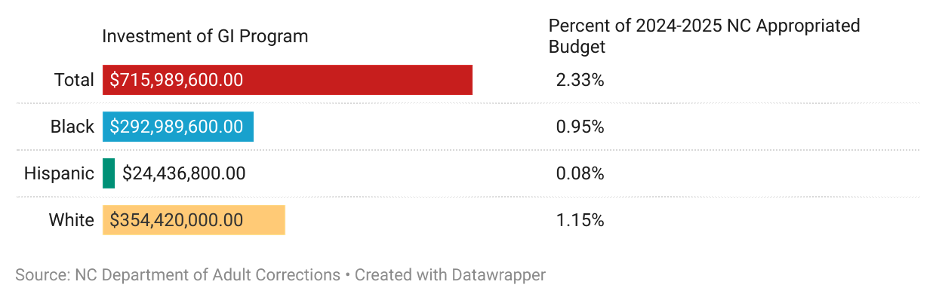
The first design follows the Excel Program implemented by the City of Durham. Expanding this program at the state level means that all North Carolinians who exited prison in the past five years would receive a $600-per-month GI package. This analysis only accounts for the cost of the packages per person and does not account for either the number of individuals who recidivate each year or the additional administrative costs of the program. However, it is also important to note the untapped potential of GI programs to reduce government costs through decreased recidivism rates. For example, the families of formerly incarcerated individuals struggle to pay for the fees and costs of reentry that are associated with the incarceration system. This GI package could help these families afford substance abuse treatment programs and stable housing, which have also proven to reduce recidivism rates (DeVuono-Powell et al. 2015). If GI programs are able to decrease recidivism rates, they would also significantly decrease the costs of incarceration to the state of NC. This is exemplified by prior programs that successfully decreased recidivism rates and therefore the future costs of incarceration to the public by effectively reintegrating the formerly incarcerated into society (Redcross et al. 2012).
In fiscal year 2024, the daily costs associated with an incarcerated individual were $148.67, and the average population of incarcerated individuals in the state of NC was 30,596. Accounting for 365 days in a year, the total annual cost of the entire population of incarcerated individuals is more than $1.6 billion (North Carolina Department of Adult Corrections n.d.). The $715 million cost of a GI program for incarcerated individuals is less than half this amount. A statewide GI program with the Excel program design could have the chance to pay for itself if it effectively decreases state incarceration costs by more than the costs of the program. Lastly, 41 percent of the investment of the Excel design GI program would benefit Black North Carolinians and their families, while the total share of NC’s Black population is only 20 percent (Census Reporter 2025). Thus, the Excel GI design functions as a reparative policy by effectively redistributing income to the Black community.
Bring Neighbors Home Design: Guaranteed Income for Unhoused People
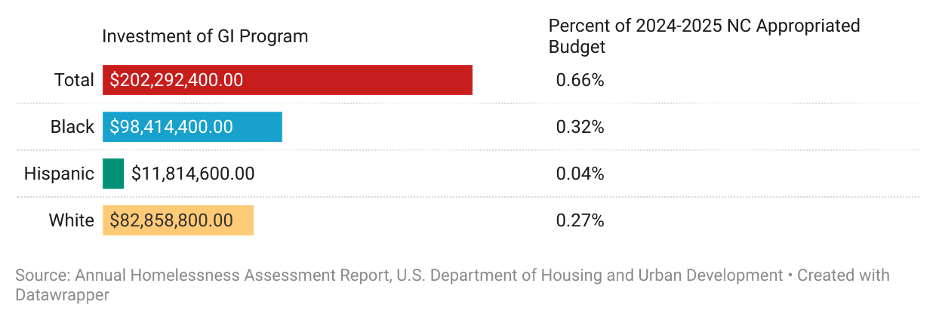
The second design follows the Bring Neighbors Home Program implemented by the City of Raleigh. Establishing this program at the state level means that all unhoused people in NC would receive a $1,450-per-month GI package. Following the implementation of the Bring Neighbors Home Program, the City of Raleigh released a report detailing the cost of homelessness to taxpayers, calculated at $35,000–$96,000 per unhoused individual per year (City of Raleigh 2025). In comparison, a GI package for unhoused individuals would cost $17,400—almost half the cost of homelessness. The Bring Neighbors Home GI design helps to address poverty, which is one of the causes of homelessness. Similar to reducing recidivism costs, if this program is able to decrease homelessness, then it could pay for itself by saving the public potential costs of managing homelessness. Also, similar to the Excel program, it is important to recognize that a GI package alone is not enough to address homelessness, and a holistic approach is necessary. Lastly, more than half of the investment of the Bring Neighbors Home contributes toward individuals and families in the Black community. The proportion of this investment further shows how GI programs contribute to racial justice outcomes.
LIFT Act Design: Guaranteed Income for Expectant Mothers & Foster Care Exiters
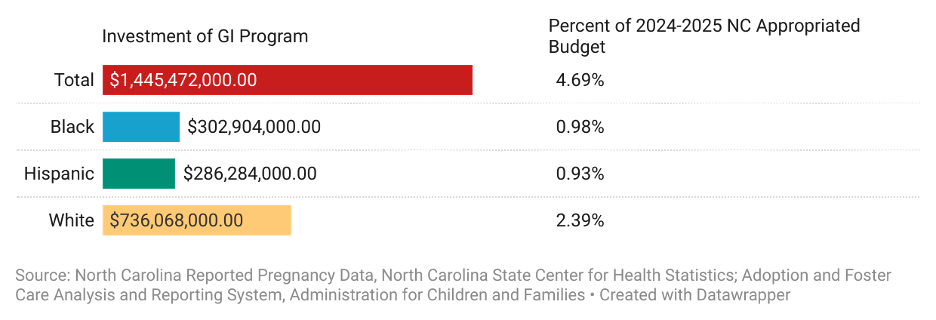
The third design takes after the proposed LIFT Act (SB 583), which proposed a $1,000 GI package for expectant mothers and foster care exiters. This is the most expensive model for GI thus far, but it still totals less than 5 percent of the 2024–25 state budget. This GI model provides 21 percent of the investment for individuals and families among the Black community, which is on par with the 20 percent proportion of NC’s population that identify as Black. Additionally, the LIFT Act design provides 20 percent of the investment for individuals and families among the Hispanic community, which is greater than the 11 percent proportion of NC’s population that identify as Hispanic. GI programs that target expectant mothers and children are shown to have positive results for their communities: For example, the Magnolia Mother’s Trust (MMT), a program that gives a GI to Black mothers, is currently taking in its sixth cohort with more than 500 mothers supported in total. This is one of the longest-lasting GI programs. Financially, qualitative research studies show that MMT helps mothers to afford their costs of living, further their education, access reliable transportation, and reduce overall stress. Holistically, MMT improved mental health, physical health, and the ability to assist family members (Campos et al. n.d.). The LIFT Act has the potential to replicate the impacts of the MMT on a statewide level, representing just one way that NC can holistically create a healthier community that has more access to the good life.
DCo Thrives Design: Guaranteed Income for People Below the Poverty Line
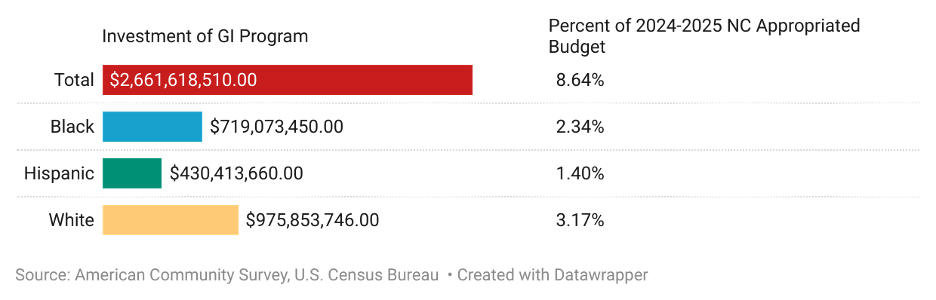
The fourth design is largely the most classic way to approach GI income by targeting low-income individuals. The DCo Thrives program, which proposed a $750 GI package for families below the poverty level, exemplifies what this program could look like in NC. It is also the most expensive design of the four. The costs of this program are likely underestimated given that this analysis does not account for a means-tested phase-out design that avoids a situation in which the GI program creates a welfare cliff. Nonetheless, 27 percent of this investment would funnel into the Black community and 16 percent into the Hispanic community, showing that addressing poverty is also a large way that NC can address racial justice in the state. Additionally, the challenges that formerly incarcerated individuals, unhoused individuals, expectant mothers, and former foster care young adults face are all shaped by poverty. Therefore, providing this financial package for those under the poverty line would provide greater opportunity at the good life to several marginalized communities.
Recommendation 2: Reimplement an Inheritance Tax in NC
The previous analysis shows that a GI is much more financially feasible than most may believe, but it is still important to uphold fiscally responsible decisions. Nonetheless, fiscal responsibility can emphasize equitable outcomes if designed correctly. For example, GI will lead to increases in the state budget, but these increases can be offset from revenue generated if inheritance taxes—taxes collected on the value of the portions of an estate that are transferred from the estate owner to the estate recipients—are established in NC. Inheritance taxes target the wealth of individuals, and there are inequities in how much wealth Black Americans and people of color own in comparison to white Americans. In 2018, more than 20 percent of both Black households and households of color in NC held no wealth, or their debts were greater than their wealth assets. On the other hand, only 11.8 percent of white households in NC held no wealth, or had debts greater than their wealth assets (Aurelien and Pienkosz 2019). Additionally, white families are twice as likely to receive an inheritance compared to Black families, and the size of the inheritance that white families receive is three times as much as that of Black families (Matsui, Menefee, and Royce 2022). An inheritance tax would further help redistribute wealth, since a greater proportion of white individuals own the wealth in NC.
NC also has a history of inheritance taxation. Before 2000, NC raised more than $10 million annually using an inheritance tax, which accounted for about 1.25 percent of the NC General Fund on average from fiscal year 1995–99 (“Estate Tax” 2025). In 2000, federal tax credits incentivized state-level estate taxes, and NC repealed its inheritance tax and implemented an estate tax. In 2010, the Bush administration tax cuts eliminated the federal tax credit, incentivizing state-level estate taxes, and NC repealed the state’s estate tax in 2013. However, over the next 10 years, NC individuals are expected to transfer an estimated $104 billion, and over the next 40 years an estimated $501 billion (Winchester and Opatz 2024). Harnessing these estimated wealth transfers, an inheritance tax can fund a significant portion of different guaranteed income models. Inheritance taxes would target racial wealth gaps by equitably collecting revenue and redistributing the funds collected to communities who need the investment most.
Conclusion
GI in the state of NC holds great promise to address poverty, racial injustice, and the challenges that marginalized North Carolinians face everyday. It gives greater opportunity to several different groups of North Carolinians who have been historically neglected, and it does so in a way that delivers feasible promise. The most expensive GI design of this study would cost less than 10 percent of the 2024–25 state budget. Furthermore, the benefits of a GI program could offset its cost if the GI programs save the government costs in spending. There is also potential for net cost reductions if the program stimulates the economy and increases tax revenue (Nikiforos, Steinbaum, and Zezza 2017).
While GI is a necessary investment, it should not be the end of the expansion of economic opportunity. A GI for incarcerated individuals, unhoused people, and their families is just a small part of a suite of policies needed to fully address the challenges of these groups. Holistic approaches that combine more restorative justice practices, reparative policies, community-centered interventions, public health supports, and public investments in education are all key in the movement toward a truly inclusive economy.
The NC government could also offset the costs of a GI program through new revenue streams such as an inheritance tax or other forms of wealth taxation that effectively redistribute the tax burden away from marginalized communities. Beyond the revenue generated, inheritance taxation represents a push against wealthy interests. Through anti-GI legislation, third-party organizations, such as the Foundation of Government Accountability, try to advance government austerity measures that seek to give money back to the wealthy through decreased government spending. Wealth taxation through inheritance taxes is in direct opposition to this and sends a message that the state of NC is dedicated to making sure all people pay their fair share to uplift all North Carolinians through public investments.
References
Aurelien, Martine and AshLeigh Pienkosz. 2019. “Without Adequate Policy Changes, the Racial Wealth Gap May Never Allow for Prosperity for All.” North Carolina Budget & Tax Center, February 25. https://ncjustice.org/publications/without-adequate-policy-changes-the-racial-wealth-gap-may-never-allow-for-prosperity-for-all.
Atwater, Will. 2023. “State Budget Provision Stymies Local Plastic Reduction Efforts in North Carolina.” NC Health News, September 26. https://northcarolinahealthnews.org/2023/09/26/state-budget-provision-stymies-local-plastic-reduction-efforts-in-north-carolina.
Balakrishnan, Sidhya, Michael Lewis, and Stephen Nuñez. 2020. Reweaving the Safety Net: The Best Fit for Guaranteed Income. New York: Jain Family Institute. https://jainfamilyinstitute.org/wp-content/uploads/pdf/reweaving-the-safety-net-12.15.20.pdf.
Bhattacharya, J. 2019. “Exploring Basic Income through a Race and Gender Justice Lens.” Roosevelt Institute, June 19. https://rooseveltinstitute.org/publications/exploring-guaranteed-income-through-a-racial-and-gender-justice-lens.
Bregman, Rutger. 2014. “Why We Should Give Everyone a Basic Income,” TED Talk, October 2014, 16:46, TEDx Talks, YouTube, https://youtube.com/watch?v=aIL_Y9g7Tg0.
Campos, Stephanie, Jamela Clark, Hamzeh Daoud, Sashana Rowe-Harriott, Jabarey Wells, and Christyl Wilson Ebba. n.d. The Magnolia Mother’s Trust 2023-2024 Evaluation & Case Study Report: Planting The Seed for Holistic Prosperity. Jackson, MS: Springboard to Opportunities. https://springboardto.org/wp-content/uploads/2024/10/MMT-2023-2024-Eval-Case-Study-Report.pdf.
Carson, E. Ann, and Rich Kluckow. 2025. Prisoners in 2022 – Statistical Tables. US Department of Justice. https://bjs.ojp.gov/document/p22st.pdf.
Census Reporteer. n.d. “Quick Facts: NC.” Accessed June 12, 2026. http://censusreporter.org/profiles/04000US37-north-carolina.
City of Raleigh. 2025. “City of Raleigh’s Bringing Neighbors Home Pilot Program.” https://cityofraleigh0drupal.blob.core.usgovcloudapi.net/drupal-prod/COR19/UPDATED-HN-Unsheltered_Homelessness_Pilot_Program_One_Pager_v10.pdf.
Couloute, Lucius , Nidhi Tandon, Stacia West, Sydney Blocker, Henisha Patel, and Amy Castro. 2025. The American Guaranteed Income Studies: Durham, North Carolina. Philadelphia: Center for Guaranteed Income Research. https://guaranteedincome.us/images/durham-report.pdf.
Covert, Bryce. 2020. “Can $500 a Month Change Your Life?” The New Republic, March 11. https://newrepublic.com/article/156584/can-500-month-change-life.
Emancipate NC. n.d. “DCo Thrives.” https://emancipatenc.org/dco-thrives.
DeVuono-Powell, Saneta, Chris Schweidler, Alicia Walters, and Azadeh Zohrabi. 2015. Who Pays? The True Cost of Incarceration on Families. Oakland, CA: Ella Baker Center for Human Rights. https://ellabakercenter.org/wp-content/uploads/2022/09/Who-Pays-FINAL.pdf.
Economic Security Project. 2025. “Community Organizations Buck Big Money Lobbyists’ Attempt to Ban Guaranteed Income.” Press release, June 3. https://economicsecurityproject.org/news/texas-gi-victory-statement.
Farooqui, Sana. 2021. “The Case for Universal Basic Income as a Tool for Racial Justice.” Harvard Public Health Review, 30 (1). https://bcphr.org/30-article-farooqui.
Floyd, Ife, LaDonna Pavetti, Laura Meyer, Ali Safawi, Liz Schott, Evelyn Bellew, and Abigail Magnus. 2021. TANF Policies Reflect Racist Legacy of Cash Assistance. Washington, DC: Center on Budget and Policy Priorities. https://cbpp.org/research/income-security/tanf-policies-reflect-racist-legacy-of-cash-assistance.
General Assembly of North Carolina, Senate, Lead. Invest. Families/Foster Teen Act (LIFT), SB 583, 2025-2026 Senate, 2025 sess., introduced in Senate March 26, 2025, https://ncleg.gov/Sessions/2025/Bills/Senate/PDF/S583v1.pdf.
General Assembly of North Carolina, Senate, Local Govts/Guaranteed Income Programs, HB 859, 2025-2026 House, 2025 sess., introduced in House March 26, 2025, https://ncleg.gov/Sessions/2025/Bills/Senate/PDF/S583v1.pdf.
Institute on Taxation and Economic Policy (ITEP). n.d. “North Carolina: Who Pays? 7th Edition.” Washington, DC: ITEP. https://itep.org/north-carolina-who-pays-7th-edition.
Johnson, Kristen. 2025. “NC House Bill Targets Guaranteed-Income Programs for Poor Individuals, Families.” Raleigh News & Observer, updated May 5, 2025. https://newsobserver.com/news/local/article305344976.html.
Lewis, Michael A. and Eri Noguchi. 2025. “An Equal Playing Field: Why UBI Is Preferable to GI.” From Restoring Economic Democracy: Progressive Ideas for Stability and Prosperity. Roosevelt Institute: 46–48. https://rooseveltinstitute.org/publications/restoring-economic-democracy.
Matsui, Amy, Kathryn Menefee, and Amy Royce. 2022. Advancing Gender and Racial Equity By Taxing Wealth. Washington, DC: National Women’s Law Center. https://nwlc.org/wp-content/uploads/2022/04/NWLC-4.-Advancing-Gender-And-Racial-Equity-By-Taxing-Wealth.pdf.
Nikiforos, Michalis, Marshall Steinbaum, and Gennaro Zezza. 2017. Modeling the Macroeconomic Effects of a Universal Basic Income. New York: Roosevelt Institute. https://rooseveltinstitute.org/publications/macroeconomic-effects-universal-basic-income-ubi.
North Carolina Department of Adult Corrections. n.d. “Publications, Data and Research.” Accessed October 7, 2025. https://dac.nc.gov/information-and-services/publications-data-and-research.
North Carolina Department of Revenue. “Table 5. Estate Tax Collections.” Accessed October 7, 2025. https://ncdor.gov/documents/reports/table5-5/open.
North Carolina Department of Health and Human Science. “2015 – 2023 North Carolina Resident Births By Race/Ethnicity.” North Carolina Reported Pregnancy Data, accessed October 7, 2025. https://ncdor.gov/documents/reports/table5-5/open.
Redcross, Cindy, Megan Millenky, Timothy Rudd, and Valerie Levshin. 2012. More Than a Job: Final Results from the Evaluation of the Center for Employment Opportunities (CEO) Transitional Jobs Program. MDRC. https://mdrc.org/work/publications/more-job.
Shrivastava, Aditi. 2024. States Should Protect Guaranteed Income Initiatives and Other Unrestricted Cash Programs. Washington, DC: Center on Budget and Policy Priorities. https://cbpp.org/blog/states-should-protect-guaranteed-income-initiatives-and-other-unrestricted-cash-programs.
Singh, Parvati, Ryan Brown, William E Copeland, E J Costello, and Tim A Bruckner. “Income Dividends and Subjective Survival in a Cherokee Indian Cohort: A Quasi-Experiment.” Biodemography Soc Biol 65 (2), 2020: 172–87. doi:10.1080/19485565.2020.1730155.
Stockton Economic Empowerment Demonstration (SEED). n.d. “Our Vision for SEED: A Discussion Paper.” Stockton, CA: SEED. https://static1.squarespace.com/static/6039d612b17d055cac14070f/t/605029ab52a6b53e3dd38cf8/1615866284641/10+-+SEED+Discussion+Paper.pdf.
Tharpe, Wesley. 2023. Easing State Restraints on Local Taxing Power Can Strengthen Democracy, Promote Prosperity and Equity. Washington, DC: Center on Budget and Policy Priorities. https://cbpp.org/research/state-budget-and-tax/easing-state-restraints-on-local-taxing-power-can-strengthen.
Thomason, Kennedy. 2025. “New Law Exempts UNC System from Local Development Regulations.” Daily Tar Heel, October 5. https://dailytarheel.com/article/city-hb-926-regulatory-reform-20251006.
US Census Bureau. n.d. “Poverty Status in the Past 12 Months.” https://data.census.gov/table/ACSST1Y2023.S1701?q=+Poverty&g=040XX00US37.
US Department of Health and Human Services (HHS). n.d. “The AFCARS Dashboard.” Washington, DC: HHS. https://tableau-public.acf.gov/views/afcars_dashboard_main_page/mainpage?%3Aembed=y&%3AisGuestRedirectFromVizportal=y.
US Department of Housing and Urban Development (HUD). n.d. “North Carolina Homeless Populations and Subpopulations.” 2024 Annual Homelessness Assessment Report. Accessed October 7, 2025. https://files.hudexchange.info/reports/published/CoC_PopSub_State_NC_2024.pdf.
Winchester, Benjamin, and Aiden Opatz. 2024. Transfer of Wealth Opportunity State of North Carolina. Department of Community Development, University of Minnesota. https://assets.noviams.com/novi-file-uploads/ncng/2024-State-of-North-Carolina-TOW-Detailed-Report.pdf.
Zwolinski, Matt. 2015. “Our Welfare System Insults the Poor. Basic Income Could Do Better.” Washington Post, September 28. https://washingtonpost.com/news/in-theory/wp/2015/09/28/our-welfare-system-insults-the-poor-basic-income-could-do-better.
Acknowledgments
I would like to extend my sincere gratitude to the entire Roosevelt Institute and Network for the opportunity to be both a Forge and Emerging Fellow. I cannot name everyone, but Robert-Thomas, Eric, Jeanne, Elijah, Alex, Lina, and Katie, you have all been so kind and believed in my vision every step along my journey. Thank you. With this project, I also want to thank Stephen Nuñez, the NC Budget & Tax Center staff, and all my interviewees for your feedback and insight on my policy brief. Lastly, I want to give my acknowledgments to all my peers within each of my cohorts and all my fellow Roosevelters. You all inspire and fuel me to continue the fight for a progressive future. These experiences were more than just a network, you are all family, and I cannot wait to continue doing great work with all of you.
AUTHOR

Olu Rouse is a senior economics, political science, and mathematics student and a February One Scholar at the illustrious North Carolina Agricultural & Technical State University. His work centers on strengthening democratic participation and advancing economic justice through evidence-based fiscal policy. As an undergraduate research fellow in the Roosevelt Network, Olu completed research analyzing how reparation programs, North Carolina guaranteed income programs, and progressive tax policy shape racial and economic disparities.