

Fact Sheet: Who’s Minding the Kids These Days?
May 7, 2026
Policymakers, advocates, and journalists have had access to data on childcare prices for years, but nationally representative information on the care arrangements families actually use is sparse. The Census Bureau once regularly summarized this kind of childcare data in public-facing “Who’s Minding the Kids?” reports, but the most recent version relied on data collected in 2011.
Roosevelt’s new report by Sarah Jane Glynn, Who’s Minding the Kids These Days?, fills that gap. The report draws on family-level data from the Survey of Income and Program Participation (SIPP), a nationally representative Census Bureau survey that asks families detailed questions about income, work, family life, and childcare arrangements. Glynn’s analysis offers a rare national look at how families care for children, including care from grandparents, other relatives, formal programs, informal providers, and parents themselves.
Childcare Is Economic Infrastructure
For many parents, getting to work starts with knowing their children are cared for. Nearly one-third of US workers are parents with children at home. More than 12 percent of workers have a child under age six. These recent data show that 15.3 million children under age 5 and 18.5 million children ages 5 to 10 were in care arrangements while their parents worked or went to school. And how that care is distributed can vary widely:
- Family care sits at the center of this system. More than two-thirds of children under age five received care from a relative when a parent was working, in school, or otherwise unavailable. Nearly half received some form of nonrelative care, such as daycare or preschool. But school does not eliminate families’ need for care: Even among children ages 5 to 10, relative care remains common, especially outside school hours and during gaps in the school day or week.
- Within family care, grandparents play an especially large role. Nearly half of children under age five spent time in grandparent care while a parent was working, in school, or otherwise unavailable. The same was true for nearly 38 percent of children ages 5 to 10. For many families, grandparent care is the arrangement they want. For others, it may be the only arrangement that works when formal care is too expensive, too far away, or unavailable during the hours they need it.
- Formal care is still a big part of the story. More than three-quarters of children in nonrelative care attended a center-based program. But the data also show that one arrangement often does not cover all the hours families need. For instance, one in four children under age 5 and one in five children ages 5 to 10 were in more than one nonrelative care arrangement.
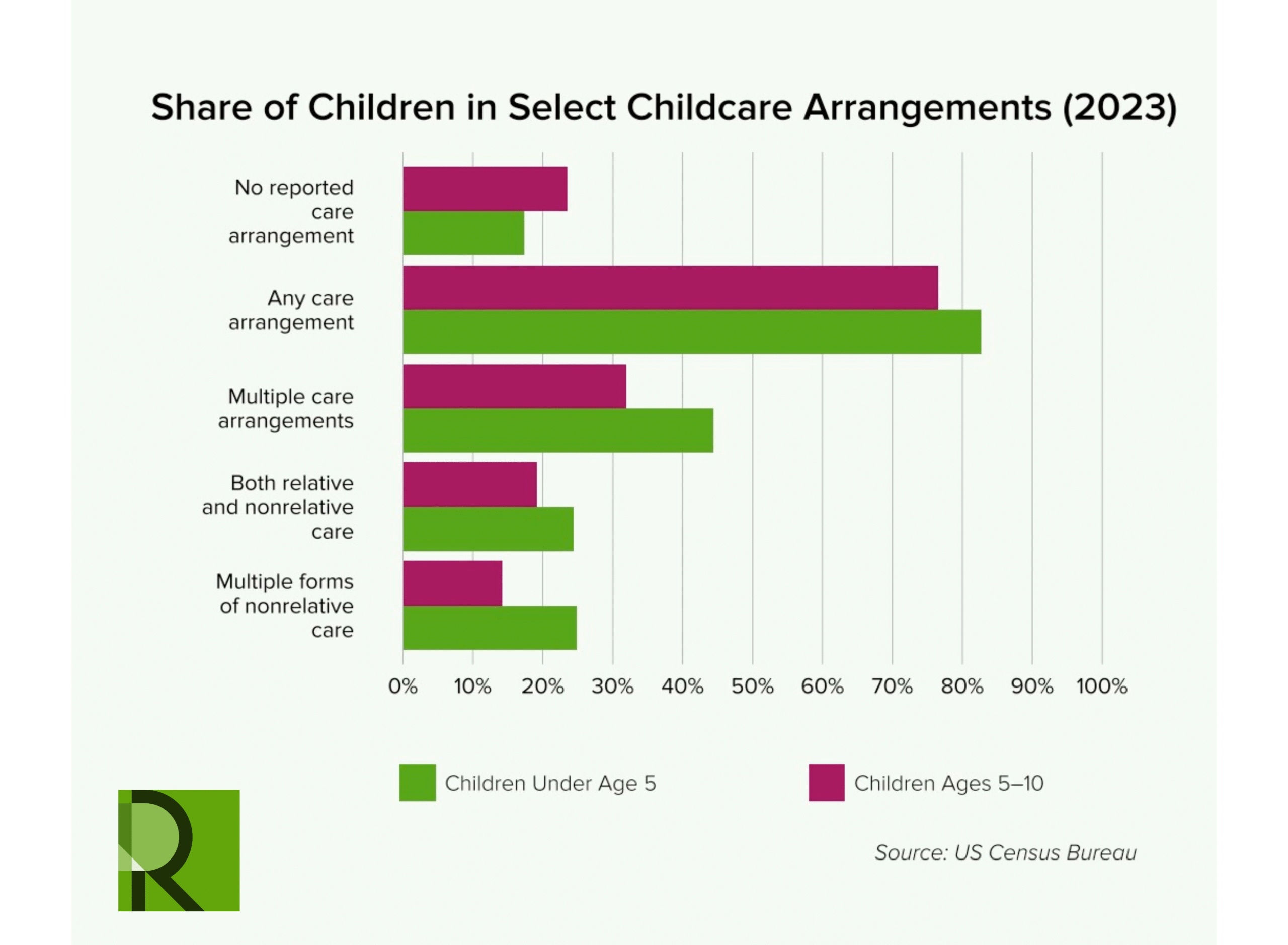
Put together: Families are assembling care from the options available to them. A week of care might include a grandparent, an after-school program, or a parent watching a child while trying to work. Some arrangements fit a family’s needs. Others reflect a more difficult reality of formal care that may be too expensive, too far away, or unavailable when parents need it.
Building a System Around Families’ Actual Care Needs
That is where Roosevelt’s broader research on childcare comes in.
In work developed with Community Change, Roosevelt has called for a universal public childcare system that is affordable for families, sustainable for providers, and supported by direct public funding. That system should also extend beyond early childhood to cover the predictable gaps that public schools leave for families to solve, including before- and after-school hours and summer care. And Roosevelt’s work on direct spending makes clear that these investments should rely on stable public funding, not indirect tax subsidies that leave families to find scarce care on their own.
These new data show the care arrangements families are using now. With stronger public investment, families would have more than a patchwork to rely on. Existing providers could get more support, underserved communities could gain more options, and parents could spend less time trying to fill gaps before they can get to work.