

Homeownership Is Not a Solution to the Racial Wealth Gap
October 8, 2026
By Zawadi Rucks-Ahidiana

Key Takeaways
- Although increasing Black homeownership seems like an easy fix for the racial wealth gap, the racism embedded within the housing market makes homeownership an uncertain investment for Black Americans.
- Black households enter the housing market with substantially less wealth, making down payments, maintenance costs, and financial emergencies harder to absorb.
- Housing discrimination and predatory inclusion expose Black homebuyers to unequal opportunities, mortgage terms, and risks.
- Homes in Black neighborhoods are systematically valued and appreciate less than comparable homes in White neighborhoods, limiting the wealth-building benefits of homeownership.
- Although homeownership itself is not the solution, these realities demonstrate that structural reform is needed to protect current and potential Black homeowners.
Introduction: Assumptions and Realities Underpinning Black Homeownership
With White Americans holding six times more in wealth than Black Americans on average (Aladangady et al. 2023), policymakers and inequality scholars have been searching for solutions to reduce the racial wealth gap. One common proposal that resurfaces regularly is to increase Black homeownership rates (Asante-Muhammad et al. 2021; Choi et al. 2019; Dean 2024; Ratcliffe and Choi 2021; Sullivan et al. 2015). For most Americans, homeownership is the bulk of their wealth holdings (Darity et al. 2018; Kermani and Wong 2021; Kochhar and Moslimani 2023; Quillian et al. 2020; Rucks-Ahidiana 2023), but White Americans have a much higher rate of homeownership than Black Americans at 72 percent compared with 41 percent (Markley et al. 2020). The underlying logic of these homeownership proposals is that increasing the number of Black homeowners would add a large-value asset to Black Americans’ wealth holdings and thus decrease the Black-White wealth gap.
We see this recommendation in calls from National Community Reinvestment Coalition (NCRC), the Urban Institute, and Demos, including a goal to add 3 million new Black homeowners by 2030 (Ratcliffe and Choi 2021).1 For example, an NCRC proposal suggests a targeted plan to increase Black homeownership to 60 percent by focusing on Black Americans who are “over the age of 40 with credit scores between 600 and 700 and a median annual household income of $40,000 to $100,000” in order to “address significant barriers to housing access and wealth creation for the African American community” (Asante-Muhammad et al. 2021). Recommendations from the Urban Institute include “establishing opportunities to create new homeowners while ensuring existing homeowners can sustain their homes” (Choi et al. 2019, 29) like addressing credit access, support for down payments, housing supply issues, and federal housing funding.
Setting aside the question of whether these recommendations are able to address the scale of the racial wealth gap, these policy proposals make three core assumptions about homeownership that are in fact untrue.
Assumption 1: All middle-income Americans can afford to become homeowners.
The assumption is that all middle-income Americans have enough wealth to afford a down payment, handle home maintenance costs, and sustain their homeownership through a financial emergency.
Assumption 2: All Americans have equal terms on home financing products.
Some of the proposals also assume that all Americans have access to similar financial products for financing their home purchases through mortgage lenders. That is, everyone who meets standard loan qualifications will have access to similar term mortgage loans in terms of length of loan, interest rates, and stability of those terms.
Assumption 3: Homeownership provides consistent and equal returns through appreciation.
The focus on homeownership as the solution to the massive Black-White wealth gap assumes that all homes experience (positive) appreciation in value over time that is not only in the same direction, but of a similar magnitude.
While these three assumptions represent ideals for the expansion of homeownership to more Black Americans, they are not realities. The impact of structural racism that has established and continues to maintain the racial wealth gap means that none of these three assumptions are true, which also means that individual-level solutions like homeownership will not solve the racial wealth gap. This brief counters each of these assumptions with three realities for Black Americans that demonstrate that the problem of the racial wealth gap is far more systemic and expensive than a solution of Black homeownership suggests:
Reality 1: Homeownership requires more wealth than most Black Americans have.
Reality 2: Black Americans experience discrimination and predatory inclusion in the real estate market.
Reality 3: Homes appreciate unequally by race.
As I demonstrate, these realities mean that homeownership (an individual-level solution) cannot possibly resolve the Black-White wealth gap, despite looking like an easy fix. In fact, homeownership is actually a risky asset for Black Americans (Markley et al. 2020; Kuebler 2013). Black Americans are likely to tie up more of their wealth in homeownership, leaving them in a more financially precarious state in the case of a financial emergency. They experience discrimination in the housing market that diminishes their returns to homeownership. Lastly, they gain less from homeownership through appreciation, which means that Black homeownership doesn’t contribute to wealth to the same extent that White homeownership does. All of this suggests that tackling the racial wealth gap will require not subjecting more Black Americans to a racist system, but fixing the deeply embedded racism in the systems and structures that govern the housing market.
The racism and discrimination Black homeowners face in the housing market has real consequences for their returns on homeownership and for the terms and conditions of their mortgage loans.
Reality 1: Homeownership Requires More Wealth Than Most Black Americans Have
Homeownership is the epitome of the expression “wealth begets wealth.” Homebuyers usually need cash in hand for a down payment to buy a home. They also need savings for home repairs or maintenance costs when the furnace, hot water heater, or dryer inevitably breaks down. For some homebuyers, these pots of wealth come from their own holdings, while others receive monetary gifts from parents or grandparents. Black Americans are less likely to hold both of these forms of wealth, meaning they are less likely to hold or have access to the wealth necessary to support stable homeownership.
Black Americans held a median of $44,900 in wealth in 2022, compared with $285,000 among White Americans (Aladangady et al. 2023). This significant gap in wealth holdings means that Black Americans have less to invest in homeownership. As Alexandra Killewald and Brielle Bryan note, “wealth is itself a determinant of transition to homeownership” (2016, 110) because homeownership requires wealth. In fact, the Black-White homeownership gap among low-income households is also tied to disparities in wealth: “The homeownership gap is larger for low-income households likely because low-income white households, on average, have higher household wealth and young white adults are more likely to have access to financial support from their parents” (Choi et al. 2019, v). Because low-income Black Americans hold about $0 in wealth compared with $18,000 among low-income White Americans (Darity et al. 2018), low-income White Americans are more likely to be homeowners than their Black counterparts.
In addition to these wealth gaps, Black-White gaps in income also matter, as studies find that income contributes to the Black-White homeownership gap (Choi et al. 2019; Dean 2024; Kermani and Wong 2021; Kuebler 2013; Weller et al. 2021). Two factors drive this phenomenon: Black Americans make less than White Americans in the same jobs, and Black Americans are more likely to work in low-wage work and thus be low-income. This Black-White income gap is also connected to racial differences in credit score. Black Americans are more likely to have no credit or low credit scores than White Americans due in part to their income differences (Choi et al. 2019). Because credit score is part of the algorithm that defines mortgage lending approval, Black Americans are less likely to meet requirements for mortgage loans, and they receive worse loan terms when they can secure them.
The racial wealth and income gaps are particularly important for understanding the Black-White homeownership gap because home values have been increasing since the White middle-class gained access to homeownership in the 1940s. As Junia Howell and Elizabeth Korver-Glenn (2021) remark, it is increasingly harder financially to buy a home. This difficulty means that (a) existing and prior homeowners, who are predominately White, have benefited tremendously from homeownership, and (b) descendants of these current and former homeowners may benefit from their families’ homeownership status through monetary gifts from parents and grandparents (Shapiro 2004). In fact, studies show that the homeownership gap between Black and White Americans is tied to historical wealth through parental homeownership (Choi et al. 2019; Killewald and Bryan 2016; Kuebler 2013; Sullivan et al. 2015).
These wealth transfers include both gifts and inheritance. For example, a grandchild might inherit money from a grandparent after their passing or could receive a cash gift from them while they’re still alive. Both of these exchanges are more common for White Americans than for Black Americans, and these gifts often support the transition to being a homeowner (Shapiro 2004). As William Darity Jr. et al. note, “Rather than homeownership creating wealth, having family wealth in the first place leads to homeownership, particularly high equity homeownership” (2018, 14). Generational wealth provides the financial support to allow White Americans to become homeowners.
In fact, one study found that White Americans transitioning to homeownership had assistance on down payments 54 percent of the time. In contrast, Black Americans paid for down payments on their own 90 percent of the time (Kuebler 2013). This intergenerational support allows White Americans to become homeowners more often and sooner than Black Americans (Killewald and Bryan 2016; Kuebler 2013; Sullivan et al. 2015). Killewald and Bryan found that “whites spend, on average, 14.9 years in homeownership during the twenty-three year period [of study], versus 10.8 for Hispanics and 7.6 for blacks” (2016, 117). That 7.3 years of difference between White and Black homeowners has implications for how much mortgage debt White and Black homeowners carry, when they pay off that mortgage debt, and how much time their home has to appreciate in value.
One study found that White Americans transitioning to homeownership had assistance on down payments 54 percent of the time. In contrast, Black Americans paid for down payments on their own 90 percent of the time.
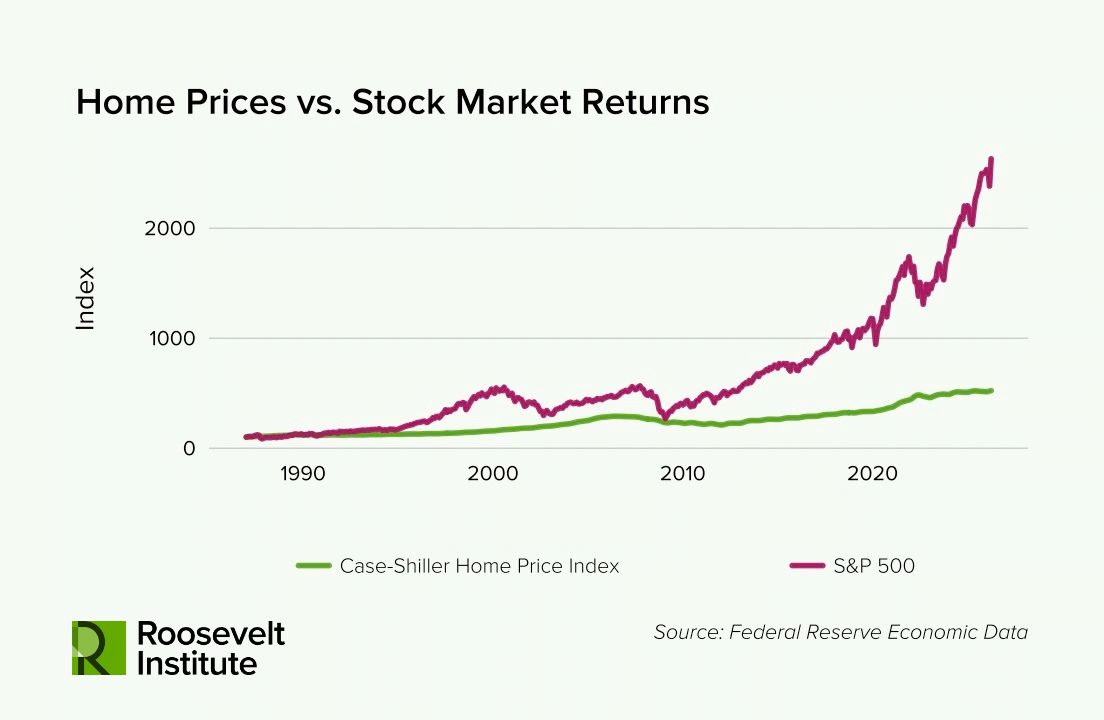
These two forms of Black-White wealth gaps also have implications for wealth portfolio composition. While Americans overall hold most of their wealth in home value, Black Americans hold even more of their wealth in home value than White Americans (Darity et al. 2018; Dean 2024; Kochhar and Moslimani 2023; Kuebler 2013; Ratcliffe and Choi 2021; Rucks-Ahidiana 2023). For example, Joseph Dean (2024) found that 44 percent of Black Americans’ wealth was in home equity, compared with 19 percent of White Americans wealth in 2022. This suggests that Black homeowners have fewer liquid assets to fall back on in the case of a financial or home repair emergency than White homeowners. This paired with the later entry to ownership and shorter ownership tenure of Black homeowners contributes to racial differences in returns on investment through home equity, given that increases in home prices (as shown in Figure 1) have slowed in comparison to returns to stock investments.
Figure 1
In sum, homeownership takes wealth to enter and maintain. Black Americans’ lower wealth standing and lower incomes mean that homeownership is not only often harder to achieve and maintain, but may also produce precarity and instability rather than providing a more stable life for Black households.
Reality 2: Black Americans Experience Discrimination and Predatory Inclusion in the Real Estate Market
The assumptions that market processes work the same for all Americans ignore structural racism. In the housing market, Black Americans face discrimination and predatory inclusion that mean the terms of their inclusion in the market are not equitable to those of White Americans. This includes inequities in homes shown during the home buying process, access to mortgage loans, and the terms and conditions of those loans.
During the home buying process, real estate agents engage in a discriminatory process called steering, which means that Black and White homebuyers of similar means do not have access to the same home buying opportunities (Quillian et al. 2020; Sullivan et al. 2015; Weller et al. 2021). Steering is primarily defined as when real estate agents match available properties to clients by race, so that Black homebuyers are shown homes in predominately Black neighborhoods and White homebuyers are shown homes in predominately White neighborhoods. Studies show that real estate agents often pair steering with verbal discouragement when clients ask about homes in areas where their racial group is not the majority. For example, an agent in Los Angeles told a researcher, “If it’s a mixed neighborhood, that’s all right. But you want to make sure it’s mixed; you don’t want to be the only White person there” (Galster and Godfrey 2005, 258). Because Black neighborhoods are devalued, Black homebuyers are steered toward neighborhoods with lower home values and lower rates of appreciation (or even with rates of depreciation) during the home buying process.2
Discrimination in the home buying process also comes in the form of discrimination in the mortgage lending process. Studies using Home Mortgage Disclosure Act (HMDA) data consistently show that Black homebuyers are more likely to be declined for mortgage loans than White homebuyers (Quillian et al. 2020). This is true even when controlling for variation in income, gender, and creditworthiness. Although HMDA data does not include credit scores, which makes it difficult to prove the relationship between mortgage denials and creditworthiness, these consistent results across 19 studies provide strong evidence of racial discrimination even with the missing information (Quillian et al. 2020).
When Black homebuyers are approved for mortgage loans, evidence suggests that they do not receive comparable terms on mortgage loans to their otherwise comparable White counterparts. In fact, there is strong evidence that when Black Americans experience increased access to homeownership, it is under terms that are not beneficial in the long run. Louise Seamster and Raphael Charron-Chenier (2017) and Keeanga-Yamahtta Taylor (2019) call this “predatory inclusion,” or extending access to Black people under predatory terms and conditions. In the case of mortgage loans, we see this clearly with the foreclosure crisis during the Great Recession. Black Americans gained access to mortgage loans during this time, but primarily under subprime mortgage loans. With high interest rates or exploding interest rates, subprime loans hit Black homeowners hard when the economy declined and Black Americans disproportionately faced job loss and strained financial conditions (Asante-Muhammad et al. 2021; Kuebler 2013; Markley et al. 2020; Sullivan et al. 2015; Faber 2013; Weller et al. 2021). These conditions were not just felt by low-income Black homebuyers, but even by middle- and upper-income Black homebuyers, who were similarly targeted with subprime loans (Asante-Muhammad et al. 2021; Faber 2013).
Discrimination in the housing market means that Black Americans experience inequity in the homebuying process twice through (1) the homebuying process and (2) the mortgage lending process. This diminishes their returns to homeownership, whether through buying homes that are worth less and depreciate or appreciate more slowly in value, or by having mortgage loan terms that lead to significantly higher repayment amounts and higher likelihood of foreclosure.
Reality 3: Homes Appreciate Unequally by Race
The assumption that homes appreciate over time is highly tied to the experiences of White middle-class Americans entering homeownership in the 1940s through 1960s. As the federal government made mortgage loans more accessible for the White middle-class, White Americans entered homeownership at a low price point and paid off their mortgages while their homes appreciated dramatically in value (Rucks-Ahidiana 2023). The problem is that home value appreciation is not universal.3 Some homes depreciate in value over time. Furthermore, when appreciation does occur, homes in Black neighborhoods experience lower returns through appreciation than homes in White neighborhoods. This is inherent to the structural racism of the housing market discussed in Reality 2.
Figure 2
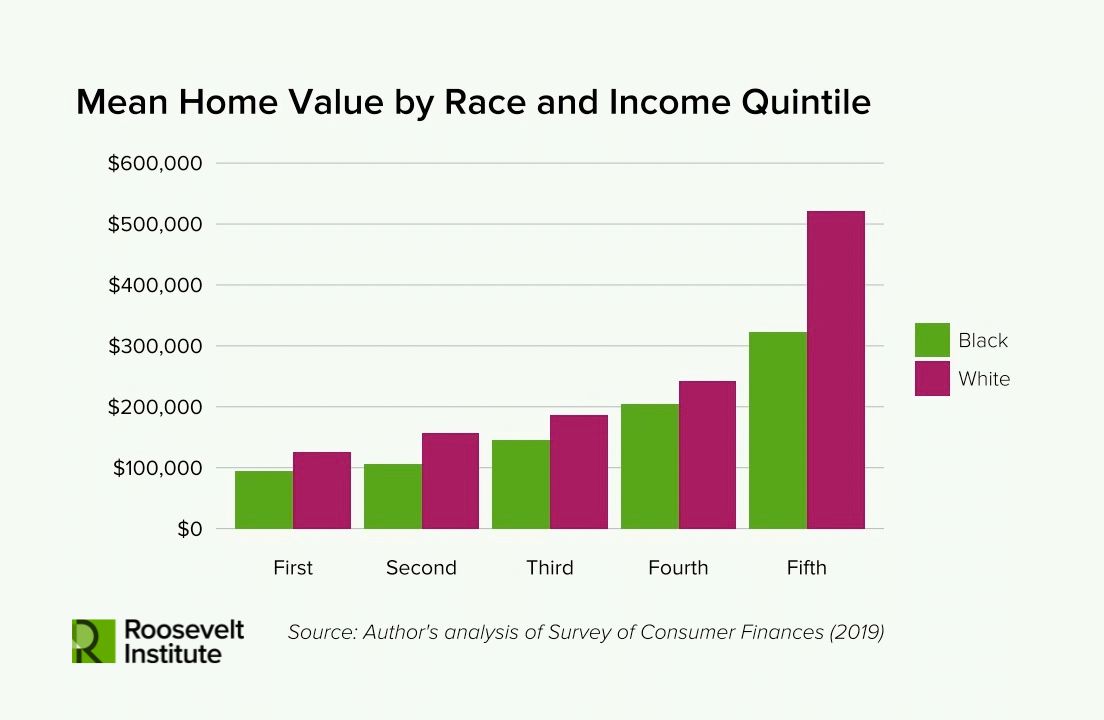
Home values in White neighborhoods are generally higher than home values in Black neighborhoods, even when considering homes with similar characteristics (Darity et al. 2018; Dean 2024; Howell and Korver-Glenn 2018; 2021; 2022; Markley et al. 2020; Rucks-Ahidiana 2023; Perry 2020; Perry et al. 2018). This difference between Black- and White-owned homes exists regardless of income, with particularly large disparities between high-income Black and White homeowners, as shown in Figure 2. The devaluation of Black neighborhoods drives this disparity (Perry 2020; Perry et al. 2018; Rucks-Ahidiana 2022). Home values are driven in part by an investment motive. White homebuyers who have more to spend on homes are generally not interested in moving into Black neighborhoods and thus generally don’t invest their money in Black neighborhoods. Relatedly, real estate investors and developers are less likely to invest in homes in Black neighborhoods.
An important additional, and only recently documented, contributor to appreciation is the appraisal process, during which an appraiser decides how much a home is worth. Junia Howell and Elizabeth Korver-Glenn (2018) find that this process inherently devalues homes in Black neighborhoods compared with similar homes in White neighborhoods because of the use of “comps.” Comps come from “real estate records . . . [of] recently sold, similar homes” that appraisers analyze for “the amount these comps sold for to begin to establish what the house they are evaluating is worth” (Howell and Korver-Glenn 2022, 5). The official, national standards for appraisers include several neighborhood factors to identify comps that indicate class composition and neighborhood resources such as education, household income, and public services, but, as Howell and Korver-Glenn note, “many of these neighborhood characteristics correlate with neighborhood racial composition” (2022, 7). Furthermore, qualitative interviews with appraisers revealed that some appraisers used a neighborhood’s racial composition to identify comparable sold homes (Howell and Korver-Glenn 2018), which limits the comparison of homes being sold in Black neighborhoods to homes in other Black neighborhoods. These comparisons could lead to homes in Black middle- or upper-class neighborhoods being compared to those in lower-income Black neighborhoods that do not have comparable housing. Each of these factors contribute to homes in Black neighborhoods being devalued compared with comparable homes in White neighborhoods, while homes in White neighborhoods are compared to comparable houses and thus appraised appropriately.
This devaluation contributes to lower appreciation for homes in Black neighborhoods over time (Howell and Korver-Glenn 2021; Kermani and Wong 2021; Killewald and Bryan 2016; Kuebler 2013; Markley et al. 2020; Weller et al. 2021). Alexandra Killewald and Brielle Bryan find that,
Our race-specific results show substantial disparities in the wealth returns to homeownership. Whites are estimated to accumulate median wealth gains of $7,602 for every year of homeownership versus $4,684 for Hispanics and only $3,645 for blacks. Thus the wealth benefits of each year of homeownership are 48 percent as large for blacks as for whites and 62 percent as large for Hispanics (2016, 120).
The reality is that home appreciation produces unequal returns by race. Because Black neighborhoods are devalued spaces, returns on investment to those neighborhoods are of lower value than those in the valued spaces of White neighborhoods.
Over the course of the number of years that midlife homeowners had owned their homes by race, White midlife homeowners accumulated approximately $113,270 on average over the 23 years of study.4 In contrast, Black homeowners accumulated approximately $27,702 on average. That’s a difference of $85,568 in just 23 years.
Importantly, some studies also find that homes in Black neighborhoods are more likely to depreciate in value. For example, Scott N. Markley et al. (2020) found that, between 2000 and 2016, homes in majority-Black neighborhoods in Atlanta had depreciated by $22,000 in high-income neighborhoods and $38,000 in low-income neighborhoods, whereas homes in all majority-White neighborhoods in Atlanta had appreciated in value. Depreciation occurred across Black neighborhoods of all socioeconomic statuses, not just low-income Black neighborhoods, while appreciation was similarly universal for White neighborhoods regardless of income (Markley et al. 2020).
As Markley et al. conclude, “homeownership had not yielded Black households the wealth gains it had historically conferred upon white households” (2020, 313). While White middle-class Americans were able to establish and dramatically expand their wealth through homeownership due to early access at low prices, Black Americans have not had that luxury (Rucks-Ahidiana 2023). The reality is that home appreciation produces unequal returns by race. Because Black neighborhoods are devalued spaces, returns on investment to those neighborhoods are of lower value than those in the valued spaces of White neighborhoods.
The reality is that home appreciation produces unequal returns by race. Because Black neighborhoods are devalued spaces, returns on investment to those neighborhoods are of lower value than those in the valued spaces of White neighborhoods.
Conclusion: Reforming the Broken Housing Market
The three realities of homeownership for Black Americans mean that fewer Black Americans have the required wealth to pursue homeownership without it being a financial burden, and that even those who have sufficient wealth face racism and discrimination that can make homeownership a risky investment through predatory lending, with limited returns due to racism in the appraisal process and disinvestment in Black neighborhoods. Although increasing Black homeownership seems like an easy fix for the racial wealth gap, the existing racism of the housing market and the constantly evolving forms of predatory inclusion that have and could emerge to take advantage of new Black homeowners, suggest that—rather than being a sure asset that will appreciate significantly in value as homeowners age—homeownership is uncertain for Black Americans. Will their homes actually depreciate in value? Will the terms and conditions of their mortgage loans help or hinder long-term homeownership? Does late entry into homeownership mean little to no return?
Furthermore, tackling the racial wealth gap by addressing an asset is unlikely to have the necessary impact of reducing Black-White disparities. At best, addressing a Black-White asset disparity could slow the growth of the racial wealth gap temporarily, but White Americans are so far ahead in wealth both in time and dollars that it is unlikely that an asset-focused approach could reduce or eliminate the gap. The scale of change to any asset required to ameliorate the racial wealth gap could also be unobtainable, as are the challenges of adding sufficient homeownership opportunities to reach the 3 million new Black homeowners proposed (Ratcliff and Choi 2021).
Although homeownership is not the answer to the racial wealth gap, the realities of homeownership make it clear that reform is needed to protect existing and new Black (and Brown) homeowners and homebuyers, as the existing Fair Housing Act has not solved the problem. The racism and discrimination Black homeowners face in the housing market has real consequences for their returns on homeownership and for the terms and conditions of their mortgage loans. Policies and protections that go beyond fair housing law—to ensure that appraisal comps are not limited to comparable homes based on a neighborhood’s racial demographics, that steering is not limiting the homeownership opportunities that qualifying Black Americans can access, and that racial discrimination is not leading to predatory inclusion in mortgage lending—would help stabilize existing and future Black homeowners.
But homeownership itself is not going to solve the racial wealth gap.
Footnotes
- Importantly, these recommendations assume that sufficient housing units are available to accommodate an additional 3 million or more homeowners and that it is possible to expand the housing supply by that scale. ↩︎
- Even if realtors were not engaging in steering, White Americans’ preferences for neighborhoods that are at least 50 percent White would continue to produce segregated neighborhoods (Bobo et al. 2012). ↩︎
- I focus here on home value appraisals, but a similar story of racial inequality could be told about tax assessment appraisals. ↩︎
- I calculated these estimates by multiplying the average returns by year by the average number of years that each racial group owned a home during the 23 years of the Killewald and Bryan (2016) study. ↩︎
References
Aladangady, Aditya, Andrew C. Chang, and Jacob Krimmel Ma. 2023. “Greater Wealth, Greater Uncertainty: Changes in Racial Inequality in the Survey of Consumer Finances.” FEDS Notes. Board of Governors of the Federal Reserve System. https://federalreserve.gov/econres/notes/feds-notes/greater-wealth-greater-uncertainty-changes-in-racial-inequality-in-the-survey-of-consumer-finances-20231018.html.
Asante-Muhammad, Dedrick, Jaime Buell, and Joshua Devine. 2021. “60% Black Homeownership: A Radical Goal for Black Wealth Development .” National Community Reinvestment Coalition, March 2. https://ncrc.org/60-black-homeownership-a-radical-goal-for-black-wealth-development.
Bobo, Lawrence, Camille Charles, Maria Krysan, and Alicia Simmons. 2012. “The Real Record on Racial Attitudes.” In Social Trends in American Life: Findings from the General Social Survey since 1972, edited by Peter V. Marsden. Princeton University Press.
Choi, Jung Hyun, Alanna McCargo, Michael Neal, Laurie Goodman, and Caitlin Young. 2019. Explaining the Black-White Homeownership Gap: A Closer Look at Disparities across Local Markets. Urban Institute. https://urban.org/research/publication/explaining-black-white-homeownership-gap-closer-look-disparities-across-local-markets.
Darity, William, Jr., Darrick Hamilton, Mark Paul, et al. 2018. What We Get Wrong About Closing the Racial Wealth Gap. Samuel DuBois Cook Center on Social Equity and the Insight Center for Community Economic Development. https://insightcced.org/what-we-get-wrong-about-closing-the-racial-wealth-gap.
Dean, Joseph. 2024. The Racial Wealth Gap 1992 to 2022 . National Community Reinvestment Coalition. https://ncrc.org/the-racial-wealth-gap-1992-to-2022.
Faber, Jacob W. 2013. “Racial Dynamics of Subprime Mortgage Lending at the Peak.” Housing Policy Debate 23 (2): 328–49. https://doi.org/10.1080/10511482.2013.771788.
Galster, George, and Erin Godfrey. 2005. “By Words and Deeds: Racial Steering by Real Estate Agents in the US in 2000.” Journal of the American Planning Association 71 (3): 251–68. https://doi.org/10.1080/01944360508976697.
Howell, Junia, and Elizabeth Korver-Glenn. 2018. “Neighborhoods, Race, and the Twenty-First-Century Housing Appraisal Industry.” Sociology of Race and Ethnicity 4 (4): 473–90. https://doi.org/10.1177/2332649218755178.
Howell, Junia, and Elizabeth Korver-Glenn. 2021. “The Increasing Effect of Neighborhood Racial Composition on Housing Values, 1980–2015.” Social Problems 68 (4). https://doi.org/10.1093/socpro/spaa033.
Howell, Junia, and Elizabeth Korver-Glenn. 2022. Appraised: The Persistent Evaluation of White Neighborhoods as More Valuable Than Communities of Color. Weidenbaum Center on the Economy, Government, and Public Policy. https://doi.org/10.31235/osf.io/6r5zs.
Kermani, Amir, and Francis Wong. 2021. Racial Disparities in Housing Returns. National Bureau of Economic Research. https://nber.org/papers/w29306.
Killewald, Alexandra, and Brielle Bryan. 2016. “Does Your Home Make You Wealthy?” Russell Sage Foundation Journal of the Social Sciences 2 (6): 110–28. https://doi.org/10.7758/RSF.2016.2.6.06.
Kochhar, Rakesh, and Mohamad Moslimani. 2023. Wealth Surged in the Pandemic, but Debt Endures for Poorer Black and Hispanic Families. Pew Research Center. https://pewresearch.org/race-and-ethnicity/2023/12/04/wealth-surged-in-the-pandemic-but-debt-endures-for-poorer-black-and-hispanic-families.
Kuebler, Meghan. 2013. “Closing the Wealth Gap: A Review of Racial and Ethnic Inequalities in Homeownership.” Sociology Compass 7 (8): 670–85. https://doi.org/10.1111/soc4.12056.
Markley, Scott N., Taylor J. Hafley, Coleman A. Allums, Steven R. Holloway, and Hee Cheol Chung. 2020. “The Limits of Homeownership: Racial Capitalism, Black Wealth, and the Appreciation Gap in Atlanta.” International Journal of Urban and Regional Research 44 (2): 310–28. https://doi.org/10.1111/1468-2427.12873.
Perry, Andre M. 2020. Know Your Price: Valuing Black Lives and Property in America’s Black Cities. Brookings Institution Press.
Perry, Andre, Jonathan Rothwell, and David Harshbarger. 2018. The Devaluation of Assets in Black Neighborhoods: The Case of Residential Property. Brookings Institution. https://brookings.edu/articles/devaluation-of-assets-in-black-neighborhoods.
Quillian, Lincoln, John J. Lee, and Brandon Honoré. 2020. “Racial Discrimination in the US Housing and Mortgage Lending Markets: A Quantitative Review of Trends, 1976–2016.” Race and Social Problems 12 (1): 13–28. https://doi.org/10.1007/s12552-019-09276-x.
Ratcliffe, Janneke, and Jung Hyun Choi. 2021. “Adding 3 Million Net New Black Homeowners in the Next Decade Can Narrow the Widening Homeownership Gap.” Urban Institute, May 24. https://urban.org/urban-wire/adding-3-million-net-new-black-homeowners-next-decade-can-narrow-widening-homeownership-gap.
Rucks-Ahidiana, Zawadi. 2022. “Theorizing Gentrification as a Process of Racial Capitalism.” City & Community 21 (3): 173–92. https://doi.org/10.1177/15356841211054790.
Rucks-Ahidiana, Zawadi. 2023. “Housing as Capital: US Policy, Homeownership, and the Racial Wealth Gap.” In Sociology of Housing, edited by Brian J. McCabe and Eva Rosen. University of Chicago Press.
Shapiro, Thomas M. 2004. The Hidden Cost of Being African American: How Wealth Perpetuates Inequality. Oxford University Press.
Sullivan, Laura, Tatjana Meschede, Lars Dietrich, et al. 2015. The Racial Wealth Gap. Institute for Assets and Social Policy and DEMOS. https://homewisdom.org/s/Demos-RacialWealthGap.pdf.
Taylor, Keeanga-Yamahtta. 2019. Race for Profit: How Banks and the Real Estate Industry Undermined Black Homeownership. UNC Press.
Weller, Christian E., Connor Maxwell, and Danyelle Solomon. 2021. “Simulating How Large Policy Proposals Affect the Black-White Wealth Gap.” Journal of Economics, Race, and Policy 4 (3): 196–213. https://doi.org/10.1007/s41996-020-00077-8.
Acknowledgments
The author would like to thank Stephen Nuñez and Michael Madowitz for their feedback, insights, and contributions to this paper, as well as Noa Rosinplotz and Toyosi Odusola for their research assistance and Katherine De Chant for her editorial support. Any errors, omissions, or other inaccuracies are the author’s alone.
Suggested Citation
Rucks-Ahidiana, Zawadi. 2026. “Homeownership Is Not a Solution to the Racial Wealth Gap,” Roosevelt Institute, October 8.
RELATED RESOURCES
Author