

Where States Are Innovating on Childcare: Lessons for a National Universal Childcare Policy
September 24, 2026
By Lena Bilik
This is a web-friendly preview of the report.

Key Takeaways
- States are making significant progress toward the Roosevelt Institute’s framework for universal childcare—15 states have expanded subsidies beyond the federal threshold, 11 states have made collective bargaining agreements with providers that take subsidies, and 17 states have consolidated multiple state entities into dedicated departments or agencies for early childhood programs.
- Case studies of Connecticut, New Mexico, and Vermont demonstrate that expanding access to affordable, public, high-quality childcare is possible in the US. States are using higher reimbursement rates, direct wage supports, benefits, training, and workforce-development programs to stabilize providers and increase childcare capacity.
- State innovations also reveal the limits of state-only solutions. The balance between raising childcare workers’ wages and keeping down costs for families remains the greatest hurdle and the primary reason federal investment is necessary to achieve a nationwide universal system.
What States Can Teach Us About Universal Childcare
The US ranks 40th out of 41 comparably wealthy nations in offering accessible, affordable, and quality childcare. Childcare is essential infrastructure; it not only allows parents to work, attend school, and gain financial stability, but it is also a necessary building block of healthy child development. Lack of public funding for childcare has left American families on their own to navigate a mostly private system, leaving many families either cost-burdened by childcare or struggling to access it at all. Decades of federal inaction have stymied the system.
The US needs a national public option for universal childcare. There are multiple definitions of “universal childcare,” but this brief uses the term to mean a system where all children and families have access to free or affordable (with a nominal base fee), high-quality, publicly funded childcare where they live. In such a system, childcare providers would also receive thriving wages and benefits.
Since the COVID-19 pandemic, public recognition of the essential role of childcare and childcare workers in the economy has been growing. States and localities have been stepping up where the federal government has failed to expand the boundaries of what is possible in publicly financed childcare.
Increasingly, federal policymakers are indicating interest in higher federal investments in childcare. When making these investments and implementing new childcare programs, policymakers should learn lessons from states about implementation, governance, and stakeholder engagement.
This brief draws three overarching conclusions from state innovations in childcare:
- States have shown that expanding access to affordable, public, high-quality childcare is possible in the US.
- Expanding public childcare systems to be accessible and affordable requires improving compensation for the childcare workforce. Without workforce investments, supply will not meet demand.
- A small group of states is leading the way, but to give every child in America the access and opportunity they deserve, it is time for the federal government to provide significant investments to make public, universal childcare a sustainable reality across the entire country.
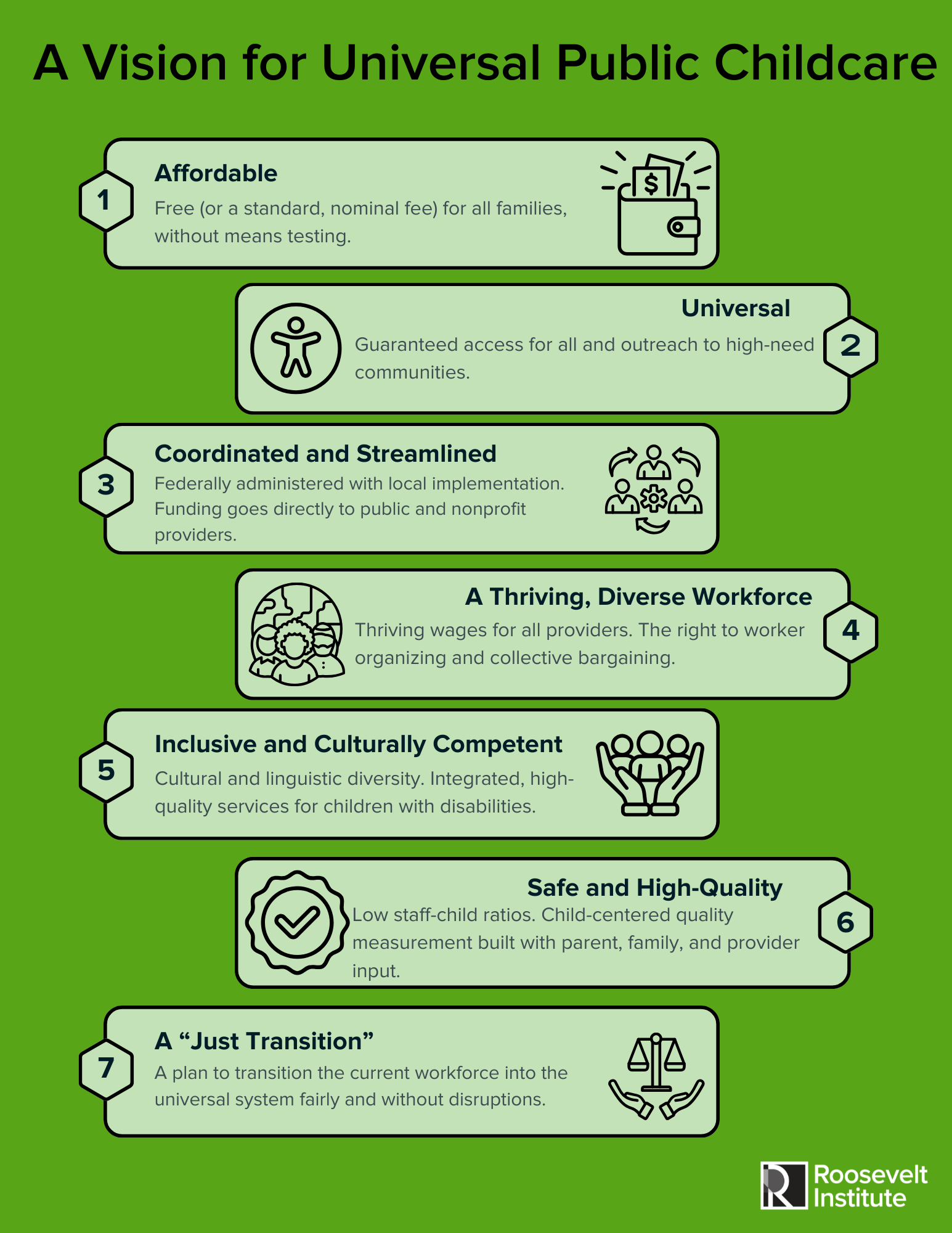
This brief highlights interviews with state leaders and implementers and lessons from promising emerging childcare policy in three states: Connecticut, New Mexico, and Vermont. These were selected using the framework outlined in a 2025 report from the Roosevelt Institute and Community Change, which identified seven core principles for a universal public childcare policy. For this brief, I used those principles to assess states’ progress toward universal public systems. The three selected states offer important lessons on expanding public access to affordable childcare.
For public, affordable, high-quality childcare to be available to all, stable, long-term public funding is necessary—and this means federal investment. States can and must attempt to fill in the gaps in federal funding for childcare, but this is very costly. States cannot deficit spend, and they have a widely varied ability to raise revenue and capacity for implementation—not to mention a broad range of political will for making new public investments in social programs. Across states, this creates vast inequities: In FY 2026, state investments in early childhood education ranged from less than $500 per child under five to more than $5,000 per child.
All states in this brief have made significant efforts to make childcare more affordable for families, primarily through expanding eligibility limits so more families can access subsidized care. Another major throughline in all states highlighted here is their efforts to improve compensation for the childcare workforce parallel to their affordability measures. The states have made significant progress, but federal funding would make it much more possible for these states to maintain investments in both of these efforts, and for other states to join them. Parents can’t pay more, and providers can’t afford to make a dollar less—childcare workers already receive poverty wages, which leads to high turnover and massive workforce shortages that translate to childcare shortages. This classic market failure demands government intervention. The states in this brief have done just that through increased reimbursement rates for subsidies, direct wage supplementation (either permanently or as a temporary stabilization strategy), or a combination. As a result, they have started to see progress in increasing the supply of childcare programs alongside increased access to subsidized care. These states’ progress expanding public childcare has been significant in recent years. This means we have more real-world examples of the successes and challenges of US public childcare expansion and implementation than ever before. A federal universal childcare policy should take lessons learned from state policy innovations and leverage local wisdom and infrastructure to successfully implement a national system for all children and families.
Recommendations for a Federal Universal Childcare System
The following are recommendations for a federal universal childcare proposal that summarize the lessons learned from the states highlighted in this brief.
Affordable and Accessible
Federal childcare policy should:
- Remove eligibility limits for publicly subsidized childcare for all families to ensure affordability and ultimately achieve universal free or highly affordable childcare for all.
- Invest in workforce compensation to ensure an adequate supply of providers. Without the workforce to supply the care, universal care cannot be achieved.
- Adjust rates based on the age of children served. For example, infant and toddler care is more expensive than care for older children, so it requires additional investment and workforce incentives to ensure adequate supply.
- Include capital funding for physical capacity and supply, through both retrofitting and expanding current programs and building new ones.
- Provide funding to develop accessible technology so states can create a single point of entry to help families find care.
Coordinated and Streamlined
Federal childcare policy should:
- Use existing capacity and expertise at the local, regional, and state levels to coordinate and implement programs. Any universal childcare bill will interact with and connect to state systems that already exist, and states should be able to continue what is already working.
- Help states implement dedicated, coordinated state entities that focus on early childhood education. Dedicated entities would not only help with the rollout of the universal program but could also continually improve quality and engage with the community.
A Thriving Workforce
- Federal childcare policy should invest significant public funding to ensure that childcare providers can receive truly professional pay and benefits.
- A federal universal childcare proposal should learn from states and meaningfully engage with labor unions. Policy language should ensure the right to collectively bargain and unionize in good faith, with an eye toward building long-term mechanisms to support worker power in this historically marginalized workforce.
Inclusive and Culturally Competent
Federal childcare policy should:
- Include sufficient funding to serve children with special needs and disabilities and require early intervention to be coordinated with all other childcare programs, with help from state and local governance structures.
- Fund local needs assessments to ensure that care meets the diverse needs of families. Culturally responsive care will vary widely across the country as well as within states.
A Just Transition
Federal childcare policy should:
- Partner with labor unions, higher education, resource and referral agencies, and provider networks to help build worker pipelines, support workforce development, and provide continuing education.
- Require community engagement at the local level. As demonstrated through interviews in this brief, community engagement should be done in partnership with local organizations and communities. The trust that states have built through community listening sessions and taking feedback from advocates, parents, and providers has been critical for bringing providers into expanded public systems, advertising the system to families, and ensuring high quality without impacting supply.
Why Federal Investment Matters for Universal Childcare
In the face of federal inaction, states are making enormous strides toward building more accessible and affordable public childcare systems. But even though state policies on childcare are promising and offer many road maps to draw upon, the US overall is still missing the mark on early childhood education. Only one state offers true universal eligibility for public childcare. And no state has a completely public system for the birth-to-five continuum with true guaranteed universal access without work or education requirements, akin to the K-12 public school system. (New Mexico requires parents to be working, looking for work, or in school, with some exemptions.)
To meet the vast need for childcare across the country, we need federal investment in a public birth-to-five childcare system for all families. Significant federal public investment—particularly investment in the necessary conditions for a universal public system, like the workforce and age-inclusive care—would aid many of the challenges facing states, even those leading the way. To build the supply of childcare, we need more childcare providers, and, to sustain and grow that workforce, we need to give them thriving professional wages and benefits. Without a significant public payer like the federal government, the balance between raising wages and keeping down costs for families will continue to be an enormous hurdle.
The US needs a childcare system that is universally guaranteed through stable investment, rather than an inequitable patchwork of local programs that depend on volatile state budgets and unequal access to resources. To implement a true public option for childcare, rather than simply patching the holes in the safety net, the US should take these lessons learned from state childcare policy and partner with state agencies and communities to build a truly universal, national public childcare system.
Acknowledgments
The author would like to thank the state interviewees whose institutional knowledge made this brief possible: Elena Trueworthy, Maggie Adair, Kristen Dudanowicz, Elizabeth Groginsky, Mariana Padilla, and Janet McLaughlin. The author would also like to thank Ruth Friedman, Harriet Dichter, Nina Dastur, Suzanne Kahn, Julie Hersh, and Katherine De Chant for their feedback, insights, and contributions to this paper. Any errors, omissions, or other inaccuracies are the author’s alone.
Suggested Citation
Bilik, Lena. 2026. “Where States Are Innovating on Childcare: Lessons for a National Universal Childcare Policy,” Roosevelt Institute, September 24.
RELATED RESOURCES
Authors

Lena Bilik
Senior Program ManagerAs senior program manager, Lena supports think tank staff and fellows with research and project management.