

Laying Green Groundwork: How Climate Policy Sequencing Can Work for the United States
December 18, 2025
By Daniel Driscoll
This is a web-friendly preview of the brief.
Executive Summary
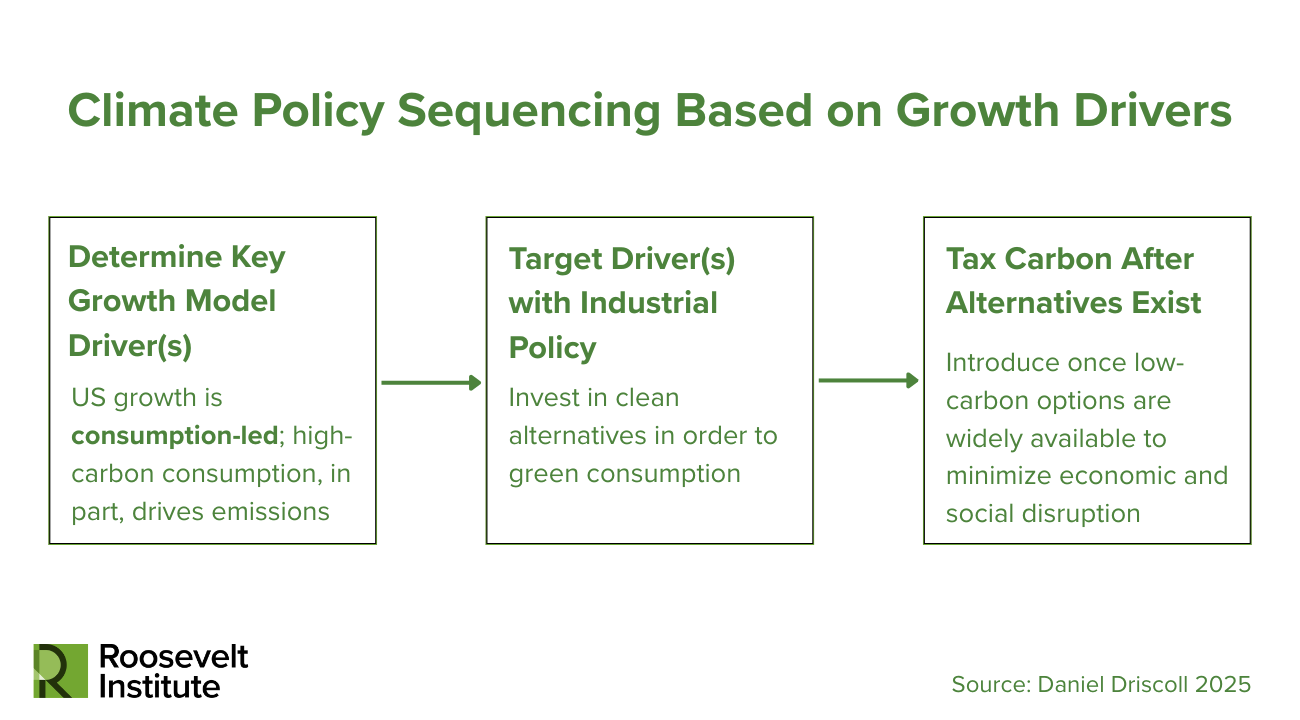
US climate policy has long oscillated between carbon pricing and green industrial policy. Initially favored by policymakers, carbon taxes failed politically in 2009. Industrial policies, such as the Inflation Reduction Act (IRA) of 2022, gained prominence recently. Historic policy challenges stem from underestimating decarbonization complexity, ignoring the realities of trial-and-error learning from policy experiments, and failing to account for the growth model fundamentals of the United States. Research shows both carbon taxes and industrial policies are effective, especially when sequenced; i.e., decarbonization is most successful when industrial policies (carrots) precede carbon taxes (sticks). The US growth model is heavily consumption-driven with carbon-intensive consumption complicating immediate carbon pricing. Thus, sequencing policies to align with growth drivers can reduce social, economic, and political backlash. In that context, investments targeting clean consumption create the ideal conditions for potential future carbon pricing.
Suggested Citation
Driscoll, Daniel. 2025. “Laying Green Groundwork: How Climate Policy Sequencing Can Work for the United States.” Roosevelt Institute, December 18, 2025.
Acknowledgments
The author would like to thank Todd N. Tucker and Aastha Uprety for their feedback, insights, and contributions to this paper. Any errors, omissions, or other inaccuracies are the author’s alone.
This brief is loosely informed by the findings and arguments presented in the book, Why Carbon Taxes Failed, forthcoming with Oxford University Press.
RELATED RESOURCES
Author

Daniel Driscoll
Fellow, Climate PolicyAt Roosevelt, Daniel Driscoll works on climate and industrial policy.