

Parents Need Childcare They Can Count On: New Evidence on Childcare-Related Work Disruptions and Mothers’ Employment
August 27, 2026
By Sarah Jane Glynn


Key Takeaways
- Childcare disrupts work for millions of parents. In 2022 and 2023, 16 percent of parents with children under 15 reported working less, working part time, not working, or otherwise having their paid work limited by caregiving.
- Mothers bear the brunt. Nearly 27 percent of mothers experienced a childcare-related work disruption, compared with 2.9 percent of fathers. Gender remained the strongest demographic predictor after other factors were taken into account.
- Working an irregular schedule is associated with a greater likelihood of childcare-related work disruptions, but most other measured differences do not significantly change the likelihood of disruptions. This isn’t because disruptions don’t happen or don’t matter—it’s because they are so common, regardless of a family’s circumstances.
- Better access to reliable, affordable childcare is an economic imperative.
Introduction
Norms around parenting and work have changed over time, and in different ways for women and men. Fathers today are more involved in childcare than in the past; they are more likely to both provide care and spend more time doing it. For example, from 2003 to 2024 the share of fathers with children under six who reported providing childcare on the average day increased by more than 13 percentage points, and the amount of time they spent taking care of their children increased by 44 percent.1
Not every child has two parents at home, and while fathers may be doing more caregiving for their children than in the past, it is supplementing, not replacing, the care provided by mothers. Over the same time period that fathers have been increasing their caregiving, the time mothers spend has not changed significantly. This is especially remarkable since over the same time period the labor force participation rate among mothers with children under six increased by 5.5 percentage points, while the rate for fathers with young children fell by 0.5 percentage points.2
Taken as a whole, this means that mothers are more likely to work outside the home than they were 20 years ago, and, if they are partnered with a man, they are likely to have more help with childcare. But despite these meaningful changes in their lives, mothers are still more likely to be the primary caregiver for their children. It is not so surprising, then, that mothers report such high levels of conflict between work and family.
To be certain, conflicts between work and other responsibilities are not limited to mothers or parents. Everyone who works has times when the demands of their job get in the way of their lives outside of work. This can happen in two primary ways: through interference and overload.3
We all hold multiple roles in our lives—as employees, parents, and heads of household, but also as friends and members of extended families and local communities. Sometimes the different roles interfere with one another because of scheduling conflicts or competing expectations. Imagine a parent who, upon arrival at work, receives a call from their daycare center saying their toddler has come down with a stomach bug and needs to be picked up immediately. Since there is no way to be in two places at once, the parent has no other option than to decide what to prioritize. Some parents may have backup childcare options, and some might have sympathetic employers, but for many working parents the interference between their roles as caring parents and good employees can become an unsolvable physics problem.
At other times there is no emergency; there is simply too much to do and not enough time to do it all, or at least not to the standards one might hope. This scenario is so familiar for many parents that it functions as a cultural trope. How many family sitcoms feature episodes where a parent has a big work assignment that overlaps with a school bake sale or science fair or playoff game, with role overload playing out to comic results? But for most real people there is not a heartwarming result after 30 minutes; typically, people have to either postpone or refuse responsibilities because there is no practical way to do it all. This can look like turning down a promotion because it would require traveling during the school week or passing up a better job because the commute is incompatible with childcare drop-off and pick-up times.
Sometimes the result isn’t just a missed opportunity for advancement; it’s working fewer hours, smaller paychecks and less retirement savings, and sometimes even leaving the labor force entirely. This impacts mothers the most—and not just anecdotally. As discussed below, this phenomenon is striking in official statistics. Maternal labor force participation has increased significantly in the United States, but it is still lower than the rate for fathers and lags many peer countries. Mothers are also more likely to work part time and have lower pay and less access to workplace benefits, which are often tied to work hours.
Access to childcare should help address some of these conflicts. But childcare only supports working families when it is reliably available, and, even when families have childcare arrangements in place, issues always arise. Emergencies like extreme winter storms that make driving on iced-over streets unsafe, or more mundane crises like a broken water pipe, can cause unexpected closures to centers and home-based childcare. Childcare workers deserve breaks and vacations too, and many providers have planned closures to allow their staff time off. Even something as common as a cold can prevent a child from going to their care provider. Other parents cannot access childcare because it is too expensive, or because there are no available openings for their child. They may experience even more unpredictability because they either have no standard childcare arrangement in place or must rely on a patchwork of informal care providers like friends and neighbors when they are available.
These kinds of childcare issues are agonizingly familiar to the millions of working parents affected by them, and we know this affects parents’ ability to work. For example, as the price of care increases, mothers become less likely to work,4 and in states with shorter school days mothers are less likely to work full time and more likely to work part time.5 But very little data exists to help measure whether there is a connection between the types of childcare arrangements families have in place and work limitations related to childcare.
Using detailed data on labor force participation, job features, and childcare arrangements, the following analysis adds nuance to what is currently known about the ways reliable childcare impacts parents’ ability to work. Data show that it is very common for childcare needs to reduce parents’ labor supply, whether by reducing their work hours or keeping them out of the workplace entirely. As has consistently been shown across a number of different metrics, mothers are the family members most impacted by childcare demands, and gender is a significant predictor of which parents are likely to cut back on paid labor to provide unpaid family care. Unsurprisingly, parents are more likely to report that caregiving impacts their ability to work when their children are young; these odds decline as children age. And while work limitations become less likely as a parent’s individual earnings increase, family income has no statistically significant link to work disruptions, indicating both how ubiquitous these challenges are and that money alone cannot prevent caregiving responsibilities from impacting work.
Using detailed data on labor force participation, job features, and childcare arrangements, the following analysis adds nuance to what is currently known about the ways reliable childcare impacts parents’ ability to work.
Data
The Survey of Income and Program Participation (SIPP) is an annual longitudinal survey, one of the few that collects detailed information on families and their childcare arrangements. The SIPP asks respondents who are parents with at least one child under the age of 15 about their childcare use during a typical week in the previous fall. Information is collected separately about each child in the household, but the questions are only asked of the “reference parent,” usually the mother. For this analysis, when a secondary parent is present in the home, childcare responses have been linked to both parents. (For more information and analysis of the SIPP’s childcare data, please see “Who’s Minding the Kids These Days?: An Analysis of Children’s Care Arrangements.”6)
The SIPP contains detailed information about monthly labor force participation, employment, and job characteristics for everyone in the sample over age 15. If someone did not hold a job for at least one week in a month, a series of 12 follow-up questions asks why; one of the questions asks if they did not work because they were taking care of children or other persons. Because the reasons are asked separately, people can report more than one.
Each month of the dataset includes information about work hours and whether those hours changed; this is recorded separately for each job a person had that month. If they report working part time, whether permanently or temporarily, they are asked the main reason why. There are 12 possible responses, including the option “taking care of children or other persons, such as due to coronavirus pandemic school closures.” If a job ends over the course of the year, the main reason for no longer working for that employer is recorded from a list of 16 possible responses, one of which is the same as the caregiving reason for working part-time. Reference parents are also asked if childcare arrangements prevented them from working or working more during the fall of the reference year, the same time period they are asked about childcare arrangements.7
The following analysis pools data from 2022 and 2023 to create a larger sample size and combines responses to create an annual indicator of whether parents reported experiencing some type of work disruption or reduction in labor supply—leaving a job, working part time, or not working for pay—due to caregiving.
While survey questions about not working or working part time do not differentiate between caring for children and caring for other people, the sample used in this analysis was limited to parents of children under 15 living in the same household. For example, imagine a hypothetical parent who did not work over the summer for caregiving reasons, but did work during the rest of the year. They would be recorded in the data as experiencing a work-limiting disruption caused by childcare, and any variables related to job characteristics, such as earnings, would be based on their responses during the months they were employed.
Childcare and Work: Key Differences Between the SIPP and the CPS
The Current Population Survey (CPS) is a key monthly data source for labor force statistics; the basic monthly survey and—beginning with the addition of new care questions in 2025—Annual Social and Economic Supplement (ASEC) contain data that can be used to analyze the links between childcare and work.
Unlike the SIPP, which asks why every person is not working, the CPS monthly survey only asks this of those who are not working, have not looked for a job within the past four weeks, and answered “Yes, or maybe, it depends” when asked if they currently want a job. This significantly limits the sample and excludes anyone who is not currently able to work or who is currently looking for a new job. While the SIPP records multiple reasons why someone may not be working, the CPS monthly survey only asks the main reason and records as a single response; this can include “can’t arrange childcare” or “family responsibilities.”
The CPS monthly survey and the SIPP contain similar information about the reasons for working part time, and both record a single, main response. But while the CPS monthly survey only includes information about a person’s main job, the SIPP collects this information for every job a person holds in a month, whether because they have multiple jobs or because they ended one job and started another. And while the SIPP collects information about the main reason a job ended, the CPS monthly survey does not include questions about job separations.
The Annual Social and Economic Supplement is collected every March and includes the same information as the monthly survey with additional supplementary data on work experience, income, noncash benefits, and migration. In 2025 the ASEC introduced a series of new questions related to actions taken to address challenges with childcare arrangements. In households with at least one child under 14, survey respondents were asked, “In 2024, if child care was closed, unavailable, or unaffordable, or if there was concern for the [child’s/children’s] safety in care, what actions did the adults in your household take to provide care?”8 Nine possible responses were recorded individually, including “did not look for a job,” “cut work hours,” “took unpaid leave,” “quit a job,” and “were fired from a job.”
Comparing SIPP and CPS monthly data for 2022–23 and ASEC data for 2024, we would expect to see differences based on the different ways the questions are asked, as well as the fact that the ASEC data is only available for a later year. The estimates of the share not working for childcare-related reasons are significantly higher in the SIPP than in the CPS monthly survey or ASEC. This makes sense given that the monthly survey asks only a small subset of nonworkers the reason why and records only one. The ASEC estimate is larger than the monthly survey but still significantly smaller than the SIPP, potentially because they are measuring two slightly different things: those who did not look for a job because of childcare and those who did not work because of childcare.
Estimates of the share working part time for childcare-related reasons are highest in the ASEC, although the difference with the SIPP is very small (0.2 percentage points) and at least some variation is normal over different years. Both produce estimates that are roughly three times larger than the CPS monthly survey. The ASEC estimates of workers who were fired or quit a job for childcare reasons are much higher than the estimate in the SIPP. It is possible this is caused by differences in years or in how the questions are worded, but the SIPP may be undercounting (or the ASEC overcounting) those who left a job due to childcare.
This analysis relies on the SIPP because it contains detailed information about childcare arrangements and information about changes within jobs that are not available in other datasets. When different types of childcare-related disruptions are aggregated together, as the analysis in this brief does, results from the 2022–23 SIPP and the 2024 ASEC are statistically identical, lending confidence to the validity of the data.
Whose Employment Is Most Affected by Childcare?
All parents are likely to experience conflicts between their roles as parents and the other identities in their lives, and clashes between caregiving responsibilities and work responsibilities are common. But some groups are more vulnerable to childcare-related work disruptions than others. This analysis considers parents to have experienced a disruption if they report leaving a job, working part time, or not working to care for children.9
Prior research and the existing childcare services landscape lead us to the following five hypotheses about the attributes of childcare-related work disruptions:
Gender has a significant impact on who provides care, and consequently on who will face the most disruptions when childcare needs arise.
- Despite mothers’ recent record-high labor force participation, when conflicts arise between caring for family and holding down a job, it is typically mothers who reduce their work hours or leave the labor force to meet demands at home.10
Parents of school-aged children report fewer work limitations related to childcare.
- Older children are more likely to attend school and spend less time in other childcare settings, making parents with older children less likely to report work limitations stemming from childcare problems.
Parents who are able to rely on others in the household to provide care have more options to prevent work disruptions.
- Parents who are married or cohabitating with a partner are less likely to have work disruptions related to childcare because the second adult in the home can also provide care, although this may be less true in families where all the adults are employed.
- For similar reasons, parents of families where older siblings can provide childcare or where children are old enough to care for themselves may face fewer work disruptions. But families with multiple children may also be more likely to face childcare-related work disruptions, given the greater opportunity for challenges to arise if children of different ages are in different care arrangements.
Not all jobs are created equal, and workers with higher earnings, greater flexibility, and standard work schedules have more options to address childcare problems.
- Typically, family members with the lowest earnings potential are more likely to reduce their labor supply to address family caregiving needs. Since education is highly correlated with wages, it is reasonable to suspect that parents with higher levels of educational attainment will be less likely to report work limitations related to childcare. Families with higher total incomes are also more likely to have the financial resources to pay for care to avoid work disruptions.
- While telework on its own is not a sufficient solution to overcome severe childcare disruptions,11 recent research has shown that women who can work from home are more likely to remain employed after having children.12 Parents who have the ability to telework—at least those with older children, who do not require the same level of supervision—are less likely to report work disruptions caused by childcare.
- Childcare is less available during nontraditional hours, defined as weekends and weekdays from 6 pm to 7 am.13 Working parents who need childcare during these times are more likely to use informal care providers, such as family and friends. These types of care provide critical support to families because they tend to be more flexible, but they can also be more unreliable because the individuals providing informal care may not always be available.14
Accessing reliable, affordable childcare is challenging for most families, and parents with more robust care arrangements in place have a stronger safety net.
- Previous research found that more than half of families with young children lived in a childcare desert, “a census tract with more than three children under age 5 for every licensed childcare slot.”15 Childcare deserts were more likely to be in rural communities, low- to moderate-income areas, and areas with higher shares of Hispanic or Latino residents. Parents in low-income families, Latino parents, and those living in nonmetro areas are all predicted to be more likely to report work limitations related to childcare.
- If families have multiple care arrangements in place, such as a formal care arrangement at a childcare facility and additional care provided by family and friends, this could reflect a more robust network of care providers to address work conflicts. Families with multiple care arrangements may be less likely to report that childcare limits their ability to work—though this is not universal, as costs and other constraints can compel the choice of multiple arrangements.
- As outlined above, center-based care facilities tend to have more rigid hours and availability, but their larger staff size also makes care provision more predictable. For example, childcare centers are less likely to close when a single staff member is out sick, but an in-home daycare may have to in order to comply with staff-to-child ratios. Families using center-based care may be less likely to face disruptions than those relying solely on non-center-based care.
Findings: Rates of Work Disruptions Caused by Childcare Issues
Work disruptions caused by childcare are very common. Out of all parents, more than one in seven (16.2 percent) reported that over the course of the year childcare issues led them to work part time, leave a job, not work, or work less than they would have otherwise. The most common type of work limitation reported was not working, which accounted for the majority of all childcare-related disruptions.
Figure 1
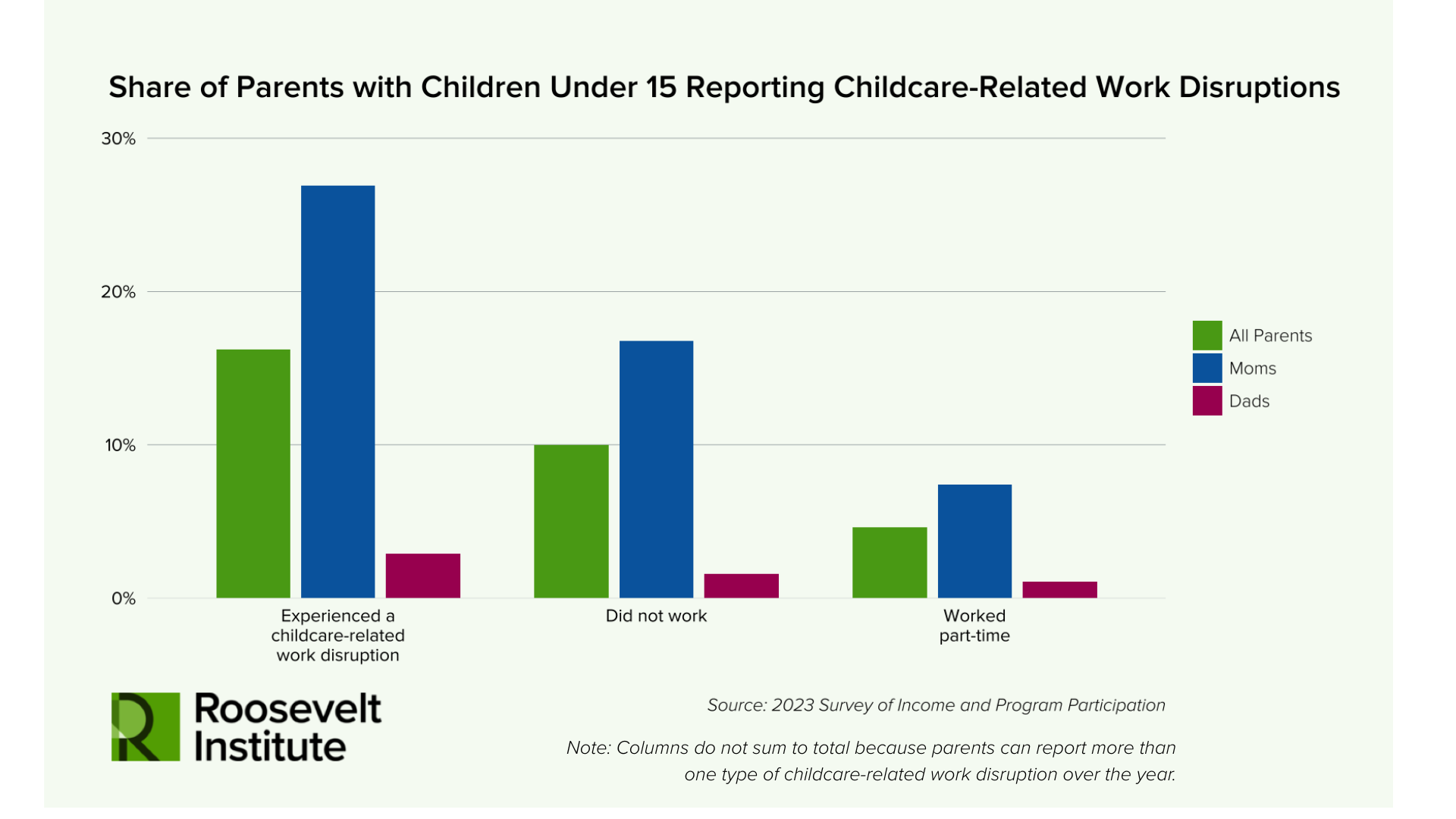
Work limitations were nine times more common among mothers than fathers, with over one-quarter (26.9 percent) of all mothers reporting that childcare affected their ability to work compared to 2.9 percent of fathers. Mothers were much more likely to report all types of work limitations, consistent with prior research and our hypothesis that mothers would experience more childcare-related work disruptions than fathers.
Some groups were more likely to report childcare-related work disruptions than others. In line with expectations, parents of younger children were more likely to experience childcare problems that impacted their ability to work,16 and the likelihood increased with the number of children in the home. Latino families, whom research has shown are more likely to live in childcare deserts, reported more work problems caused by childcare, but there were no differences between white and Black parents.
Table 1
| Group | Share of Parents Reporting Childcare-Related Work Disruptions (1) |
|---|---|
| All parents of children under 15 | 16.2% |
| Age of youngest child | |
| Under 5 | 20.4% |
| Ages 5 to 9 | 14.5% |
| Ages 10 to 14 | 9.9% |
| Parent to teenager ages 15–19 (2) | |
| Yes | 14.3% |
| No | 16.7% |
| Number of children under 15 | |
| 1 | 13.1% |
| 2 | 17.2% |
| 3+ | 23.5% |
| Married or cohabitating (3) | |
| Living with a partner | 15.9% |
| Not living with a partner | 17.5% |
| Parent race and ethnicity (4) | |
| White | 14.6% |
| Black | 14.9% |
| Hispanic | 20.2% |
| All other races | 16.9% |
| Poverty status | |
| Above poverty line | 13.6% |
| Below poverty line | 34.8% |
| Family income (5) | |
| Bottom 20% | 31.3% |
| Second 20% | 17.4% |
| Middle | 15.5% |
| Fourth 20% | 12.2% |
| Top 20% | 11.1% |
| Metropolitan status | |
| Metro area | 16.8% |
| Nonmetro area | 14.4% |
| Educational attainment (6) | |
| Less than high school | 19.9% |
| High school diploma | 17.7% |
| Some college, no degree | 19.4% |
| Associate’s degree | 17.2% |
| Bachelor’s degree | 15.1% |
| Advanced degree | 10.8% |
Notes:
All reported estimates are statistically significant at the .05 level.
(1) The sample consists of parents with at least one child under 15.
(2) Parents with teenagers 15 and older also have younger children in the home.
(3) Differences between partnered and non-partnered parents are not significant.
(4) Differences between Hispanic/Latino and white parents, and differences between Hispanic/Latino and Black parents, are significant. All other differences by race and ethnicity are not statistically significant.
(5) Differences between families in the second and third quintiles are not significant. Differences between families in the top two quintiles are not significant.
(6) Differences between parents with advanced degrees and all other levels of educational attainment are significant. All other comparisons by education are not statistically significant.
Figure 2
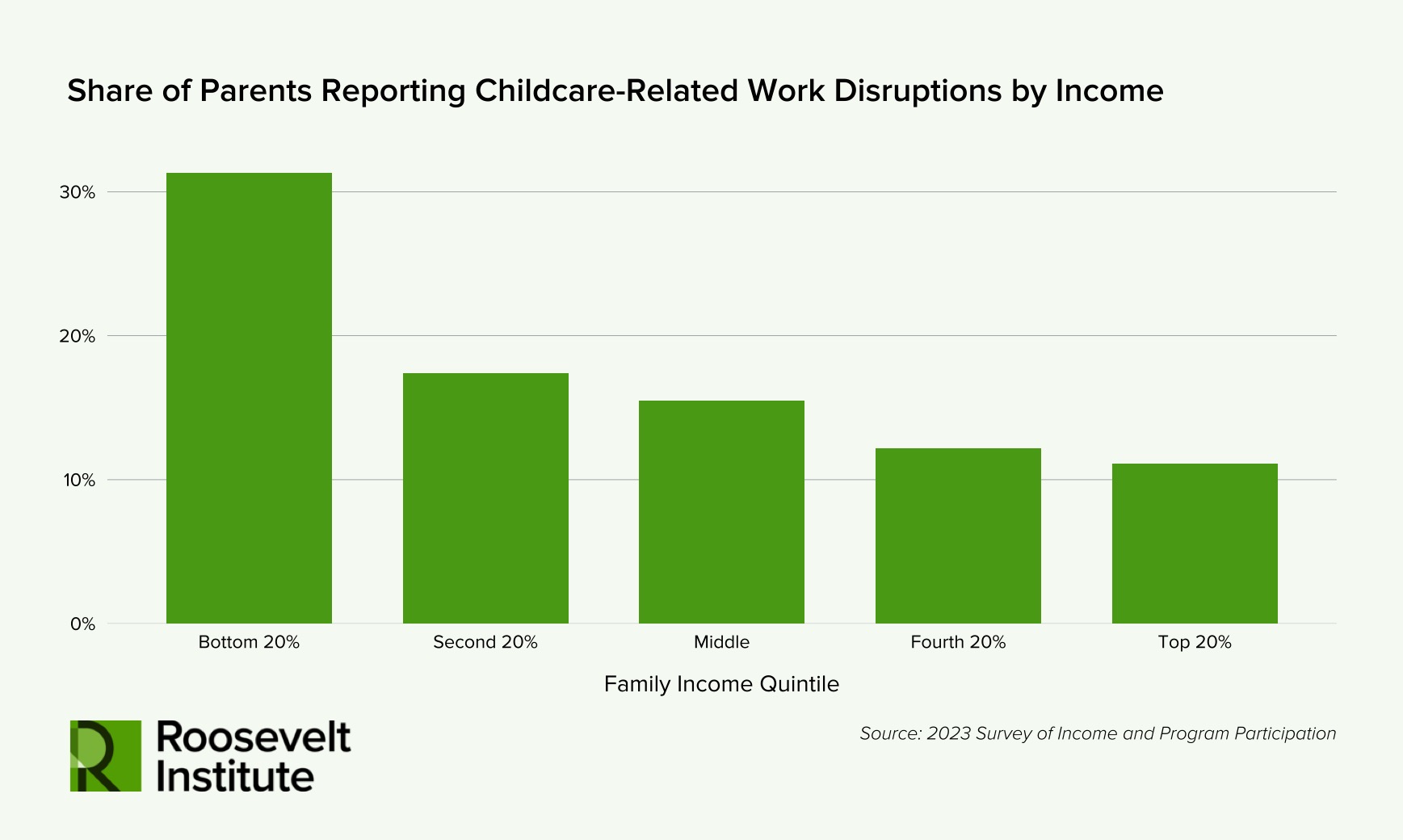
Parents living below the poverty line were the most likely to have their ability to work affected by problems with childcare, with over one-third experiencing childcare problems (34.8 percent). However, it is not possible to determine which is the cause and which is the effect using this data, and there are obvious feedback loops. It could be that parents below the poverty line experience more disruptions because low incomes and insufficient or unavailable childcare subsidies make it more difficult to secure stable, reliable childcare arrangements. It is also possible that the work disruptions caused by childcare problems are so destabilizing for some families that they push families below the poverty line by limiting parents’ ability to work. At the same time, if some families have higher incomes because they are paying for more expensive, but more stable, childcare arrangements that allow them to work more, this would understate the financial strain instability creates. Childcare issues become less common as family incomes increase, though the same issue determining the direction of causality applies here too, since childcare-related work disruptions may be a source of lower family incomes. Higher incomes may reduce the impact of childcare problems on the ability to work, but they do not prevent disruptions entirely; childcare problems impact the work of 1 in 10 parents in the top income quartile (annual family incomes over $180,500).
Other demographic differences had no statistically significant correlation with work-limiting childcare issues, and the data did not support all of the original hypotheses. Single parents were no more or less likely than married or cohabitating parents to have their work disrupted due to childcare. Childcare deserts are more common in rural areas, but there were no significant differences between parents living in metro and nonmetro areas. And while parents with advanced degrees were less likely to have childcare problems, there were no differences in the experiences of parents at any other level of educational attainment.
Parents living below the poverty line were the most likely to have their ability to work affected by problems with childcare, with over one-third experiencing childcare problems (34.8 percent).
Certain types of job characteristics and work schedules were also correlated with a greater likelihood of experiencing disruptive childcare problems, supporting some of the original hypotheses. The share of parents who reported work disruptions due to childcare problems declined significantly as monthly earnings increased, which may be because in two-parent households the lower earner is more likely to cut back their hours or change jobs to one with lower pay but greater flexibility. However, the same problems with the direction of the correlation and feedback loops apply here as well. Parents who are working part time due to childcare problems are likely to have lower earnings compared to those able to work longer hours, for instance.
The ability to work from home did not have a significant effect on the likelihood that a parent would report that childcare problems caused them to leave a job or work part time. While there is evidence that telework allows some parents to maintain their ties to the workforce after having children, the insignificant findings here are consistent with research showing that working from home is not a panacea when facing serious childcare limitations, like those experienced during the pandemic. This intuitively makes sense, as time spent working from home is still time spent working. Parents with very young children are not likely to be able to seamlessly provide care while simultaneously doing their paid job.
Working on weekends, working nights, and working an irregular schedule were all associated with a greater likelihood of reporting childcare-related disruptions. Parents with standard schedules, only working daytime hours on weekdays, were significantly less likely to experience childcare-related work disruptions compared to those working any other type of schedule.
Figure 3
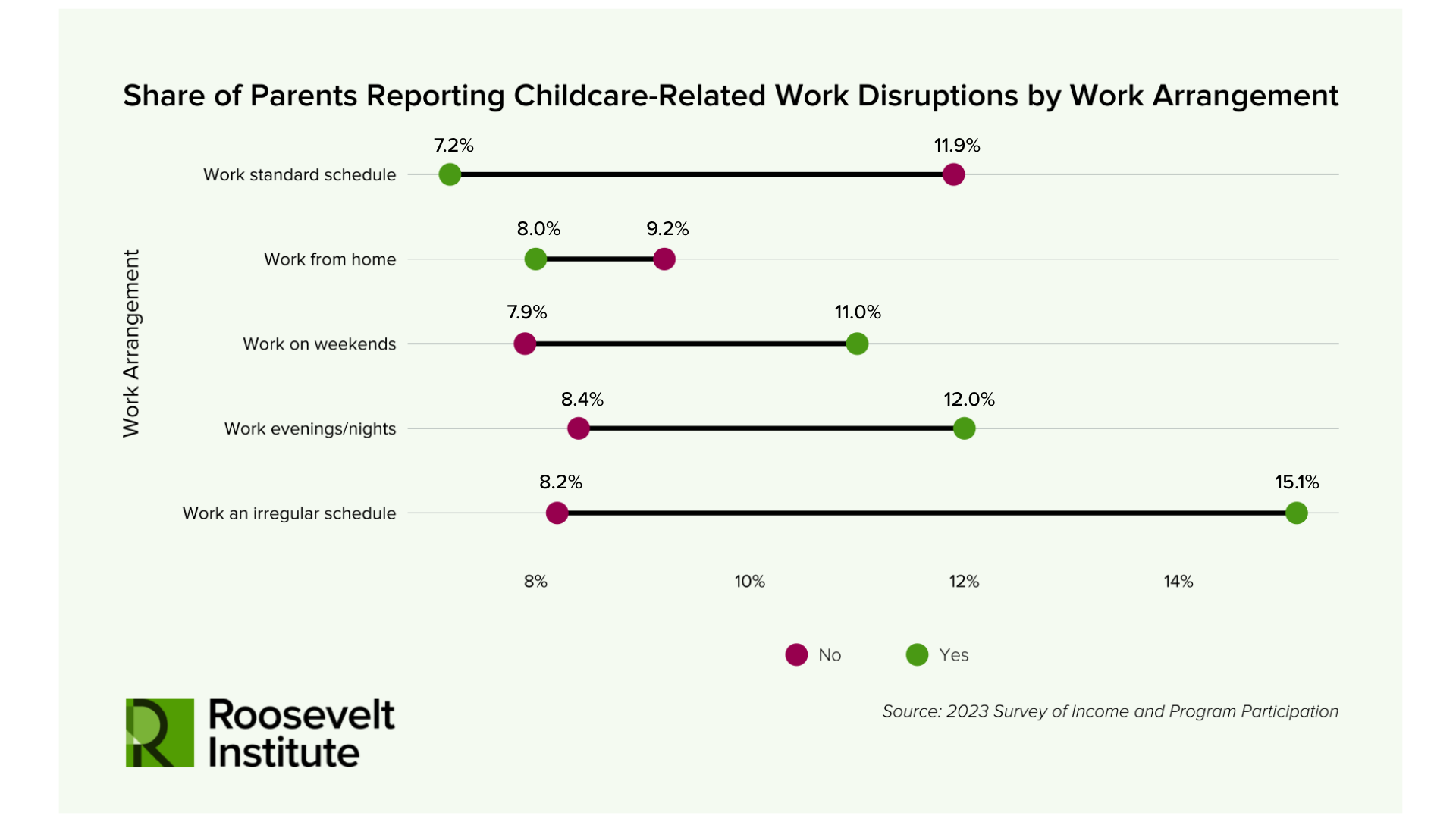
Table 2
| Group | Share of Parents Reporting Childcare-Related Work Disruptions (1) |
|---|---|
| All parents of children under 15 | 16.2% |
| By distribution of monthly wages (2) | |
| Bottom 20% | 26.7% |
| Second 20% | 12.2% |
| Middle | 6.7% |
| Fourth 20% | 4.0% |
| Top 20% | 2.7% |
Notes:
All reported estimates are statistically significant at the .05 level.
(1) The sample consists of parents with at least one child under 15.
(2) Monthly earnings represent a parent’s average wages calculated over months with earnings. Months with zero earnings are not included. Differences between parents with monthly earnings in the third and fourth quintiles, and differences between those in the top two quintiles are not significant.
Not only are childcare issues that cause work disruptions common across many different groups of parents, but they also occur with similar frequency across virtually all types of childcare arrangements. Nearly one-quarter of parents with no formal care arrangement (23.9 percent) reported experiencing work disruptions, compared to one-in-seven parents (14.8 percent) with at least one care arrangement in place.17
Figure 4
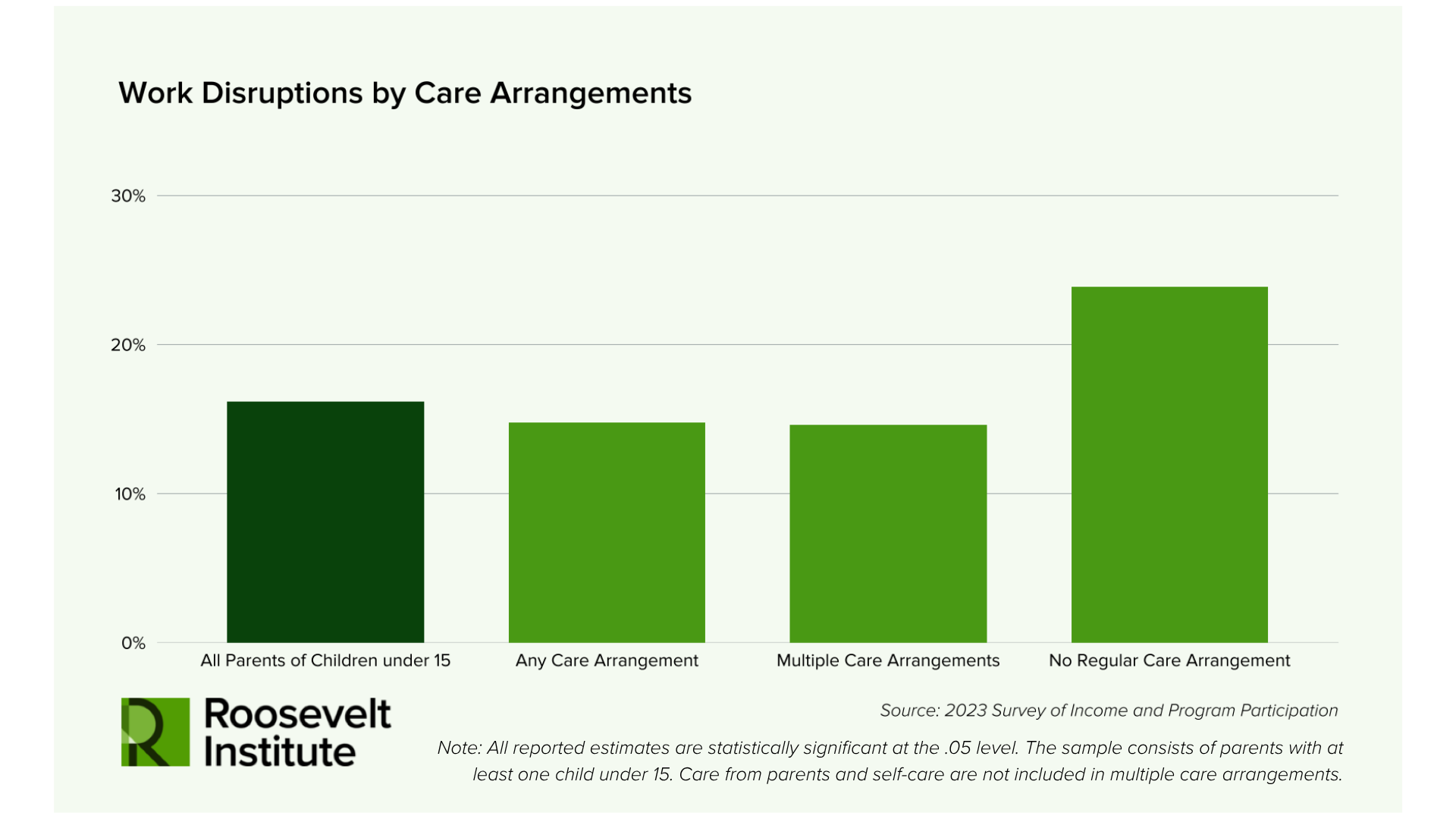
Although some forms of care are more stable than others, no arrangement protects parents from experiencing childcare-related work disruptions. Limiting analysis to parents who had at least one childcare arrangement in place shows very few differences by type of arrangement. Parents who reported that they cared for their children themselves while working or attending school were more likely to report work disruptions, but the very fact that they were caring for their children while on the clock is an example of a childcare-related work disruption.
Overall, having children in a center-based care facility did not have a significant effect on the likelihood of childcare-related work limitations, nor did having older siblings, grandparents, or other relatives who provided care. Rates of work disruptions were similar between parents using any form of relative- or nonrelative-provided care, and parents with multiple care arrangements were no different from those relying on a single form of care.
Probit Modeling
Understanding the landscape of childcare-related work disruptions and which parents are most likely to experience them is an important step toward developing meaningful policy solutions. However, only comparing rates like those shown in the tables above can mask underlying vulnerabilities, and identifying the populations most susceptible to experiencing problems does not necessarily provide insight into the underlying causes.
Many of the factors associated with greater rates of childcare disruptions are correlated with one another. For example, parents whose children attended nursery or preschool were more likely to report work disruptions. This doesn’t mean preschool causes more work disruptions, because while these kinds of care programs differ from other forms of childcare in meaningful ways, the children attending are also by definition younger than school age. Parents of younger children were more likely to experience childcare problems that impact their ability to work compared to those with older children. Once age is controlled for, having a child attend a nursery or preschool program has no significant effect on work disruptions.
In order to establish which variables were most likely to predict work disruptions caused by childcare problems, a probit regression analysis estimated the marginal effects of various demographic characteristics, job qualities, and childcare arrangements on work disruptions.18 In other words, SIPP data was used to estimate the comparative likelihood that a parent would experience a childcare-related work disruption while controlling for differences between parents and families.
The probit models allowed us to estimate the effects of each variable while holding all other variables constant. This lets us isolate and quantify the impact of each factor on the likelihood of having a childcare-related work limitation. As a result, we can test and measure the impact of a characteristic like gender on the likelihood of having experienced a work limitation due to childcare, while controlling for other factors like number of children, education, family income, etc. Results from the complete model are presented below.19
Figure 5
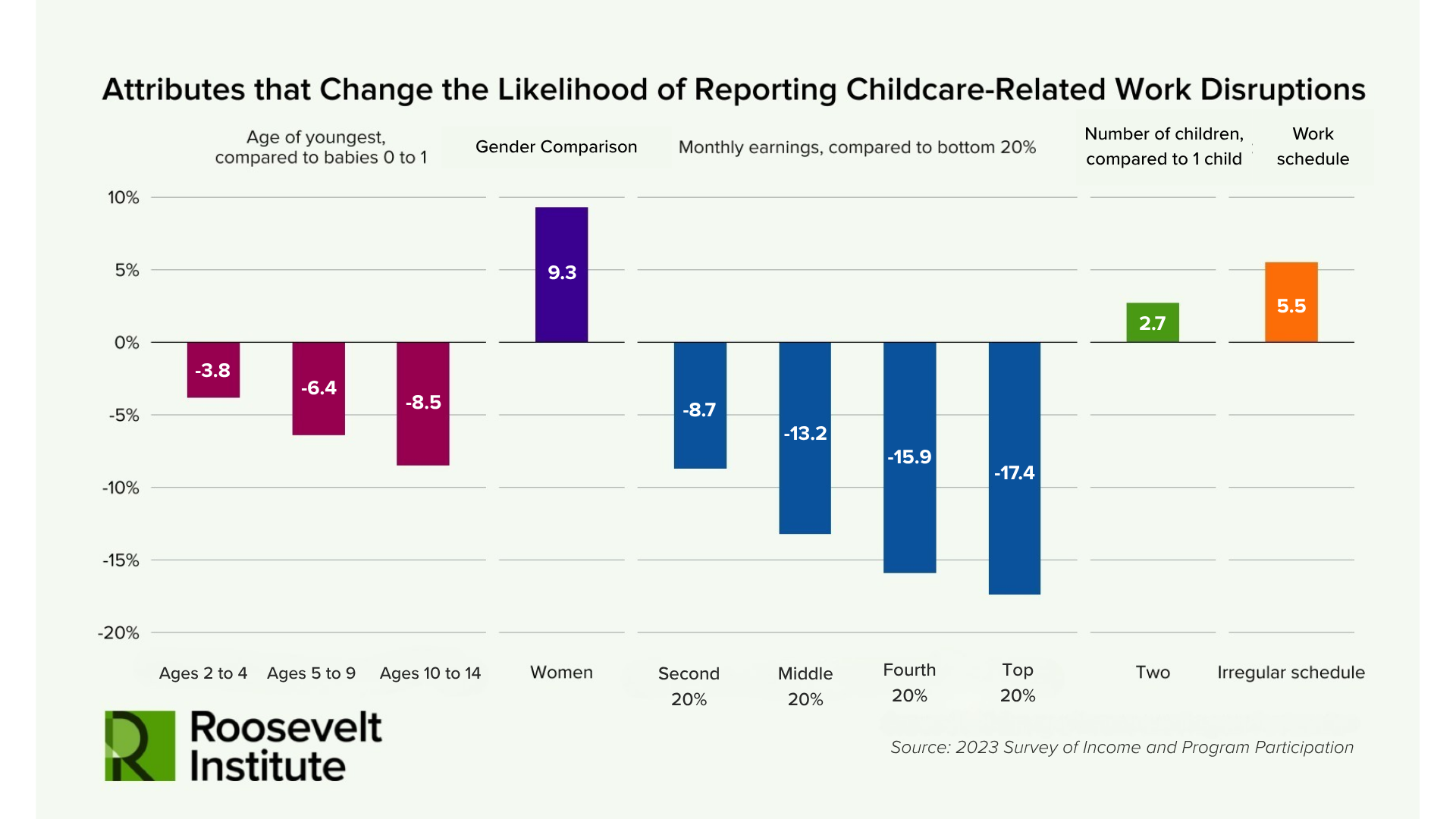
The results from the final model support only a few of the original hypotheses that emerged when looking at each variable in isolation. Gender is the most significant demographic factor influencing the likelihood of child-related work disruptions. In line with expectations, mothers were 9.3 percentage points more likely to experience work disruptions stemming from childcare than fathers. When comparing rates overall, Latino parents were more likely to experience childcare-related work disruptions, but once all other factors are accounted for there were no differences between Latino and white non-Hispanic parents, nor between white and Black parents or parents of any other race or ethnicity.
Parents with younger children were more likely to report work disruptions. As predicted, parents whose youngest was aged 2 to 4 were less likely than those with a baby at home to report childcare-related work disruptions (-3.8 percentage points), as were parents whose youngest was 5 to 9 (-6.4 percentage points) and 10 to 14 (-8.5 percentage points). Consistent with expectations, parents with two children are more likely to experience work disruptions than those with a single child (2.7 percentage points), although surprisingly there were no significant differences for parents with three or more children (likely due to other meaningful differences between families20).
In the full model where other factors are controlled for, being married or partnered, family income, poverty status, and living in a metropolitan area were not statistically significant predictors of care-related disruptions. Parents with advanced degrees were more likely to experience work disruptions than those without a high school diploma. This may be a reflection of having more options; workers with less formal education tend to have lower earnings, so these parents may not have the means to voluntarily scale back their work hours. Alternatively, the jobs available to parents without a high school diploma may actually be more flexible and create fewer conflicts with childcare than the jobs parents with advanced degrees are likely to hold. No other differences by educational attainment were statistically significant.
Monthly earnings was the only job-related characteristic with statistical significance, and it warrants further discussion—this finding should be interpreted with caution, as warned above. Lower earnings could be the result of childcare-related disruptions, rather than a causal factor.
Family income and poverty status were not statistically significant in the full model, suggesting that the connection is not solely the result of having more or less money to spend on childcare solutions. There are reasons to suspect that parents with low-paying jobs are more likely to experience a childcare-related work disruption. For many families, if someone has to reduce their work hours or otherwise modify their work in a way that reduces the size of their paycheck, it makes economic sense for that to be the person who was already getting paid the least in order to minimize the financial toll. So it could be that parents in low-paid jobs are more likely to be the ones to cut their work hours or exit the labor force when childcare conflicts with work, especially if they have a higher-paid partner. It also is plausible that low-paying jobs have other characteristics, such as inflexible schedules or zero-tolerance policies, that make these parents more likely to experience a work disruption when they have childcare problems.
Unfortunately, in this analysis it isn’t possible to separate these possibilities from the parents who experienced an earnings drop because of childcare problems; it is possible that lower earnings are the result of work disruptions, rather than a predictive factor. Average monthly earnings only include the months that a parent was working in order to capture how much someone was paid when they were employed; any months without earnings were excluded so that parents who took time out of the labor force wouldn’t automatically appear to have lower earnings potential.21 But while months with zero earnings were excluded, average wages could still be lower because of prior or ongoing work disruptions, like if a parent had to reduce their hours, take unpaid time off, leave a job mid-month, or stop working and suffer a wage penalty when they return to the labor force.
In further contrast with expectations, only one of the work scheduling variables showed significant impact once other factors were controlled for.22 Working weekends, nights, or otherwise nonstandard schedules were not significant predictors once other differences were accounted for in the model—though working an irregular schedule was associated with a greater likelihood of work disruptions (+5.5 percentage points). This could be because having the financial resources to pay for childcare is more important than working nights or weekends as long as the schedule is predictable, or because low-wage jobs with nonstandard schedules differ in other meaningful ways from those that are more highly paid. Reality is likely a combination of both factors. It is easy to imagine how a highly paid professional who works on the weekends experiences childcare problems differently than a low-paid retail or food service worker, even after accounting for differences in pay.
Types of care arrangements also showed no statistical significance in the full model. Access to childcare is highly dependent on where a family lives and what they can afford. While some forms of childcare are likely to be more stable and dependable than others, once additional factors are controlled for there is no significant relationship between the types of care families use and parents’ likelihood of having a work disruption.
Discussion
Parents should have the option to leave the labor force or scale back at work to spend more time caring for children, but too often this is not a freely made choice. Some parents who experience childcare problems may voluntarily leave or reduce their paid work without a negative impact on their family’s economic security, but this is not the norm. For instance, families with stay-at-home mothers are three times more likely to fall below the supplemental poverty line than those with a working mother.23
As shown in this data, roughly 16 percent of all parents with children under 15, including 27 percent of mothers, experienced a childcare-related work disruption in 2022 and 2023. Mothers bear the brunt of these challenges, and being a woman is one of the few significant predictors of experiencing a childcare-related work disruption. Too many women are pushed out of the labor force because stable, reliable childcare is inaccessible; this often has significant negative consequences for them and their entire families. When working mothers leave a job or reduce their hours, they can lose out on more than just pay and future promotions. Many workplace benefits, like access to health insurance and job-protected leave, are tied to work hours and job tenure. Mothers’ caregiving leads to an estimated average lifetime cost of $295,000 (in 2021 dollars) in lost earnings and forgone retirement income.24 It is telling that so few measurable differences between parents have a significant correlation to childcare-related work disruptions. Decades of research demonstrate consistently a strong relationship between gender and parenting- or childcare-related work disruptions. It is unsurprising that parents of school-aged children would be less likely to have childcare problems or that parents with two children would increase their odds compared to those with only one. And most researchers and laypeople alike would expect higher earnings to serve as a buffer against childcare preventing work, especially since wages are often a proxy for job quality.
It would be impossible for the economy to function without the contributions of working mothers; one out of every seven workers is a mother with a child at home, and without their labor economies would grind to a halt.
But many of the characteristics predicted to help stave off childcare-related work disruptions have no effect once other differences are controlled for. Having a high family income, living in a large metro area, being married or partnered, graduating from college—none of these factors has a significant effect, whether positive or negative. One conclusion that can be drawn from this data is that many parents experience work disruptions every year, and they affect parents from all different walks of life. The data does not distinguish between parents who prefer and can easily choose to work less or not at all and parents whose difficulty accessing childcare prevents them from working as much as they want or need to. But even if some parents are being pushed out of the workplace while others are choosing to stay home, better access to reliable, affordable childcare is an economic imperative.
It would be impossible for the economy to function without the contributions of working mothers; one out of every seven workers is a mother with a child at home, and without their labor economies would grind to a halt.25 Working mothers are central to economic growth, the development and maintenance of healthy communities, and their families’ economic well-being. This analysis focuses on work disruptions, but most mothers work for pay even when their children are very young and even if their wages are lower than they might be if they had fewer caregiving demands. And most mothers who leave the workforce will reenter it as their children grow up.
Meaningful shares of parents reduce their work hours, change jobs, or leave the labor force entirely to meet childcare needs, a phenomenon that unnecessarily hampers economic growth and family well-being. Adequate investments in childcare are vital to the economic, physical, and emotional health of families and communities. This is certainly true at the individual level, given the outsized role most mothers play within families to provide and coordinate care for children or other family members. But the benefits of supportive childcare policies reach far beyond families with young children, because working mothers are likely to be employed in jobs that support the education, care, and employment of others as well.26 Any sound economic strategy for the future must include investments in care infrastructure.
Footnotes
- American Time Use Survey, series IDs: TUU30105AA01042916 and TUU10101AA01042916, 2003–2024, raw data (US Bureau of Labor Statistics, August 6, 2025). ↩︎
- Current Population Survey – Marital and Family Labor Force Statistics, series IDs: FMUP1378865 and FMUP1378864, raw data (US Bureau of Labor Statistics, August 2, 2025). ↩︎
- Patricia Voydanoff, “Linkages Between the Work-Family Interface and Work, Family, and Individual Outcomes: An Integrative Model,” Journal of Family Issues 23, no. 1 (2002): 138–164, https://doi.org/10.1177/0192513X02023001007. ↩︎
- Valeska Araujo, Linden McBride, and Danielle H. Sandler, The Impact of Childcare Costs on Mothers’ Labor Force Participation (US Census Bureau, Center for Economic Studies, 2025), https://census.gov/library/working-papers/2025/adrm/ces/CES-WP-25-25.pdf. ↩︎
- Leah Ruppanner, Stephanie Miller, and Liana Sayer. “Expensive Childcare and Short School Days = Lower Maternal Employment and More Time in Childcare?: Evidence from the American Time Use Survey,” Socius 5 (January 2019): 1–14, https://doi.org/10.1177/2378023119860277. ↩︎
- Sarah Jane Glynn, Who’s Minding the Kids These Days?: An Analysis of Children’s Care Arrangements (Roosevelt Institute, 2026), https://rooseveltinstitute.org/publications/whos-minding-the-kids-these-days. ↩︎
- Reference parents are usually mothers, which has the potential to skew results by gender. However, the vast majority of work disruptions captured in the data are identified from the monthly employment questions asked of the full sample, and analysis excluding the disruption question asked only of reference parents produces results that are nearly identical, with no statistically significant differences. ↩︎
- US Census Bureau, Current Population Survey, 2025 Annual Social and Economic (ASEC) Supplement (Bureau of Labor Statistics, 2025), https://www2.census.gov/programs-surveys/cps/techdocs/cpsmar25.pdf. ↩︎
- The motivations and feelings behind employment outcomes are not captured in the SIPP, so it isn’t possible to separate families in which a parent chooses to cut hours or leave work to care for children from those in which a parent is pushed out. Regardless of the individual reasons why, there are still short- and long-term economic consequences to reducing labor supply after having children. See, for example, Richard W. Johnson, Karen E. Smith, and Barbara A. Butrica, Lifetime Employment-Related Costs to Women of Providing Family Care (Urban Institute, 2023), https://urban.org/sites/default/files/2025-02/Lifetime-caregiving-costs.pdf. ↩︎
- William J. Scarborough, Liana Christin Landivar, Caitlyn Collins, and Leah Ruppanner, “How Do Gender Norms and Childcare Costs Affect Maternal Employment Across US States?” Gender and Society 35, no. 6 (2021), https://doi.org/10.1177/08912432211046988; ↩︎
- Misty Heggeness and Palak Suri, “Telework, Childcare, and Mothers’ Labor Supply,” Opportunity and Inclusive Growth Institute Working Paper 52, 2021, https://doi.org/10.21034/iwp.52. ↩︎
- Emma Harrington and Matthew E. Kahn, “Has the Rise of Work from Home Reduced the Motherhood Penalty in the Labor Market?” National Tax Journal 79, no. 2 (2026): 507–27, https://doi.org/10.1086/740865. ↩︎
- Diane Schilder, Cary Lou, and Laura Wagner, Child Care Use for Young Children During Nontraditional Hours (Urban Institute, 2023), https://urban.org/sites/default/files/2023-05/Child%20Care%20Use%20for%20Young%20Children%20during%20Nontraditional%20Hours.pdf. ↩︎
- Kristen Harknett, Daniel Schneider, and Sigrid Luhr, “Who Cares if Parents Have Unpredictable Work Schedules?: The Association Between Just-in-Time Work Schedules and Child Care Arrangements,” Social Problems 69, no. 1 (2022), https://doi.org/10.1093/socpro/spaa020. ↩︎
- Rasheed Malik, Katie Hamm, and Won F. Lee, “The Coronavirus Will Make Child Care Deserts Worse and Exacerbate Inequality,” Center for American Progress, June 22, 2020, https://americanprogress.org/issues/early-childhood/reports/2020/06/22/486433/coronavirus-will-make-child-care-deserts-worse-exacerbate-inequality. ↩︎
- While not reported in the table, among children under age five there were no significant differences between parents whose youngest was under age two and those whose youngest child was ages two to four. ↩︎
- This result could also be skewed by parents who were pushed out of the labor force by childcare issues, such as no longer having a care arrangement. ↩︎
- John Herbert Aldrich and Forrest Nelson, Linear Probability, Logit, and Probit Models (Sage Publications, 1984), https://doi.org/10.4135/9781412984744. ↩︎
- Four separate probit models were run. The first model included demographic variables such as gender, age, race/ethnicity, and education. The second model included variables related to job qualities, like scheduling variables and earnings. The third model included variables describing childcare arrangements. The final model includes all variables. Results from each of the first three models are available upon request. ↩︎
- For example, compared to families with two children, families with three or more were more likely to have a child under age five, and to be in the bottom earnings quintile. ↩︎
- Months with zero earnings were not included in the averages in order to control for those who left the labor force or became unemployed because they needed to provide childcare. The measure is intended to capture earnings potential rather than total annual earnings divided by 12 months. ↩︎
- This is true for the full model, and for the model that only included job-related characteristics. ↩︎
- Laura Valle Gutierrez, Julie Kashen, and Sarah Jane Glynn, “Who Are America’s Stay-at-Home Moms?” Century Foundation, April 9, 2026, https://tcf.org/content/commentary/who-are-americas-stay-at-home-moms. ↩︎
- Johnson, Smith, and Butrica, Lifetime Employment-Related Costs to Women of Providing Family Care. ↩︎
- US Bureau of Labor Statistics, “57. Employment Status of the Civilian Noninstitutional Population by Sex, Presence and Age of Children, Race, and Hispanic or Latino Ethnicity,” last modified February 20, 2026, https://bls.gov/cps/cpsaat57.htm. ↩︎
- Sarah Jane Glynn and Katie Hamm, “The Economics of Caregiving for Working Mothers,” Center for American Progress, December 10, 2019, https://americanprogress.org/article/economics-caregiving-working-mothers. ↩︎
Acknowledgments
The author would like to thank Katherine De Chant, Suzanne Kahn, Michael Madowitz, Keesa McKoy, Ijeoma Ogbonna, and Aastha Uprety for their feedback, insights, and contributions to this paper. Any errors, omissions, or other inaccuracies are the author’s alone.
Suggested Citation
Glynn, Sarah Jane. 2026. “Parents Need Childcare They Can Count On: New Evidence on Childcare-Related Work Disruptions and Mothers’ Employment.” Roosevelt Institute, August 27.
RELATED RESOURCES
Author

Sarah Jane Glynn
Former FellowAs a former Roosevelt Institute fellow, Sarah Jane (SJ) Glynn researched workers’ experiences in the labor market, particularly the experiences of women, all workers of color, and workers in low-paid jobs.