

The Care Cascade: Interviews from Our Broken Care System
June 23, 2026
By Jessica Calarco


Key Takeaways
- The US care system functions through a “care cascade.” The US relies on a DIY model of care that pushes responsibility downstream. Rather than treating care as a collective obligation, the system expects families to purchase or provide whatever care they need and absorb the costs when they can’t.
- The cascade shifts care from men onto women. The current system reinforces long-standing gender inequalities by making it easier for men to prioritize paid work while women become default caregivers. As a result, women disproportionately shoulder the unpaid labor of raising children, caring for relatives, managing households, and coordinating family life.
- The burden is further pushed onto more vulnerable women. Women with greater economic resources often outsource care to paid workers. Because care work is systematically undervalued, these jobs are disproportionately filled by immigrant women and women of color who face limited economic alternatives.
- The care cascade is unsustainable. By concentrating caregiving responsibilities in the hands of those already carrying the greatest burdens, the system produces burnout, worker shortages, and growing tensions between paid work and caregiving. Without structural change, the people absorbing those costs will continue to pay with their health, their careers, and their financial security.
- The invisibility of care work obscures its human costs. The system depends on care work while rendering much of it invisible. The result is not only an inefficient system, but one that dehumanizes the people whose labor makes families, communities, and the broader economy function.
Introduction: The Problem of Care
Care is the work of anticipating, noticing, and attending to someone’s physical, social, and/or emotional needs. For decades, US policymakers have tried to meet these needs with markets—expecting Americans to purchase whatever care they need for themselves and their families. Of course, not everyone can afford to purchase the care they need, particularly given the concentration of demand.1 And yet, rather than abandon their free-market principles, policymakers have largely thrown care consumers some demand-side subsidies and called it a day.
These subsidies haven’t solved the care crisis, because markets are increasingly incapable of meeting people’s needs for care. Care cannot be easily automated or outsourced,2 particularly at the level of quality that people need to live with dignity (Pugh 2024; Wells and Spilda 2024) and to contribute productively to the economy (Deller 2022; Fenton 2023; Konrad and Mangel 2000). As a result, costs for healthcare,3 childcare, and eldercare have risen rapidly in recent decades—outpacing overall inflation and rising costs for other goods and services in the US economy (Cox et al. 2025; Eaton 2005; Gutierrez and Kashen 2025; Workman 2021; Wynn 2026).4 These rising costs are leading a growing number of US consumers to opt for cheap but risky substitutes (Scott 2025), to look outside of the market for care (Sutherland and Chakrabarti 2025), or to go without the care they need (Sparks et al. 2026). Ultimately, then, and in light of these market failures, subsidy-driven solutions are contributing to the “enshittification” (Doctorow 2023) of the system of care.
One alternative solution is to take care out of the market. This is how many European countries have managed the problem of care (Bettio and Plantenga 2004; Kautto 2002). Social insurance programs can be effective for meeting highly concentrated care needs, like with long-term care for older adults and people with severe disabilities (Karagiannidou and Wittenberg 2022). Public goods, meanwhile, provide a more sustainable, just, and cost-effective system for meeting more universal needs, like for healthcare (Heneghan 2025) and childcare (Bilik et al. 2025).
Current policies incentivize all of us to push care downstream: from men onto women, and from women in privileged positions onto others more vulnerable than them. This cascade is fundamentally unsustainable, as it concentrates care in the hands of those who are already overburdened while obscuring and undervaluing their contributions.
Instead, and in keeping with the broader neoliberal turn in US policymaking (Baradaran 2024; Brown 2019; Oreskes and Conway 2023), the US has denied that the market for care is failing and told people to figure it out on their own (Calarco 2024). The message is: If you can’t pay someone to meet your care needs, then you must meet them yourself or get your family to take care of you.5
The result of this do-it-yourself (DIY) model is that care in the US has reached a crisis point: Americans need care, but most cannot find or afford the quality care they need to live with dignity.6 At the same time, care workers are underpaid relative to other industries (D’Angelo et al. 2024; Dey et al. 2023), leading to shortages and high rates of turnover (Connacher 2023; Gilreath 2023; Hoffman et al. 2023; Sutcher, Darling-Hammond, and Carver-Thomas 2019; Yang, Carter, and Nelson 2021), as all but the most vulnerable workers flee for better-paying work.
Unfortunately, many Americans are unaware (or at least underconcerned) about this crisis because the DIY model has also led to a cascade of care. Drawing on interviews with families navigating our broken care system, I show how current policies incentivize all of us to push care downstream: from men onto women, and from women in privileged positions onto others more vulnerable than them. This cascade is fundamentally unsustainable, as it concentrates care in the hands of those who are already overburdened while obscuring and undervaluing their contributions. In the process, however, this cascade also makes the care crisis less visible and more difficult to solve. To create a new, progressive policy paradigm that treats care as the solution rather than as a problem to ignore, we must first grapple with an accurate picture of what care looks like in the US today.
The Cascading Problem of Care
This paper builds off of scholarship that follows the “global care chain”—in which migrant workers travel to richer nations to become care workers while hiring poorer women in their countries of origin to care for their own children—as well as scholarship tracing racial divisions of reproductive labor to the history of enslavement in the US (Duffy 2007; Estévez-Abe 2015; Glenn 2010; Macdonald 2011; Nadasen 2017; Nazareno et. al 2022). It provides qualitative evidence of these phenomena from families experiencing the system firsthand. My research team and I began this project in 2018–19, recruiting 250 pregnant women from prenatal clinics—including Medicaid-serving clinics—in Indiana, with an eye toward understanding how families navigate the challenges of raising children in the absence of a sturdy social safety net. We invited these women to complete up to six waves of follow-up interviews about their parenting experiences, and, at later waves, we also invited their partners and their friends and family members to participate in interviews (see Calarco 2024).
This data shows that the cascade of care follows grooves carved by market pressures and contoured by racism and sexism.
Pushing Care from Men onto Women
In a market-based model, the easiest way to get your care needs met is to make enough money to pay other people (directly or indirectly) to take care of you, and making more money is easier when you can avoid responsibility for care.7 Meanwhile, in the context of patriarchal systems—and the persistent pay gaps (Fry and Aragão 2025) and motherhood penalties (Deming 2022) they generate—those who can make enough money are disproportionately men, which is why the cascade of care begins with them.
Men’s role in the cascade of care is twofold. It involves, first, hoarding most of the higher-paying jobs (Penner et al. 2022; Shauman 2006; Zheng and Weeden 2023)—leaving underpaid caregiving jobs open to women looking for work (Cohen and Huffman 2003; Dill and Duffy 2022). And it involves, second, focusing most of their energies on breadwinning—leaving women in their families and their communities to manage the informal and unpaid work of care (Calarco 2024; Daminger 2019; England 2010; Gerstel 2000; Hochschild 1989; Wong 2023).8
To that end, consider Dennis and Bethany9 (Calarco 2024). Before they had kids, Dennis was earning about $90,000 a year in IT, while Bethany was making about $30,000 a year as a social worker—despite the fact that Bethany had a master’s degree, and Dennis had only a bachelor’s degree. When their daughter was born, Bethany considered sending her to childcare so she could continue working for pay full time, but she recognized that, with Dennis spending roughly 60 hours a week at the office and with her salary only a fraction of his, she would still end up being the “default parent” (Calarco et al. 2021) and the one handling the bulk of the “second shift” of housework at home (Hochschild 1989). In the context of those trade-offs, Dennis persuaded Bethany to quit her job to become a stay-at-home mom instead, telling her, in his words, that she was unhappy “making dirt” as a social worker and that it wasn’t worth it to “spend half of her paycheck finding care.”
In a market-based model, the easiest way to get your care needs met is to make enough money to pay other people (directly or indirectly) to take care of you, and making more money is easier when you can avoid responsibility for care.
In the end, though, it was Dennis who benefited most from having Bethany at home. Bethany described how being home with the kids meant being “on” from the time the kids woke up in the morning to the time they went to bed. “At that point,” Bethany explained, “I’m exhausted, or worn out, and so I sit down until I fall asleep basically, and then start all over again.” That exhaustion stemmed from the fact that Dennis rarely got home before Bethany started getting the kids ready for bed, which left Bethany to manage not only all the childcare but almost all the housework as well. “It’s just easier if she takes care of all that,” Dennis told me. “That’s the perk of her getting to stay home.”
As Dennis and Bethany’s story illustrates, men’s ability to be the “ideal worker” depends on having someone else to do the work of care. And the easiest and most cost-effective way for men to fill those care needs is often to push that work onto the women in their families.
Pushing Care from Privileged Women onto Those More Vulnerable
Men aren’t the only ones complicit in the care cascade. Current policies also incentivize more privileged women to push the work of care further downstream onto other women even more vulnerable than them (Calarco 2024; Glenn 2010; Macdonald 2011; Østbakken, Orupabo, and Nadim 2023). The more housework and caregiving that women outsource, the more money they’re able to earn for their households (Craig and Baxter 2016; Killewald 2011; Kornrich and Roberts 2018; Raz-Yurovich and Tsachor-Shai 2025). The less that workers are paid for all that caregiving labor, the easier it is for women to outsource more. And the more marginalization that workers face in their lives, the harder it is for them to avoid getting trapped in low-paying caregiving jobs (Calarco 2024; Estévez-Abe 2015; Glenn 2010; Macdonald 2011; Østbakken, Orupabo, and Nadim 2023; Poo 2015).
In the US, the vulnerable workers who get pushed into low-wage caregiving jobs are disproportionately immigrant women and women of color. In the US long-term care industry, for example, the vast majority of home health and personal care aides are women (87 percent), and women of color are vastly overrepresented in that group (BLS 2024a), with immigrants making up a particularly outsized share (40 percent) (Chidambaram and Pillai 2025). Meanwhile, the median salary for home health and personal care aides is only $34,900 a year (BLS 2025a). Similarly, in the US childcare industry, nearly all workers are women (95 percent) (DeMaria 2024), and immigrant women are particularly overrepresented, making up roughly 20 percent of the workforce, and nearly 50 percent in big cities like New York and Los Angeles (Ali, Brown, and Herbst 2024; Coleman-Castillo et al. 2025). These workers, meanwhile, are paid even less than home health aides, with a median salary of only about $32,000 a year (BLS 2025b).
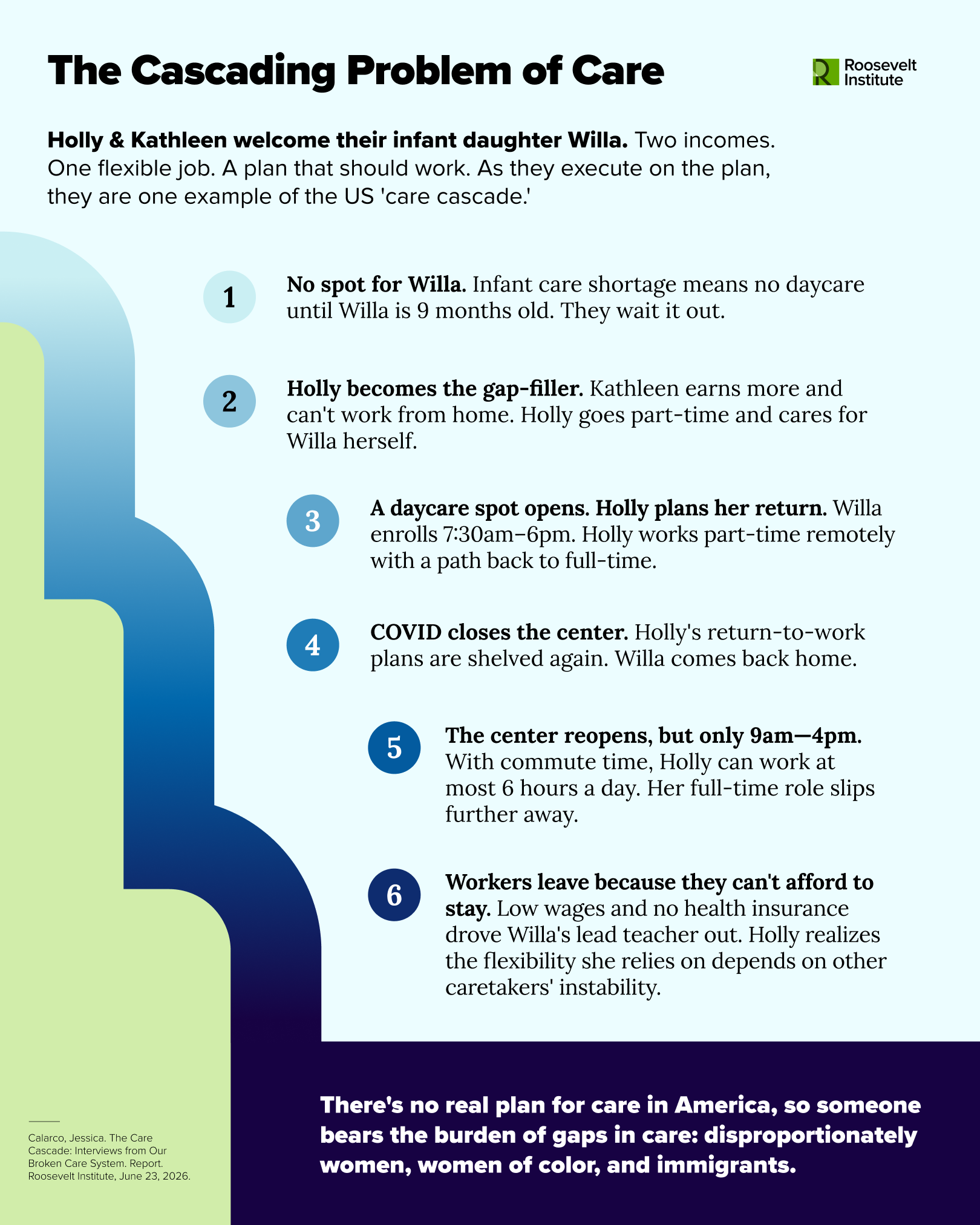
These low wages make it possible for more privileged women to outsource caregiving labor that might otherwise fall to them, as Holly and Kathleen’s story strikingly illustrates. When their daughter Willa was born in 2019, Holly and Kathleen initially planned to split paid work and childcare equally. Yet, like many families (Mader 2022), because of a severe shortage of infant care (Haspel 2019; Malik et al. 2018; Melhorn 2024), they were unable to find a spot for Willa until she was about nine months old. In the meantime, Holly and Kathleen decided that Holly would work part time remotely as a data analyst while caring for Willa, since Kathleen’s job in law enforcement paid more and could not be done from home. That arrangement got increasingly difficult as Willa got older, and Holly was grateful when Willa was finally able to go to childcare. However, almost as soon as they started that new arrangement, COVID-19 closed the center, forcing Holly to set aside the plans she had made with her boss to bump up to a full-time, in-person role. Moreover, when the center did finally reopen months later, it announced that it would only be open from 9 am to 4 pm on weekdays, rather than 7:30 am to 6 pm. This derailed Holly’s plans once again, since, given the commute from the center to her office, she would only be able to work, at most, six hours a day.
In a free-market system, whether and to what extent women can afford to outsource care responsibilities depends on whether they can find other women whose vulnerability leaves them with few options beyond underpaid jobs in care.
Frustrated, Holly went to the center director to complain. And yet, what she learned in the process surprised and humbled her. Pre-pandemic, like most childcare centers, Willa’s had two shifts of workers for each classroom—one to set up in the morning and provide care for the first half of the day, and one to provide care for the second half of the day and clean up in the evenings, with some overlap in the middle for planning time and to give each shift a break without leaving the children alone. During the pandemic, many the center’s staff had left, and the director could not find enough staff to cover two shifts for each room, given the relatively low wages the center was able to pay (at least without substantially raising prices), and given that the center was unable to offer benefits like health insurance coverage to its employees. Willa’s former lead teacher, for example, had left to take a different job that paid more, because not having health insurance had left her with substantial medical debt. Holly told me, “Kathleen and I just felt really guilty about being complicit in this thing where it’s like, ‘Oh, we have all these women of color watching our kids, and we’re not really taking good care of them.’”
That guilt weighed heavily on Holly. Yet she also described the pressure she faced to secure her own economic future. She and Kathleen needed reliable, affordable childcare if they were both going to be working full time, but they probably couldn’t afford to pay more for childcare, especially given that they would need to pay for IVF to have a second child, as they had planned. She told me, “I saw my OB in July, and I was like—okay, we want to have one more kid. I was 35 at the time, and she was like—you should do it now; I’m worried about complications from your age . . . [But] we were basically waiting until we had the money in place—just to be able to pay for more daycare.”
As we see in Holly and Kathleen’s story, women are best able to compete with men in the workforce, avoid economic precarity, and even have more egalitarian relationships with their partners if they can outsource responsibilities like housework and childcare (Arpino and Luppi 2020; Landivar, Ruppanner, and Scarborough 2021; Ruppanner et al. 2019). Yet, in a free-market system, whether and to what extent women can afford to outsource care responsibilities depends on whether they can find other women whose vulnerability leaves them with few options beyond underpaid jobs in care (Calarco 2024; Estévez-Abe 2015; Glenn 2010; Macdonald 2011; Østbakken, Orupabo, and Nadim 2023; Poo 2015).
When care workers go unseen, the care they perform can seem to happen as if by magic. This makes the workers themselves seem expendable, even when their labor is what allows their employers to have healthier, happier, and more productive lives.
In the US today, much of that unseen care work is done by immigrants (Ali, Brown, and Herbst 2024; Chidambaram and Pillai 2025; Coleman-Castillo et al. 2025). One in five careworkers nationally are immigrants, and 97.6 percent of them are women (American Immigration Council 2025). The Trump administration, in its choice to vilify immigrants and enact mass deportations and new restrictive visa regimes, sought both to take advantage of the invisibility of their labor and eliminate it without consequence. Its efforts paradoxically made immigration’s crucial role in our care system increasingly visible (Álvarez 2025; Sainato 2026). But visibility alone will not make care more equitable or more sustainable.
The Unsustainability of a DIY Solution to the Problem of Care
The inequities of the care cascade make a DIY “solution” to capitalism’s care problem highly unsustainable. The DIY model creates tension between paid work and caregiving responsibilities, makes paid caregiving jobs undesirable, concentrates care in the hands of those who are already overburdened, and overwhelms the proverbial village to the point where it can no longer support those who need informal care.
Creating Tension Between Paid Work and Caregiving
Under a DIY model, responsibility for care falls to individuals and families, who are expected to take care of their own. The problem, however, is that the members of families who need high levels of care—like the children, the sick, and the elderly—are often unable to perform paid work. And so the members responsible for supporting the family financially are often the same ones responsible for care. Those responsibilities tend to conflict with each other, particularly in the context of pressures toward overwork (Cha 2010; Craig and Brown 2017; Milkie, Nomaguchi, and Schieman 2019; Petersen 2020; Schor 1993)10 and intensive demands for care (Collins 2019; Damaske 2011; Stone 2007). Those conflicts then lead to feelings of stress and burnout (Mikolajczak, Gross, and Roskam 2019; Petersen 2020; Pugh 2015; Schor 1993), particularly for women, who typically carry the bulk of their families’ unpaid caregiving responsibilities, even when they are the primary breadwinner (Calarco et al. 2021; Collins 2019; Fry et al. 2023; Hochschild 1989).11
Consider Erica and Gabe (Calarco 2024). Before their first child was born in 2014, Gabe was working full time as a marketing manager, and Erica was working full time as a network engineer at a computer data center. Combined, they had a six-figure annual income, but they were also trying to pay down their mortgage and more than $100,000 in student loans. After college, Erica and Gabe had moved far from family in pursuit of high-paying jobs,12 which meant that, when Erica became pregnant, they didn’t have any family nearby to help them with childcare. So they would have to pay $2,000 a month or more for full-time childcare, even for times when they did not need care, like during weeks when Erica was required to work a night shift and was home during the day.13 Erica worried about whether they could afford those costs, and she worried about who would take care of the baby during the weeks when she had to work nights or evenings and Gabe couldn’t be home, because he was regularly working 60-plus hours a week and also taking classes toward a master’s degree part time. Erica asked her manager if she could switch to working only day shift, and, when he said no, Erica decided that her best option was to switch to a much lower-paying, part-time, remote-work job as a data analyst and to send her daughter, and later her son, to the three-hour-a-day childcare program at their church.
“It wasn’t really a decision. It was just this by default. Because he’s full time. So, you know, whatever pays the most wins.”
When the COVID-19 pandemic hit in 2020, Erica was earning so much less than Gabe, and was already doing so much more of the parenting, that they never talked about how they would manage care for their children when schools and childcare programs closed. That work just fell to Erica, while Gabe holed up to work in their bedroom each day at home. As Erica explained, “It wasn’t really a decision. It was just this by default. Because he’s full time. So, you know, whatever pays the most wins.” Being the default parent also took a toll on Erica’s mental health and her relationship with her husband and her kids. As she described in 2020: “I’ve definitely been the one that’s been more frustrated and less patient with the kids. . . . Every day the house gets destroyed—toys everywhere . . . [and the kids] get up early, so by 8 pm, that’s hour 13 of nonstop togetherness, and I think at that point, I’m done. And it’s like—okay, goodnight, go to bed.”
Erica and Gabe might have been able to better manage the pressures of paid work if they had more support with housework and childcare. Yet, like so many other families, they ran up against shortages in the availability of affordable, high-quality care.
Making Paid Caregiving Jobs Undesirable
These shortages stem from the way our DIY system makes paid caregiving jobs undesirable. Because care can’t be easily automated or outsourced, the easiest way to make care affordable enough for just some portion of the people who need it is to keep care work deeply underpaid. That underpayment, however, makes caregiving jobs unsustainable, even for people who enjoy the work involved. And that unsustainability pushes workers out of caregiving fields, leading to high rates of turnover and widespread shortages of care (Butryn et al. 2017; Ingersoll and Tran 2023; Khattar and Coffey 2023; Lin, Lin, and Zhang 2016; Lippert, Rosing, and Tendick-Matesanz 2020; Quinn et al. 2021; Watson et al. 2022).
Take Sylvia, a former home health aide I interviewed in my research (Calarco 2024). As a teenager, Sylvia had plans to go to college, but she ended up taking a job as a home health aide instead after her brother and his girlfriend began struggling with drug addiction, leaving Sylvia and Sylvia’s mother to raise Sylvia’s brother’s kids. As a home health aide, Sylvia provided full-time, hands-on care for people who were elderly and infirm. Sylvia liked working with her patients, but she was barely making minimum wage for the work she was doing, and she had to cover work-related costs—like the cost of gas for driving her charges to appointments and errands—out of her own take-home pay. “Like, they wanted us to take [the patients] to the doctor,” Sylvia told me, “but they took that benefit away from us—paying us to do that, like for the mileage. They took that away. And then they just added more duties, but they weren’t raising the pay. . . . They were taking everything away and expecting us to do more work for less pay.” In light of those frustrations, Sylvia was eager to quit her job. And she did so as soon as she was able—she met and married a man almost twice her age, and, after she became pregnant, he convinced her that she should quit her job and stay home.
“Like, they wanted us to take [the patients] to the doctor,” Sylvia told me, “but they took that benefit away from us—paying us to do that, like for the mileage. They took that away. And then they just added more duties, but they weren’t raising the pay. . . . They were taking everything away and expecting us to do more work for less pay.”
While shortages are particularly acute in fields like home health care, which do not require licenses or college degrees, they can also be seen among licensed professional caregivers (Butryn et al. 2017; Ingersoll and Tran 2023; Khattar and Coffey 2023; Lin, Lin, and Zhang 2016; Lippert, Rosing, and Tendick-Matesanz 2020; Quinn et al. 2021; Watson et al. 2022). These shortages stem, at least in part, from the tension between the high costs of obtaining the degrees and certifications needed to work in professional caregiving jobs and the relatively low salaries that even college-educated care workers—like teachers and social workers—are paid (Amin et al. 2021; Fakunmoju and Kersting 2016; Fiddiman, Campbell, and Partelow 2019; García et al. 2023; Park and Coles 2022).14 While these workers generally have salaries at or above the US median income (BLS 2025b, 2025c, 2025d), they are typically paid less than non-care workers with similar levels of education (Allegretto 2023; Budig, Hodges, and England 2019; England et al. 2002). K-12 teachers, for example, are paid less, on average, than the median worker with a bachelor’s degree (BLS 2024b), despite the fact that more than half of US K-12 teachers have at least a master’s degree (Irwin et al. 2023). And recall how Bethany, a social worker with a master’s degree, was making only a third of what her husband Dennis was making with a bachelor’s degree in IT.
Worker shortages in caregiving professions—like K-12 teaching, nursing, social work, and mental healthcare—are likely to become increasingly prevalent as earnings in these fields stagnate (Gautham and Folbre 2024; Henry 2025; Walker 2022) and as policymakers push more of the costs of higher education onto students and their families.15
Take Lillian, for example, a social worker and mental health counselor I interviewed in my research. After finishing her master’s degree in counseling psychology, Lillian moved with her husband back to her hometown in Indiana, where the job she could find there was as a social worker, working for the Department of Children’s Services for about $30,000 a year. At the time, Lillian, who was pregnant with her first child, decided the low salary was worth it, because she could rely on her retired mother for free childcare. A few years later, however, Lillian’s mother was diagnosed with terminal cancer, which left Lillian scrambling to figure out a new childcare plan.
Given her low salary—and the fact that her husband, an African immigrant, was trying to finish his bachelor’s degree while making less than $10,000 a year working part time for an apartment-leasing company—Lillian couldn’t afford to pay market rates for childcare. And so, Lillian decided that her best option was to quit her job and work from home as an independent contractor, providing online mental health counseling while caring for her kids full time.
With the switch, Lillian was able to make more money working fewer hours, but she had to give up her employer-sponsored health plan and pay more each month for a plan purchased through the Affordable Care Act’s healthcare marketplace, which left the family worse off financially in the end. As Lillian explained, “We don’t make savings. We make our bills, but some bills I let sit and wait. Like, we’ll sit on this credit card bill. We’ll let this psychiatrist visit wait. We’ll pay that later. You know? There’s a lot of financial awareness of what’s coming and what’s going out.”
The stress of that constant calculus took a toll on Lillian, who sometimes fantasized about quitting her job to care for the kids full time. As she explained, “I just wish that as parents you could have the space to take care of your mental health, to take care of your children, and the basic needs that they have. And to not constantly worry that you were going to go bankrupt because of making decisions between those things.”
Concentrating Caregiving Responsibilities
Those competing priorities are amplified in a DIY system because of how such a system concentrates caregiving responsibilities in the hands of those who are already overburdened with care. That includes members of the so-called sandwich generation—adults who find themselves caring for their aging parents while they still have their own children at home (Grundy and Henretta 2006; Riley and Bowen 2005). This sandwich generation is growing rapidly, such that, as of 2025, roughly 15 percent of American teens and adults had unpaid eldercare responsibilities, and more than 20 percent of these caregivers were also caring for a child (BLS 2025b).
The modal sandwich-generation caregiver is a woman between the ages of 45 and 64, and she’s probably also working for pay full time (BLS 2025b).16 Given all that she’s juggling, others might see her as superhuman, and thus as capable of handling such an outsized set of responsibilities for care. And yet, beneath the surface, such caregivers are often barely holding it together, struggling with their mental health, their relationships, and their careers (Burke 2017; Cheng and Santos-Lozada 2024; Riley and Bowen 2005).
Consider, for example, Patricia, another woman I interviewed in my research. Before the COVID-19 pandemic, Patricia was working full time from home as a customer service representative for a health insurance company. Patricia hated the job, which paid less than $10 an hour, but she kept it because working remotely meant that she did not need to find afterschool care for her elementary-aged children or make backup arrangements if her toddler got sick and had to stay home from childcare. When the pandemic hit, however, that job also meant that Patricia became the default parent (Calarco et al. 2021)—she and her husband Rodney never even discussed who would care for the children while their school and childcare center were closed, because his job in construction required him to leave the house every day. Having the children at home was taxing for Patricia, in that they were constantly disrupting her while she was trying to do her paid work. As she explained, “You start getting a headache. And they want you to sit and listen to them talk and everything. And it’s like, ‘Just go! Please! Everybody just leave me alone!’” At the same time, Patricia felt guilty for being short with her children, chiding herself in saying, “When it’s time to clock out, I need to not clock out mentally as a mother, too.”
Given that guilt, and given that Patricia also became unexpectedly pregnant with twins during the pandemic, leaving Patricia exhausted, she decided in the fall of 2020 to cut back to four days a week of paid work instead of five. That extra day off, however, quickly got gobbled up with eldercare responsibilities, as Patricia felt compelled to use the time to take her aging mother to doctor’s visits and to the grocery store. Sighing, Patricia explained the letdown she felt when “your whole day that you had to yourself is dedicated to running errands for someone else.”
After the twins were born, things got even more complicated for Patricia, because of a three-month gap between the end of her maternity leave and when a childcare spot would open for the twins. “I was depressed,” Patricia recalled, “on how I was going to keep my job and still trying to manage the needs of my babies, my twins. They’re getting older, and your job only lets you be on maternity leave so long before they’re just like, ‘okay, boom, it’s time, you have to come back.’ And I didn’t have childcare. . . . It was a struggle trying to answer calls and type and try to burp a baby and feed a baby and change a baby. And oh, the two babies have had a [diaper] blowout at the same time—that just about had my hair out.”
The stress of that time also drove a wedge between Patricia and Rodney, whom Patricia resented for not helping her more, and who ended up leaving Patricia to raise all five kids on her own. “It’s pretty depressing,” Patricia said mournfully, a few months after Rodney left, “to have two brand-new babies and you’re doing this by yourself because you and your partner couldn’t get along. . . . And it’s not actually like they’re trying to be part of the kids’ lives anyway—they’re not getting their own life together enough to be able to be a balance for the kids. But it’s just all on you. It’s all on you.”
Overwhelming the Village
Our DIY solution to the problem of care has overwhelmed the proverbial village to the point where it can no longer meet most people’s needs (Hacker 2019; Pugh 2015). In 2021, for example, I conducted a survey of more than 2,000 families with children from across the US.17 I asked participants about where they could turn for help if they needed it in the next month.18 Only 31 percent said they had someone they could count on to loan them $200, only 29 percent said they had someone they could turn to for a place to live, and only 29 percent said they had someone they could count on for emergency childcare.19 Maybe unsurprisingly, participants in lower-income families were less likely than participants in higher-income families to have access to these kinds of informal support.20
Along those lines, take Tara, another woman I interviewed in my research. Growing up, Tara’s life was tumultuous—her father was in prison, and her mother was addicted to drugs and alcohol. So, when Tara became pregnant in high school in 2013, she saw it as an opportunity to set out on her own. She left school and married her boyfriend, and they both found jobs at a nearby manufacturing facility, making a combined $40,000 a year. That income was too high to qualify for childcare vouchers in Indiana, where Tara was living. Yet, it was not enough to cover market rates for childcare while also leaving money for other essentials like food and rent. So Tara asked her mother to care for her daughter, and later for her second daughter as well, paying her mother what little she could. Tara hoped that her mother would be able to handle the responsibility, despite her history with addiction. And Tara was devastated when she learned that her mother had relapsed and sold Tara’s mother’s dog for money for drugs. Unable to continue trusting her mother with the safety of her children, Tara decided that her only option was to drop out of the workforce to stay home full time, despite the fact that doing so would cut her household income almost in half and push the family below the poverty line.
Essentially, by incentivizing Americans to push the work of care downstream, American care policy is crushing the caregivers and leaving them scrambling to meet care needs. This system is not only inequitable but also highly unstable. Because it forces those who are most vulnerable to shoulder the greatest responsibility for care work. And because it leaves many people—particularly the most marginalized—unable to access sufficient high-quality care.
The Inhumanity of a DIY Solution to the Problem of Care
The care cascade is both inequitable and unsustainable. And yet, Americans are often willing to overlook these problems, because sexist narratives make it seem “natural” for caregiving to fall to women, because racist narratives makes it seem reasonable for underpaid work to fall to members of racially marginalized groups, and because the market obscures the humanity of those—disproportionately women, and especially women of color and immigrant women—left struggling under the resulting deluge of responsibility for care. Put differently, the trickle-down of care is easiest to justify when we can’t see the harm we’re causing downstream. Recall from Holly’s story, for example, how her frustration with her childcare center—for offering only part-time rather than full-time hours, despite the high costs she was paying—evaporated once she learned that the center’s limited hours stemmed from worker shortages, which stemmed, in turn, from the fact that the center—like most childcare centers—could not afford to offer its workers health insurance or paid sick leave or to pay those workers a living wage (Rudich et al. 2021). Faced with that reality, Holly’s frustration dissolved into feelings of guilt because, in Holly’s words, “we have all these women of color watching our kids, and we’re not really taking good care of them.” That revelation, however, did nothing to solve Holly’s childcare problem, which was preventing her from securing her family’s financial future—and from being able to afford the IVF she would need to have a second baby—by working for pay full time.
Managing this tension might have been easier if Holly could put the genie back in the bottle—not knowing (or at least not actively considering) that her own sense of security hinged on her ability to exploit someone in a more vulnerable position than her own. In that sense, a DIY “solution” to the care problem incentivizes all of us to close our eyes as we dump care downstream. To not see the people who grow our children’s minds and bodies, listen to their stories, and lovingly tend their playground-scraped knees. To not see the people who bathe and cook for our aging parents, take them to doctor’s appointments, and hold their hands as they wistfully recall better days. To not see the people who sweep our crumbs and wipe our spills and make the spaces we inhabit more livable. To not see the people who check our vitals, take our medical histories, dress our wounds, and administer lifesaving medications. To not see the people who dry-clean our clothes or drop off our grocery deliveries. The invisibility of caregiving labor goes hand-in-hand with the illusion that people can and should take care of themselves. That illusion, in turn, is easiest to maintain when we vilify those who cannot meet their own care needs, and particularly those who rely on the government for support.
Famously, during his 1976 presidential campaign, Ronald Reagan told and retold the story of the so-called welfare queen (New York Times 1976). Demonizing all recipients of government benefits by focusing on one extreme (and exaggerated) case, Reagan accelerated decades-long hostility toward government assistance programs and vitriol toward the beneficiaries (Levin 2019; Edin and Lein 1997). This hostility even crossed party lines, with President Bill Clinton signing the 1996 Personal Responsibility and Work Opportunity Reconciliation Act and declaring that he would “end welfare as we know it” by imposing work requirements and time limits on benefits (New York Times 1996).
Early iterations of this era of intense anti-welfare rhetoric particularly targeted the Black beneficiaries of these programs; more recent rhetoric has updated this to include Latino and immigrant populations, as well as low-income white families (Powell and Rich 2018; Fraser 1993; Gans 1995; Soss, Fording, and Schram 2011; Watkins-Hayes and Kovalsky 2016). In his bestselling book Hillbilly Elegy, for example, Vice President JD Vance claimed, “I have known many welfare queens; some were my neighbors, and all were white” (Vance 2016).
This rhetoric has real effect: Today, for example, nearly half of US adults think government aid to the poor does more harm than good, because, in their view, it makes poor people too dependent on the government rather than pushing poor people to try to take care of themselves (Pew Research Center 2024).21 Meanwhile, surveys show that more than 4 in 10 Americans blame the need for government assistance on poor people’s bad choices, and roughly a third of Americans believe that poor people are poor because they just don’t work hard enough (Horowitz, Igielnick, and Kochhar 2020).22
These ideas have become commonplace even among people who rely on government benefits themselves (Calarco 2024; Cramer 2016; Hochschild 2016; Mazelis 2016). Take Akari, whom I first met in 2019, when she was living in Indiana with her fiancé Theo, whom she had met in college before they both dropped out when the costs got too high. Theo had a small home maintenance business that brought in about $30,000 a year, while Akari stayed home full time with their two young children. Akari, who had previously worked in retail, had initially planned to continue working for pay after having children, but her and Theo’s combined salaries were simultaneously too low to cover the costs of childcare and too high to quality for their state’s childcare subsidy program, and they did not have family nearby who could care for the kids full time.
Life on a single income was rarely easy for Akari and Theo—they had to keep postponing wedding plans and plans to visit Akari’s mother, who had moved back to Japan after divorcing Akari’s father when Akari was in high school. The tenuous stability they had built together shattered suddenly when Theo died unexpectedly during the summer of 2020 (though not from COVID-19). The couple had no savings—they had put everything into Theo’s business—and Theo, like roughly half of US adults, had no life insurance (Wood and Leyes 2025).
When the rent came due, Akari had no way to pay it and no way to find a job, because, at the height of the COVID-19 pandemic, local businesses were furloughing or laying off workers (Perry, Aronson, and Pescosolido 2021), and childcare centers were closed (Calarco et al. 2021). Working with a local community organization, Akari applied for a range of government assistance programs, including Temporary Assistance for Needy Families (TANF), Women, Infants, and Children (WIC) assistance, and Section 8 housing. Yet she received less than $300 a month in cash benefits—not even enough to cover rent or car insurance (Thompson, Azevedo-McCaffrey, and Carr 2023)—and her WIC benefits did not cover diapers and wipes (Randles 2022). And so, while waiting for a spot to open up in a Rental Assistance Demonstration (RAD) affordable housing community, Akari moved with her children into a shelter for unhoused families and began relying on food pantries to help make ends meet.
The idea of being on government assistance was challenging for Akari, who had grown up in a conservative community and identified as a conservative Republican herself. She justified her own reliance on the social safety net by drawing a moral line between herself and other recipients—a line that closely traced the Reagan-esque stereotypes she had heard. “I believe welfare is temporary,” Akari told me. “It’s not supposed to be a lifestyle. It’s other people’s tax money. So, when you need it, you use it, you appreciate it. But it’s not a lifestyle.” Akari effectively reassured herself that she was more deserving of welfare than the other stereotypical recipients she imagined, because she treated welfare as a temporary crutch to lean on in a crisis, while the imagined stereotypical recipients leaned into welfare as a lifestyle.
The reality, of course, is that assistance is temporary for everyone who uses it, and that it’s impossible to support any kind of lifestyle on welfare alone. In Indiana, the program comes with a two-year lifetime limit on benefits for adults, and a five-year limit for kids (Family and Social Services Administration 2025). Meanwhile, the cash benefits provided by the program are so meager that they fall far short of meeting people’s basic needs (Edin and Lein 1997; Thompson, Azevedo-McCaffrey, and Carr 2023). Recipients are expected to begin looking for paid work immediately, but every dollar they earn cuts the value of the benefits they receive (CBPP 2021).
Conclusion
As the US confronts authoritarianism (Gambino 2025; Herman and Benson 2025), Americans might be tempted to see a return to basic neoliberalism as a lesser of two evils. Take, for example, the speech that Democratic Senator Elissa Slotkin gave in response to President Donald Trump’s 2025 address to the joint session of Congress (Associated Press 2025). Slotkin invoked President Ronald Reagan, arguing that, unlike Trump, “Reagan understood that true strength required America to combine our military and economic might with moral clarity.” Recall, however, that Reagan—with support from advisors like Milton Friedman and Friedrich Von Hayek—played a key role in promoting the kind of moral accounting that led us into our current mess. His vilification of welfare recipients—and his willingness to lean into racist and sexist tropes in doing so—generated widespread disdain for those who need the government’s help to care for themselves and their families. That vilification opened the door for decades of policies that have eroded the US social safety net, making it difficult for Americans to find and afford the quality care they need to live with dignity, and difficult for care workers to make ends meet, given how little they are paid.
US policymakers have had plenty of opportunities to take care out of the market. Instead, they opted time and again for a DIY “solution” to capitalism’s problem of care—telling Americans to find a way to get their needs met, despite the high costs and hurdles involved.
As the stories of people living in this system show, finding a way usually means pushing care downstream. Americans meet their own care needs by exploiting others whose marginalization and vulnerability leave them with little choice but to do the work of care for little or no pay. This approach is deeply unsustainable. And yet, racism and sexism render care work largely invisible, making it easier for Americans further upstream in this system to ignore those who are drowning in the flood of care below.
Ultimately, returning to Reagan as our compass risks leading us right back to where we currently find ourselves. Instead, what the US desperately needs is a new progressive policy paradigm that treats care as a solution to society’s problems, rather than as a problem to be solved. Under such a paradigm, the work of care would be shared, sustainable, and systematized, addressing labor inequities at home and in the broader US economy. And under such a paradigm, no one would be forced to suffer the indignity of being denied the care they need, allowing people to live longer, healthier, and happier lives (Case and Deaton 2020), and easing some of the resentments that heighten the appeal of Reagan’s neoliberal paradigm (Anderson 2023).
Footnotes
- With healthcare, for example, 20 percent of patients account for roughly 80 percent of all healthcare spending in the US (McGough et al. 2026). Similarly, and with respect to childcare, only 16 percent of US households have children under six years old (Hemez, Buck, and Anderson 2024), and 70 percent of those children live in households where all the adults are employed (Gibbs and Peeks 2026). This unequal distribution means that people who need the most care will struggle to afford it, particularly if their care needs also prevent them from working for pay. ↩︎
- Even if machines can perform some forms of caregiving labor, humans still far surpass technologies in the quality of care they can provide (Brown and Halpern 2021; Guilherme 2019; Kostyrka-Allchorne et al. 2019; Wells and Spilda 2024). ↩︎
- While healthcare is often considered distinct from other care sectors, parts of the healthcare system follow similar patterns, such as with Certified Nursing Assistants, Licensed Practical Nurses, paramedics, pharmacy techs, and workers who manage medical records. Wages in these extremely hands-on jobs are much lower than in other parts of the healthcare system, resulting in shortages of care. ↩︎
- In other sectors of the economy, automation and outsourcing have allowed firms to produce more with fewer workers. Buoyed by this increased productivity, firms in these sectors could have lowered consumer prices. And yet, because of capitalism’s profit pressures (Beckert 2013), firms have instead tended to keep prices high, leading to increased profits, some of which they have shared with their remaining workers in the form of higher wages (Baumol 2012). Rising wages in these other sectors put further strain on employers in the care sector, by driving up nonlabor costs (through the inflationary impact of rising wages on prices for other goods) and by making it more difficult to find workers who are willing to work in care-sector jobs, given the growing gap between wages for care work and wages in other more profitable sectors of the economy. ↩︎
- The idea here is that if you are incapable of meeting your own needs, then your family should step in to prevent you from becoming dependent on the state. This is part of why neoliberalism tends to go hand-in-hand with conservative Christianity (Calarco 2024; Cooper 2017; Hackworth 2012) and with efforts to “strengthen” the nuclear family, such as with so-called marriage promotion programs (Heath 2013; Randles and Woodward 2018). ↩︎
- The idea here is that if you are incapable of meeting your own needs, then your family should step in to prevent you from becoming dependent on the state. This is part of why neoliberalism tends to go hand-in-hand with conservative Christianity (Calarco 2024; Cooper 2017; Hackworth 2012) and with efforts to “strengthen” the nuclear family, such as with so-called marriage promotion programs (Heath 2013; Randles and Woodward 2018). ↩︎
- Research shows that spending more time on “female”-typed domestic responsibilities (e.g., childcare and house cleaning) leads to lower earnings (Maani and Cruickshank 2010; Noonan 2001; Stratton 2001) and that the negative effects of caregiving on wages are more pronounced for women than for men (Raz-Yurovich and Tsachor-Shai 2025). Research also shows that when women spend less time on “female”-typed domestic responsibilities, it is usually because they have paid to outsource these responsibilities, while men instead tend to reduce their own engagement in “female”-typed domestic labor by pushing those responsibilities onto the women in their families to manage unpaid (Killewald 2011). ↩︎
- Men in the US tend to earn higher incomes when their wives do more unpaid caregiving labor, allowing them to devote more time and energy to their careers (Bardasi and Taylor 2008; Bianchi et al. 2000; Budig and Lim 2016; Chun and Lee 2001) and thus to be the kind of “ideal worker” that is best poised to compete for high-paying, breadwinning jobs (Brumley 2018; Cha 2010; Davies and Frink 2014; Kelly et al. 2010). ↩︎
- All names are pseudonyms for privacy reasons. ↩︎
- Roughly 40 percent of full-time workers in the US now work at least 50 hours a week for pay (Brenan 2019), and a growing number work nonstandard hours, including overnight and irregular shifts (Kalleberg 2013; NELP 2018; Ravenelle, Kowalski, and Janko 2021). These trends make it more difficult for paid workers to fulfill responsibilities for care (Cha 2010; Craig and Brown 2017; Mikolajczak, Gross, and Roskam 2019; Milkie, Nomaguchi, and Schieman 2019; Petersen 2020; Schor 1993). ↩︎
- Overwork, for example, exacerbates gender inequalities in paid and unpaid work within the household (Cha 2010) and often leads women to multitask with paid work and unpaid care work in ways that are detrimental for their health and well-being (Sayer 2007). Meanwhile, nonstandard shifts sometimes make it easier for paid workers to manage their informal caregiving responsibilities, such as when a mother of young children takes a weekend or overnight job because she cannot afford to pay for childcare, and working a nonstandard shift allows her to stay home with her children during daytime hours (Calarco 2024; Damaske 2011). These choices come with trade-offs in terms of loss of sleep and lack of quality time with family, and they can also make it more difficult to outsource help with care (Moilanen et al. 2016; Richardson, Prentice, and Lero 2021). ↩︎
- Rates of geographic mobility are low in the US overall. However, when couples do move far from family, it is usually to pursue high-paying jobs (Wong 2017). ↩︎
- Erica and her colleagues worked alternating shifts—day shift one week, night shift the next week, graveyard the following, then back to day shift—to keep the data center running around the clock. ↩︎
- You might think of physicians as an exception here, because, despite working in healthcare, their median salary is above that of other workers with advanced degrees ($239,200, versus $80,200) (BLS 2026; NCES 2024). That said, physicians’ real wages have declined in recent years (Kim 2024). And the specialties involving more of the connective care (Pugh 2024) and “dirty work” of medicine (Buchbinder 2022; Ward 2021)—which, not coincidentally, are dominated by women, as with pediatrics, family medicine, and obstetrics and gynecology—offer far lower wages than the more technical specialties—like surgery, cardiology, neurology, and anesthesiology—that continue to be dominated by men (Darves 2025). Pediatricians, for example, have an average salary of $205,860 per year, while orthopedic surgeons have an average salary of $378,259 per year (BLS 2023a, 2023b). ↩︎
- Policymakers have increased the share of college costs paid by students and their families by cutting state funding for public higher education (Mitchell, Leachman, and Saenz 2019), by failing to increase federal funding to keep up with inflation (Goldrick-Rab 2016), and by attacking loan forgiveness programs (Douglas-Gabriel 2025). ↩︎
- More than 80 percent of sandwich generation caregivers are working for pay on top of their unpaid caregiving responsibilities. Most of them work for pay full time, but those who work for pay part time—the vast majority of whom are women—spend substantially more time providing unpaid eldercare than do full-time paid workers with eldercare responsibilities (BLS 2025e). ↩︎
- Survey participants were recruited from Ipsos panels, with quota sampling used to make the sample demographically representative of US parents of children under 18, as determined by the 2021 Current Population Survey. The final sample included 2,016 US adults living with at least one child under the age of 18. ↩︎
- Participants were asked: “During the next month, if you needed help, could you count on someone to provide any of the following forms of support? Please mark all that apply.” Options included: Loan you $200; Co-sign a bank loan with you for $1,000; Co-sign a bank loan with you for $5,000; Provide a place to live; Help with emergency babysitting or childcare; None of these. ↩︎
- Other studies point to similar conclusions regarding gaps in access to financial support and informal support with care (Eggleston et al. 2023). ↩︎
- Among participants in households with incomes less than $25,000 a year, only 23 percent said they had someone they could count on to loan them $200, had someone they could turn to for a place to live, or had someone they could count on for emergency childcare. ↩︎
- Participants were asked to choose which of two statements better matched their beliefs: “Government aid to the poor does more harm than good, by making people too dependent on government assistance,” or “Government aid to the poor does more good than harm, because people can’t get out of poverty until their basic needs are met.” ↩︎
- Participants were given a list of factors and asked to indicate whether each of those factors contributes “a great deal,” “a fair amount,” “not too much,” or “not at all” to economic inequality. “The outsourcing of jobs to other countries” and “the tax system” were the factors most frequently selected to be contributing “a great deal” (45% each), followed by “problems with the educational system” (44%), “the different life choices people make” (42%), “some people start out with more opportunities than others” (40%), “not enough regulation of major corporations” (37%), “some people work harder than others (34%), “discrimination against racial and ethnic minorities” (32%), “the automation of jobs” (30%), “current U.S. trade policies with other countries” (29%), “the growing number of legal immigrants working in the U.S.” (23%), and “too much regulation of major corporations” (15%). ↩︎
References
Ali, Umair, Jessica H. Brown, and Chris M. Herbst. 2024. “Secure Communities as Immigration Enforcement: How Secure Is the Child Care Market?’” Journal of Public Economics 233. https://doi.org/10.1016/j.jpubeco.2024.105101.
Allegretto, Sylvia. 2023. “Teacher Pay Penalty Still Looms Large: Trends in Teacher Wages and Compensation through 2022,” Economic Policy Institute, September 29. https://epi.org/publication/teacher-pay-in-2022.
Álvarez, Ashley. 2025. “A Chilling Effect: Increased Immigration Enforcement Jeopardizes Child Care and Mothers’ Employment.” New America, December 11. https://newamerica.org/insights/a-chilling-effect-increased-immigration-enforcement-jeopardizes-child-care-and-mothers-employment.
American Immigration Council. 2025. Immigrant Workers and the Childcare Crisis: What’s at Stake for Families and the Economy. https://americanimmigrationcouncil.org/wp-content/uploads/2025/12/childcare_report.pdf.
Amin, Kunal A., Timothy R. Ulbrich, Loren M. Kirk, and M. Dave Gothard. 2021. “Investigating the Impact of Student Loan Debt on New Practitioners.” Journal of the American Pharmacists Association 61 (2): 191–97. https://pubmed.ncbi.nlm.nih.gov/33303337.
Anderson, Elizabeth. 2023. Hijacked: How Neoliberalism Turned the Work Ethic against Workers and How Workers Can Take It Back. Cambridge University Press.
Arpino, Bruno, and Francesca Luppi. 2020. “Childcare Arrangements and Working Mothers’ Satisfaction with Work-Family Balance.” Demographic Research 42 (19): 549–88. https://demographic-research.org/articles/volume/42/19.
Associated Press. 2025. “Read Sen. Elissa Slotkin’s Full Democratic Response to Trump’s Joint Address to Congress.” PBS News, March 5. https://pbs.org/newshour/politics/read-sen-elissa-slotkins-full-democratic-response-to-trumps-joint-address-to-congress.
Baradaran, Mehrsa. 2024. The Quiet Coup: Neoliberalism and the Looting of America. W. W. Norton & Company.
Bardasi, Elena, and Mark Taylor. 2008. “Marriage and Wages: A Test of the Specialization Hypothesis.” Economica 75 (299): 569–91. https://jstor.org/stable/40071818.
Baumol, William J. 2012. The Cost Disease: Why Computers Get Cheaper and Health Care Doesn’t. Yale University Press.
Beckert, Jens. 2013. “Capitalism as a System of Contingent Expectations: Toward a Sociological Microfoundation of Political Economy.” Politics & Society 41 (3): 323–50. http://dx.doi.org/10.2139/ssrn.2464021.
Bettio, Francesca, and Janneke Plantenga. 2004. “Comparing Care Regimes in Europe.” Feminist Economics 10 (1): 85–113. https://doi.org/10.1080/1354570042000198245.
Bianchi, Suzanne M., Melissa A. Milkie, Liana C. Sayer, and John P. Robinson. 2000. “Is Anyone Doing the Housework? Trends in the Gender Division of Household Labor.” Social Forces 79 (1): 191–228. https://doi.org/10.1093/sf/79.1.191.
Bilik, Lena, Mary Beth Salomone Testa, Suzanne Kahn, Nina Dastur, and Meredith Loomis Quinlan. 2025. Building a Vision for Universal Public Childcare: Principles for a Childcare System That Works for Workers and Families. Roosevelt Institute. https://rooseveltinstitute.org/publications/building-a-vision-for-universal-public-childcare.
Bureau of Labor Statistics (BLS). 2023a. “29-1221 Pediatricians, General.” Occupational Employment and Wage Statistics, last modified April 3, 2024. https://bls.gov/oes/2023/may/oes291221.htm.
BLS. 2023b. “29-1242 Orthopedic Surgeons, Except Pediatric.” Occupational Employment and Wage Statistics, last modified April 3, 2024. https://bls.gov/oes/2023/may/oes291242.htm.
BLS. 2024a. “In 2023, the Majority of Home Health Aides and Personal Care Aides Were Women.” TED: The Economics Daily, November 13. https://bls.gov/opub/ted/2024/in-2023-the-majority-of-home-health-aides-and-personal-care-aides-were-women.htm.
BLS. 2024b. “Median Weekly Earnings of Full-Time Workers with Only a Bachelor’s Degree $1,541 in Q2 2024.” TED: The Economics Daily, July 25. https://bls.gov/opub/ted/2024/median-weekly-earnings-of-full-time-workers-with-only-a-bachelors-degree-1541-in-q2-2024.htm.
BLS. 2025a. “Occupational Outlook Handbook: Home Health and Personal Care Aides.” Last modified August 28. https://bls.gov/ooh/healthcare/home-health-aides-and-personal-care-aides.htm.
BLS. 2025b. “Occupational Outlook Handbook: Childcare Workers.” Last modified August 28. https://bls.gov/ooh/personal-care-and-service/childcare-workers.htm.
BLS. 2025c. “Occupational Outlook Handbook: Kindergarten and Elementary School Teachers.” Last modified August 28. https://bls.gov/ooh/education-training-and-library/kindergarten-and-elementary-school-teachers.htm
BLS. 2025d. “Occupational Outlook Handbook: Social Workers.” Last modified August 28. https://bls.gov/ooh/community-and-social-service/social-workers.htm.
BLS. 2025e. “Unpaid Eldercare in the United States 2021-2022: Data from the American Time Use Survey.” News release, September 25. https://bls.gov/news.release/pdf/elcare.pdf.
BLS. 2026. “Occupational Outlook Handbook: Physicians and Surgeons.” Last modified August 28. https://bls.gov/ooh/healthcare/physicians-and-surgeons.htm.
Brenan, Megan. 2019. Women, Hourly Workers Less Satisfied with Some Job Aspects. Gallup. https://news.gallup.com/poll/267206/women-hourly-workers-less-satisfied-job-aspects.aspx.
Brown, Julia E. H., and Jodi Halpern. 2021. “AI Chatbots Cannot Replace Human Interactions in the Pursuit of More Inclusive Mental Healthcare.” SSM – Mental Health 1: 100017. https://doi.org/10.1016/j.ssmmh.2021.100017.
Brown, Wendy. 2019. In the Ruins of Neoliberalism: The Rise of Antidemocratic Politics in the West. Columbia University Press.
Brumley, Krista M. 2018. “‘It’s More Appropriate for Men’: Management and Worker Perceptions of the Gendered Ideal Worker.” Sociological Spectrum 38 (6): 406–21. https://doi.org/10.1080/02732173.2018.1564096.
Buchbinder, Mara. 2022. “Dirty Work in Medicine: Understanding U.S. Physicians’ Agency in Contested Medical Practices.” Medical Anthropology Quarterly 36 (4): 534–51. https://pubmed.ncbi.nlm.nih.gov/35986924.
Budig, Michelle J., Melissa J. Hodges, and Paula England. 2019. “Wages of Nurturant and Reproductive Care Workers: Individual and Job Characteristics, Occupational Closure, and Wage-Equalizing Institutions.” Social Problems 66 (2): 294–319. https://doi.org/10.1093/socpro/spy007.
Budig, Michelle J., and Misun Lim. 2016. “Cohort Differences and the Marriage Premium: Emergence of Gender-Neutral Household Specialization Effects.” Journal of Marriage and Family 78 (5): 1352–70. https://doi.org/10.1111/jomf.12326.
Burke, Ronald J. 2017. “The Sandwich Generation: Individual, Family, Organizational and Societal Challenges and Opportunities.” In The Sandwich Generation, edited by Ronald J. Burke and Lisa M. Calvano. Elgar. https://doi.org/10.4337/9781785364969.00007.
Butryn, Tracy, Leah Bryant, Christine Marchionni, and Farhad Sholevar. 2017. “The Shortage of Psychiatrists and Other Mental Health Providers: Causes, Current State, and Potential Solutions.” International Journal of Academic Medicine 3 (1): 5. https://journals.lww.com/ijam/fulltext/2017/03010/the_shortage_of_psychiatrists_and_other_mental.2.aspx.
Calarco, Jessica. 2024. Holding It Together: How Women Became America’s Safety Net. Portfolio.
Calarco, Jessica McCrory, Emily Meanwell, Elizabeth Anderson, and Amelia Knopf. 2021. “By Default: How Mothers in Different-Sex Dual-Earner Couples Account for Inequalities in Pandemic Parenting.” Socius. https://doi.org/10.1177/23780231211038783.
Case, Anne, and Angus Deaton. 2020. Deaths of Despair and the Future of Capitalism. Princeton University Press.
Center on Budget and Policy Priorities (CBPP). 2021. “Policy Basics: Temporary Assistance for Needy Families.” Updated March 1, 2022. https://cbpp.org/research/family-income-support/temporary-assistance-for-needy-families.
Cha, Youngjoo. 2010. “Reinforcing Separate Spheres: The Effect of Spousal Overwork on Men’s and Women’s Employment in Dual-Earner Households.” American Sociological Review 75 (2): 303–29. https://doi.org/10.1177/0003122410365307.
Cheng, Kent Jason Go, and Alexis Rául Santos-Lozada. 2024. “Mental and Physical Health Among ‘Sandwich’ Generation Working-Age Adults in the United States: Not All Sandwiches Are Made Equal.” SSM – Population Health 26: 101650. https://pubmed.ncbi.nlm.nih.gov/38516528.
Chidambaram, Priya, and Drishti Pillai. 2025. What Role Do Immigrants Play in The Direct Long-Term Care Workforce? Kaiser Family Foundation. https://kff.org/medicaid/what-role-do-immigrants-play-in-the-direct-long-term-care-workforce.
Chun, H., and I. Lee. 2001. “Why Do Married Men Earn More: Productivity or Marriage Selection?” Economic Inquiry 39 (2): 307–19. https://doi.org/10.1111/j.1465-7295.2001.tb00068.x.
Cohen, Philip N., and Matt L. Huffman. 2003. “Occupational Segregation and the Devaluation of Women’s Work across U.S. Labor Markets,” Social Forces 81 (3): 881-903. https://doi.org/10.1353/sof.2003.0027.
Coleman-Castillo, Karla, S. Shrestha, Tania Villarroel, and Cristobal Ramón. 2025. Immigrants Care: How Immigrant Early Educators Hold Up the Care Economy. National Women’s Law Center. https://nwlc.org/resource/immigrants-care-how-immigrant-early-educators-hold-up-the-care-economy.
Collins, Caitlyn. 2019. Making Motherhood Work: How Women Manage Careers and Caregiving. Princeton University Press.
Connacher, Claire. 2023. “Direct Care Worker Pay and Benefits Are Low Despite High Demand for Services,” Center for American Progress, December 8. https://americanprogress.org/article/direct-care-worker-pay-and-benefits-are-low-despite-high-demand-for-services.
Cooper, Melinda. 2017. Family Values: Between Neoliberalism and the New Social Conservatism. MIT Press.
Cox, Cynthia, Jared Ortaliza, Emma Wager, and Krutika Amin. 2025. “Health Care Costs and Affordability,” Kaiser Family Foundation, October 8. https://kff.org/health-costs/health-policy-101-health-care-costs-and-affordability.
Craig, Lyn, and Janeen Baxter. 2016. “Domestic Outsourcing, Housework Shares and Subjective Time Pressure: Gender Differences in the Correlates of Hiring Help.” Social Indicators Research 125 (1): 271–88. https://doi.org/10.1007/s11205-014-0833-1.
Craig, Lyn, and Judith E. Brown. 2017. “Feeling Rushed: Gendered Time Quality, Work Hours, Nonstandard Work Schedules, and Spousal Crossover.” Journal of Marriage and Family 79 (1): 225–42. https://doi.org/10.1111/jomf.12320.
Cramer, Katherine J. 2016. The Politics of Resentment: Rural Consciousness in Wisconsin and the Rise of Scott Walker. University of Chicago Press.
D’Angelo, Sophia et al. 2024. “Wages of Direct Care Workers Continue to Be Lower in Most States Relative to Other Entry-Level Jobs (Issue Brief).” Office of the Assistant Secretary for Planning and Evaluation, US Department of Health and Human Services. https://aspe.hhs.gov/sites/default/files/documents/9f37d617a1b21bf0c2dfad433b1c95af/dcw-entry-level-wages-continue-lower.pdf.
Damaske, Sarah. 2011. For the Family?: How Class and Gender Shape Women’s Work. Oxford University Press.
Daminger, Allison. 2019. “The Cognitive Dimension of Household Labor.” American Sociological Review 84 (4): 609–33. https://doi.org/10.1177/0003122419859007.
Darves, Bonnie. 2025. “Physician Specialty Compensation Trends: Salaries on the Rise, but Increases Mostly Modest.” New England Journal of Medicine Career Center, January 29. https://resources.nejmcareercenter.org/article/physician-specialty-compensation-trends-salaries-on-the-rise-but-increases-mostly-modest.
Davies, Andrea Rees, and Brenda D. Frink. 2014. “The Origins of the Ideal Worker: The Separation of Work and Home in the United States From the Market Revolution to 1950.” Work and Occupations 41 (1): 18–39. https://doi.org/10.1177/0730888413515893.
Deller, Steven C. 2022. “Access to Health Care and Rural Worker Productivity.” Applied Economic Perspectives and Policy 44 (2): 722–41. https://doi.org/10.1002/aepp.13243.
DeMaria, Kyle. 2024. “Employment Dynamics in Childcare,” Trendlines 5 (February). US Department of Labor. https://dol.gov/sites/dolgov/files/ETA/opder/DASP/Trendlines/posts/2024_02/Trendlines_Newsletter_February_2024_Final.pdf.
Deming, Sarah Morgan. 2022. “Beyond Measurement of the Motherhood Penalty: How Social Locations Shape Mothers’ Work Decisions and Stratify Outcomes.” Sociology Compass 16 (6): e12988. https://doi.org/10.1111/soc4.12988.
Dey, Matthew, Mark Loewenstein, and David S. Piccone Jr. 2023. “The Pay Gap Between Care Workers and Workers at Comparable Jobs.” US Census Bureau and US Bureau of Labor Statistics, November 7. https://bls.gov/osmr/research-papers/2023/pdf/ec230020.pdf.
Dill, Janette, and Mignon Duffy. 2022. “Structural Racism and Black Women’s Employment in the US Health Care Sector.” Health Affairs 41 (2): 265-272. https://doi.org/10.1377/hlthaff.2021.01400.
Doctorow, Cory. 2023. “The ‘Enshittification’ of TikTok.” WIRED, January 23. https://wired.com/story/tiktok-platforms-cory-doctorow.
Douglas-Gabriel, Danielle. 2025. “Trump Moves to Block Public Servants from Loan Forgiveness Based on Ideology.” Washington Post, October 30. https://washingtonpost.com/education/2025/10/30/student-loan-forgiveness-changes-trump.
Duffy, Mignon. 2007. “Doing the Dirty Work: Gender, Race, and Reproductive Labor in Historical Perspective.” Gender & Society 21 (3): 313–336. https://jstor.org/stable/27640972.
Eaton, Susan C. 2005. “Eldercare in the United States: Inadequate, Inequitable, but Not a Lost Cause.” Feminist Economics 11 (2): 37–51. https://doi.org/10.1080/13545700500115845.
Edin, Kathryn, and Laura Lein. 1997. Making Ends Meet: How Single Mothers Survive Welfare and Low-Wage Work. Russell Sage Foundation.
Eggleston, Casey, Yeris H. Mayol Garcia, Mikelyn Meyers, and Yazmin Garcia Trejo. 2023. About 1 in 5 Parents Relied on a Relative for Child Care. US Census Bureau. https://census.gov/library/stories/2023/11/child-care.html.
England, Paula. 2010. “The Gender Revolution: Uneven and Stalled.” Gender & Society 24 (2): 149–66. https://doi.org/10.1177/0891243210361475.
England, Paula, Michelle Budig, and Nancy Folbre. 2002. “Wages of Virtue: The Relative Pay of Care Work.” Social Problems 49 (4): 455–473. https://doi.org/10.1525/sp.2002.49.4.455.
Estévez-Abe, Margarita. 2015. “The Outsourcing of House Cleaning and Low Skill Immigrant Workers.” Social Politics 22 (2). https://dx.doi.org/10.1093/sp/jxv007.
Fakunmoju, Sunday B., and Robert C. Kersting. 2016. “Perceived Effects of Student Loan Forgiveness on Turnover Intention among Social Workers in Massachusetts.” Social Work 61 (4): 331–39. https://doi.org/10.1093/sw/sww051.
Fenton, George. 2023. Gains From Expanded Child Tax Credit Outweigh Overstated Employment Worries. Center on Budget and Policy Priorities. https://cbpp.org/research/federal-tax/gains-from-expanded-child-tax-credit-outweigh-overstated-employment-worries.
Fiddiman, Bayliss, Colleen Campbell, and Lisette Partelow. 2019. Student Debt: An Overlooked Barrier to Increasing Teacher Diversity. Center for American Progress. https://americanprogress.org/article/student-debt-overlooked-barrier-increasing-teacher-diversity.
Fraser, Nancy. 1993. “Clintonism, Welfare, and the Antisocial Wage: The Emergence of a Neoliberal Political Imaginary.” Rethinking Marxism 6 (1). https://doi.org/10.1080/08935699308658040.
Fry, Richard and Carolina Aragão. 2025. Gender Pay Gap in U.S. Has Narrowed Slightly over 2 Decades. Pew Research Center. https://pewresearch.org/short-reads/2025/03/04/gender-pay-gap-in-us-has-narrowed-slightly-over-2-decades.
Fry, Richard, Carolina Aragão, Kiley Hurst, and Kim Parker. 2023. In a Growing Share of U.S. Marriages, Husbands and Wives Earn About the Same. Pew Research Center. https://pewresearch.org/social-trends/2023/04/13/in-a-growing-share-of-u-s-marriages-husbands-and-wives-earn-about-the-same.
Gambino, Lauren. 2025. “US ‘on a Trajectory’ Toward Authoritarian Rule, Ex-Officials Warn.” The Guardian, October 16. https://theguardian.com/us-news/2025/oct/16/trump-authoritarianism-warning.
Gans, Herbert J. 1995. The War Against the Poor. The Underclass and Antipoverty Policy. BasicBooks.
García, Emma, Wesley Wei, Susan Kemper Patrick, Melanie Leung-Gagné, and Michael A. DiNapoli Jr. 2023. In Debt: Student Loan Burdens Among Teachers. Learning Policy Institute. https://eric.ed.gov/?id=ED642535.
Gautham, Leila, and Nancy Folbre. 2024. “The High Cost of Doing Good: Earnings in Social Assistance Jobs in the United States.” Social Problems 73 (1). https://doi.org/10.1093/socpro/spae051.
Gerstel, Naomi. 2000. “The Third Shift: Gender and Care Work Outside the Home.” Qualitative Sociology 23: 467–483. https://doi.org/10.1023/A:1005530909739.
Gibbs, Hailey, and Casey Peeks. 2026. “America’s Licensed Child Care Deserts.” Center for American Progress, April 29. https://americanprogress.org/article/americas-licensed-child-care-deserts.
Gilreath, Ariel. 2023. The Problem Child Care Subsidies Can’t Solve: The Shrinking Provider Pool. Hechinger Report. https://hechingerreport.org/the-problem-child-care-subsidies-cant-solve-the-shrinking-provider-pool.
Glenn, Evelyn Nakano. 2010. Forced to Care: Coercion and Caregiving in America. Harvard University Press.
Goldrick-Rab, Sara. 2016. Paying the Price: College Costs, Financial Aid, and the Betrayal of the American Dream. University of Chicago Press.
Grundy, Emily, and John C. Henretta. 2006. “Between Elderly Parents and Adult Children: A New Look at the Intergenerational Care Provided by the ‘Sandwich Generation.’” Ageing & Society 26 (5): 707–22. https://doi.org/10.1017/S0144686X06004934.
Guilherme, Alex. 2019. “AI and Education: The Importance of Teacher and Student Relations.” AI & Society 34 (1): 47–54. https://doi.org/10.1007/s00146-017-0693-8.
Gutierrez, Laura Valle, and Julie Kashen. 2025. “Still Unaffordable: Child Care’s Rising Prices, Stretched Supply, and Staffing Shortages.” Century Foundation, December 10. https://tcf.org/content/commentary/still-unaffordable-child-cares-rising-prices-stretched-supply-and-staffing-shortages.
Hacker, Jacob S. 2019. The Great Risk Shift: The New Economic Insecurity and the Decline of the American Dream, Second Edition. Oxford University Press.
Hackworth, Jason. 2012. Faith Based: Religious Neoliberalism and the Politics of Welfare in the United States. University of Georgia Press.
Haspel, Elliot. 2019. Crawling Behind: America’s Child Care Crisis and How to Fix It. Black Rose Writing.
Heath, Melanie. 2013. “Sexual Misgivings: Producing Un/Marked Knowledge in Neoliberal Marriage Promotion Policies.” Sociological Quarterly 54 (4): 561–83. https://doi.org/10.1111/tsq.12042.
Hemez, Paul, Clayton Buck, and Lydia Anderson. 2024. “Less Than Half of U.S. Family Households Include Children Under 18.” US Census Bureau, November 12, https://census.gov/library/stories/2024/11/family-households.html.
Heneghan, Mara. 2025. “How to Start Fixing a Health-Care System That Creates Medical Debt.” Roosevelt Institute, November 13. https://rooseveltinstitute.org/blog/fixing-health-care-medical-debt.
Henry, Tanya Albert. 2025. Medicare Physician Pay Has Plummeted Since 2001. Find Out Why. American Medical Association. https://ama-assn.org/practice-management/medicare-medicaid/medicare-physician-pay-has-plummeted-2001-find-out-why.
Herman, Dan, and Robert Benson. 2025. A Green Light for Authoritarianism: How the Trump Administration Fuels Global Autocracy. Center for American Progress. https://americanprogress.org/article/a-green-light-for-authoritarianism-how-the-trump-administration-fuels-global-autocracy.
Hochschild, Arlie Russell. 1989. The Second Shift: Working Families and the Revolution at Home. Penguin Books.
Hochschild, Arlie Russell. 2016. Strangers in Their Own Land: Anger and Mourning on the American Right. The New Press.
Hoffmann, Jennifer A., Megan M. Attridge, Michael S. Carroll, Norma-Jean E. Simon, Andrew F. Beck, and Elizabeth R. Alpern. 2023. “Association of Youth Suicides and County-Level Mental Health Professional Shortage Areas in the US.” JAMA Pediatrics 177 (1): 71–80. https://jamanetwork.com/journals/jamapediatrics/fullarticle/2798887.
Holmes, Seth M. 2023. Fresh Fruit, Broken Bodies: Migrant Farmworkers in the United States. University of California Press.
Horowitz, Juliana Menasce, Ruth Igielnick, and Rakesh Kochhar. 2020. “What Americans See as Contributors to Economic Inequality.” Pew Research Center. https://pewresearch.org/social-trends/2020/01/09/what-americans-see-as-contributors-to-economic-inequality.
Ingersoll, Richard M., and Henry Tran. 2023. “Teacher Shortages and Turnover in Rural Schools in the US: An Organizational Analysis.” Educational Administration Quarterly 59 (2): 396–431. https://doi.org/10.1177/0013161X231159922.
Irwin, V., et al. 2023. Condition of Education 2023. National Center for Education Statistics. https://nces.ed.gov/use-work/resource-library/report/compendium/condition-education-2023.
Family and Social Services Administration. 2025. “About TANF.” https://in.gov/fssa/dfr/tanf-cash-assistance/about-tanf.
Kalleberg, Arne L. 2013. Good Jobs, Bad Jobs: The Rise of Polarized and Precarious Employment Systems in the United States 1970s to 2000s. Russell Sage Foundation.
Karagiannidou, Maria, and Raphael Wittenberg. 2022. “Social Insurance for Long-Term Care.” Journal of Population Ageing 15 (2): 557–75. https://doi.org/10.1007/s12062-022-09366-6.
Kautto, Mikko. 2002. “Investing in Services in West European Welfare States.” Journal of European Social Policy 12 (1): 53–65. https://doi.org/10.1177/0952872002012001636.
Kelly, Erin L., Samantha K. Ammons, Kelly Chermack, and Phyllis Moen. 2010. “Gendered Challenge, Gendered Response: Confronting the Ideal Worker Norm in a White-Collar Organization.” Gender & Society 24 (3): 281–303. https://doi.org/10.1177/0891243210372073.
Khattar, Rose, and Maureen Coffey. 2023. The Child Care Sector Is Still Struggling To Hire Workers. Center for American Progress. https://americanprogress.org/article/the-child-care-sector-is-still-struggling-to-hire-workers.
Killewald, Alexandra. 2011. “Opting Out and Buying Out: Wives’ Earnings and Housework Time.” Journal of Marriage and Family 73 (2): 459–71. https://doi.org/10.1111/j.1741-3737.2010.00818.x.
Kim, Abraham. 2024. “Physician Pay Appears Higher Than Ever. The Reality Is Much More Bleak.” Op-Med, June 18. https://opmed.doximity.com/articles/physician-pay-appears-higher-than-ever-the-reality-is-much-more-bleak.
Konrad, Alison M., and Robert Mangel. 2000. “The Impact of Work-Life Programs on Firm Productivity.” Strategic Management Journal 21 (12): 1225–37. https://doi.org/10.1002/1097-0266(200012)21:12<1225::AID-SMJ135>3.0.CO;2-3.
Kornrich, Sabino, and Allison Roberts. 2018. “Household Income, Women’s Earnings, and Spending on Household Services, 1980–2010.” Journal of Marriage and Family 80 (1): 150–65. https://doi.org/10.1111/jomf.12450.
Kostyrka-Allchorne, Katarzyna, Amanda Holland, Nicholas R. Cooper, Woakil Ahamed, Rachel K. Marrow, and Andrew Simpson. 2019. “What Helps Children Learn Difficult Tasks: A Teacher’s Presence May Be Worth More than a Screen.” Trends in Neuroscience and Education 17:100114. https://pubmed.ncbi.nlm.nih.gov/31685123.
Landivar, Liana Christin, Leah Ruppanner, and William J. Scarborough. 2021. “Are States Created Equal? Moving to a State With More Expensive Childcare Reduces Mothers’ Odds of Employment.” Demography 58 (2): 451–70. https://pubmed.ncbi.nlm.nih.gov/33834229.
Levin, Josh. 2019. The Queen: The Forgotten Life Behind an American Myth. Little, Brown and Company.
Lin, Vernon W., Joyce Lin, and Xiaoming Zhang. 2016. “U.S. Social Worker Workforce Report Card: Forecasting Nationwide Shortages.” Social Work 61 (1): 7–15. https://pubmed.ncbi.nlm.nih.gov/26897994.
Lippert, Julia, Howard Rosing, and Felipe Tendick-Matesanz. 2020. “The Health of Restaurant Work: A Historical and Social Context to the Occupational Health of Food Service.” American Journal of Industrial Medicine 63 (7): 563–76. https://pubmed.ncbi.nlm.nih.gov/32329097.
Ma, Jason. 2026. “A Two-Child Household Must Earn $400,000 a Year for Childcare to Be Affordable, Study Says. ‘It’s Easy to See Why Birth Rates Are Falling.’” Fortune, February 22. https://fortune.com/2026/02/22/two-child-household-income-400000-childcare-affordability-crisis-cost-of-living.
Maani, Sholeh and Amy A. Cruickshank. 2010. “What Is the Effect of Housework on the Market Wage? And Can It Explain the Gender Wage Gap?” Journal of Economic Surveys 24 (3): 402-427. https://doi.org/10.1111/j.1467-6419.2009.00586.x.
Macdonald, Cameron Lynne. 2011. Shadow Mothers: Nannies, Au Pairs, and the Micropolitics of Mothering. University of California Press.
Mader, Jackie. 2022. “Finding Child Care Is Still Impossible for Many Parents.” Washington Post, October 28. https://washingtonpost.com/education/2022/10/28/child-care-shortage-pandemic.
Malik, Rasheed, Katie Hamm, Leila Schochet, Cristina Novoa, Simon Workman, and Steven Jessen-Howard. 2018. America’s Child Care Deserts in 2018. Center for American Progress. https://marylandfamiliesengage.org/wp-content/uploads/2018/12/AmericasChildCareDeserts20182.pdf.
Mazelis, Joan Maya. 2016. Surviving Poverty: Creating Sustainable Ties among the Poor. NYU Press.
McGough, Matthew, Imani Telesford, Lynne Cotter, and Gary Claxton. 2026. “How Do Health Expenditures Vary Across the Population?” Peterson-KFF Health System Tracker. https://healthsystemtracker.org/chart-collection/health-expenditures-vary-across-population.
Melhorn, Stephanie Ferguson. 2024. Understanding America’s Labor Shortage: The Impact of Scarce and Costly Childcare. US Chamber of Commerce. https://uschamber.com/workforce/understanding-americas-labor-shortage-the-scarce-and-costly-childcare-issue.
Mikolajczak, Moïra, James J. Gross, and Isabelle Roskam. 2019. “Parental Burnout: What Is It, and Why Does It Matter?” Clinical Psychological Science 7 (6): 1319–29. https://doi.org/10.1177/2167702619858430.
Milkie, Melissa A., Kei Nomaguchi, and Scott Schieman. 2019. “Time Deficits with Children: The Link to Parents’ Mental and Physical Health.” Society and Mental Health 9 (3): 277–95. https://pubmed.ncbi.nlm.nih.gov/31763056.
Mitchell, Michael, Michael Leachman, and Matt Saenz. 2019. State Higher Education Funding Cuts Have Pushed Costs to Students, Worsened Inequality. Center on Budget and Policy Priorities. https://cbpp.org/research/state-budget-and-tax/state-higher-education-funding-cuts-have-pushed-costs-to-students.
Moilanen, Sanna, Vanessa May, Eija Räikkönen, Eija Sevón, and Marja-Leena Laakso. 2016. “Mothers’ Non-Standard Working and Childcare-Related Challenges: A Comparison between Lone and Coupled Mothers.” International Journal of Sociology and Social Policy 36 (1/2): 36–52. https://doi.org/10.1108/IJSSP-11-2014-0094.
Nadasen, Premilla. 2017. “Rethinking Care: Arlie Hochschild and the Global Care Chain.” Women’s Studies Quarterly 45 (3/4): 124–128. https://jstor.org/stable/26421126.
Nazareno, Jennifer, Cynthia Cranford, Lolita Lledo, Valerie Damaso, and Patricia Roach. 2022. “Between Women of Color: The New Social Organization of Reproductive Labor.” Gender & Society 36 (3): 342–367. https://jstor.org/stable/27196017.
NELP. 2018. “America’s Nonstandard Workforce Faces Wage, Benefit Penalties, According to U.S. Data.” https://nelp.org/americas-nonstandard-workforce-faces-wage-benefit-penalties-according-us-data.
New York Times. 1976. “‘Welfare Queen’ Becomes Issue in Reagan Campaign.” February 15. https://nytimes.com/1976/02/15/archives/welfare-queen-becomes-issue-in-reagan-campaign-hitting-a-nerve-now.html.
New York Times. 1996. “Text of President Clinton’s Announcement on Welfare Legislation.” August 1. https://nytimes.com/1996/08/01/us/text-of-president-clinton-s-announcement-on-welfare-legislation.html.
Noonan, Mary C. 2001. “The Impact of Domestic Work on Men’s and Women’s Wages.” Journal of Marriage and Family 63 (4): 1134-1145. https://jstor.org/stable/3599819.
Oreskes, Naomi, and Erik M. Conway. 2023. The Big Myth: How American Business Taught Us to Loathe Government and Love the Free Market. Bloomsbury Publishing.
Østbakken, Kjersti Misje, Julia Orupabo, and Marjan Nadim. 2023. “The Hierarchy of Care Work: How Immigrants Influence the Gender-Segregated Labor Market.” Social Politics 30 (3): 818-843. https://doi.org/10.1093/sp/jxac039.
Park, Chulwoo, and Eric Coles. 2022. “The Impact of Student Debt on Career Choices among Doctor of Public Health Graduates in the United States: A Descriptive Analysis.” International Journal of Environmental Research and Public Health 19 (8): 4836. https://doi.org/10.3390/ijerph19084836.
Penner, Andrew M. et al. 2022. “Within-Job Gender Pay Inequality in 15 Countries.” Nature Human Behavior 7: 184-189. https://nature.com/articles/s41562-022-01470-z
Perry, Brea L., Brian Aronson, and Bernice A. Pescosolido. 2021. “Pandemic Precarity: COVID-19 Is Exposing and Exacerbating Inequalities in the American Heartland.” Proceedings of the National Academy of Sciences 118 (8): e2020685118. https://doi.org/10.1073/pnas.2020685118.
Petersen, Anne Helen. 2020. Can’t Even: How Millennials Became the Burnout Generation. Dey Street Books.
Pew Research Center. 2024. Americans’ Views of Government Aid to Poor, Role in Health Care and Social Security. https://pewresearch.org/politics/2024/06/24/americans-views-of-government-aid-to-poor-role-in-health-care-and-social-security.
Poo, Ai-jen. 2015. The Age of Dignity: Preparing for the Elder Boom in a Changing America. New Press.
Powell, Catherine, and Camille Gear Rich. 2018. “The New ‘Welfare Queen’: Donald Meet Ronald, Ronald Meet Donald.” Just Security, October 23. https://justsecurity.org/61164/welfare-queen-donald-meet-ronald-ronald-meet-donald.
Pugh, Allison J. 2015. The Tumbleweed Society: Working and Caring in an Age of Insecurity. Oxford University Press.
Pugh, Allison J. 2024. The Last Human Job: The Work of Connecting in a Disconnected World. Princeton University Press.
Quinn, M. M., P. K. Markkanen, C. J. Galligan, S. R. Sama, J. E. Lindberg, and M. F. Edwards. 2021. “Healthy Aging Requires a Healthy Home Care Workforce: The Occupational Safety and Health of Home Care Aides.” Current Environmental Health Reports 8 (3): 235–44. https://pubmed.ncbi.nlm.nih.gov/33982149.
Randles, Jennifer. 2022. “Fixing a Leaky U.S. Social Safety Net: Diapers, Policy, and Low-Income Families,” RSF: The Russell Sage Foundation Journal of the Social Sciences 8 (5): 166-183. https://doi.org/10.7758/RSF.2022.8.5.08.
Randles, Jennifer, and Kerry Woodward. 2018. “Learning to Labor, Love, and Live: Shaping the Good Neoliberal Citizen in State Work and Marriage Programs.” Sociological Perspectives 61 (1): 39–56. https://doi.org/10.1177/0731121417707753.
Ravenelle, Alexandrea J., Ken Cai Kowalski, and Erica Janko. 2021. “The Side Hustle Safety Net: Precarious Workers and Gig Work During COVID-19.” Sociological Perspectives 64 (5): 898–919. https://doi.org/10.1177/0731121421100548.
Raz-Yurovich, Liat, and Assaf Tsachor-Shai. 2025. “Does Outsourcing of Domestic Work Reduce Gender Inequality in Labor Force Participation within Households?—A Couple-Level Panel Analysis.” Social Forces 104 (3). https://dx.doi.org/10.1093/sf/soaf060.
Richardson, Brooke, Susan Prentice, and Donna Lero. 2021. “‘I’m Kind of in a Dilemma’: The Challenges of Non-Standard Work Schedules and Childcare.” Community, Work & Family 26 (4). https://doi.org/10.1080/13668803.2021.2007048.
Riley, Lesley D., and Christopher “Pokey” Bowen. 2005. “The Sandwich Generation: Challenges and Coping Strategies of Multigenerational Families.” Family Journal 13 (1): 52–58. https://doi.org/10.1177/1066480704270099.
Rudich, Jacquelyn, Sarah Sugar, Nina Chien, Christie Peters, and Benjamin D. Sommers. 2021. Assessing Uninsured Rates in Early Care and Education Workers. US Department of Health and Human Services. https://aspe.hhs.gov/sites/default/files/documents/d204851e33f516055a4def06c50b41d7/early-educators-uninsured-data-point.pdf.
Ruppanner, Leah, Stephanie Moller, and Liana Sayer. 2019. “Expensive Childcare and Short School Days = Lower Maternal Employment and More Time in Childcare? Evidence from the American Time Use Survey.” Socius 5. https://doi.org/10.1177/2378023119860277.
Sainato, Michael. 2026. “Trump’s Immigration Agenda Worsening Childcare Crisis, Lawmakers Warn.” The Guardian, February 13. https://theguardian.com/us-news/2026/feb/13/childcare-trump-immigration-enforcement.
Sayer, Liana C. 2007. “Gender Differences in the Relationship between Long Employee Hours and Multitasking.” In Workplace Temporalities, edited by B. A. Rubin. Research in the Sociology of Work 17. Emerald Group Publishing Limited. https://doi.org/10.1016/S0277-2833(07)17013-8.
Schor, Juliet B. 1993. The Overworked American: The Unexpected Decline Of Leisure. Basic Books.
Scott, Dylan. 2025. “Americans Are Ditching Traditional Health Care for Something Cheaper — and Riskier.” Vox, November 4. https://vox.com/future-perfect/395077/health-insurance-cost-sharing-ministries-medical-bills.
Shauman, Kimberlee A. 2006. “Occupational Sex Segregation and the Earnings of Occupations: What Causes the Link Among College-Educated Workers?” Social Science Research 35 (3): 577-619. https://doi.org/10.1016/j.ssresearch.2004.12.001.
Soss, Joe, Richard C. Fording, and Sanford Schram. 2011. Disciplining the Poor: Neoliberal Paternalism and the Persistent Power of Race. University of Chicago Press.
Sparks, Grace et al. 2026. “Americans’ Challenges with Health Care Costs.” Kaiser Family Foundation, updated April 30. https://kff.org/health-costs/americans-challenges-with-health-care-costs.
Stone, Pamela. 2007. Opting Out? University of California Press.
Stratton, Leslie S. 2001. “Why Does More Housework Lower Women’s Wages? Testing Hypotheses Involving Job Effort and Hours Flexibility.” Social Science Quarterly 82 (1): 67-76. https://doi.org/10.1111/0038-4941.00007.
Sutcher, Leib, Linda Darling-Hammond, and Desiree Carver-Thomas. 2019. “Understanding Teacher Shortages: An Analysis of Teacher Supply and Demand in the United States.” Education Policy Analysis Archives 27 (35). https://doi.org/10.14507/epaa.27.3696.
Sutherland, Paige and Meghna Chakrabarti. 2025. “What’s Driving the Rise in Grandparent Childcare.” On Point. WBUR. https://wbur.org/onpoint/2025/12/17/rise-in-grandparent-childcare.
Thompson, Gina Azito, Diana Azevedo-McCaffrey, and Da’Shon Carr. 2023. Increases in TANF Cash Benefit Levels Are Critical to Help Families Meet Rising Costs. Center on Budget and Policy Priorities. https://cbpp.org/research/income-security/increases-in-tanf-cash-benefit-levels-are-critical-to-help-families-meet-0.
Vance, JD. 2016. Hillbilly Elegy: A Memoir of a Family and Culture in Crisis. Harper.
Walker, Tim. 2022. “Average Teacher Salary Lower Today Than Ten Years Ago, NEA Report Finds.” NEA Today, April 26. https://nea.org/nea-today/all-news-articles/average-teacher-salary-lower-today-ten-years-ago-nea-report-finds.
Ward, Kelly Marie. 2021. “Dirty Work and Intimacy: Creating an Abortion Worker.” Journal of Health and Social Behavior 62 (4): 512–25. https://pubmed.ncbi.nlm.nih.gov/34018439.
Watkins-Hayes, Celeste, and Elise Kovalsky. 2016. “The Discourse of Deservingness: Morality and the Dilemmas of Poverty Relief in Debate and Practice.” In The Oxford Handbook of the Social Science of Poverty, edited by D. Brady and L. Burton. Oxford University Press.
Watson, Kate R., Gordon Capp, Ron Avi Astor, Michael S. Kelly, and Rami Benbenishty. 2022. “‘We Need to Address the Trauma’: School Social Workers′ Views About Student and Staff Mental Health During COVID-19.” School Mental Health 14 (4): 902–17. https://pubmed.ncbi.nlm.nih.gov/35251359.
Wells, Katie J., and Funda Ustek Spilda. 2024. Uber for Nursing: How an AI-Powered Gig Model Is Threatening Health Care. Roosevelt Institute. https://rooseveltinstitute.org/publications/uber-for-nursing.
Wong, Jaclyn S. 2017. “Competing Desires: How Young Adult Couples Negotiate Moving for Career Opportunities.” Gender & Society 31 (2): 171–96. https://doi.org/10.1177/0891243217695520.
Wong, Jaclyn S. 2023. Equal Partners?: How Dual-Professional Couples Make Career, Relationship, and Family Decisions. University of California Press.
Wood, Stephen, and Maggie Leyes. 2025. 2025 Insurance Barometer Study. LIMRA. https://limra.com/en/research/research-abstracts-public/2025/2025-insurance-barometer-study.
Wynn, Paul. 2026. “AARP Report Finds Long-Term Care Costs Outpacing Americans’ Incomes.” AARP, March 12. http://aarp.org/caregiving/financial-legal/long-term-care-affordability-report.
Workman, Simon. 2021. The True Cost of High-Quality Child Care Across the United States. Center for American Progress. https://americanprogress.org/article/true-cost-high-quality-child-care-across-united-states.
Yang, Bo Kyum, Mary W. Carter, and H. Wayne Nelson. 2021. “Trends in COVID-19 Cases, Deaths, and Staffing Shortages in US Nursing Homes by Rural and Urban Status.” Geriatric Nursing 42 (6): 1356–61. https://pubmed.ncbi.nlm.nih.gov/34562808.
Zheng, Haowen and Kim A. Weeden. 2023. “How Gender Segregation in Higher Education Contributes to Gender Segregation in the U.S. Labor Market.” Demography 60 (3): 761-784. https://doi.org/10.1215/00703370-10653728.
Acknowledgments
The author would like to thank Stephen Nuñez, Hannah Groch-Begley, Suzanne Kahn, Michael Madowitz, and Katherine De Chant for their feedback, insights, and contributions to this paper. Any errors, omissions, or other inaccuracies are the author’s alone.
Suggested Citation
Calarco, Jessica. 2026. “The Care Cascade: Interviews from our Broken Care System.” Roosevelt Institute, June 23, 2026.
RELATED RESOURCES
Author