
The Public Options Tool Kit: Ensuring Access, Public Value, and Accountability in the Economy
April 2, 2026
By Suzanne Kahn

This is a web-friendly preview of the report.

Definitions
- Public option: “a government program with two features: it provides an important service at a reasonable cost, and it coexists, quite peaceably, with one or more private options offering the same service.”1
- Direct provision: directly providing a good or service (e.g., public education)
- Public insurance: directly providing insurance that enables people to purchase a good or service (e.g., Medicare)
- Public utilities: directly providing financing to private actors who will provide that good or service (e.g., electricity)
Executive Summary
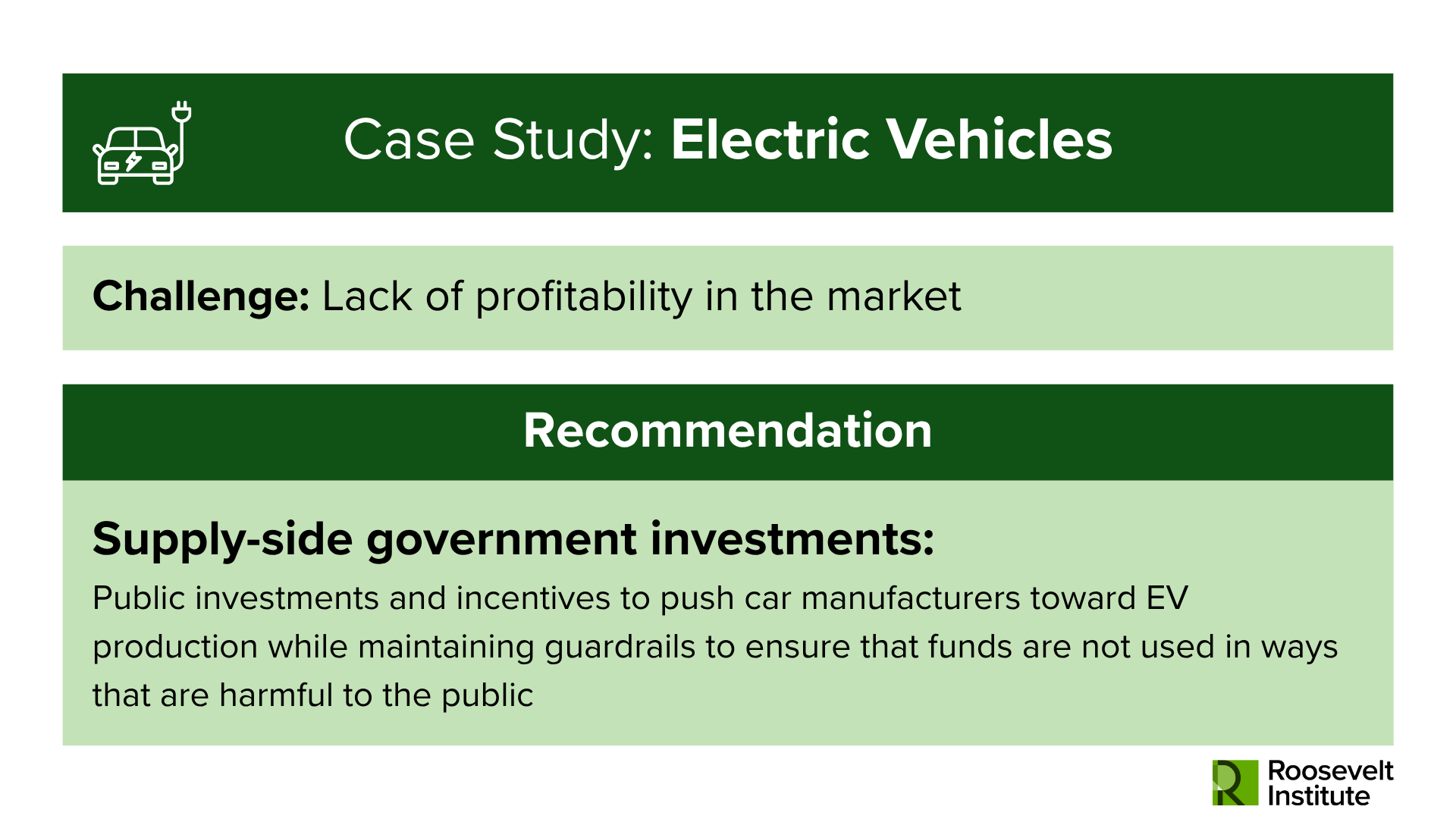
Policymakers working under the neoliberal order have long been reliant on market-forward policy tools like tax expenditures and privatization. The Biden administration began experimenting with economic ideas outside this order, but too often found itself limited by reliance on these familiar policy tools. Ensuring democratic economic governance that can deliver for working people will require policymakers to have not only a strong commitment to the values of equitable access, public value, and accountability, but a thorough understanding of the policy tools that can successfully implement these values. Public options, in which the government is directly involved in providing a public good or service, are one such tool kit available. Through various forms of public option, explored in detail in this report, the government can ensure the building blocks of a good life are available to all. The examples of childcare, electric vehicles, and banking illustrate the variety of ways in which the public options can be applied to different sectors.
Introduction: Policy Tools for Progressive Governing Values
We are in a moment of profound democratic crisis. The collapse of shared norms— social and political—has brought us to a point where even the continued existence of our democracy is regularly debated in the news. Many have written about the collapse of the market-first neoliberal policy paradigm of the last half century and the heated contest on both the Left and the Right about what will replace it.2 But other lost norms are just as salient, including a shared view that the US should aspire to have its elected leaders and lawmakers above corruption, that democracy can deliver for everyday people, and even that it is possible to have shared objective data about the world we live in. Any future administration with the ambition to use the federal government to ensure all Americans have access to a good life will have to simultaneously rebuild many state capacities and deliver for everyday Americans in ways that restore their trust in government and each other.
In 2021, when Joe Biden took office, the needs were similar, if less (or at least differently) dire. Much of his administration understood itself to be experimenting with economic policies outside of the neoliberal order. But it soon found itself trapped trying to execute on a new set of values using an old tool box dominated by tax expenditures, privatization, and market primacy. To avoid this fate, future administrations will need not only a strong commitment to values beyond neoliberal market primacy, but also a thorough understanding of the policy tools required to implement an agenda that is neither neoliberal nor plutocratic.
Public options are one such tool available. In their book on the subject, Ganesh Sitaraman and Anne Alstott define the public option as “a government program with two features: it provides an important service at a reasonable cost, and it coexists, quite peaceably, with one or more private options offering the same service.”3 This definition, appropriately, leaves a lot of room for variation. This report digs into that variation with the aim of deepening policymakers’ understanding of public options, in their many forms and their many uses.
Future administrations will need not only a strong commitment to values beyond neoliberal market primacy, but also a thorough understanding of the policy tools required to implement an agenda that is neither neoliberal nor plutocratic.
To be clear at the start, public options are not a panacea and they are far from sufficient on their own. Other critical tools for democratic governance include a robust taxation system and structures that build organized countervailing power. All of those tools were weakened by neoliberal primacy and thus were often left on the shelf during the Biden administration, to the detriment of its agenda.
At a moment when we are seeing unprecedented use of state power—sometimes in the form of more public control of companies—this report takes a step back to examine why and when public options should be an essential part of today’s governance tool kit. It will explore what tools are included within the category of public option (e.g., direct provision, public insurance, public utilities) and how to decide when and which to deploy to achieve equitable and democratic ends.
At the heart of economic governance under the neoliberal order was an overriding belief that the government’s primary role was fostering markets, that maximizing choice through market competition that kept prices down was the best way to support innovation and growth while serving consumer-citizens.4 The tools that policymakers used—from tax credits and vouchers to monetary policy monomaniacally focused on managing inflation—reflected these values. This neoliberal policy infrastructure resulted in an increasingly unequal economy where those outside the very wealthy have experienced rising economic precarity and increased democratic alienation.
In the last year, we have seen a different vision for government from Donald Trump’s administration: one that prioritizes using government to foster not markets but rather the individual wealth and power of select allies. We would be remiss if we did not acknowledge that this plutocratic rule is simultaneously masquerading as populism while living comfortably alongside continued neoliberal policy excesses.
In contrast to the last 40 years of policy choices and the current administration, policymakers who are truly responsive to the American people must see their role not as fostering markets or individual wealth, but as fostering economic democracy and the well-being of all Americans. This report argues that the best way to do that is not through policies that maximize choice but through policies that value and prioritize democratic access to essential goods and services, such as childcare, housing, education, clean water, and a liveable planet. Such access requires stable supply, equitable distribution, and affordable prices, as well as clear lines of accountability so that those accessing the goods and services can hold providers—including the government itself—accountable for quality and availability.
Although it can feel hard to champion at a moment when state power is being deployed for personal enrichment and violent suppression of dissent, the government is uniquely suited to help ensure these basic conditions are met across a wide variety of sectors. Indeed, we would argue that only the government can play that role. But for it to do so effectively, policymakers must embrace that the government should be using its power to orient markets toward producing the things we most need, and the public must trust that the government serves them. In other words, responsive, democratic economic governance in our new era must orient itself around ensuring individual access, producing public value, and guaranteeing accountability.
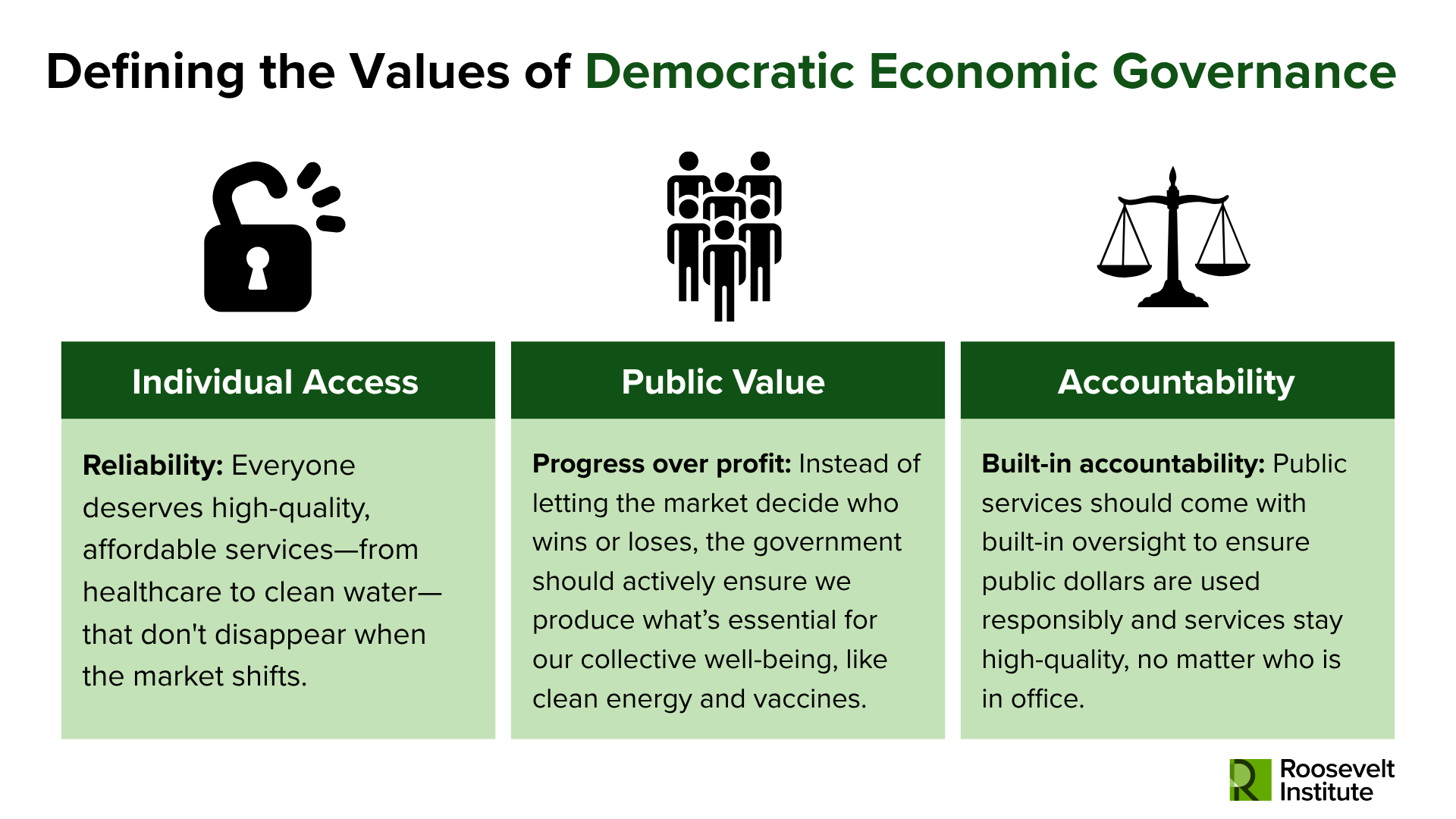
Individual Access: Access means ensuring that everyone can reliably count on being able to get the goods and services they need—from health care to childcare to clean water. Individual access requires that these goods and services are
- available equitably, regardless of race, gender, and geography;
- high quality;
- stable, so that individuals do not need to worry about them suddenly disappearing;
- affordable across the income spectrum; and
- easy to acquire and use.
Public Value: Public value means ensuring that the economy is oriented toward creating the conditions for Americans to thrive over the long term. Neoliberalism posited that the government should not pick winners or losers in industries. Although it may not have ever achieved this ideal, it was guided by a fundamental belief that a market unrestrained by public policy was the most effective way to organize society. In the wake of the collapse of neoliberal hegemony, policymakers of all stripes have embraced a more active role for government in directing the economy; some have called this approach “marketcrafting.” For Americans to benefit from this more active government, policymakers must orient this activity to ensure the production of goods that are essential to our collective well-being, from clean energy to vaccines.
Accountability: Having access as individuals or a community to a good or service is not enough. Users must trust the good or service will be high quality and know where to go if they have a problem. To the extent public money is involved in its production, the public needs to know that money is being stewarded responsibly. Public options have the advantage of having the built-in accountability mechanism of being ultimately run by an elected government, but, as the last year has shown us, a corrupt administration can use the time between elections to exercise its power over public options to enrich itself. It’s therefore especially essential that public options have additional accountability mechanisms that function across administrations and leadership transitions.
Different types of public option tools can be deployed to deliver on these obligations. These include, but are not limited to, (a) directly providing a good or service, (b) directly providing insurance that enables people to purchase a good or service, and (c) directly providing financing to private actors who will provide that good or service. Although the mechanism varies, each of these tools allows the government to ensure the availability of goods that are required for a shared, prosperous future. In each case it is minimizing and absorbing risk—whether those are risks borne by individuals, as in the case of the social safety net, or by companies, as in the case of industrial policy—to offer long-term security to both the immediate recipient and broader society.
A central question when deploying public options thus becomes whose risk should the government absorb, how much of it, and what, if anything, should it demand in return? The answer to that question will vary depending on the kind of problem the government is attempting to solve, and enacting these answers will require deploying different kinds of public options. Thus, understanding the range of tools available within the broader category of public option can help us bring together different design choices to appropriately answer this and other questions in each specific case.
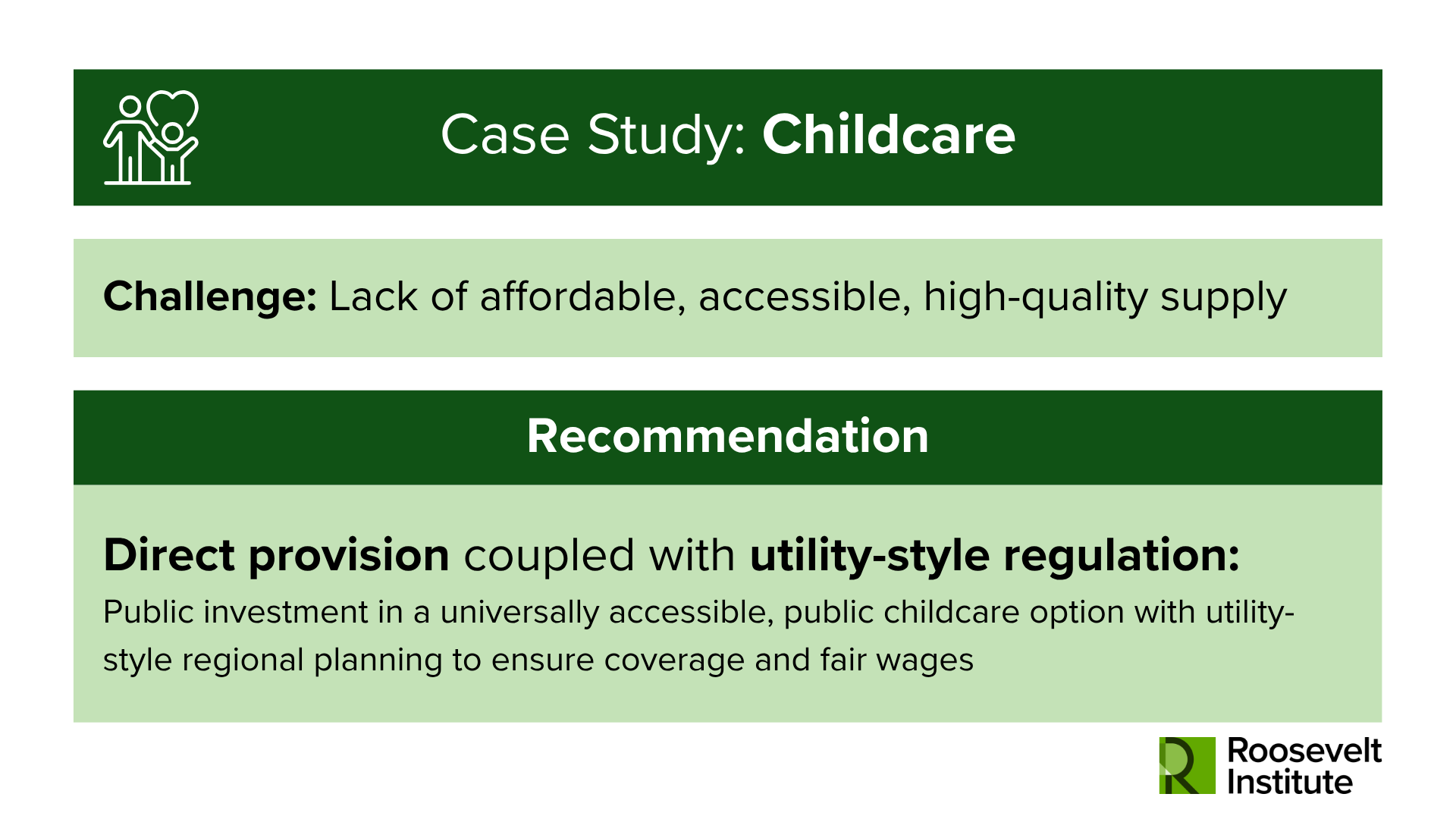
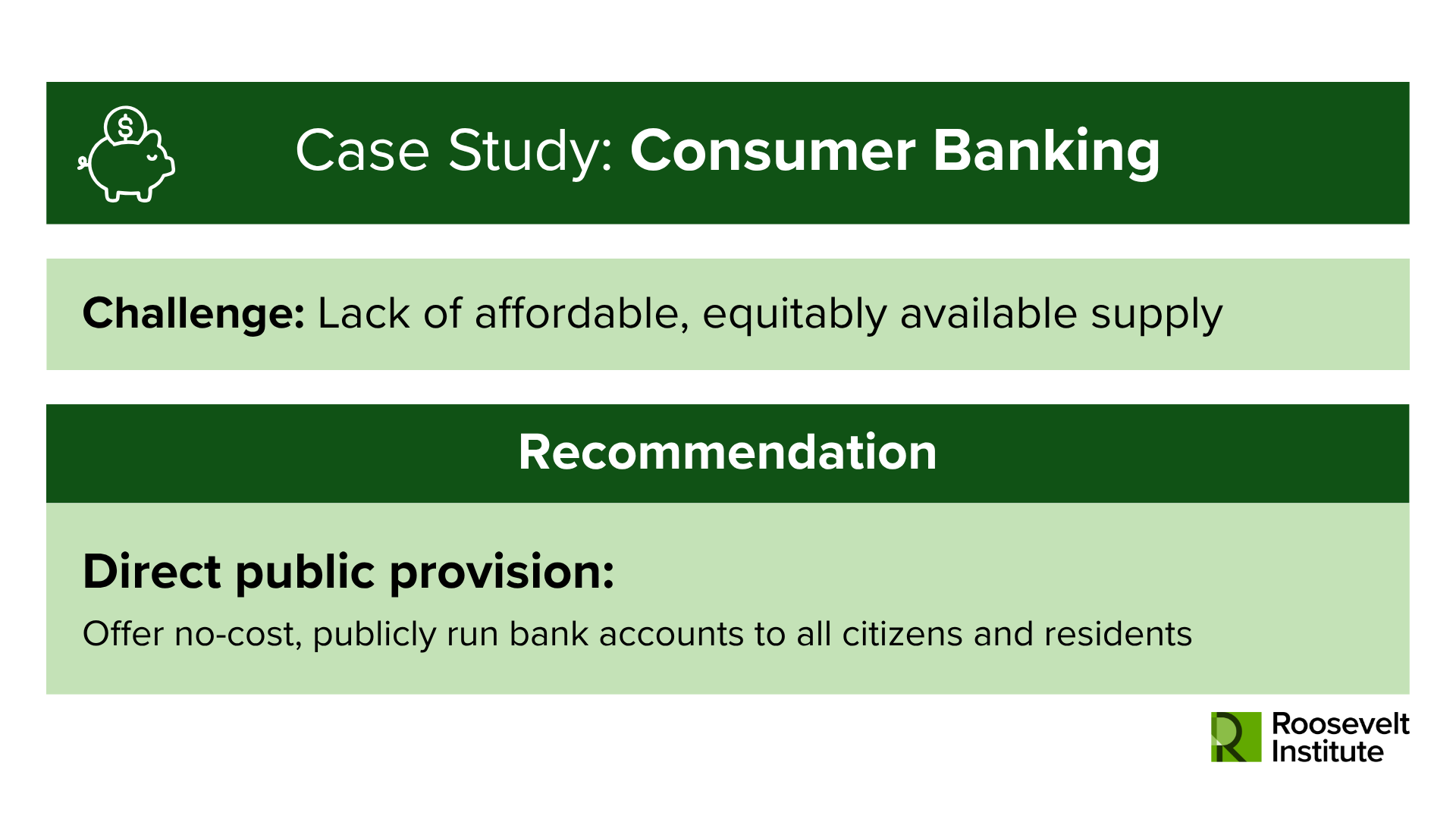
Section I begins with a discussion of neoliberal governance tools and their limited value in implementing progressive policy goals. Section II takes a deeper look inside the public options tool kit, offering a typology of the kinds of public options available to policymakers and the kinds of the problems they are best suited to solve. Section III looks at three case studies—childcare, electric vehicles, and banking—to examine which sorts of public options are appropriate in each case and why. Fundamentally, the government has an essential, unique, and appropriate role to play in ensuring a democratic and equitable economy oriented toward producing public value. Public options are one set of tools to help it fulfill that role.
Making the Case for a Public Options Tool Kit
To make the case for the public option tool kit, this paper has drawn on examples from the United States’ health care, childcare, education, housing, banking, manufacturing, and energy industries. We would be remiss not to note that in almost every single of these industries, the first year of the second Trump administration has seen policy decisions that have reduced and destabilized access or redirected attention away from critical public goals like reducing vulnerability to the climate crisis. Our goal must be to not just rebuild so that these systems look as they did at the end of 2024, but to create systems that are more resilient because they provide better access, clearly work toward shared goals, and are accountable to the American people.
Public options hold immense promise for the project before us. They should allow the government to build an economy and policy infrastructure that ensures all Americans have access to a good life. The tool kit of policies that fall under the category of public option is essential for policymakers working to move in this direction, but they are far from the only tools available or sufficient for building this economy.
A thriving economy will also need a rebuilt labor movement and other extra-governmental forms of civic representation and engagement. These kinds of organizations are essential for holding the public accountable, in particular by organizing people to take advantage of new accountability mechanisms. Public options can help facilitate the rebuilding of these organizations, but they will not stand in their place.
Public options hold immense promise for the project before us. They should allow the government to build an economy and policy infrastructure that ensures all Americans have access to a good life.
We also should state upfront: To make full use of public options, policymakers must move beyond the austerity mindset in which neoliberal policy tools were established and embrace a more progressive tax code. Indeed, a rebalanced tax code should both help support progressive policy tools and itself serve as another essential tool of progressive governance and structuring the economy. Taxes, organized countervailing power, and public options are three essential components of a progressive governing tool kit, and each one will make the other tools in the tool kit stronger. Together they can help us build a stable policy infrastructure rather than a patched and crumbling wall.
Footnotes
- Ganesh Sitaraman and Anne Alstott, The Public Option: How to Expand Freedom, Increase Opportunity, and Promote Equality (Harvard University Press, 2019), 2 ↩︎
- Roosevelt has been an active part of these debates. Our prior work, including Felicia Wong’s The Emerging Worldview: How Progressivism is Moving Beyond Neoliberalism and Sea Change: How a New Economics Went Mainstream were early entries into this conversation. ↩︎
- Ganesh Sitaraman and Anne Alstott’s excellent book, The Public Option: How to Expand Freedom, Increase Opportunity, and Promote Equality (Harvard University Press, 2019), 2, makes a strong case for the importance of public options, including how they can benefit the private sector. This report aims to be additive to their work by offering policymakers tools for thinking about what kinds of public options to use once they have settled on the need to deploy one. ↩︎
- Suzanne Kahn, More than Consumers: Post-Neoliberal Identities and Economic Governance (Roosevelt Institute, 2022), https://rooseveltinstitute.org/publications/more-than-consumers. ↩︎
Acknowledgments
The author would like to thank Rey Fuentes, Matt Hughes, Taylor-Jo Isenberg, Meredith MacKenzie de Silva, Mike Madowitz, Keesa McKoy, Toyosi Odusola, Ijeoma Ogbonna, Ganesh Sitaraman, Aastha Uprety, Elizabeth Wilkins, and Felicia Wong for their feedback, insights, and contributions to this paper. Any errors, omissions, or other inaccuracies are the author’s alone.
Suggested Citation
Kahn, Suzanne. 2026. The Public Options Tool Kit: Ensuring Access, Public Value, and Accountability in the Economy. New York: Roosevelt Institute.
RELATED RESOURCES
Author