
Taking Stock of the Oil-Shocked Economy
March 20, 2026
Plus, a safety net that builds power, not just economic security.
The Roosevelt Rundown features our top stories of the week.
“One of the Largest Oil Disruptions in History”
As war rages on in the Middle East, the Fed kept interest rates steady this week. In new analysis of the economic picture, Roosevelt Institute Principal Economist Michael Madowitz dives deep into oil prices: With the increasing risk of inflation from oil supply shocks amid an already anemic job market, there isn’t much wiggle room for the economy to absorb the impacts of a supply chain crisis.
“The buffer that enabled the US economy to walk off bad news since the pandemic has eroded,” Madowitz writes.
At the start of the year, job growth was slow, producer inflation was inching up, and GDP estimates found that the growth was lower than we thought.
Now, all eyes are on energy markets and how the closure of the Strait of Hormuz will shake the global economy. “Oil shocks are famously bad for the economy,” Madowitz writes, “and the US has created one of the largest oil disruptions in history.”
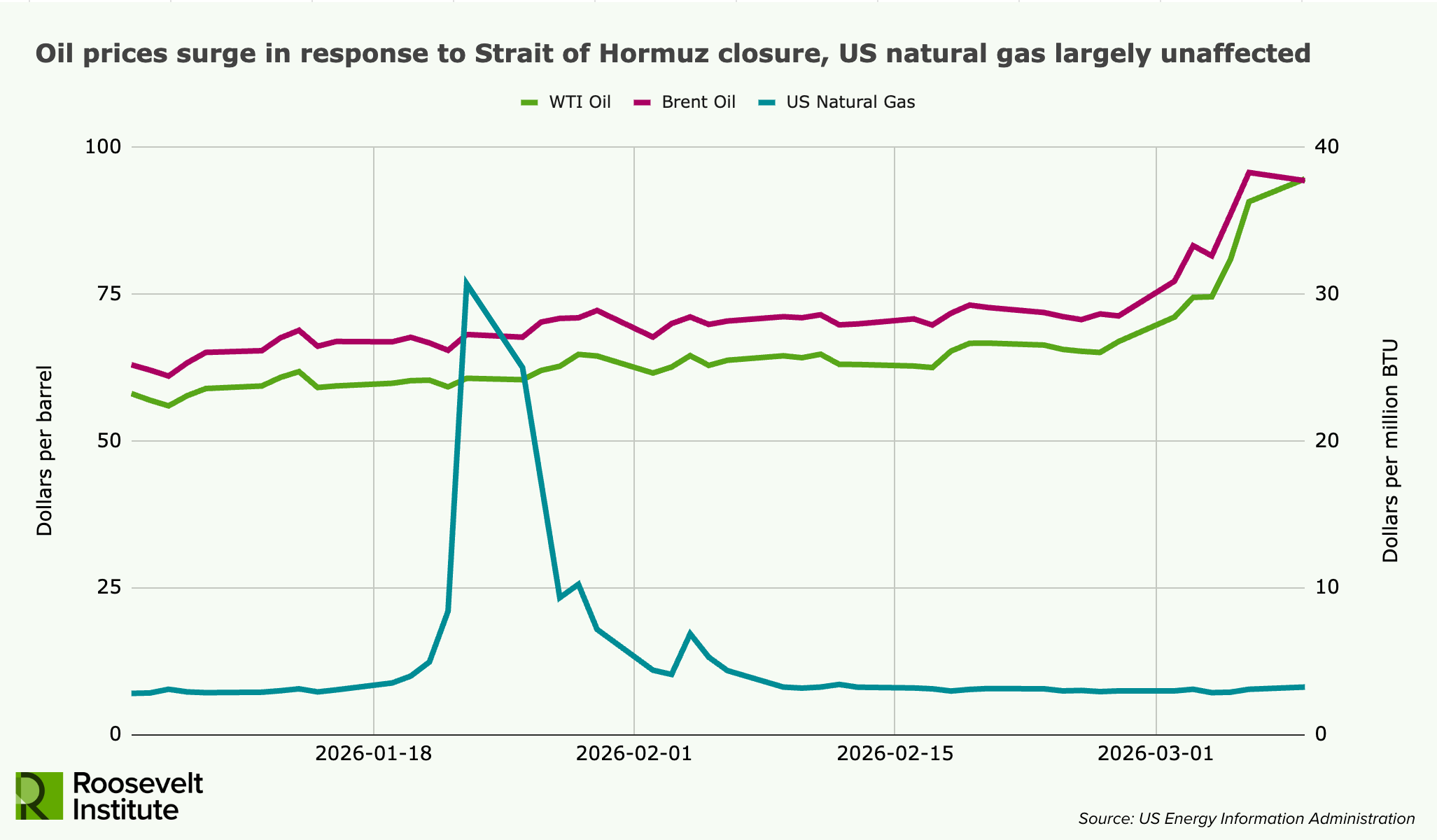
US oil is tightly integrated into the global market, making prices highly responsive to supply disruptions. On the other hand, less than 1 percent of the US’s natural gas production is exported, shielding US natural gas prices from global turmoil. But, as the chart shows, prices are still vulnerable to domestic shocks such as this January’s winter storm.
Read the blog post: The Economy Doesn’t Have the Room to Absorb This Oil Shock
- And check out Roosevelt’s related research: Fossil Fuel–Driven Price Volatility Demonstrates the Need for a Renewable Transition
From Economic Security to Economic Freedom
The US social safety net has lifted millions out of poverty. But its patchwork design, further weakened by underinvestment and cuts, has meant countless others have fallen through the gaps.
In a new report, Roosevelt Fellow Jamie Keene argues that tackling today’s affordability crisis will require policy that not only delivers economic security, but rebalances power from concentrated wealth to working and low-income people. That was what FDR’s New Deal aimed to do: expand economic freedom by building a system of social insurance, making markets fairer, and supporting essential needs through public options.
“Instead of a safety net that tries (and fails) to help people survive the economy,” Keene writes, “we need a power base that helps people shape it.” Read: From Safety Net to Power Base: Reimagining, Not Restoring, the US Antipoverty System
What We’re Talking About
What We’re Reading
- Detroit tenants are still recovering from the neglect of crypto real-estate bros. WIRED’s Joel Khalili reports on RealToken’s scheme to sell shares of property and let peoples’ homes spiral into disrepair. “The promise of spending a few bucks to become a landlord, often from the other side of the globe, has collided with the inconvenient physicality of homes and the humans who live in them,” Khalili writes.
- Last month, Roosevelt Board Member and Michigander Keyontay Humphries wrote about RealToken’s impact on housing quality in the community. In the words of one tenant, “It has been really, really hard. We can’t wash certain clothes . . . we’re bathing out of buckets from boiling water on the stove . . . and it’s freezing outside.”
- For more on what we learned about this crisis and the community organizations fighting it, read Roosevelt’s Brad Lipton’s November blog post: Detroit’s Fight Against Housing Greed
- Here’s how to tame the electric grid and lower electricity prices. Energy demand is surging, and part of the problem is a regulatory system that protects monopolies, Roosevelt Fellow Josh Macey argues in Fortune. His proposed fixes include reducing utility returns, speeding up interconnection queues, blocking vertical integration, and federal government involvement in planning and financing transmission.
- We’re training the next generation of policy minds. This week, the Roosevelt Network announced its 2026 cohort of undergraduate fellows. These 65 students come from across the country, and over the next year will learn the ins and outs of the policy field: by participating in workshops and career talks, completing internships, and writing research papers.
- Roosevelt is also recruiting for a new cohort of graduate humanities interns. This paid part-time internship will help current grad students in the humanities learn about how to think and work in policy spaces. Apply here.