
What Will We Do About the AI economy?
October 8, 2026
It’s past time to get serious about AI governance
As AI takes over a growing share of the economy, the need for regulation to rein in the world’s biggest companies and protect the working class has become increasingly urgent. To think through these challenges, the Roosevelt Institute and Data & Society are excited to announce that a new cohort of Good Life Residents will be focused on using policy to shape AI investment in the public’s interest.
What policy tools can steer private capital flows toward a deconcentrated economy that serves all Americans? How can we ensure that investors don’t neglect other critical sectors? Our three new resident scholars will explore these big questions and more:
- Advait Arun, senior associate for capital markets at the Center for Public Enterprise
- Danica Yu, technology fellow at the Ford Foundation
- Matthew Scherer, fellow at the Open Markets Institute
As Sam Levine—a Roosevelt Network alum—noted in The Nation this week, “We know that emerging technology can make changes in the economy feel inevitable, as though the rest of us are just passive bystanders along for the ride. We are not.”.
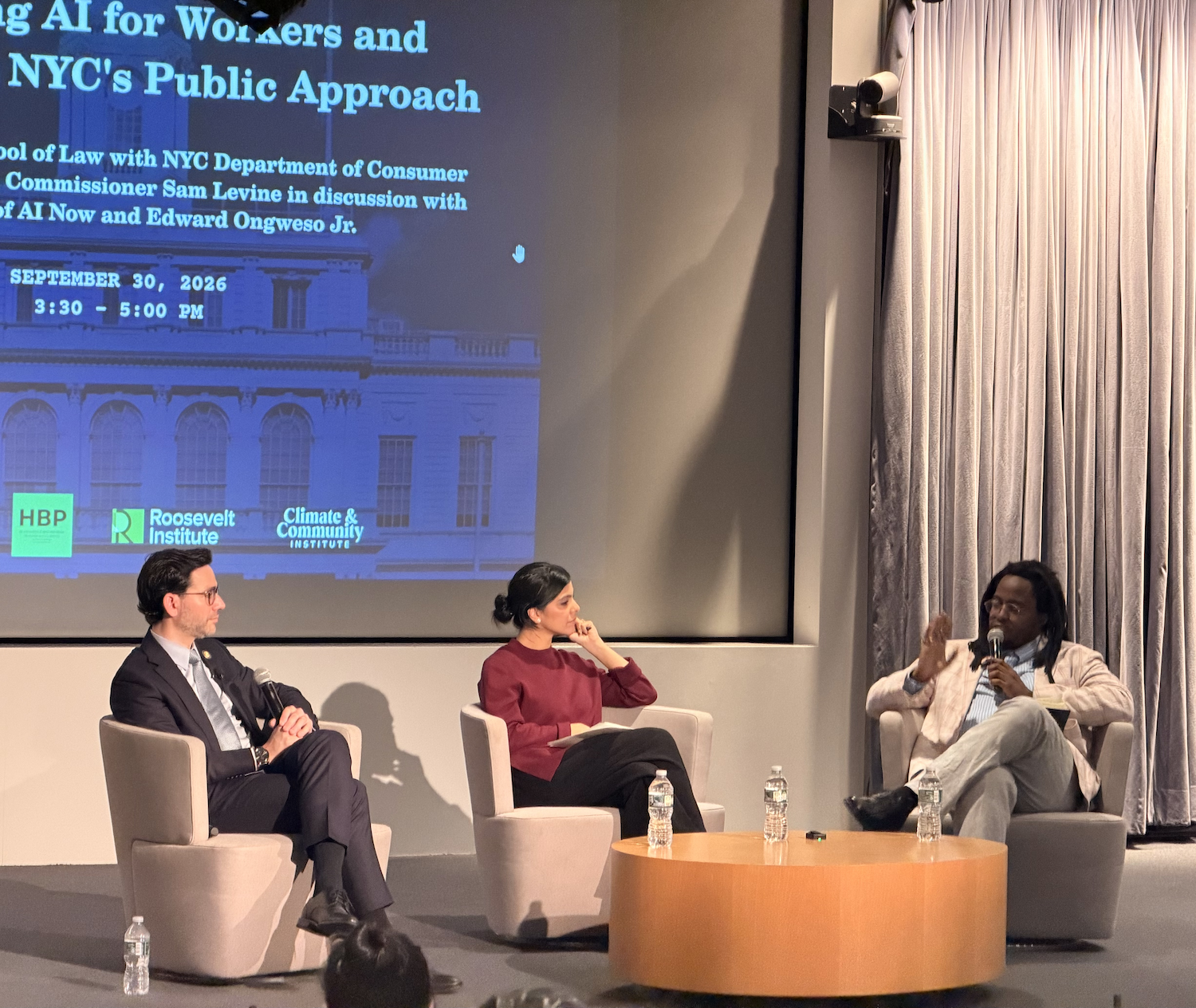
Levine joined AI Now Co-Executive Director Amba Kak and journalist Edward Ongweso Jr. for a discussion on AI governance cohosted by the New York City Policy Forum, Climate and Community Institute, and Roosevelt last week. He spoke about how the city is taking action to protect working-class New Yorkers from algorithmic surveillance pricing, wage discrimination, and more.
Watch the recording:
What else we’re up to
- Prediction markets are spending big to avoid regulation. Kalshi and similar platforms have spent at least $3 million this year lobbying government, particularly at the state level, to wriggle their way out of state gambling laws—a debate that Roosevelt’s Brad Lipton calls an “existential question” for prediction markets.
- “It’s not at all clear to me that their business model can compete if they are going to comply with state law,” Lipton told OpenSecrets. “They’re really trying to create a situation, I think, where they have enough political power to overcome the legal deficiencies in their arguments.”
- Read more from Lipton about policy considerations for regulation, and check out our entire four-part series on prediction markets’ effects on society.
- When “the state breaks the implicit social contract of data collection.” Roosevelt Fellow Chastity Murphy writes in Forbes about law enforcement’s use of financial data to conduct low-stakes policing and argues for the anonymity of everyday economic transactions.
- “Implementation is where change really happens.” In our latest Roosevelt Society profile, Emma Horst-Martz, an organizer with Planned Parenthood, discusses how to hold government accountable from the outside.
- Join the Roosevelt Book Club on October 15 at 1:00 pm ET for this month’s read, Disposable Workers: The Transformation of Employment. As author Paul Osterman shows, the US system of employer-provided benefits has driven businesses to classify more and more workers as contractors and freelancers and made unemployment even more precarious. In this conversation, he’ll share insights from his research, which includes findings from an original survey of 6,000 workers.
What we’re talking about