

Why Americans Are Concerned About the 2026 Economy
January 23, 2026
Plus, what we can learn from the YIMBY movement.
The Roosevelt Rundown features our top stories of the week.
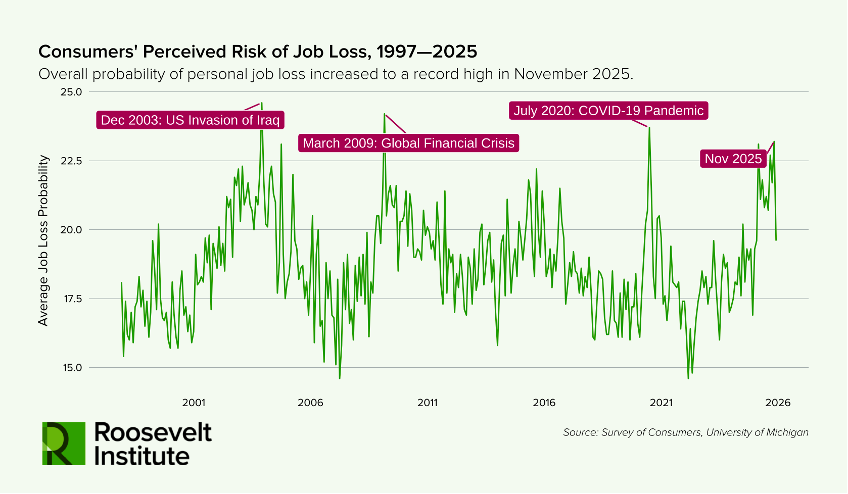
A Pessimistic Jobs Outlook for the New Year
Now that the dust has settled on year one of Trump 2.0, Roosevelt Principal Economist Michael Madowitz offered his thoughts on the trends shaping up for 2026.
Top-line indicators are looking worse overall: Unemployment and inflation are both creeping up, and consumer sentiment in particular is hitting levels of pessimism akin to those of the 2008 recession and the COVID-19 pandemic.
“Another vibe shift is underway—the vibes are still bad, but they’re starting to come from a weak job market more than high inflation,” Madowitz writes. “In other words, Americans remain very concerned about affordability, but it’s increasingly a function of a weak job market and weak income growth, rather than the price growth story that has dominated headlines since the pandemic.”
Various factors—lingering tariff shocks, last year’s tax cuts for the rich, Supreme Court decisions, and increasing utility prices—will continue to add uncertainty to the economy this year, and the chaos is unlikely to subside anytime soon.
Read the blog post: “Now That That’s All Out of the Way, a 2026 Economic Preview”
Meeting Need Is Just as Much About Supply as Subsidy
Contrasting it with the “abundance” movement, which has struggled to assemble itself under a unified political program, Roosevelt Fellow Ned Resnikoff argues that the Yes in My Backyard (YIMBY) movement has remained an effective underlying framework dedicated to a pragmatic set of organizing strategies. In a new brief, Resnikoff explains how the YIMBY playbook offers lessons for progressive policymakers who want to measurably improve people’s material conditions.
A central goal of modern American progressivism, in the words of Franklin D. Roosevelt, is “to make a country in which no one is left out.” To achieve that goal, policymakers often turn to direct subsidy, giving vouchers to Americans who lack access to necessities like housing, food, or health care. But subsidy alone is insufficient to contend with supply constraints in markets like housing, a philosophy reflected in the YIMBY movement.
“YIMBYism is not an alternative to social policy,” he writes. “It is a strategy for making social policy work as intended.”
As Resnikoff argues, possible policy levers include regulatory reform, public investment, and state capacity alike, depending on the issue at hand—and all come with their own benefits and trade-offs. “But the most important virtue of adopting a YIMBY mindset is more dispositional: At its heart, YIMBYism is about finding the right balance between hard-nosed pragmatism and future-oriented optimism.”
Read the brief: “Lessons from YIMBYism: Taking ‘Abundance’ Back to Its Fundamentals”
What We’re Talking About
What We’re Reading
- On California’s billionaire tax: California legislators have proposed to fund health care, education, and food assistance with a one-time tax on the state’s billionaires. Roosevelt Fellow Brian Galle, who worked on the proposal, talked to the LA Times about billionaires’ threats to flee the state to avoid taxation: “We see a lot of cheap talk from billionaires. Some people do actually leave and change their behavior, but the vast bulk of wealthy people don’t, because it doesn’t make sense.”
- On Social Security: Roosevelt’s Stephen Nuñez spoke to CNBC about the myth of Social Security’s impending bankruptcy. “Legislators are going to be forced to deal with Social Security, even though they have not wanted to,” he said. “The longer we wait to do something, the higher the cost is going to be.”
- On utility prices: The AI boom and its associated data centers are driving up electricity prices for consumers, putting tech and utility giants on the front lines of the national affordability fight.