Community Action’s Institutional Infrastructure: How Federal Investment Can Cultivate Collective Power
November 5, 2026
By Sophie Jacobson

This is a web-friendly preview of the report.

Key Takeaways
- Community Action was not the short-lived failure it is often remembered to be. Much of the local institutional network has endured since the 1960s despite repeated political attacks and major changes in federal administration.
- Federal policy can build democracy from below by investing in durable infrastructure for collective power. Community Action funded and recognized locally rooted organizations outside traditional gatekeepers, embedded resident authority and lived experience in governance and implementation, and supported grassroots organizing.
- Durable institutional infrastructure does not automatically produce organized people power. The Community Action Program’s local institutional network endured more consistently than its constituency-building efforts. Democratic reconstruction should build on that surviving infrastructure while reinvesting in people power.
Introduction: Community Action as a Durable Federal Experiment
Community Action Agencies (CAAs) are a durable, federally incubated network of community-based antipoverty organizations launched under the Community Action Program (CAP) of the Economic Opportunity Act of 1964 (EOA) and sustained today through the Community Services Block Grant (CSBG). Nearly 1,000 CAAs remain active nationwide; in FY 2023, 995 CAAs served 10.7 million low-income Americans (NASCSP 2023). They coordinate dozens of government programs; braid local, state, federal, and private resources; convene public and private partners; regularly assess community needs; and translate those needs into action on antipoverty priorities.
The puzzle is durability. Community Action is widely remembered as a politically defeated and historically bounded War on Poverty experiment. Yet much of the institutional network that federal policy built in the 1960s remains in place. An original reconstruction links roughly 70 percent of today’s CSBG-eligible entities directly to CAAs operating in the late 1960s.
How the Community Action Agency Network Survived from 1971 to 2026
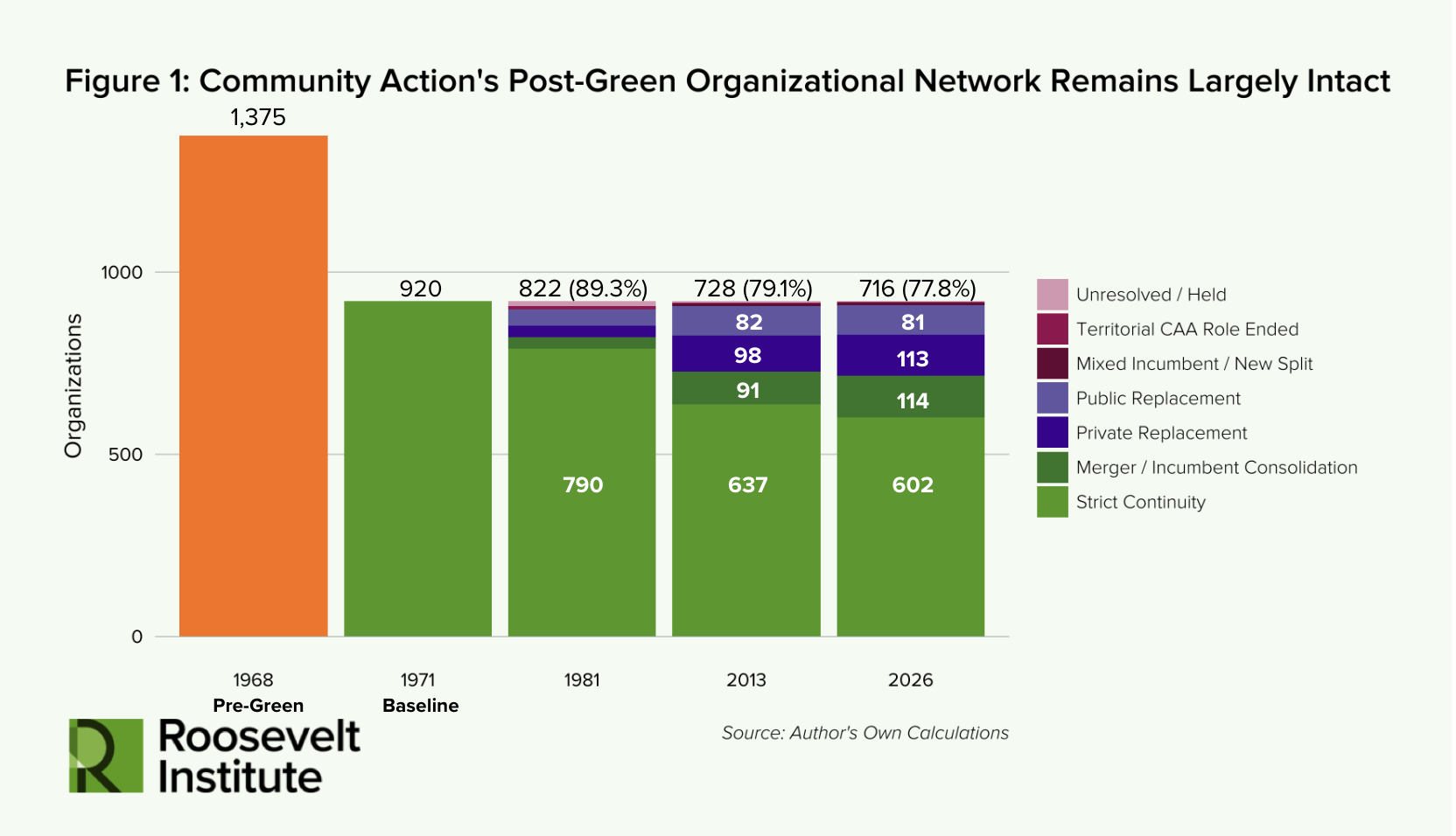
This paper argues that Community Action is best understood as a durable federal experiment in cultivating collective power—and, more broadly, in how federal policy can build democracy from below. CAP’s central innovation was to change who has the organizational capacity, sustained institutional access, and political influence to shape antipoverty governance in American communities (Hertel-Fernandez et al. 2025). Maximum feasible participation repositioned poor residents from passive recipients of aid toward organized roles developing, delivering, and overseeing programs meant to improve their lives.
Community Action shifted power through three linked mechanisms: creating a direct federal channel that gave locally rooted organizations resources and standing outside traditional gatekeepers, embedding resident authority and lived experience inside governance and implementation, and underwriting the organizations and relationships through which poor communities could act collectively over time. Federal administrative machinery helped make those capacities durable by credentialing local organizations, empowering communities to take on governance and implementation, sustaining federal-local relationships, and pairing institutional continuity with review, correction, and resident recourse.
Repeated efforts to claw back Community Action’s resources and authority provide revealing stress tests: During the Nixon years, CAAs and their allies defended Community Action across courts, Congress, and the administration itself. In 1981, Congress dismantled much of the direct federal-local administrative channel inherited from the Office of Economic Opportunity (OEO) and Community Services Administration (CSA) but carried the incumbent CAA network into CSBG as protected eligible entities and required states to pass through at least 90 percent of CSBG funding to them. Community Action survived because federal policy had built organizations with the resources, access, and influence to act strategically across levels and venues of government.
But network capacity and organizational durability should not be conflated with consistently activated people power. Community Action preserved antipoverty organizations more consistently than it organized the people those institutions served. People power must be resourced and organized too.
Recovering the history of the CAAs rewrites the lessons we draw from the War on Poverty. Community Action was neither a brief, failed experiment in participation nor a model to replicate wholesale. It was an uneven but durable experiment in using federal policy to break concentrated local control and build democratic infrastructure from below. Correcting the failure myth reveals an institutional inheritance: a living, federally supported network with deep local roots, nationwide reach, and institutional capacity accumulated over decades. The question now is how to reinvest, reimagine, and reconstruct to defend and deepen democracy.
Table 1. Community Action Legislative Milestones and Key Terms
| Term | Description |
|---|---|
| Economic Opportunity Act of 1964 (EOA) | The War on Poverty statute that created the Office of Economic Opportunity and authorized the Community Action Program, including its participatory mandate. |
| Office of Economic Opportunity (OEO) | The original federal agency administering Community Action. OEO made grants directly to local organizations and operated through regional offices that maintained relationships with CAAs. |
| Community Action Program (CAP) | The federal program authorized by the EOA to support locally organized antipoverty action. |
| Community Action Agency (CAA) | A public or private nonprofit organization serving a defined community or service area and responsible for coordinating Community Action locally. |
| Maximum feasible participation | CAP’s participatory mandate. OEO translated it into roles for low-income residents in planning, governance, implementation, evaluation, and employment. |
| Tripartite governance/ board | Community Action’s three-part governing architecture representing low-income residents, public officials, and private or community interests. |
| Green and Quie Amendments (1967) | Green gave state and local officials a formal role in designating organizations as CAAs and altered service-area rules. Quie formalized tripartite governance. These changes constrained Community Action but did not displace the incumbent network. |
| Designation/federal recognition | Green authorized state and local officials to designatean organization to serve as the CAA. OEO separately recognized the organization for federal Community Action purposes, preserving the independent federal-local institutional relationship. |
| Community Services Administration (CSA) | The independent federal agency that succeeded OEO in the mid-1970s and continued direct federal administration of much of Community Action until 1981. |
| Office of Community Services (OCS) | The US Department of Health and Human Services (HHS) office that became Community Action’s principal federal administrative home in 1981. It continues to administer CSBG at the federal level. |
| Community Services Block Grant (CSBG) | The 1981 block grant that sustains Community Action today. CSBG shifted states into the funding and oversight roles while preserving the local organizational network. |
| Eligible entity | The statutory status that enables incumbent CAAs to receive CSBG funding. There are set procedures for correction, funding reduction, and termination. |
Acknowledgments
The author would like to thank Suzanne Kahn, Hannah Garden-Monheit, Alex Hertel-Fernandez, Sam Berger, David Bradley, Jae Yeon Kim, Mary Beth Maxwell, and K. Sabeel Rahman for their thoughtful feedback and conversations that helped shape this paper. Any errors, omissions, or other inaccuracies are the author’s alone.
Suggested Citation
Jacobson, Sophie. 2026. “Community Action’s Institutional Infrastructure: How Federal Investment Cultivates Collective Power,” Roosevelt Institute, November 5.
RELATED RESOURCES
Author