

How Prediction Markets Are Shaping Real-World Events and Eroding Public Trust
July 22, 2026
By Brad Lipton and Toyosi Odusola
Prediction markets offering contracts on virtually every topic are one of the fastest-growing industries in the United States, just trailing behind AI. Who wins and loses in these markets? How is their operation shaping our society? And what rules do we need to manage them?
In a new four-part series, The Hidden House: Prediction Markets and How They’re Shaping Society, we’re exploring all of these questions and more. You can read the first installment here.
In this second installment, we look beyond the consumers who participate in prediction markets to the effects these markets are having on our society more broadly.
The 2026 FIFA World Cup was full of all the intrigue, athleticism, and adrenaline that the beautiful game typically brings. But what made this year different from tournaments past—besides the hydration breaks—may have been the sheer ubiquity of advertisements for the prediction markets Kalshi and Polymarket.
Although most Americans have never participated in a prediction market, these increasingly popular platforms are already shaping our world more broadly. We are seeing prediction markets entangled in everything from news coverage to war to weather forecasts, with journalists being threatened and battlefield maps literally being redrawn to affect the outcome of prediction market bets.
The corrupting effects that gambling can have, particularly on sports, are well known—scandals like the Chicago Black Sox fixing the 1919 World Series finals are ingrained in the mainstream imagination. As sports betting has become much more accessible and pervasive in our society over the last few years, we are seeing the return of similar scandals, such as wide-ranging indictments involving NBA players. And with prediction markets offering similarly accessible opportunities to bet on a much wider range of topics, the consequences for our society could be far worse than what’s possible with traditional gambling.
Indeed, the many incidents of insider trading on prediction markets covered by the media should be concerning not only because they are unfair to the participants who lose money, but because those insiders could very well use their access to alter real-world events, with much greater consequences than a baseball game. As people’s faith in our society’s institutions has dropped in recent years, prediction markets threaten to accelerate that trend.
How Prediction Markets Corrupt Incentives
Do we want people to wonder whether online betting is driving how journalists report the news, influencing what a politician says, or even affecting military actions? We are already starting to see signs that prediction markets can have these effects, as people are incentivized—or even threatened—to modify their behavior in the “real world” based on betting.
Although prediction market companies advertise their platforms as providing reliable information about what will happen in the world, the markets they create often incentivize bettors to manipulate outcomes. Perhaps the clearest example involved Emanuel Fabian, a journalist who Polymarket users threatened to change his reporting on a missile attack earlier this year. The users had lost money on a contract that was resolved based on the details of his reporting. Fabian didn’t capitulate to their demand, but he expressed his worry that other journalists might be swayed to change how they report the news by threats or promised earnings.
In a lesser-known case, a staff member at the think tank Institute for the Study of War manipulated a map of the Ukraine war to affect prediction market betting. Polymarket relied on the map for its wager on when Russia would capture Myrnohrad, a Ukrainian city. The staff member allegedly changed the map right before the market resolved to suggest Russia had captured the city, despite comprehensive contrary evidence. This action may have secured profits of over 33,000 percent for some users in a market with over $1.3 million wagered.
There’s even some chance that prediction markets have already affected weather data: French authorities are pursuing an ongoing investigation into potential tampering of weather sensors that allowed a Polymarket trader to net $21,398 from a $119 bet.
Existing law prohibits contract markets that are “readily susceptible to manipulation.” Yet this prohibition has hardly prevented prediction markets from having an effect on the “real world.” In an earnings call in October 2025, Brian Armstrong, the CEO of Coinbase, referred to the wager on what he would say during the call before rallying off a list of words at the end of the meeting to secure payouts for some users. More recently, a song skyrocketed to the top of Spotify’s charts due to fraudulent streams, allegedly orchestrated by prediction market bettors who manipulated the streaming data to win their bets before the conduct was detected. While the stakes were low in these cases, they showed how easily prediction markets can affect behavior.
Also earlier this year, a user on Twitter/X prompted a furor by noting that Press Secretary Karoline Leavitt abruptly ended a press conference right before the payout threshold on a market for how long the meeting would last. While further investigations largely debunked the theory that this was intentional, the public reaction alone shows the corrosive effects the possibility of betting can have on people’s faith in our institutions.
Insider Trading Threatens to Erode Public Trust
Insider trading on prediction markets is clearly unfair to people participating in those markets who lose their money to the insiders. But these incidents also erode trust in our society by raising suspicions that insiders may use their access to affect real-world events.
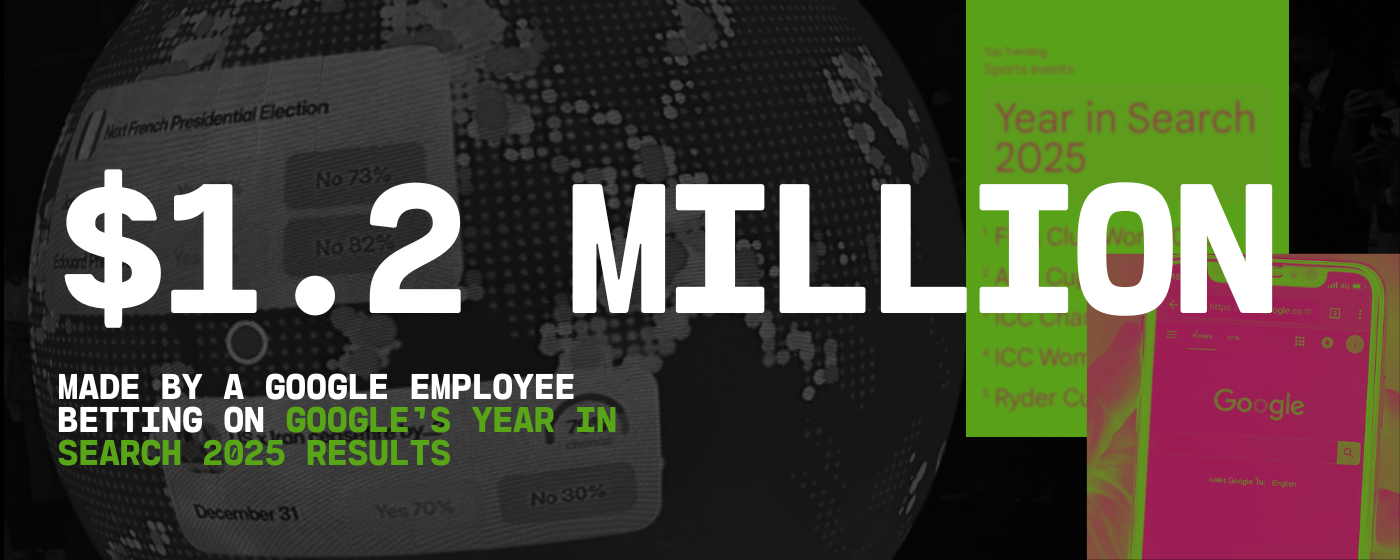
As we noted in a prior blog post, the Justice Department has so far taken up two cases of insider trading on prediction markets. The first was a charge brought against a US soldier who allegedly used private military information to make over $400,000 by betting on the capture of Venezuelan President Nicolás Maduro. The second was a charge against a Google employee who allegedly used privileged company data to bet on Google’s Year in Search 2025 results and make over $1.2 million.

These high-profile cases are just two of the many insider trading incidents that have come out in the last few months. Among the others: a teleprompter operator for the White House profiting from what Trump says during his speeches, Israeli military members who are suspected of betting on military operations using classified information, campaign staffers making thousands betting on their candidates (with some of those candidates betting on their own campaigns), and an OpenAI employee who was fired for placing bets in markets related to the company.
Insider trading is, of course, illegal in financial markets, where a lack of trust can cause participants to leave. But insider action, such as tampering with news reporting, has detrimental effects on people’s societal trust as well. The more people hear about insider trading, the more they will have doubts about the motivations of people making important decisions in our society.
What Can Be Done? Active Legislation and Potential Regulations
Trust in institutions is crucial for a functioning democracy, but has been falling in the United States in recent years. Prediction markets threaten to further undermine that trust by introducing perverse incentives. Policymakers should act to prevent the creeping corrupting effect that prediction markets may have on American society.
Not long ago, bans on sports betting were in place to protect the integrity of sports. As those regulations eased in recent years, there have been reported rises in player harassment, fan disillusionment, and investigations brought against coaches and players that may be eroding people’s faith in the institution of sports.
At least some members of Congress are aware of the similar, and potentially far worse, danger that prediction markets pose: The 119th Congress has introduced at least 24 bills that would rein in prediction markets. The US Senate has banned senators, staff, and officials from betting on prediction markets, and the House of Representatives is deliberating on a similar ban.
Prediction Markets Bills Introduced in the 119th Congress in 2026
Public Integrity in Financial Prediction Markets Act of 2026 (H.R. 7004)
Fair Markets and Sports Integrity Act (H.R. 7477)
DEATH BETS Act (S. 4035)
Prediction Markets Security and Integrity Act (S. 4060)
DEATH BETS Act (H.R. 7942)
Prediction Markets Are Gambling Act (S. 4160)
Prediction Market RISK Act (H.R. 8148)
Prediction Market Act of 2026 (S. 4469)
Campaign Event Contract Integrity Act (H.R. 8771)
Congressional Prediction Market Ban Act of 2026 (H.R. 8838)
GAME Act of 2026 (S. 4555)
Campaign Funds Integrity Act of 2026 (H.R. 8912)
Honesty and Trust in Service Act (H.R. 9082)
Stop Lawmakers From Predicting Act (H.R. 9367)
The Public Service Accountability Act (H.R. 9429)
No Profiting from Public Service Act (H.R. 9560)
As scandals continue, policymakers may consider a spectrum of regulations. They could ban contracts that are most susceptible to the corrupting effect of gambling or focus on contracts related to government activity or that have outcomes that could be easily manipulated by individuals. A more significant reform would be to ban prediction market contracts on any event that can realistically be influenced by human intervention—which would eliminate most contracts on these platforms—or to heavily tax such contracts. Policymakers should evaluate competing proposals on their ability not only to protect individuals from financial loss, but to protect real-world events from manipulation and restore public trust in institutions.
Policymakers should evaluate competing proposals on their ability not only to protect individuals from financial loss, but to protect real-world events from manipulation and restore public trust in institutions.
Prediction markets are driving the race to financialize everything. Soon, their harms may ripple across society, reaching people who never even think to log into Kalshi or Polymarket.
In our next installment of this series, we will consider how rapidly embedded these markets are becoming throughout key American institutions. We will highlight the threat of path dependence—how decisions made early on in the trajectory of an institution can make changing course later on harder to achieve—and the consequent urgency of regulation.
Related Resources
Authors

Brad Lipton
Director, Corporate Power and Financial RegulationAs director of the corporate power and financial regulation program at the Roosevelt Institute, Brad Lipton leads Roosevelt's work on the rules governing financial institutions and other corporations to produce a more equitable economy.

Toyosi Odusola
Senior Research AssociateAs a senior research associate at Roosevelt, Toyosi Odusola supports think tank staff and fellows in their research.