Public Digital Infrastructure for a Safety Net That Delivers: What One Administration Can Build
November 10, 2026
By Ivana Ng

This is a web-friendly preview of the report.

Key Takeaways
- More than $227 billion in government benefits already authorized by Congress go undelivered each year, leaving millions of eligible Americans without assistance.
- A future administration could use existing legal authority to streamline eligibility verification, expand automatic enrollment, and reduce unnecessary paperwork without waiting for new legislation.
- The report proposes four complementary reforms: maximizing existing eligibility mechanisms, strengthening accountability for benefit uptake, building public digital infrastructure, and expanding service delivery capacity.
- The proposed road map could secure an estimated $49 billion in annual benefits for eligible people, help 18 million additional people access services, and redirect more than $6 billion annually toward public infrastructure.
- Modernized benefits systems must also protect privacy, prevent misuse, and preserve people’s ability to understand and challenge government decisions.
Introduction
Congress has promised economic relief to Americans through programs that provide food assistance, health coverage, childcare support, tax credits, and more. Yet every year, more than $227 billion in benefits never reach the eligible people who are legally entitled to them. This gap comes from how programs are delivered. Most of them run on an opt-in model, where people have to navigate complicated rules and requirements, outdated website portals and onerous paperwork—-administrative burden that can cost more than the benefit itself. Georgia, for example, spent more than twice as much verifying Medicaid enrollees’ compliance with its program rules as it spent on the health coverage itself. This is the type of government waste that gets far too little attention, and represents a systemic failure to deliver on legislative promises.
When a program exists on paper but not in people’s lives, it signals to us that the government can’t keep its word. With public trust in government near historic lows, that broken promise weakens democracy itself. This report lays out a road map for what a future pro-democracy administration can do, with authority it already has, to make significant strides toward automated benefits and service delivery, and fully deliver the commitments it has made under its economic relief programs.
$227 billion
Benefits going undelivered annually
$49 Billion
Estimated additional annual benefits secured
18 million
Estimated additional people reached with direct help
The Road Map at a Glance
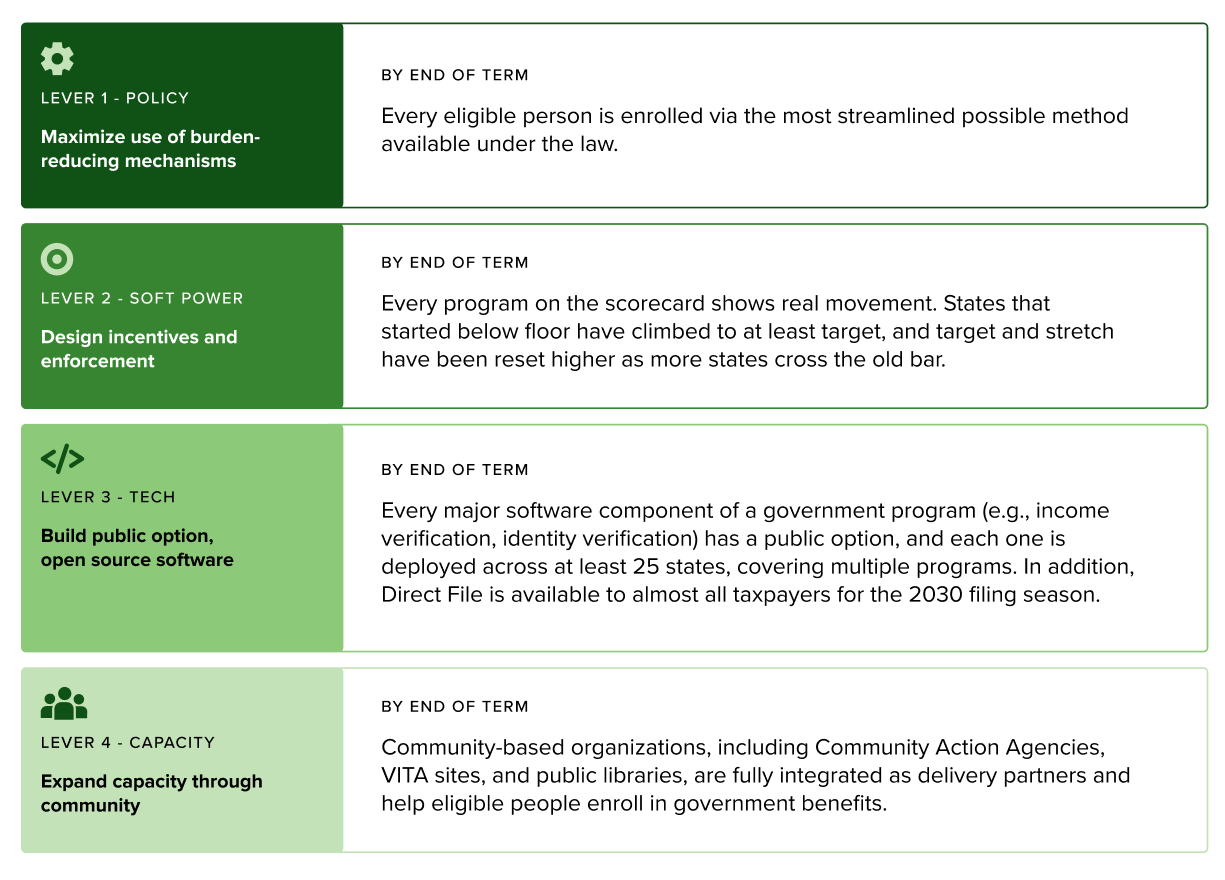
This report outlines four complementary levers to help government deliver benefits more effectively: reducing paperwork, strengthening accountability, building public digital infrastructure, and expanding direct support for eligible people. Below are examples of actions a future administration could take under each lever, from Day 1 through the end of its term. Explore the full report for the complete recommendations and road map for implementation.
1. Use existing legal options to reduce paperwork
People don’t need to do as much paperwork as they are doing. Existing law allows government agencies to use their flexibility to eliminate this burden on people.
Day 1:
Automatic enrollment in Medicaid for Supplemental Security Income (SSI) recipients
First 100 Days:
CMS issues a technical assistance tool kit to states below the national median automated Medicaid administrative renewal rate.
End of term:
States below the top quartile for automation of Medicaid administrative renewals are brought to at least 75 percent—bringing all states to the level that roughly 11 states have already proven is achievable.
2. Measure benefits delivery and hold agencies accountable
The federal government should publish what percentage of the estimated eligible population for a given program is actually enrolled and establish target benchmarks for each program. A public benchmark for delivery would create accountability for a program’s affirmative reach beyond just fraud prevention.
Day 1:
Publish an OMB memo identifying programs for a scorecard on PaymentAccuracy.gov and make the scorecard a source of public credit.
First 100 Days:
The public scorecard, with floor/target/stretch benchmarks and complete data, is live for 100 percent of the programs named in the Day 1 OMB memo.
End of term:
For every program on the scorecard, 100 percent of states that started below floor have climbed to at least target for uptake and administrative spend.
3. Build public tech infrastructure
A new administration should build a publicly owned, open source platform of shared digital components, available to any government agency. This platform’s technical architecture can and should directly guard against surveillance, disenfranchisement, and exclusion by design.
Day 1:
Direct GSA to develop a zero-trust Eligibility Rules Engine that allows agencies to share data for benefits eligibility without sacrificing privacy.
First 100 Days:
Launch a pilot hosted version of the Eligibility Rules Engine and income verification service for a small number of states.
End of term:
The Eligibility Rules Engine is used in production in at least 20 federal agency-to-agency data exchanges and in at least 40 state agencies.
4. Build capacity to reach eligible people
The federal government can leverage community-based organizations that are already funded, staffed, and running today, such as libraries, social services agencies, and food banks, to reach harder-to-access eligible populations. The people the safety net reaches should also be considered not merely recipients to be served, but a constituency to be organized.
Day 1:
Establish a single, cross-agency Benefits Navigator Program.
First 100 Days:
National benefits-navigator certification and training curriculum finalized and open to applications from any qualifying community organization.
End of term:
Certified benefits navigators, across every eligible organization type, operating in at least 90 percent of US counties.
Acknowledgments and Gratitude
This paper is built upon the collective wisdom, empirical research, and hard-won operational insights of dozens of scholars, technologists, legal experts, civic tech practitioners, and public servants. The author expresses her deepest gratitude to the institutions and research organizations whose groundbreaking work provided the foundational evidence, frameworks, and data that make this road map possible, including:
Axiom Foundation, Becker Friedman Institute for Economics at UChicago, Better Government Lab at Georgetown University, Center for Democracy and Technology, Center on Budget and Policy Priorities, Citizens for Responsibility and Ethics in Washington, Code for America, Collaborative Research Center for Resilience, Columbia World Projects, Consumer Financial Protection Bureau, Data Foundation, Democracy Forward, Digital Public Works, Economic Security Project, Empowering Democracy Initiative, Federation of American Scientists, Foundation for American Innovation, Georgetown University’s Beeck Center for Social Impact + Innovation, Government Renewal Project, GSA 18F, Institute for Responsive Government, Institute for Women’s Policy Research, IRS Direct File Team, KFF, Law and Policy Economy Project, Linda Miller of GovIntegrity, New America’s New Practice Lab, Niskanen Center, Reconstructing Democracy Project, Recoding America, Roosevelt Institute, Searchlight Institute, Tax Policy Center, Tech Viaduct, TechTonic Justice, US Digital Service, UC Berkeley School of Information (Executive Fellowship in Applied Technology Policy), University of Michigan (Gerald R. Ford School of Public Policy & Poverty Solutions), Urban Institute, Vanderbilt Policy Accelerator
The author also convened an unconference in August 2026, bringing together researchers, technologists, advocates, and current and former government officials to think through what a more user-friendly, automated social safety net could look like. Conversations that day sparked or sharpened many of the ideas, precedents, and provocations in this paper, and the author is deeply grateful to everyone who traveled, thought out loud, and pushed back in that space.
Lastly, the author is grateful to many individuals for their time, willingness to share their expertise and ideas, and feedback—this paper is much stronger for it! Thank you, Larry Bafundo, Marisa Bremer, Stephanie Burdick, Jacky Chang, Hannah Garden-Monheit, Alexander Hertel-Fernandez, Sophie Jacobson, Suzanne Kahn, Anunay Kulshrestha, Annie Lowrey, Clarence Okoh, Gnora Mahs, Jonathan Mayer, Erie Meyer, Leya Mohsin, David Myers, Marina Nitze, Amy Paris, Rebecca Piazza, Reed Showalter, Loren Schulman, Misu Tasnim, Abiah Weaver, Rebecca Williams, Elizabeth Wilkins, and Allison Zelman.
Suggested Citation
Ng, Ivana. 2026. Public Digital Infrastructure for a Safety Net That Delivers: What One Administration Can Build. New York: Roosevelt Institute.
RELATED RESOURCES
Author