

Why Doesn’t the US Tax Its Big Corporations More?: The Myth of “Global Tax Competitiveness”
September 3, 2026
By Zorka Milin

Key Takeaways
- The United States is an outlier when it comes to corporate taxes. Both corporate tax rates and the share of government revenues they make up in the US have declined dramatically since the mid–20th century, and US companies face far lower tax rates than many international peers.
- Proponents of low corporate taxes argue that keeping taxes low is necessary for both countries and companies to be “competitive” (i.e., to attract investment and business activity). However, empirical evidence at both the macro and micro levels contradicts this claim.
- As more countries engage in tax cooperation over tax competition, US policymakers should follow suit and implement robust corporate taxes to fund public investments benefiting working-class Americans.
Introduction: America Is a Low-Tax Country
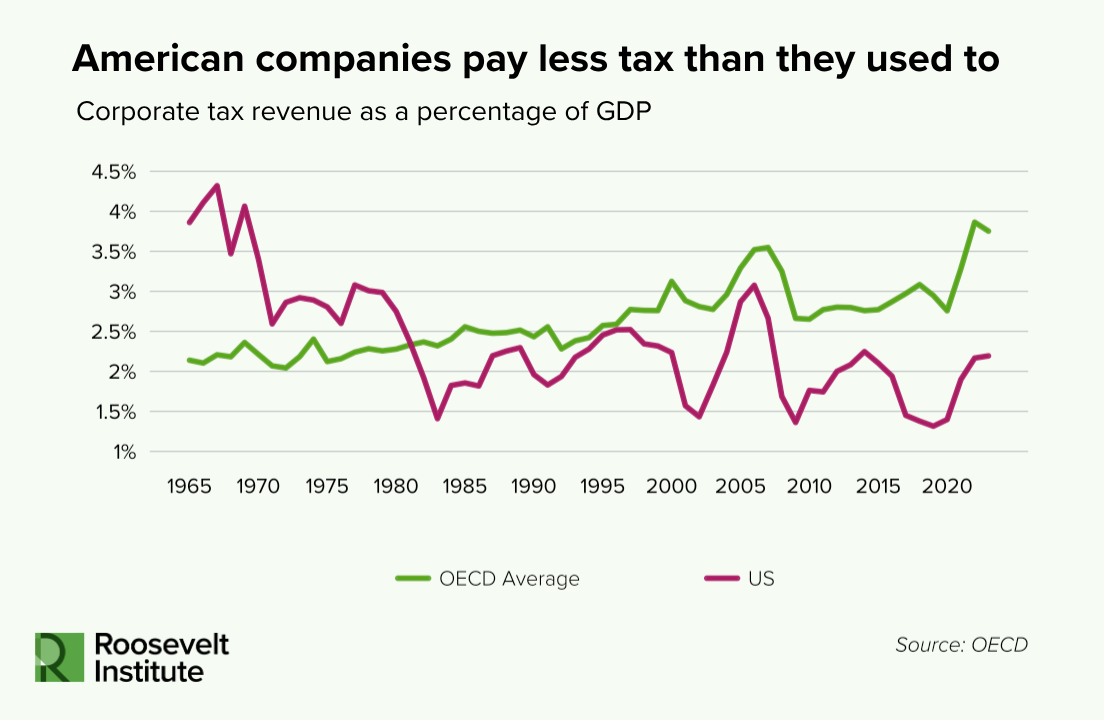
Historical and global trends confirm what most Americans already believe: Too many US corporations aren’t paying enough in taxes. Corporate tax revenues as a share of total revenues have plummeted from nearly one-third during the 1950s to only 6 percent today, and have similarly decreased as a share of total GDP (see Figure 1). And this trend is only accelerating: Successive US tax cuts in 2017 and 2025 each precipitated abrupt drops in corporate tax receipts by nearly one-third, even as other developed economies have trended toward more corporate tax revenues.
Figure 1
One important driver of these trends is the growing share of American businesses that opt not to be taxed as corporate entities at all. Instead, they “pass through” their income and tax responsibilities to their owners, who report it on their individual tax returns—a shift highlighted by both the Center for American Progress and the Washington Center for Equitable Growth. The increasing prevalence of pass-through businesses points to the need to restrict and reform pass-through taxation, but doesn’t entirely explain away the problem of low US corporate taxes.
American companies that are subject to the corporate income tax still face significantly lower effective tax rates than their peers, according to a 2022 Reuters analysis comparing the biggest American multinationals with their major foreign competitors. International corporate tax data for America’s key trading partners confirm this finding (see Figure 2). It is undeniable that the United States taxes its corporations far less than other developed countries.
Figure 2
Low Corporate Taxes Are Unpopular and Damaging
Poll after poll shows that most ordinary Americans across the ideological spectrum support raising taxes on big corporations. While there is an ideological divide among economic wonks on whether to celebrate or decry low corporate taxes, ordinary Americans understand that when big corporations pay a smaller share of taxes, individual taxpayers are left filling the gap and bearing the consequences of shrinking revenues, leaving the good life increasingly out of reach for most Americans.
The status quo of low corporate taxes is neither fair nor sustainable, especially as growing budget deficits coincide with labor’s record-low share of national income and record-high corporate profits concentrated among a handful of large tech corporations. The stark capital-labor divide and corporate concentration are both poised to grow further with the rise of artificial intelligence. Moreover, lightly taxing corporate profits increasingly means those profits escape US taxation altogether, since a growing share of US corporate equity is owned by foreign investors and other shareholders exempt from US tax, as shown in research by the Urban-Brookings Tax Policy Center.
There is room to increase US corporate taxes: The current 21 percent domestic corporate tax rate is far below the 70 percent revenue-maximizing rate established in a recent literature review by the Congressional Research Service. The revenues at stake are substantial. A recent Hamilton Project proposal estimates that a modest increase in tax rates on domestic and overseas corporate profits, coupled with complementary reforms, could raise $4 trillion in new revenue over 10 years.
In the face of popular support for higher taxes, why can big American corporations manage to keep their taxes so low? The problem is ultimately a political one. US corporations exert influence through significant electoral campaign donations and tax lobbying, far beyond what is possible in other countries. The policy justification given by corporate lobbyists and policymakers aligned with them is that raising corporate taxes hurts the global competitiveness of US companies.
The obsession with competitiveness in international economic policy is not new: Back in the 1990s, Paul Krugman, current Roosevelt Institute senior fellow, critiqued this fixation as dangerous and wrong. More recently, the perniciousness of the competitiveness myth has received attention in trade and climate policy areas, but tax policy has yet to reckon with it. Claims about the importance of global tax competitiveness—the idea that nations should slash corporate taxes to attract more corporate investment—are overstated or contradicted by the evidence in three important ways: empirically at both the macroeconomic and microeconomic levels, and by observing recent trends in international tax cooperation.
Dispelling the Myth That Low Corporate Taxes Always Promote Growth
First, on a macroeconomic or country level, any claims that low corporate taxes are a recipe for economic success are not borne out by evidence. Tax competitiveness, however defined and measured, does not determine a country’s real economic growth. The right-leaning think tank Tax Foundation compiles an annual “international tax competitiveness index,” ranking Estonia and Latvia as having the top two most “competitive” tax codes—two countries that also happen to rank at the rock bottom of The Economist magazine’s ranking of best-performing economies in 2024.
To be sure, corporate taxes can have some marginal effect on growth, but it is only marginal and depends in part on how the revenues are spent. Most economic modeling mustered in support of lower corporate taxes assumes that when companies are taxed more, the increased cost of capital reduces new investment and growth. But in the real world, where the user cost of capital depends (heavily) on interest rates and public budgets can’t be assumed to balance, higher corporate tax revenues can reduce deficits, which can in turn lower interest rates, making it easier for all firms to borrow and grow regardless of tax liabilities. Across peer-reviewed studies, the evidence for pro-growth impacts of low corporate taxes is mixed at best, and overstated by anti-tax advocates including the Tax Foundation. Growth that is purely tax-driven does not translate into real growth, let alone the higher economy-wide living standards we assume go with it.
Take Irish “leprechaun economics,” for example: Ireland’s stratospheric GDP growth rates in the 2010s were largely a mirage that reflected the country’s role in sheltering multinational corporate profits rather than real, sustainable, and equitable economic prosperity. In the US, evidence shows that 2017 corporate tax cuts exacerbated inequality: Although jobs and earnings modestly increased, 87 percent of gains went to the top 10 percent of the income distribution. Corporate tax breaks also undermine child and family well-being, as previous Roosevelt research shows.
At the micro level of individual business decision-making, proponents of low corporate taxes tend to assume they are a primary factor driving business investment decisions. In reality, tax is just one factor among many others that are much more important, such as access to capital, a skilled workforce, good public infrastructure, and legal and political stability, including rule of law and low corruption—all of which must be underwritten by robust taxes. Empirical evidence shows that tax is secondary to these other factors, and is corroborated in surveys of investment promotion agencies across Organization for Economic Cooperation and Development (OECD) countries. These structural advantages are themselves largely the product of sustained public investment. Corporate tax is not just a business cost to be minimized but a necessity for funding the essential public goods that are the prerequisite of an attractive investment climate.
The United States is home to more of the world’s competitive and successful companies than any other country—not because of low taxes, but because it is a large and mature market economy that possesses all of the desirable attributes above. The US doesn’t need to offer tax breaks to attract investment the way emerging markets might. Even in China—the bogeyman of American competitiveness anxieties—taxes are only one aspect of the country’s industrial policy, and not the primary one. China is a mid-to-high tax country, and, like in the US, what attracts foreign investors to the country are not taxes, but skilled workers, access to consumers and capital, and innovative companies that drive productivity and profits. Neither economy is outcompeting much poorer countries on the basis of lower tax costs.
Corporate tax is not just a business cost to be minimized but a necessity for funding the essential public goods that are the prerequisite of an attractive investment climate.
When companies do respond to tax changes, the response is far more likely to involve accounting than economics: Firms are about three times more likely to shift where they report their profits on paper than to relocate productive activity such as jobs and factories, whether to China or to a lower-tax jurisdiction. To the extent that tax considerations alone drive decisions to enter or exit a market, they create market distortions that should be discouraged, regardless of if the change exists only on paper or involves real economic activity.
Choosing not to address these distortions is a policy decision, not an inevitability. Policymakers can stop American companies from inverting into tax havens, for example, as the Obama administration did. They can also better align taxes with real economic activity by allocating taxing rights between countries according to where sales take place, and not where companies are incorporated. This solution is not just theoretical. Most US states already apportion corporate taxes based on sales, in part because it’s simple to implement and harder to evade. This approach prevents companies from reducing their tax liability by simply shifting income or moving headquarters to lower-tax jurisdictions: That would require decreasing their revenues, which is undesirable because it reduces profits more than taxes do.
International Tax Cooperation Beats Tax Competition
Recent progress in international cooperation against the global tax race to the bottom should finally put the myth of global tax competitiveness to rest. In 2021, more than 130 countries agreed to tax the profits of all large multinational companies at least 15 percent. This global corporate minimum tax was championed by the United States and is the result of years of diplomatic negotiation and compromise at the OECD. It represents a historic victory for real competition over tax competition. As then–US Treasury Secretary Janet Yellen said, “Rather than competing on our ability to offer low corporate rates, America will now compete on the skills of our workers and our capacity to innovate, which is a race we can win.”
Average statutory and effective corporate tax rates continue to climb as dozens of countries around the world implement the global minimum tax, but unfortunately, the US is an outlier. Despite the United States’ central role in instigating and negotiating this groundbreaking global tax framework, which dates back to the first Trump presidency, the second Trump administration has pushed hard to exempt American companies, arguing that their foreign profits are already taxed “robustly.” In reality, US corporations continue to book significant profits in tax havens, according to their own tax disclosures. This is no surprise, as the US tax code rewards US multinationals for shifting profits and outsourcing jobs overseas. Rather than closing offshore loopholes, the 2025 tax cut showered nearly a trillion dollars in new and expanded tax breaks on the nation’s largest companies, including $170 billion in international tax breaks.
A truly democratic sovereign would serve the interests of its people, not the quasi-sovereign corporate interests that capture it.
It is telling that in the face of global progress in addressing tax competition, domestic proponents of global tax competitiveness have now switched to championing “tax sovereignty” instead. Treasury Secretary Scott Bessent, speaking before the US Congress in June 2025, emphasized “the importance of retaining America’s tax sovereignty from nations that choose to unfairly tax American businesses in order to fill their own treasuries.”
But a truly democratic sovereign would serve the interests of its people, not the quasi-sovereign corporate interests that capture it. Exempting American firms from global tax standards is not a win for the US or its tax sovereignty, but for tax havens and the big corporations that move profits there. The exemption does nothing to increase tax revenues, curb corporate power, or advance the interests of American workers and families. To really do that, a future administration must champion and adopt higher corporate taxes, including robust minimum taxes both at home and abroad. Safeguarding the foundations of our economy and our democracy demands nothing less.
Acknowledgments
The author would like to thank Patrick Driessen, Thomas Georges, Duncan Hardell, Corey Husak, Michael Madowitz, Noa Rosinplotz, and Aastha Uprety for their feedback, insights, and contributions to this paper. Any errors, omissions, or other inaccuracies are the author’s alone.
Suggested Citation
Milin, Zorka. 2026. “Why Doesn’t the US Tax Its Big Corporations More? The Myth of ‘Global Tax Competitiveness.’” Roosevelt Institute, September 3.
RELATED RESOURCES
Author