

Fixing the Tax Max: Restoring Social Security’s Wage Base
September 9, 2026
By Tyler Bond
This essay is part of the Roosevelt Institute’s Good Life Resident program, an initiative designed to develop emerging leaders and generate people-centered ideas across the Roosevelt Institute’s key economic policy priorities. Explore the full series on Social Security revenue reform.
Social Security’s Old-Age and Survivors Insurance (OASI) trust fund reserve will be depleted in six years, according to the latest estimates. Avoiding benefit cuts requires aligning revenues with benefit payments to eliminate the financing gap. While some politicians claim benefits must be cut to resolve the funding shortfall, that approach is neither popular with the American public nor reflective of the root causes of the financing gap. Simply put, the discussion of how to close Social Security’s financing gap must start with the need for additional revenues, not benefit cuts, because the erosion of the program’s revenue base is the heart of the problem.
The OASI program receives more than 90 percent of its revenue from payroll tax deductions from nearly all wage and salary workers. Restoring Social Security’s wage base would be a policy correction after years of inaction by Congress, and it’s an approach that would quickly bring money into the program.
Addressing the shortfall is critical, not only for beneficiaries, but also for the broader economy. Social Security spending generates at least $2.6 trillion of economic activity annually, and across-the-board benefit cuts would reduce economic activity by more than $300 billion. Allowing indiscriminate benefit cuts to occur (or proactively enacting them) would also significantly increase income and wealth inequality, as lower-income beneficiaries would lose a disproportionate share of their income.
This paper first explains why restoring Social Security’s revenue base—rather than cutting benefits—should guide the response to the financing gap. It then traces the history and erosion of the taxable maximum, compares leading options for raising or eliminating it, and considers how tax reforms could fit into a broader package of revenue changes.
A Brief History of the “Tax Max” and the Current Debate
Social Security uses a “contribution and benefit base” to determine both how much workers contribute and how much they will receive in benefits. The contribution and benefit base only goes up to a certain dollar amount of wages and salaries, which is $184,500 in 2026. This amount is often referred to colloquially as the taxable maximum, or “tax max” for short. Any earnings above the tax max in a given year are not taxed for the purposes of making Social Security contributions. In addition, earnings above the tax max are not used to calculate Social Security benefits when a person retires or claims benefits in another way.
Social Security has always had a tax max. The Social Security Act of 1935 established the tax max at $3,000 per year, or the equivalent of $250 per month, which was featured in the proposal from President Franklin D. Roosevelt’s Committee on Economic Security. The original Social Security Act did not contain any provisions for indexing the tax max, so it remained at $3,000 for years. Eventually, Congress realized the tax max needed to be higher so that the contributions and benefits workers make and receive would reflect the growing earnings of the American middle class. Throughout most of the 1950s and 1960s, Congress made ad hoc increases to the tax max. Congress finally realized that ad hoc increases were an inefficient way to administer this aspect of the program and, starting in the 1970s, began to index the tax max to increases in the average wage. This is largely how it has functioned since.
While Congress has increased the nominal tax max over the years, the percentage of covered earnings below or above it has varied. When Social Security began, 92 percent of all covered earnings were below the tax max (which thus helped fund Social Security). When tax max increases were ad hoc, the percentage of covered earnings fluctuated dramatically, as shown in Figure 1. The percentage of covered earnings below the tax max was 90 percent in 1982 and 1983 (as a result of Social Security amendments passed in 1977 and 1983), but it fell after 1983 and has been slowly declining since then. Indexing the tax max to changes in the average wage does not guarantee that a certain percentage of covered earnings will remain below the tax max, because the distribution of earnings differs from the average. Social Security’s recent experience illustrates this point.
Figure 1:
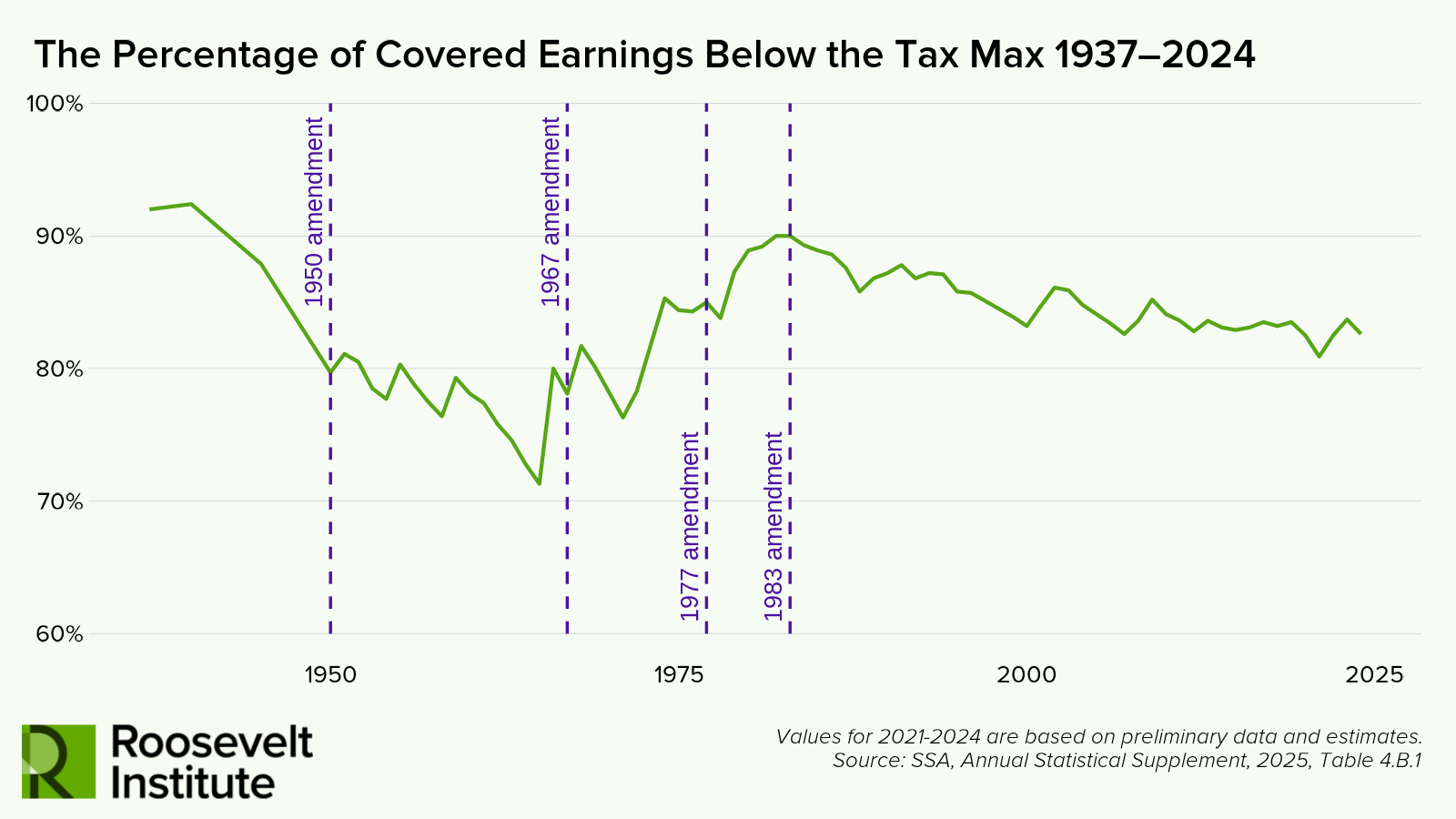
When Congress enacted the 1983 Social Security reforms, it was estimated that the percentage of covered earnings below the tax max would remain at 90 percent, harkening back to the earliest years of the program. This level of covered earnings, in combination with other changes, was projected to keep Social Security fully funded for the next 75 years. However, congressional leaders in 1983 did not anticipate how dramatically compensation patterns would shift over the coming decades and, as a result, likely had no reason to think that the current tax max structure would be insufficient for Social Security’s future needs.
The percentage of covered earnings subject to payroll tax contributions has declined over time due to the rapid growth of income above the taxable maximum. Currently, only 82.6 percent of covered earnings are subject to the Social Security payroll tax. Therefore, even as wages have risen, especially for the highest earners, Social Security’s revenue base has failed to keep up with the program’s needs.
Options for Changing the Tax Max
Considering this history and the present circumstances, Congress urgently needs to restore the Social Security wage base by resetting the tax max at an appropriate level. Social Security receives nearly all of its revenues from contributions made by current workers.1 Therefore, unless Congress considers a new revenue source, raising revenue from current workers will be necessary to resolve the financing gap, and to do so quickly.
Congress, theoretically, has a large number of potential revenue sources if one considers revenue in the broadest possible sense. However, given its nature as an insurance program, Social Security has always connected contributions from current workers to payments to current beneficiaries. Adding a new revenue source that is not based on a worker’s earnings and compensation could be administratively complex and could change people’s perceptions of Social Security.
Those who have gained the most from recent decades of economic growth have also contributed less toward Social Security as that growth has occurred. Raising or eliminating the tax max would restore some balance between economic growth and social protection.
This discussion also centers on an argument for fairness. Social Security insures all of society against risk. Since society benefits from this program and the protection it provides, as many people as possible should contribute to its success. Those who have gained the most from recent decades of economic growth have also contributed less toward Social Security as that growth has occurred. Raising or eliminating the tax max would restore some balance between economic growth and social protection.
Finally, proposals to adjust the tax max must consider the interaction between contributions and benefits within Social Security. Historically, benefits have been calculated based on the amount contributed. That’s why the tax max is officially called the “contribution and benefit base.” Some proposals would increase both contributions and benefits at the higher coverage level, meaning higher earners who contribute more would also receive more in benefits, while other proposals would only increase contributions and leave the cap on benefits in place.
Raising the cap on contributions while leaving a cap in place for benefits would change the relationship between contributions and benefits. The connection wouldn’t be completely eliminated, because higher-income workers would still receive more in total benefits, but some wealthier workers would contribute more to shore up Social Security’s overall financial health without a commensurate increase in future benefits. This may be considered an appropriate trade-off given the extreme wage growth at the very top of the income distribution in recent decades.
With these considerations in mind, this paper evaluates three buckets of options for reforming Social Security’s tax max:
- Permanently setting the tax max at 90 percent of earnings.
- Eliminating the tax max completely so all earnings are subject to the payroll tax.
- Different variations on options A and B that would involve a less direct change to the tax max.
Table 1 shows the share of the 75-year shortfall closed by options A and B, including whether benefits would be increased based on contributions above the current tax max.
Table 1: Percent of 75-Year Solvency Gap Closed by Proposed Tax Max Changes
| Increase Benefits | Do Not Increase Benefits | |
|---|---|---|
| Option A: Set tax max at 90 percent of earnings permanently | 22% | 28% |
| Option B: Completely eliminate the tax max | 48% | 67% |
A. The 90 Percent Approach With and Without Benefit Increases
The first option to consider is permanently setting the tax max so that 90 percent of all wage and salary earnings fall below it each year. Due to its historical connection to the 1983 amendments, some advocates have called for the tax max to be set to cover 90 percent of earnings in perpetuity. This would account for some of the growth in income inequality in recent decades and, to some, represents a reasonable amount of Social Security coverage.
Permanently setting the tax max at 90 percent acknowledges not just that almost all workers and employers have an obligation to contribute to this critically important program, but also that nearly everyone will need Social Security benefits in retirement. Aside from the very wealthy, who don’t derive much of their wealth from earnings anyway, most workers, including upper-middle-class workers, rely on Social Security as an important component of income in retirement and as an economically efficient source of protection against risk throughout life.
However, estimates from the Office of the Chief Actuary at the Social Security Administration (SSA) indicate that setting the tax max at 90 percent of covered earnings would only eliminate 22 percent of Social Security’s current shortfall. Setting the tax max at 90 percent, without providing benefit increases for contributions between the current tax max and 90 percent, would reduce the funding gap by 28 percent (see Table 1). These are meaningful reductions, but, on its own, setting the tax max at 90 percent of earnings is insufficient.
B. Eliminate the Cap With and Without Benefit Increases
The second option for changing the tax max would be to remove the cap entirely and make all wage and salary earnings subject to the payroll tax that funds Social Security contributions. Estimates from SSA’s Office of the Chief Actuary state that approximately two-thirds (67 percent) of the shortfall could be reduced by eliminating the cap on contributions but maintaining the cap for benefit calculations. Scrapping the tax max and giving additional benefits for additional contributions would eliminate just under half (48 percent) of the shortfall (see Table 1).
Increasing the payroll tax contributions of the highest earners would bring in substantial revenue for OASI while being less economically disruptive than other options, such as increased federal government borrowing or across-the-board benefit cuts. Moreover, for either option A or B, the mechanism to increase payroll tax contributions already exists, and the increase would be straightforward to implement.
Approximately 6 percent of workers earn above the tax max each year, and only 20 percent will ever do so at any point in their career. Receiving more contributions from higher-income individuals, who receive a disproportionately large share of the tax advantages for retirement savings elsewhere in the tax system, would have a smaller impact on the economy than other possible changes to Social Security, especially if that increase is phased in over time.
Eliminating the cap on contributions while retaining a cap on benefit calculations would represent a greater shift in the connection between contributions and benefits, but this shift is worth considering because it does much to resolve the financing gap. That much additional revenue would allow Social Security reformers more flexibility when considering other potential reforms, such as combining other revenue-base restorations discussed below.
C. Variations on Tax Max Changes
A third set of options would all involve changes to the tax max, but with variations that make them distinct from the direct changes discussed above. The list of options presented below is not meant to be exhaustive, but rather to illustrate a variety of ways Congress could change the tax max to serve the goals of Social Security.
- Congress could eliminate the tax max and increase benefits for additional contributions, but only modestly, perhaps by adding a third bend point to benefit calculations. One such proposal was estimated to reduce the 75-year shortfall by 62 percent.
- Congress could set the tax max at 90 percent of earnings for both contributions and benefits, but then collect additional contributions above the 90 percent tax max that aren’t used for benefit calculations. A proposal like this was estimated to reduce the 75-year shortfall by 39 percent.
- One widely discussed proposal in recent years would leave the current cap in place but reimpose the payroll tax on earnings above $400,000. The gap, or “donut hole,” between the current cap ($184,500) and $400,000 would close over time as the current cap rises with average wage indexing. This would bring in new revenues more slowly than other potential approaches. One version of this proposal, which would provide benefit increases for the additional contributions, was estimated to reduce the 75-year shortfall by 58 percent.
- Finally, there have been proposals to raise or eliminate the cap on contributions only on one side of the contribution split: either from employees or from employers. One of these proposals was estimated to reduce the 75-year shortfall by 41 percent.2
These alternative proposals would bring in additional revenue, yet, as with options A and B, none of the proposals in isolation would close the financing gap.
Changes to the Tax Max in the Context of a Broader Package of Reforms
Any potential change to the tax max must be paired with other changes to fully resolve the financing gap since none, implemented alone, achieves full solvency. Additionally, other policy changes included in a potential package of reforms could affect how a tax max change would impact the 75-year funding shortfall.
For instance, if raising the tax max were paired with an increase in the contribution rate (e.g., from 6.2 percent to 7.2 percent), this combination would bring in more total revenue for the program and increase the amount individual workers contribute. While some workers might change their economic behavior in response, Congress must consider the efficacy and efficiency of any potential policy change while acknowledging that behavioral responses are unavoidable.
Another consideration relevant to potential tax max changes is that the very wealthy don’t derive most of their wealth from wage and salary earnings. Above a certain level, most earnings don’t come from wage income but from other income sources, such as dividends or capital gains. Thus, the revenue resulting from lifting the tax max may not be as significant as some would expect. However, an increase in the amount of wage and salary earnings subject to the payroll tax contribution rate, paired with a new contributory tax on other sources of income, could greatly increase revenue to Social Security. One analysis estimated that eliminating the tax max combined with reforming how S corp income is treated for Social Security contribution purposes alone could close the financing gap with no need for benefit cuts or borrowing of any kind.
Regardless of how Congress ultimately decides to increase revenues to meet Social Security’s needs, these changes should be sustainable to reduce uncertainty about Social Security’s future after reform. Greater confidence in the program’s future could have unexpected economic value by reducing the financial anxiety many workers and their families face.
Conclusion
Social Security has always had a tax max, but the nominal amount of that cap and the percentage of earnings subject to it have fluctuated throughout the program’s 91-year history. The tax max should be set based on what Social Security needs to accomplish its purpose: to protect society as a whole against various risks. This level of risk protection at this relatively modest cost can only be provided at scale when everyone in society contributes. As income and wealth patterns change, the provisions of Social Security should change with them.
Thus, when Congress finally reforms Social Security to resolve the financing gap and prevent indiscriminate, across-the-board benefit cuts, changes to Social Security’s tax max will likely be included in that reform. The need for additional revenues to close the financing gap, as well as the societal impact of increased income inequality, makes it almost inconceivable that Congress would leave the current tax max unchanged. Given this reality, it is important to consider the strengths and weaknesses of various approaches to changing the tax max.
The clearest option for resolving the financing gap is to eliminate the cap on contributions while retaining a cap on benefits. This reform would generate substantial revenue to reduce the funding shortfall. This approach could lead to income shifting among some higher-income workers, which is why it would be important to pair a tax max change with other revenue base restorations to ensure that a worker’s full compensation is contributing to Social Security’s long-term success. This combined approach would also avoid the need to cut benefits in the name of solvency.
Footnotes
- OASI also receives revenues from interest earned on the bonds held in the trust funds and from the taxation of the Social Security benefits of some higher earners. These are unlikely sources to resolve the trust fund reserve depletion given that interest earnings will decline as trust fund reserves are depleted and that increasing the taxation of benefits would only have a small effect on Social Security’s financing. ↩︎
- Regardless of which contributor is asked to pay more, only increasing the contributions on part of the contribution base would bring in much less revenue than other options. And it could have unexpected and unintended consequences for how certain workers choose to be compensated. ↩︎
RELATED RESOURCES
Author