

September’s Jobs Data Will Reveal How Worried We Should Be About the Economy
August 28, 2026
By Michael Madowitz
It has not been a hot jobs summer. This month we find out if that’s just summer, or if the job market is worth worrying about.
What we know right now: The job market isn’t bad, but it’s not good either. Some indicators, like weekly unemployment insurance claims, don’t show the job market weakening. But the more comprehensive monthly Employment Situation report reveals what looks like a trend of workers paying a price for the Iran war—beyond inflation. And, the preliminary benchmark revisions suggest the job market was marginally weaker than we thought through this March.
A Slowing Job Market
Job growth started 2026 erratic, but has now weakened every month since March, with net job losses in July. The unemployment rate has improved in the last few months, which would be better news if it were not driven entirely by people leaving the labor force—the labor force participation rate, and the employment rate have fallen dramatically. Some of this is due to an aging population, but the prime-age employment rate and participation rate should both hit three-year lows this summer, indicating more than just demographic change in the labor market.
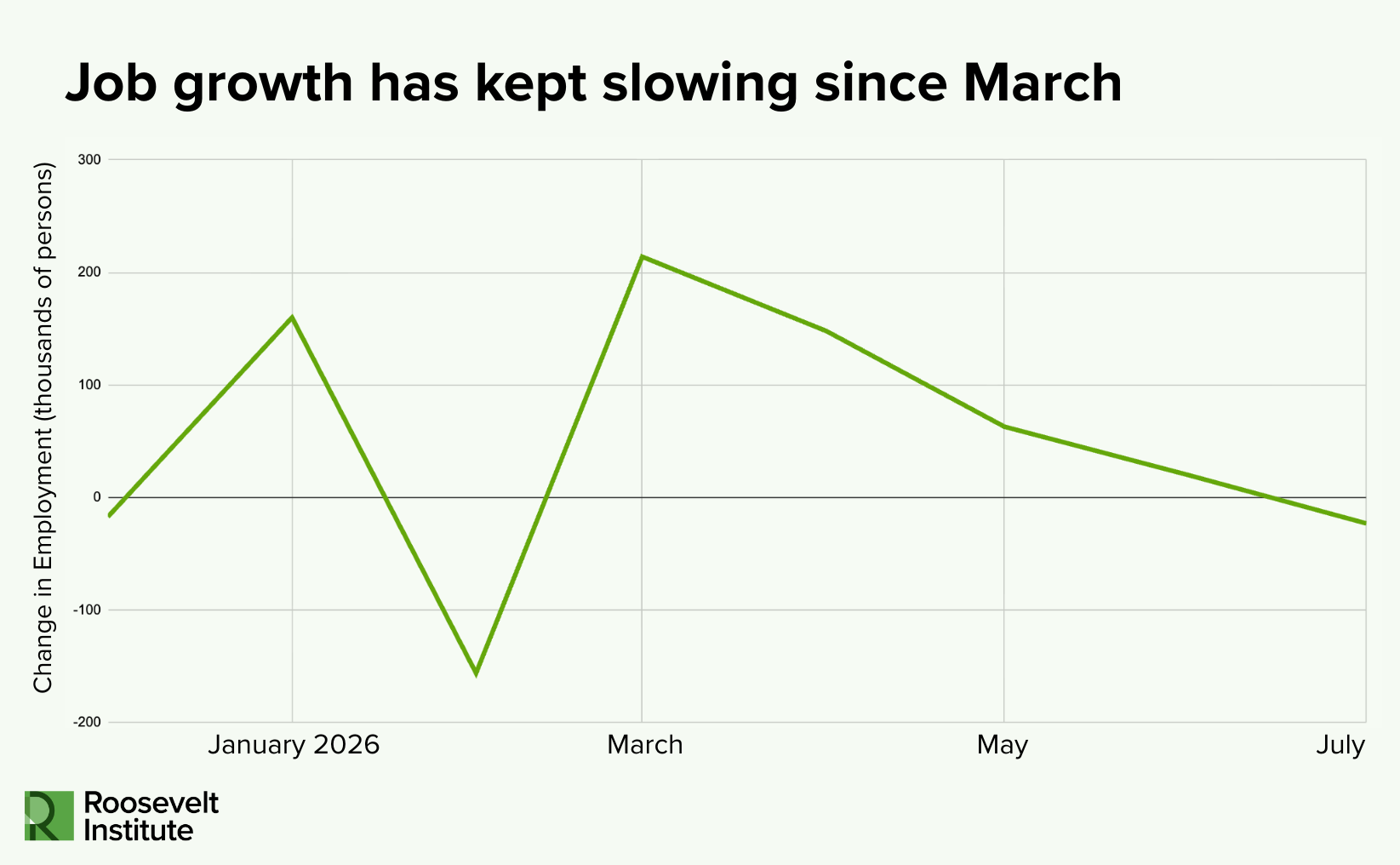
While there’s little data suggesting the economy is strong, the rest of the economic data isn’t as glum as the jobs report, and some of the weakness in recent months is plausibly seasonal.
The big outlier for industry job losses through July was teachers, and the decline in labor force participation was entirely among women—both moves are common in the summer months. (Disruptions in childcare availability, for example, can force mothers out of the labor market. According to a new Roosevelt analysis from economist Sarah Jane Glynn, more than a quarter of mothers with children under 15 have left a job, worked part-time, or not worked as a result of childcare disruptions.)
The optimistic case right now is that the seasonal adjustment algorithms are not tuned for an economy with a stagnating labor force, and starting with September’s report, we’ll begin to test that theory.
Americans are much unhappier with the economy than they usually are when the data looks as normal as it has recently. But if things take even a mild turn for the worse, this pessimism is going to look prescient.
What This Means for the Broader Economy
What this means for the broader economy is a harder question. August data releases all took pressure off the Fed—the weak jobs report and subdued inflation all pointed to the Fed having more time to hold off on rate hikes. Markets gained ground on the jobs data, Consumer Price Index, and Producer Price Index releases in August, and the market odds of a rate hike this fall fell from over 85 percent to under 50 percent in a month.
That may reverse somewhat if this month’s jobs data is healthier, but with inflation expected to accelerate again, the bigger concern is what policy levers are available if this jobs slowdown is real.
The budget deficit is nearly 6 percent of GDP already, which raises the risks that the politics could contribute to too-little fiscal stimulus to recover. The Fed’s policy rate is at 3 percent, so the straightforward 5 percent rate cut the central bank typically averages in response to recessions is off the table. What’s more, inflation from the Iran war is likely to reduce the Fed’s ability to respond.
Americans are much unhappier with the economy than they usually are when the data looks as normal as it has recently. But if things take even a mild turn for the worse, this pessimism is going to look prescient.
RELATED RESOURCES
Author