

1983 v. 2032: The Economics of the Last and Next Social Security Reform
August 4, 2026
By Kathryn Anne Edwards
Introduction
The Social Security trust fund is projected to be depleted in 2032.1 At that point, an automatic cut to benefits of around 20 percent will be implemented to rebalance the program’s long-term finances—unless Congress passes a reform that balances the program before the fund runs out. Many Americans view the trust fund’s depletion as inevitable, the inexorable result of demographics. This view stems from understanding Social Security as basically a pyramid scheme: Workers pay in, retirees get out, so the ratio between them underpins the program’s stability. People live longer and have fewer kids, ergo, Social Security is running out of money.
That’s a one-dimensional view of a multidimensional problem.
Social Security is a reflection of, and is supported by, the strength of the economy. Who is working, how much they earn, how healthy they are, and how much they save matter more than the head count. People could live longer, have fewer kids, and have a solvent Social Security if workers earned enough money.
Social Security is also not a fixed point; it has been reformed numerous times since its initial passage in 1935. Changes to the population or the economy do not necessarily hurt the program’s finances unless they were not predicted by or accounted for in any reform proposal. Do people living longer hurt Social Security’s finances? Not if Social Security reform assumed that people would live longer and adjusted benefits and taxes to take that into account. Do people having fewer children hurt Social Security’s finances? Not if Social Security reform assumed that people would have fewer children and adjusted benefits and taxes to take that into account.
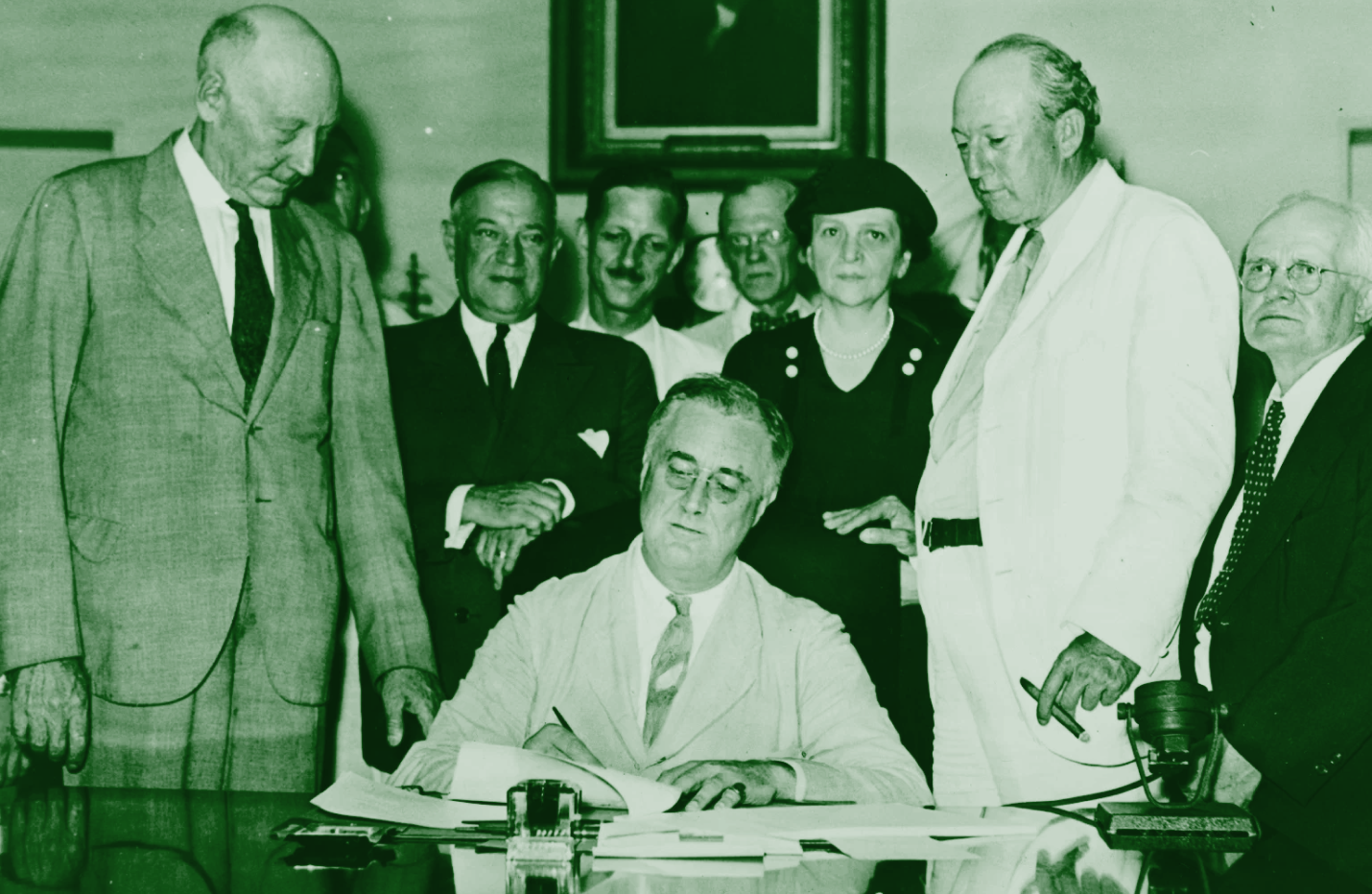
Source: FDR Library
Why the Social Security trust fund reserve is running out is thus a question of what has changed in the economy and population that the last reform missed. Answering this question is vital, because the fund is running out faster than originally anticipated and some kind of reform is coming. The last reform in 1983 was projected to keep Social Security in fiscal balance for at least 75 years. It missed by 23 years.
No matter the issue that could arise to derail mortality, fertility, and wage expectations, the answer to each is responsive, responsible economic policy.
This paper looks to 2032—to inform the reform that is coming by examining the reform from 50 years prior. The first goal is to understand what 1983 missed. The second is to consider what 2032 could miss. It’s an intellectual exercise to guess what could change in the population and economy that would affect Social Security’s outlook that reform would be wise to consider: Everything from changes to immigration patterns or a continued fall in fertility to cataclysmic shocks from new technology like artificial intelligence.
The result of this exercise is that, whatever the specific source of potential change, the threat to Social Security’s outlook in the future is the same cause of Social Security’s woes today: economic mismanagement. The economy in 2026 presides over incredible inequality and a policy history that is checkered at best, without meaningful or even basic investments in workers, like paid family leave. Whatever the future brings, the past has likely brought some version of it before. For Social Security, the make-or-break question is not the shock itself, but whether leaders manage it well. The pyramid scheme view of the program would support the conclusion that Social Security doesn’t fit the modern economy, but this analysis concludes that it is the modern economy’s failings that are hurting Social Security.
The paper starts with an assessment of the 1983 reform and how it strayed from its initial intention of 75-year solvency. The two main culprits are wage inequality and mishandling of the financial crisis and downturn known as the Great Recession. It then turns to the next 75 years and how demographics and economics—the bedrock of Social Security’s finances—could evolve. No matter the issue that could arise to derail mortality, fertility, and wage expectations, the answer to each is responsive, responsible economic policy.
Thus, this paper offers two perspectives with the same conclusion: Social Security’s long-term solvency reflects back the underlying strength of the economy and how well it is managed.
Success: Saving Social Security
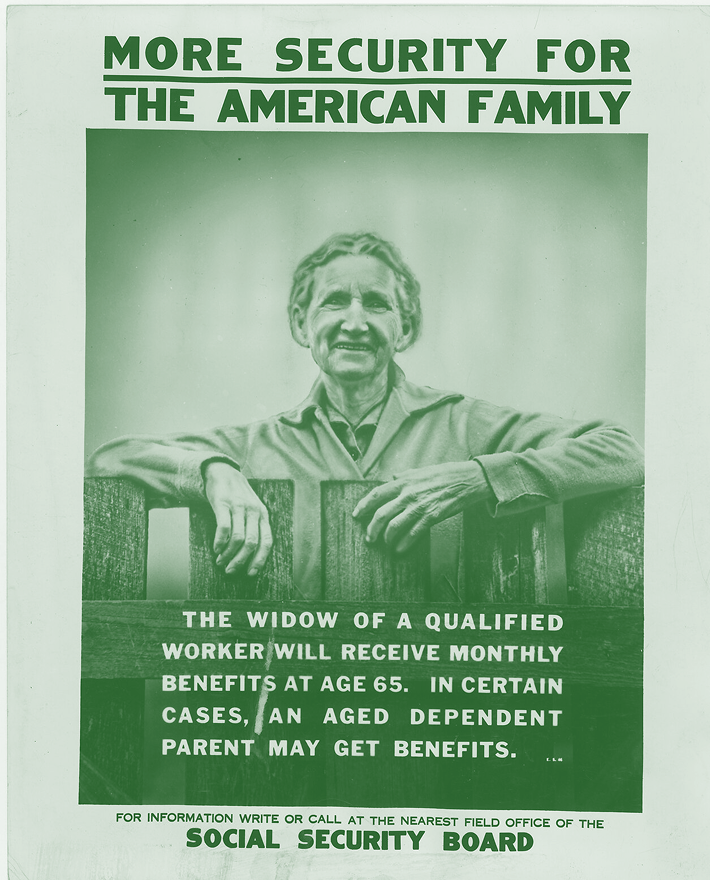
Source: Wikipedia Commons
Social Security was created by the Social Security Act of 1935 on a pay-as-you-go financing model: Taxes collected from current workers are used to pay current beneficiaries. The program doesn’t “float” tax rates or adjust them frequently to collect the exact amount of tax needed each year. Instead, Social Security uses a trust fund: a special account at the US Treasury that accumulates tax revenue, pays out benefits, and reserves any excess revenue.2 Those reserve funds are held in special Treasury bonds that can be redeemed at any time. It’s akin to a rainy day fund. The program can cushion its finances for years when tax receipts are low, such as during a recession.
The trust fund reflects a critical aspect of Social Security’s design: It is exclusively funded with Social Security tax receipts.3 The program is legally prohibited from using general revenue or borrowing to cover a shortfall.4 The only thing that pays for Social Security is Social Security.
The long-term outlook for Social Security comprises its 75-year projections. If the next 75 years of taxes are larger than the next 75 years of benefits, the program is “in balance.” If instead the next 75 years of taxes are smaller than the next 75 years of benefits, the program is “out of balance.” These projections and others are published annually in the Social Security Trustees Report.
Social Security began collecting taxes in 1937, and those contributions were deposited into the program’s first trust fund, called the Old Age Insurance (OAI) trust fund. In 1939, Social Security was expanded to cover the death of a worker, not just old age and retirement. OAI became OASI (the S for survivors). In 1956, Social Security was expanded again to cover permanent disability, and Congress created a separate trust fund for disability insurance, the DI trust fund.5
In the handful of years leading up to the 1970s, both the OASI and DI trust funds were used to meet benefit obligations when taxes were insufficient.6 From 1975 to 1981, however, Social Security collected insufficient taxes every year to cover old-age benefits. The recession that the trust fund was cushioning in those years was particularly brutal for Social Security’s finances, weakening growth and driving up prices. The former reduced tax receipts, while the latter increased benefit amounts. It wasn’t a onetime blip, but a categorical imbalance between taxes and benefits that fell outside of prior projections.
By 1981—after six years of dipping into the OASI trust fund—Social Security not only was in near-term danger of depleting the fund entirely and not being able to meet benefit obligations, but was out of balance and faced a long-term shortfall.
In 1981, newly elected President Ronald Reagan put forward two legislative packages to shore up the program’s finances, but they were mostly benefit cuts, including a 25 percent flat cut to retirement benefits. The Omnibus Budget Reconciliation Act of that year adopted some of the smaller cuts, but they were insufficient to address either the near-term or long-term issues. After his deeper cuts failed in Congress, Reagan created a commission to design reforms to address the short-term need while creating long-term balance. Formally called the National Commission on Social Security Reform, it was nicknamed the Greenspan Commission for its chair, Alan Greenspan.
By the time the Greenspan Commission began to meet, the OASI trust fund was completely depleted, and Congress had to grant emergency authorization for the OASI trust fund to borrow from the DI trust fund to meet benefit payments.7 Insider accounts of the Greenspan Commission note that the negotiations mostly fell apart after the Republicans’ poor performance in the 1982 midterm elections.8 But a group within the commission met in secret to negotiate a reform deal that was then presented to Congress and passed in 1983. It was billed as the “75-year reform,” meant to put the program on long-term stable footing. Among its numerous provisions were a major benefit cut and two tax increases: an increase in the retirement age (i.e., the benefit cut), a new tax on high-income beneficiaries, and an increase in the payroll tax rate. There have been no major changes to Social Security taxes or benefits since it was passed.
However it was billed at the time, the 1983 reform is best understood as the Baby Boom reform. By 1983, it had long been clear that the US had a large generation of Americans, followed by smaller ones; the birth rate was falling, life expectancy was rising, and a key challenge to long-run stability was the eventual retirement of this demographically exceptional group. The trust fund was key—a way to finance the Baby Boom by amassing tax revenue while they were still working, to pay out benefits once they retired. Using demographic and economic projections at the time, policymakers believed the 1983 reform would attain 75-year solvency through the boomers’ retirement and death.9
Shortfall: Missing the Long-Run Mark
The 1985 Trustees Report showed the start of a long-run 75-year imbalance that would grow over most of the subsequent years. In the 1985 report, the trust fund was projected to last until 2049. By 1992, the projection was to 2036. As of the latest report, the trust fund is projected to be depleted by 2032, less than 50 years from the last reform, rather than 75.
How should this imbalance be interpreted in terms of the accomplishments of 1983? Was the reform a failure because it did not “last” for 75 years as it was touted to do? Was the reform a success because it sustained the program for a half-century?
Those inclined to cut or dramatically alter Social Security have persistently argued that the long-term imbalance is proof positive that the program is not sustainable and must be cut or made less ambitious. Others, including members of the Greenspan Commission, congressional staffers, and members of the Office of the Chief Actuary at the Social Security Administration, argue that no one expected that the reform would perfectly follow the projections. Projections are far short of predictions, and predictions far short of reality. In the 1990s, these more technically minded policy experts advocated for Social Security to have legislatively required periodic adjustments—to use the projections and long-run imbalance as a way to motivate regular maintenance of the program. This culminated in the mid-1990s proposal for “sustainable solvency,” which would require that the trust fund reserves, expressed as a minimum percentage of annual program costs, be stable or rising.10 Leaning on a projection for 50 years is a disservice to the program, because, as we have seen, it sets it up for failure. No matter how well the program performs or what happens in the interim, the original projection becomes the de facto mark of success—almost the only barometer of success.
This paper takes a broader approach. The challenge in 1983 was to prepare Social Security for the baby boomers’ retirement. On that front, it succeeded. Demographics were the base of the 1983 projections, and, by that measure, the reform was good for 75 years. But predictable demographic changes are hardly the only challenge Social Security faces. If the next reform is to be successful, it must understand what happened after 1983 that created a chasm between projections and reality, and consider what could happen after a reform in 2032 that could do the same. I say broader because it’s not asking how to make the projections better or more accurate—instead it’s really asking: What are the threats to Social Security that don’t come solely from the program itself? What jeopardizes the long-term sustainability of this vitally important program? Reform needs to get this right.

In 2023, the chief actuary of the Social Security Administration testified before the Senate Budget Committee and was asked to explain the program’s long-term sustainability. In his testimony, he offered a clear culprit for the chasm between the solvency predicted in 1983 versus the solvency realized 40 years later: “The redistribution of earned income to the highest earners was not anticipated in 1983.”11
Contributory payroll taxes that fund Social Security are levied not on all wages but on wages only up to a cap. Social Security is not a retirement program but an insurance benefit: Workers pay in over their work life to buy protection against economic insecurity in old age. Hence the formal name of the benefit, Old Age Insurance. The tax cap is a function of risk assessment—when earned income is above a certain amount, the risk of poverty in old age is lower.
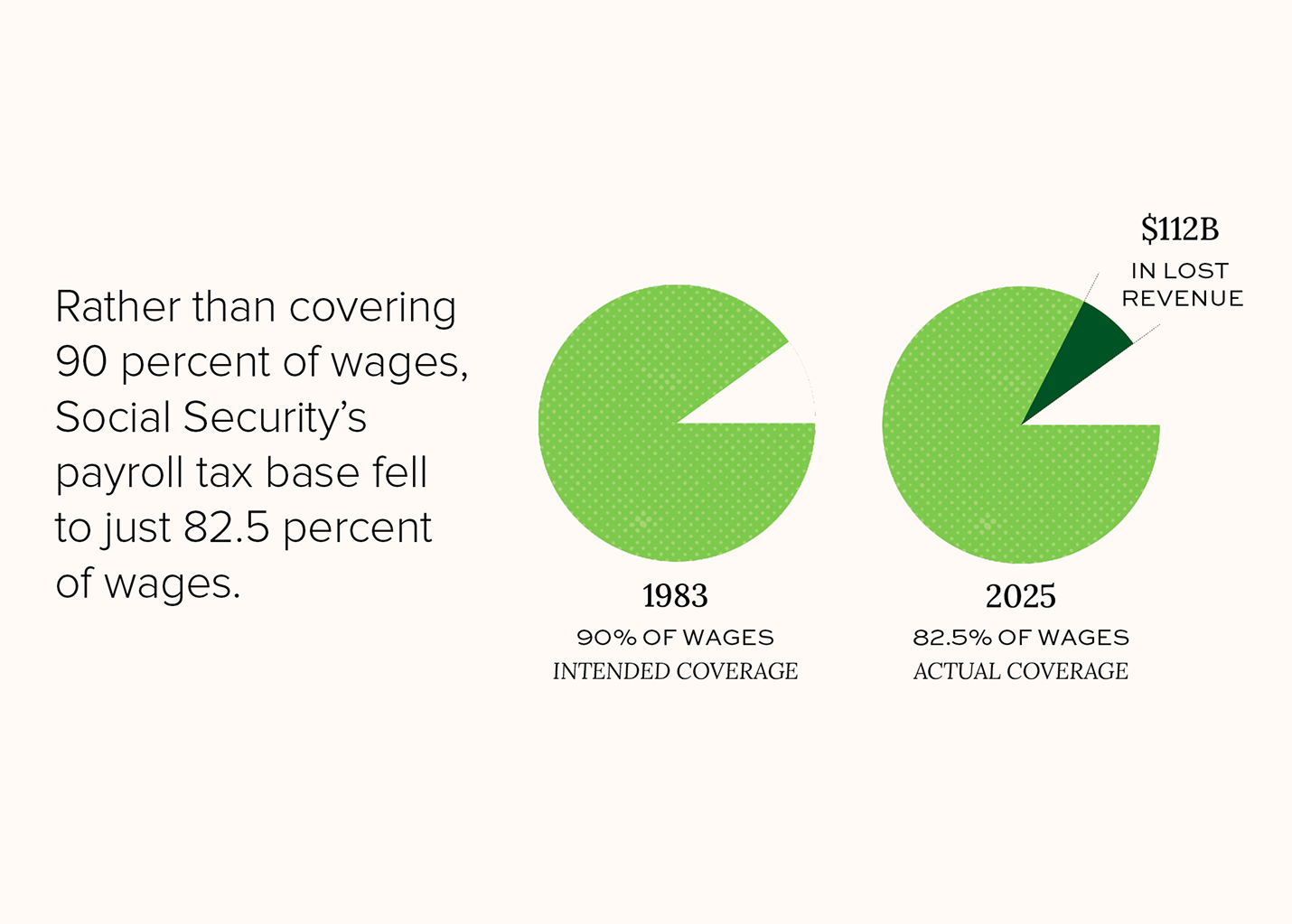
In 2025 Social Security collected $1.233 trillion in revenue from payroll taxes. If the cap was still at 90 percent, it would have collected an additional $112 billion, or 9 percent more in payroll tax revenue.
In 1983, that cap was $35,700. At the time, that level covered 90 percent of all wages earned in the US. Only 6 percent of workers earned wages above the cap. The intention was for Social Security’s tax base to remain at 90 percent of wages. Each year, the cap was and is increased automatically at the pace of average wage growth. The 1983 reform assumed that average real wages would increase 24 percent between 1983 and 2000; the reality was not far off, as average wages grew 28 percent in that time.12
What they got wrong: Earnings for those 6 percent of workers who earn more than the cap grew 62 percent, while earnings for the 94 percent below the cap grew just 17 percent. Rather than covering 90 percent of wages, Social Security’s payroll tax base fell to just 82.5 percent of wages. The “redistribution of earned income to the highest earners” is a technical way of saying wage inequality, which eroded Social Security’s bottom line. Unlike the effects of living longer and having fewer children, the last reform did not project or account for this phenomenon.13 Why can’t Social Security afford the benefits it promises? Because its tax base is far smaller than planned, by around 8 percent. That’s a massive cut. For example, in 2025 Social Security collected $1.233 trillion in revenue from payroll taxes. If the cap was still at 90 percent, it would have collected an additional $112 billion, or 9 percent more in payroll tax revenue.
Contributing to the Shortfall v. Solving It
Holding everything else constant, restoring the tax base after decades of erosion would help, but it won’t be enough. To start, the “valuation period,” or the 75-year window, is always moving forward. Each year, it drops a solvent (prior) year from the window and adds a shortfall (future) year in its place. Between 1983 and 2024, for example, two-thirds of Social Security’s actuarial shortfall is attributed to the valuation period.14 Thus, restoring the taxable wage base to cover 90 percent of earnings again—or even eliminating the cap entirely—will not fully eliminate the long-run shortfall because the problems created by inequality are compounded by waiting so long to address it.15
In the meantime, wage inequality also affects Social Security beyond revenue collection. To put it coldly, people of different earnings levels don’t live as long. If you sort workers by their lifetime earnings, the highest-earning quintile lives 10 years longer than the lowest-earning quintile.16 This shapes both equity and solvency, as lower-earning workers have dramatically shorter life expectancy yet share the same retirement age as higher-earning workers, who ultimately take home much larger benefits for a potentially much longer period of time.
And wage inequality was not the only economic development that the 1983 Social Security reform didn’t take into account in projections. It was joined by the 2007–09 Great Recession, the worst economic downturn since the Great Depression. The US economy shed a total of 8.8 million jobs over a two-year period, doubling the unemployment rate to 10 percent.17 Unfortunately, the fiscal policy response was complicated by political machinations and, as a result, was lackluster. The recovery was thus painfully slow.18 From the nadir in February 2010, it took more than four years, until April 2014, to recover those lost jobs.19 The weak jobs market also depressed wage growth, hurting Social Security tax collections on a second front, while many older workers retired, collecting Social Security benefits earlier, or sought out disability insurance. In contrast, the 2020 recession associated with the COVID-19 pandemic saw the economy shed more than 20 million jobs in a single month and unemployment rates jump to 15 percent. But the aid packages were large enough and recovery fast enough that the recession had no effect on the trust fund depletion projection.
It is not the job of actuaries to try to predict when or how recessions will occur. Their long-run economic projections assume an average unemployment rate; that average reflects long periods of low unemployment and short periods of high unemployment. The Great Recession was simply severe enough to make this average inadequate to the economy’s experience.
Social Security’s finances deteriorated rapidly in the Great Recession, a reflection of the lesson learned many times over: Social Security is sensitive to labor market performance.20 Indeed, what’s striking about both wage dispersion and the Great Recession is just how removed they are from the program’s design. It is not as if the 1983 reform had an error in benefit calculations, or that the tax structure was fundamentally misaligned. Rather, Social Security is a labor market program that is insulated from the everyday ups and downs but not from deep, structural weaknesses. That is a lesson as we approach 2032: The greatest risk to a successful reform isn’t the program’s design, but the labor market’s strength.
Social Security is a labor market program that is insulated from the everyday ups and downs but not from deep, structural weaknesses.


Given the projections of 1983 and the reasons the program’s trajectory drifted from them, the rest of this paper thinks broadly and creatively about 2032 and beyond. What would or could cause a drift from projections over the next 50 to 75 years? What is the next wage dispersion or Great Recession? This question is massive in scope, considering that 75 years beyond 2032 is the start of the 22nd century.
But there are nonetheless practical, informative ways to think about the problem. The bedrock of Social Security’s finances is the combination of demographics (mortality, immigration, fertility) and economics (wage growth). Both the demographics and economics of Social Security’s viability reflect the demographic and economic problems in the country. Specifically:
| THREATS | Understood and identified problems in the US economy that drag, and will continue to drag, on Social Security. These problems are addressable, and their effects on Social Security are relatively easy to predict. They include declines in labor force participation, immigration, and family formation; weak earnings growth; and recessions. |
| CONCERNS | Understood and identified problems in the US economy that could potentially drag on Social Security. The effects of these problems on Social Security, or how to ameliorate them, are not easy to predict. |
| UNKNOWNS | Future problems in the US economy that could potentially drag on Social Security. Both the problems and their effects are unpredictable. |
I discuss each group in turn, with the intention of informing reform efforts. Each group carries its own considerations for discussion.
Threats
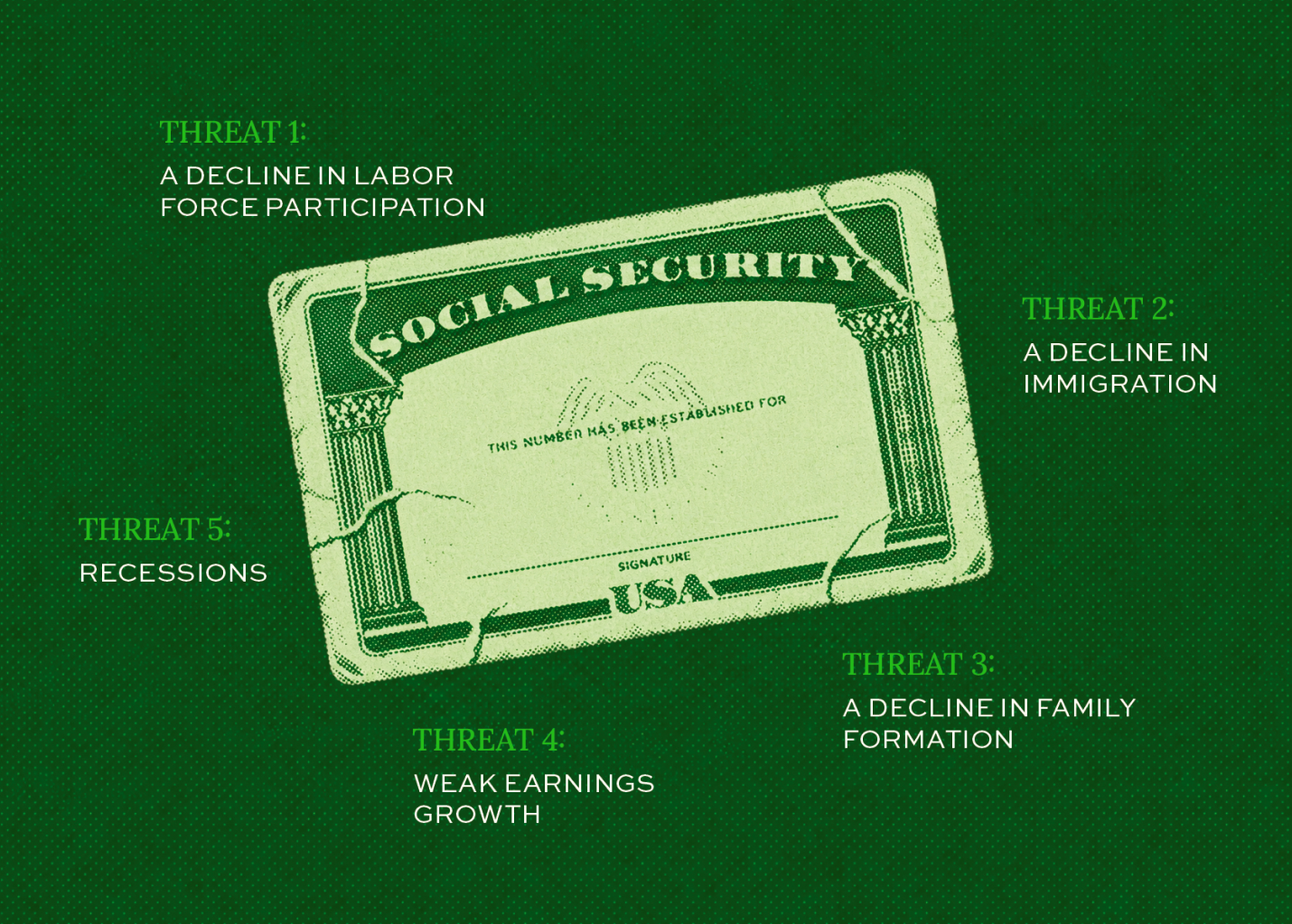
The basis for Social Security’s long-term solvency is for reform to reasonably predict how mortality, fertility, and wage growth will evolve. The “threats” are issues that affect one of those three key factors in ways that are predictable and, often, addressable: immigration, family formation, labor force participation, earnings, and recessions. The US economy is not at its full potential; Social Security suffers for that.
Reforms will address Social Security’s finances on the assumption that these threats will remain largely unchecked. However, the longevity of reform will depend on whether these threats improve or devolve, which in turn depends on whether they are the target of active policymaking. Hence, this paper discusses how Social Security should be changed, assuming no improvement (here called “program response”), as well as policies outside of the program that could generate improvement (here called “policy scenarios”).
Threat: A Decline in Labor Force Participation
Social Security needs workers, full stop. To that end, the more people who work and the more they earn, the better Social Security’s finances. However, labor force participation—the share of the population that works—shows numerous divergent trends.
Since the middle of the 20th century, the share of women working has doubled, while the share of men working has declined, though men still work at higher rates than women. The total population’s labor force participation rate has been declining for most of this century (reflecting the baby boomers’ retirement), but the labor force participation rate of the prime-age workforce (25–54 years old) remains at record highs. Workers with more education have higher participation than those with lower education. White men have higher labor force participation than Black or Hispanic men, while white women have lower labor force participation than Black or Hispanic women.
Differences in how much individuals from different groups work can reflect labor market tightness (i.e., difficulty finding a job) or labor market barriers (i.e., difficulty working). For example, individuals without a high school diploma have the lowest labor force participation rates of any educational group because most jobs require or prefer a high school diploma, and most workers have one, making it difficult for those without to find work. On the other hand, women with children under six have relatively low labor force participation rates, in part because finding and affording childcare is difficult. Similarly, individuals with a disability or chronic disease can have difficulty finding a job that is accessible to them, or one that they can maintain in addition to the time demands of healthcare. An individual whose partner or parent falls ill may have to leave the labor force to be a caregiver because they cannot afford or find a paid caregiver.
Some patterns of labor market tightness and barriers may persist, and there is always the potential for new ones to emerge. The labor market will naturally evolve along with the industrial composition of the US economy. Some people may work more, and some people may work less. The question is whether Social Security’s design can be tweaked to optimize payroll tax collection from workers (program response) and what could happen to labor force participation in the future (policy scenarios).
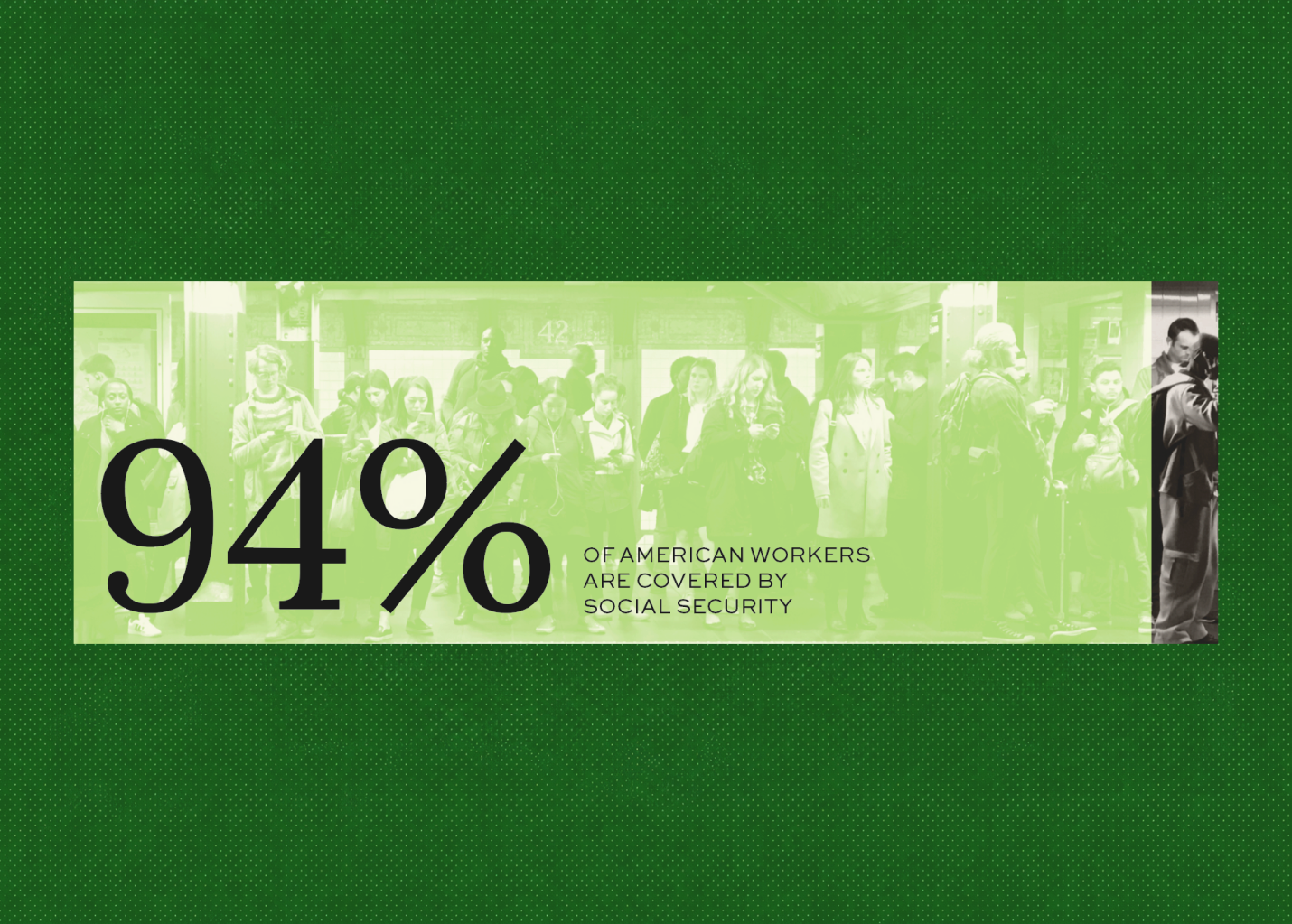
Program response. Social Security covers 94 percent of American workers.21 It has two potential avenues for expansion to bring more workers or earnings into the program. The first is relatively direct: It could expand its coverage by bringing the last 6 percent of workers into the tax base. They are primarily state and local government employees who have a separate pension plan with sufficient benefits and solvency to be acceptable as a Social Security substitute.
The second is more nuanced. Social Security’s claiming structure assumes a onetime, complete transition to retirement. That is, workers make a permanent change from working full time to not working at all. Claiming a Social Security benefit does not have a prohibition related to work, but it can have an earnings “time penalty.” Benefits are partially withheld if a claimant is working and younger than retirement age, and then repaid to the retiree after they reach their full retirement age.22 At any age, a high enough non–Social Security income can lead to a tax on Social Security benefits.23 Claiming, penalties, and taxes could be redesigned to allow or encourage working longer and, by extension, to increase tax contributions to Social Security.
For example, Social Security could create a “partial benefit” that allows workers to claim a portion of their benefit early, before their retirement age. It would help workers who want to reduce their work commitment without retiring altogether, providing a supplement to earned income without a penalty. It’s akin to an advance on their full benefit, and their full benefit can be actuarially adjusted to take into account the benefits they’ve received as well as the taxes they’ve continued to pay in.
Policy scenarios. Labor force participation, which reflects labor market tightness and the ease of finding a job, can only be increased by a strong labor market for workers across different education levels, experience levels, and locations. Policy can change the composition of workers (such as by encouraging more people to go to college or into apprenticeships) and encourage economic growth, but the unemployment rate is not directly manipulable by policy. That said, the US could endorse a policy of “full employment,” in which monetary policy prioritizes lowering unemployment.24 The lower the unemployment rate, the more people earning money and the higher their earnings, the more taxes collected by Social Security.
In addition, the US could change its approach to unemployment. The primary support for the unemployed is Unemployment Insurance, a state-run program whose generosity is determined by the state. Benefits are limited to individuals who have previously worked sufficiently and who lost their jobs through no fault of their own. The weekly benefit has strict time limits, ending after 10–26 weeks, depending on the state. The majority of the unemployed are not eligible for these cash benefits, and benefits only replace a third of prior earnings on average. In short, too little money goes to too few people. Across the political spectrum, advocates have pushed for dramatic reform to Unemployment Insurance.25
The current unemployment system aims to maximize labor force participation in the short run. Workers are pressured to get a job as soon as possible, meaning the benefits are scant and short. But this risks reducing labor force participation among workers who do not find work quickly enough, who need additional resources, or who may require investment in retraining. Plus, the fastest match is often not the best one, as financial precarity makes workers feel compelled to take a job below their qualifications. That is a net loss to the economy and to Social Security because they move to a lower earnings track.
A broader unemployment program aimed at maximizing long-run labor force participation would look different and could include training support, small-business support, job search assistance, and even public employment opportunities, all of which could result in higher labor force participation rates.
Policies targeting labor market barriers that decrease access to work could also increase labor force participation. There is the low-hanging fruit of proven and effective policies. For instance, paid sick leave, paid family and medical leave, and subsidized childcare have all been shown to increase the labor force participation of parents, particularly mothers. Employment law could include legal guarantees of and access to flexible work arrangements for some workers, such as the right to work off hours or from home. Flexible work arrangements have been shown to increase labor force participation of women and could improve the labor force participation of workers with disabilities, whose work rates reached historical highs during the work-from-home expansions of the COVID-19 pandemic.26
The Path Forward. The largest boon possible to Social Security’s finances is to have more workers, and there is ample low-hanging fruit policy to get there. Basic labor regulations, like paid sick days, paid family and medical leave, and the right to work part-time, as well as infrastructure investments like universal free childcare, would increase the number of people working.27 In addition, an unemployment program aimed at labor force retention and earnings maximization could increase the number of people working and their earnings. Social Security could benefit from this increase in workforce participation without making any change to design, but embracing the reality that workers phase into retirement could result in a small boost in labor force participation among older workers. Regardless of whether that boost bears out, it at least keeps the program relevant to what retirement looks like today.
Threat: A Decline in Immigration
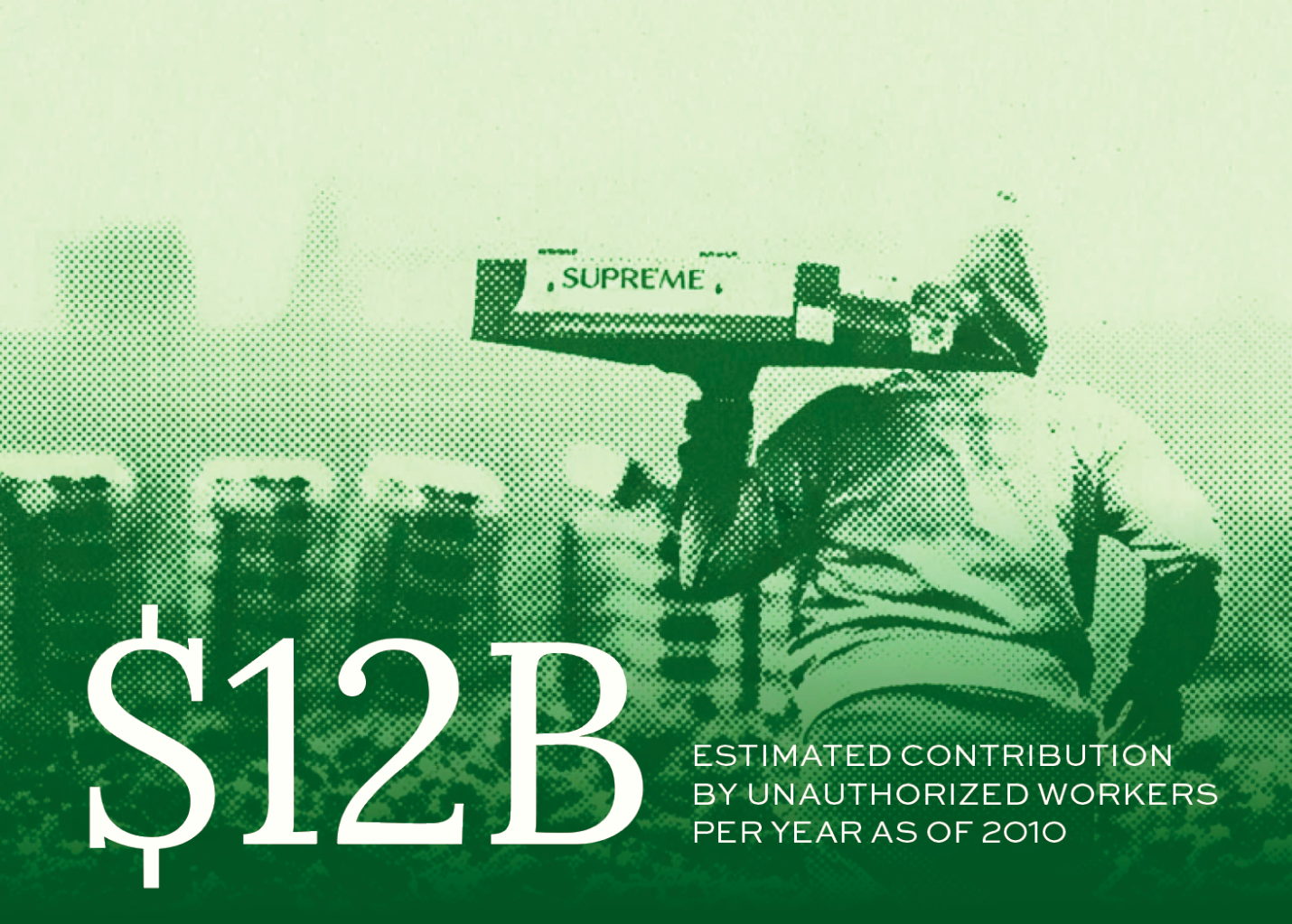
Put simply, immigration is good for Social Security. Immigrants in the United States, both with and without work authorization, contribute to Social Security in two ways. First, they directly pay into the program. Lawful permanent residents and other noncitizens with permission to work contribute to Social Security as citizens do. If they work long enough in covered employment, they can be eligible for Social Security benefits, like all workers, based solely on their earnings. Noncitizens without permission to work also largely contribute to Social Security through their earnings, but do not accrue eligibility for benefits, regardless of how long or how much they contribute. The boon to Social Security from noncitizen, unauthorized workers is not trivial. The Office of the Chief Actuary estimated in 2010 that it was a net of $12 billion a year.28
Second, immigrants add to the US population and have children who are US citizens by birthright. Immigration is the largest contributor to US population growth. The Census Bureau estimates that if the US were to completely halt immigration, the total population would immediately decline.29
However, the US has not meaningfully reformed immigration law since the Immigration Reform and Control Act of 1986 (the Illegal Immigration Reform and Immigrant Responsibility Act of 1996 was significant legislation, but it focused on enforcement of existing immigration law).30 Since then, the population of immigrants in the US without permission rose from a couple million to a peak of 12.2 million in 2007, and the population subsequently fell in the wake of the Great Recession. Recent years have seen a peak in applications from refugees and asylum seekers—individuals who are often admitted to the US and told to apply for status upon admission—and other groups that do not have permission but are protected from deportation.31 Immigration courts, however, have a backlog of cases—upward of 4 million—due to decades of underfunding.32 The US reached a new peak of 14 million immigrants without permission to be in the country in 2023.33
The One Big Beautiful Bill Act of 2025, which allocated $170 billion for immigration enforcement and deportation, constituted a dramatic reversal of immigration policy but made no changes to immigration law or status.34 The budget represents a commitment to spend $5,464 per unauthorized immigrant solely on deportation services over the next four years and caps the number of immigration court judges who may be hired in the US.35
The effect of atrophied immigration policy and retributive, deadly deportation enforcement leaves America’s immigrant future uncertain. Social Security benefits from growth in the number of workers—growth that this century has largely come from immigrants. Social Security also benefits from the payroll tax contributions of authorized and unauthorized immigrant workers, the former earning benefits, the latter not at all. On average, the US has annual net immigration growth of 1–2 million. In 2025 and 2026, early projections are that the US will have net immigration loss.36 Assuming immigration will support population growth is not advisable, as losing immigrants is the current government policy.
This raises two questions: How should Social Security be amended to account for the known exigencies of immigration (program response), and what could happen to immigration policy in the future that could affect Social Security’s finances (policy scenarios)?
Program response. Assume that the US maintains a population of immigrants both with and without authorization to work, who both continue to work. Social Security already has a clear set of rules regarding authorized workers, including benefit eligibility accrual and agreements with other countries on the repatriation of contributions and eligibility. Social Security has no articulated rules about unauthorized workers, but it de facto accepts their taxes and denies them eligibility for benefits. Going forward, the program could change either the tax acceptance or the benefit exclusion.
Changing the tax acceptance of unauthorized immigrant workers is the more difficult logistical path. In practice, the Social Security Administration would need a means of identifying tax contributions of unauthorized workers in real time, so that the contributions are rejected, or a means of identifying those tax contributions after the fact and sending them back. Unauthorized workers use Individual Tax Identification Numbers (ITINs), a unique number issued to them for tax and official administrative purposes, or Social Security numbers that are fake or illicitly obtained. ITIN contributions may be identified, but contributions using a false Social Security number are much trickier to exclude, as the risk of mistakenly excluding contributions from an authorized worker is both catastrophic for program integrity and highly probable.
If Social Security collects taxes for work, it should pay out benefits for those workers.
Designing an eligibility and benefit structure for unauthorized immigrant workers is, in many ways, easier and creates more positive spillover effects. In practice, Social Security’s eligibility rules could be amended so that unauthorized immigrant workers would have a way to earn eligibility based on their contributions made while unauthorized. The opportunity to earn eligibility for Social Security could encourage contributions. Plus, normalizing the payroll costs for workers with or without authorization reduces the employer incentive to hire an unauthorized worker as a way to reduce their own employer-side tax bill.
It is also important to remember that a worker’s status is not fixed. Many immigrants start as unauthorized workers but become lawful permanent residents or citizens. In the current system, their contributions made while unauthorized do not count toward their Social Security eligibility or benefit. As a result, they can enter old age ineligible for Social Security or with very low benefits because their authorized work history is short. They can then turn to need-based programs, such as Supplemental Security Income or Medicaid, in lieu of a sufficient Social Security benefit. Social Security boosts its finances by taking unauthorized workers’ tax contributions without any eligibility obligations, but that arrangement merely shifts the costs to other areas of the social safety net.
In a ruthless way, the current design is arguably the most beneficial for Social Security’s finances. The program gains from taxes that yield no benefits in return to a subset of immigrant workers, and the atrophy of immigration policy creates a large pool of unauthorized workers. But that type of windfall comes at the cost of program integrity. In principle, all workers who pay into Social Security will receive a payout—but in practice, unauthorized immigrants are excluded. That risks the fundamental value at the heart of Social Security’s design, success, and popularity: fairness. If Social Security collects taxes for work, it should pay out benefits for those workers.
Policy scenarios. Either immigration law in the US will be reformed in a way that encourages the arrival of noncitizens and their application for legal status, or it won’t be reformed, won’t encourage immigration, or won’t make it easy to have legal status.
Should immigration policy be reformed in a way that encourages immigration and decreases unauthorized immigration, Social Security would lose the “free contributions” from unauthorized immigrants. Yet an increase in legal, authorized immigration in a high-functioning immigration system is still beneficial to Social Security, because it draws more workers and their earnings into the program.
The only truly detrimental immigration scenario for Social Security would be if, sometime in the future, the US sees a dramatic decline in immigration, whether encouraged by a policy reform that devalues and demeans immigrants in the US or as a response to US policy, actions, economy, or climate that reduces the supply of individuals willing to come here. Social Security does not solely rely on population growth, but it would be more difficult to maintain benefits in the face of an outright decline in the working-age population that would result from an immigration collapse. Immigrants also bolster fertility rates, so a loss of immigration is a hit to both short- and long-term population. Hence, a decline in immigration would almost certainly require an increase in Social Security taxes or a cut to Social Security benefits.
The Path Forward. Any change to Social Security that allows unauthorized immigrants to both pay in and benefit from the program would be obviated by comprehensive immigration reform that doesn’t create a large, long-standing pool of workers without authorization. So long as there are people who come to the US and work, policy should acknowledge and integrate them into the labor market, rather than create a host of negative spillovers and bad incentives by pretending they are not here. Comprehensive, compassionate immigration reform is the way forward. It is helpful to Social Security design to have policy certainty and helpful to Social Security’s bottom line to continue to be a nation of immigrants.
Threat: A Decline in Family Formation
The share of individuals who are married has been falling for 50 years, with larger declines for those without a college education and those who are nonwhite.37 This corresponds to a decline in fertility and an increase in nonmarital families.38
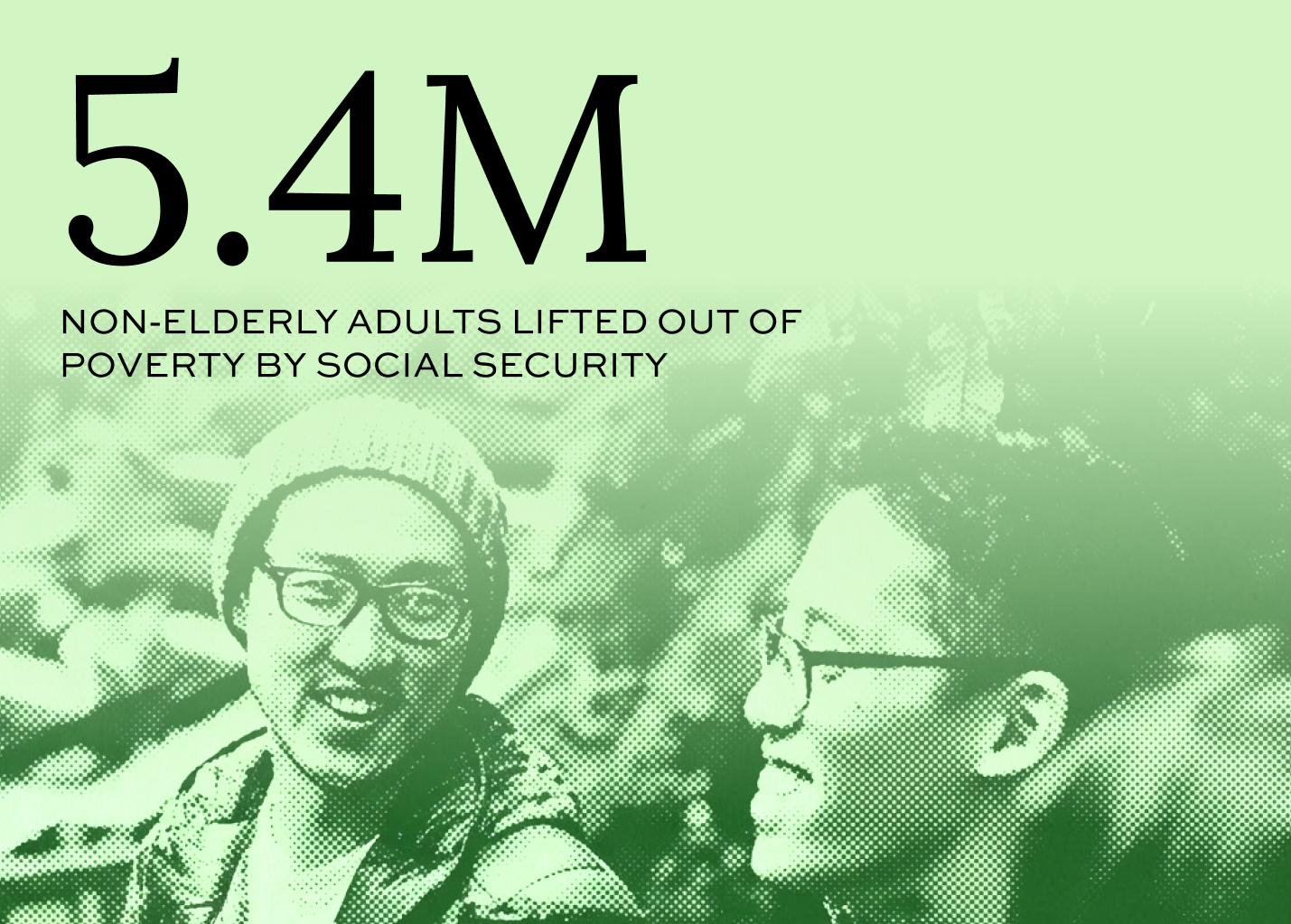
Social Security is outwardly an individual program. A person’s benefits reflect their individual earnings, not their family income or situation. However, individuals do gain family coverage that offers child benefits for dependent children, and survivors and disability coverage for family members. These are not small or unimportant components of the program; one in five beneficiaries receives disability or survivors benefits, and the program lifts over a million children and 5.4 million non-elderly adults out of poverty.39 The program also has a spousal benefit that supports low-earning partners, and thus has a marriage premium.
Both marriage and fertility trends, however, have moved at a predictable pace. Should reform continue to assume that marriage and fertility will decline, these changes to family formation would not necessarily jeopardize the program. Yet, given that Social Security was established in an era of high marriage and childbirth rates, this raises the question of whether it should be amended to account for these family changes (program response) and what might happen to family formation in the future (policy scenarios).

Program response. Social Security could change the rules for spousal benefits. Currently, if a couple has been married for at least 10 years, partners are eligible for the higher of two benefits: one based on their highest 35 years of earnings or one that is half of their partner’s benefit, which is based on the partner’s highest 35 years of earnings. This is very generous to nonearning spouses, but penalizes earning spouses.
For example, take two men who earn an identical salary. One has a wife who never worked: She gets the spousal benefit, which is half of his worker benefit. The other has a wife who stopped working for 15 years while her children were young, but went back to work afterward and worked for another 20 years (and paid into Social Security for those 20 years). Her gap years and earnings combined are less than half of her husband’s, so she also receives the spousal benefit. Thus, two women end up with the same benefit despite one having worked for 20 years. It is arguably unfair and certainly a disincentive to work to ignore earnings for not being high enough. And it puts a premium not just on marriage, but on a particular economic arrangement within marriage.
Changing the spousal benefit would not necessarily be a boon to Social Security’s finances. If policymakers wanted to add fairness to the program and remove the work disincentive, it could change the spousal benefit calculation. For example, rather than consider a spousal benefit only at the moment of benefit claiming via the highest 35 years of work, Social Security could end the spousal benefit and have each calendar-year quarter of an individual’s history of work be the highest of (a) their own earnings or (b) some percentage of their partner’s earnings. This would increase benefits for married workers with gaps in work histories. The spousal benefit recognizes the unpaid domestic labor that supports workers. There’s no programmatic reason why that recognition can only be over a lifetime.
Policy scenarios. Both the US federal income tax system and Social Security have some marriage penalties and some marriage bonuses (that generally net out in favor of bonuses).40 However, those incidental penalties and bonuses are not the same as deliberate pro-marriage policy. In addition, the US has also never had a deliberate pro-fertility policy. It is possible that after the next Social Security reform, policymakers could explicitly and directly attempt to increase marriage and childbirth. After all, a growing population can boost not just Social Security’s finances but overall economic growth.
In one scenario, the pro-marriage, pro-fertility policy is successful. This isn’t a given. Just because a policy decides to target marriage and fertility does not guarantee its success. Getting married and having a child are deeply personal decisions that reflect individual preferences. It is unclear whether policy can change those preferences, and there has been much more policy experimentation in this area in Europe, with little success. However, consistent evidence in the US shows that costs are a significant barrier to having any or additional children. Americans are having fewer children than they want, at least in part due to costs.41 Plus, policy could address obvious pain points:
- the price of assisted reproductive technology, which is often not covered by private health insurer plans
- the out-of-pocket health copays incurred from labor and delivery
- the lack of paid family and medical leave to care for newborns
- the difficulty of finding childcare
- the price of childcare
- the lack of paid sick leave to care for ill children
Assume not only that policymakers pursue these policies at the federal level, but that they successfully stabilize or reverse fertility declines. That is a pure win for Social Security: more (near future) workers. Even if these policies do not successfully increase fertility, many of them—including paid sick leave, paid family leave, and universal public childcare—have been shown to increase the labor supply and earnings of women, which is another pure win for Social Security: more people contributing more in payroll taxes that fund the program. The alternative scenario is that, whether through a failure of policy effort or a continued lack of it, marriage and fertility continue to decline. A decline that is faster or deeper than predicted could harm Social Security’s long-term finances beyond what reform accounts for. Again, Social Security does not solely rely on population growth, but it would be more difficult to maintain benefits in the face of an outright decline in the working-age population.
The Path Forward. Changing the spousal benefit is long overdue; most Americans are in dual-earning families, and the rigid 35-year window does not account for the more flexible and varied path that breaks from earnings can take. Plus, turning the spousal benefit into a single-quarter calculation would make it a de facto caregiving credit, a long-time popular policy addition to the program. While Europe’s experience in using policy to boost fertility is not encouraging, the implications for Social Security should not be the only reason for helping families in the US. Regardless of how many children they want to have or end up having, families are struggling with the cost of fertility and childrearing, and those costs are easily addressable. Reduce the out-of-pocket costs for assisted reproduction, pre- and postnatal care, and labor and delivery. Establish paid leave. Regulate the labor market to make it easier for parents. Provide free, universal childcare. These policies will help families and may have an effect on fertility, but, as discussed in the prior section, will be a boon to labor force participation regardless.
Threat: Weak Earnings Growth
If there is a single lesson from the 1983 reform and the evolution of Social Security’s finances since, it is that maintaining Social Security’s wage base is critical to its long-run solvency. Thankfully, from the perspective of not just Social Security but the overall economy, the wage inequality and wage erosion that marked the 1980s and 1990s ameliorated somewhat in the decades after. Earnings were broadly weak after the 2001 and 2007 recessions, but in the years since the pandemic, the bottom of the wage distribution has grown rapidly, even if the middle remains tepid.42
However, the wage inequality of the past four decades is a symptom of the broader disease of weak wage growth, from which the very top earners were spared. It is unclear to what degree this weak growth will persist in the future, as the causes of the slowdown are not definitive. Economists have identified some of the weaknesses as a result of how the economy has evolved: how technology on the job rewards some workers more than others, or how increased global economic integration rewards some workers and harms others. But some of the weaknesses stem from how our labor market is managed, regardless of industrial or occupational composition. For instance, unions have declined in representation and power, the minimum wage and other labor market regulations have fallen to the wayside, and employers have become much more concentrated, reducing job mobility.43
At the same time, recent decades have seen a shift in classification, with workers hired as contractors (for whom payroll and income taxes are not automatically withheld, among other things) rather than employees (for whom they are). Independent contractors must pay both the employee and employer sides of the Social Security payroll tax, in addition to federal income tax on their net income after expenses.44 Strategies to reduce their taxable income, including underreporting, effectively reduce their Social Security contributions and benefits in the future.45 Should these trends continue, growth in this type of earnings would undermine Social Security’s ability to backstop economic security for Americans.
Finally, the US has a system of employer-sponsored health insurance. Employers buy plans for their employees and split the cost of the premium. This hurts Social Security in two ways. First, the value of health insurance displaces wages in total compensation, and health insurance is not subject to the Social Security payroll tax. Second, the rising cost of health insurance dampens wage growth, making the taxable portion of compensation grow at a slower rate than the nontaxable portion of compensation.46
Wages are the backbone of Social Security; the program is funded by current earners and generates a unique benefit for every American based on their earnings history. Now that periods of broad wage stagnation and growing nonemployee work have been shown to be possible, it raises the question of how “wage-proof” the program can be (program response) and what could happen to wages in the future (policy scenarios).
Program response. Wage inequality since 1983 has eroded Social Security’s tax base, so shoring it up is a fitting response. The cap on wages can be raised or removed, subjecting more or all earnings to the payroll tax (the latter is already the case for Medicare). Wage inequality also contributes to retirement inequality, creating a large set of retirees who earned little and likely had little access to workplace savings, and a sliver of retirees who are wealthy. To address this gap, the benefit formula can be adjusted to make Social Security more progressive. Both the tax cap and the benefit formula have been changed previously.
Social Security could also become less reliant on wages by bringing in additional revenue sources. There is precedent for this as well. Beginning in 1983, a portion of benefits for high-income Social Security beneficiaries became subject to income tax, and the tax on benefits is sent to the Social Security trust fund (rather than to general revenue, where income tax is typically remitted). Policymakers could tap similar expansions to revenue, beyond the payroll tax, in the future. For example, how to adjust Social Security for the undercontributions of independent contractors requires new, non-payroll-tax thinking. One option is to tax the contracting employer. The tax can be prorated based on the amount of compensation, or structured as a user fee—a per-capita tax for each contractor used by the employer. That tax can be designed so that the per-capita amount increases with the number of contractors used. Such a structure would have small effects on firms that use contract work sparingly and would instead impose a hefty tax bill on firms that rely exclusively on contract work, incentivizing employee arrangements in addition to raising revenue for Social Security.
Social Security could also tax other sources of income, such as capital gains, estates and inheritances, and so on. For every new revenue source, the critical policy question is how those contributions are reflected in the benefit calculation (if collected from individuals) or used to shore up the trust fund. In the current scheme, a worker’s benefit is based solely on their prior (highest 35 years of) earnings, aka their highest 35 years of payroll tax contributions.
Policy scenarios. Wage growth may continue to be tepid for most and skyrocketing for some, or may shift in the future to be broadly remunerative, or any scenario in between. The past quarter-century has seen federal policy make little attempt to foster wage growth, but that could change in the future.
Policymakers could directly increase wages by raising the federal minimum wage beyond the current $7.25 per hour and renewing fiscal commitment to labor law enforcement to ensure that workers are paid for their time.47 Labor economists have long known, however, that a key principle in wage growth is power and mobility.48 To bid up wages, workers need the ability to ask for more, whether that’s through power on the job or the power from outside options. Policymakers could aim at either avenue.
Union power is incredibly effective at raising wages and decreasing income dispersion.49 Restoring the right to collective bargaining would increase union representation. In addition, many proposals have argued to expand worker organizing beyond closed-shop collective bargaining to sectoral (or industry-wide) bargaining arrangements.50
As to mobility, policymakers could target labor market factors that have been shown to curb mobility, such as noncompete agreements or employer concentration in job markets. The US has very few protections or rights for job seekers, aside from antidiscrimination protections enforced by the Equal Employment Opportunity Commission.51 The job search market could be regulated in numerous ways to tilt power back to workers and ease the administrative cost of job mobility. For example, hiring firms could be subject to basic disclosure requirements, such as being required to include, as part of each posting, the hiring timeline and the sequential steps of the hiring process. They could also have basic reporting requirements, such as mandated notifications to applicants when they have not made it to the subsequent round of consideration, steps that were posted as part of the position, or acknowledgment at what if at any point AI was used in the determination process. As a step further, hiring firms could be compelled to compensate applicants for applications or interview processes that exceed a certain length.
The earnings scenarios for Social Security are largely determined by the evolution of the labor market and how that manifests across industries and occupations. Still, there are policy scenarios in which policymakers actively increase workers’ wages, power, and mobility.
The Path Forward. Very little about the distribution of wages and their progression over time is defensible, or even really desirable. That the highest earners have seen runaway wage growth while the rest have seen falling or stagnant wages is not an outcome that any policymaker would point to as a success, for example, or that economists would say is necessary. No one owns wage inequality as a goal; it exists as an unfortunate consequence, or some kind of ante, for an otherwise thriving economy. And yet, there has been scant effort to redress it through policy. That needs to change.
Aggressive wage policy is long overdue. Part of that is regulatory: Raise the minimum wage and take other action to bring up the labor market’s floor, make it easier to start or join a union, and fund enforcement so that those laws are respected.52 Another part is acknowledging weak wage growth as the symptom of declining worker power in the labor market, and working to rebalance the scale. Unions can help with that. So can a robust unemployment program that includes protection and remuneration for job seekers, and so can battling employer concentration directly. But there’s also the need to restructure compensation and sever the link between employment and health insurance.
Social Security, meanwhile, ought to meet weak wage growth on the front foot. Eliminating the tax cap is a lucrative option and extremely popular with Americans.53 A lens into the future would see that weak wage growth could encompass a decline in wage earnings as a share of total income. A tax on the employers of independent contractors would raise money, as well as reduce the incentive to hire contractors over employees for tax purposes. The program has never relied on revenue aside from payroll tax contributions, interest on the trust fund, and income tax contributions of high-income beneficiaries, akin to almost a “closed system” of financing. However, other sources could be tapped going forward, including nonwage earned income like capital gains or inherited wealth.
Expanding to other revenue sources doesn’t require, but could benefit from, thinking about how revenue sources reflect the philosophy embedded into Social Security’s design. Social Security is an insurance program (as the name Old Age Insurance suggests): Workers pay premiums via the payroll tax that earns them protection should the insured event occur—in this case, they become too old or too sick to work. The risk is that, without earnings, workers will not have enough money to live, and Social Security protects from that scenario. This insurance structure explains many aspects of the program’s design. The cap on wages subject to the tax, for example, reflects that at a certain level of very high earnings, the risk of economic destitution in retirement is low. The universality of coverage is an assertion that all workers face the risk of economic destitution, to some degree.
Tapping new sources of revenue that are not wage earnings is arguably a departure from the insurance structure. Alternatively, it is a recognition that, if Social Security is protection against risk, the protection must evolve as the risk evolves. Risk of economic inequality, risk of savings dependent on the stock market, risk of technology that augments both. In prior eras, the risk was that earnings from work wouldn’t be sufficient, but risks in today’s economy are not so simple.
If Social Security is protection against risk, the protection must evolve as the risk evolves.
Threat: Recessions
The US has had 14 recessions since the Social Security Act was signed in 1935.54 Recessions are associated with job loss and elevated unemployment at a minimum, and, depending on the nature of the recession and its precipitating antecedent, with declines in financial, stock, housing, or other markets. Social Security has weathered each recession, but not uniformly. The 2007 recession was particularly harmful to Social Security’s long-term finances; in a single year, the estimated trust fund depletion date moved up four years, from 2041 to 2037, and never recovered. In contrast, since 2015, the trust fund depletion date has hovered between 2034 and 2035, despite a recession in the interim associated with the most dramatic job loss in US history. In March and April of 2020, 22 million people lost their jobs, yet Social Security’s long-term outlook was not permanently affected.
It is not the severity of the recession but how it is managed that determines whether Social Security is insulated or affected. The Great Recession was a paradigm shift for economists and policymakers. The fiscal response to economic downturns must be swift and generous.55 Pulling back support, as happened after the initial response to the 2007 downturn, leaves a lasting mark of weak, slow recovery. The robust response to the 2020 recession and the pandemic avoided that outcome. For Social Security, this raises the question of how recession-proof the program can be through its design (program response) and how recessions will be managed in the future (policy scenarios).
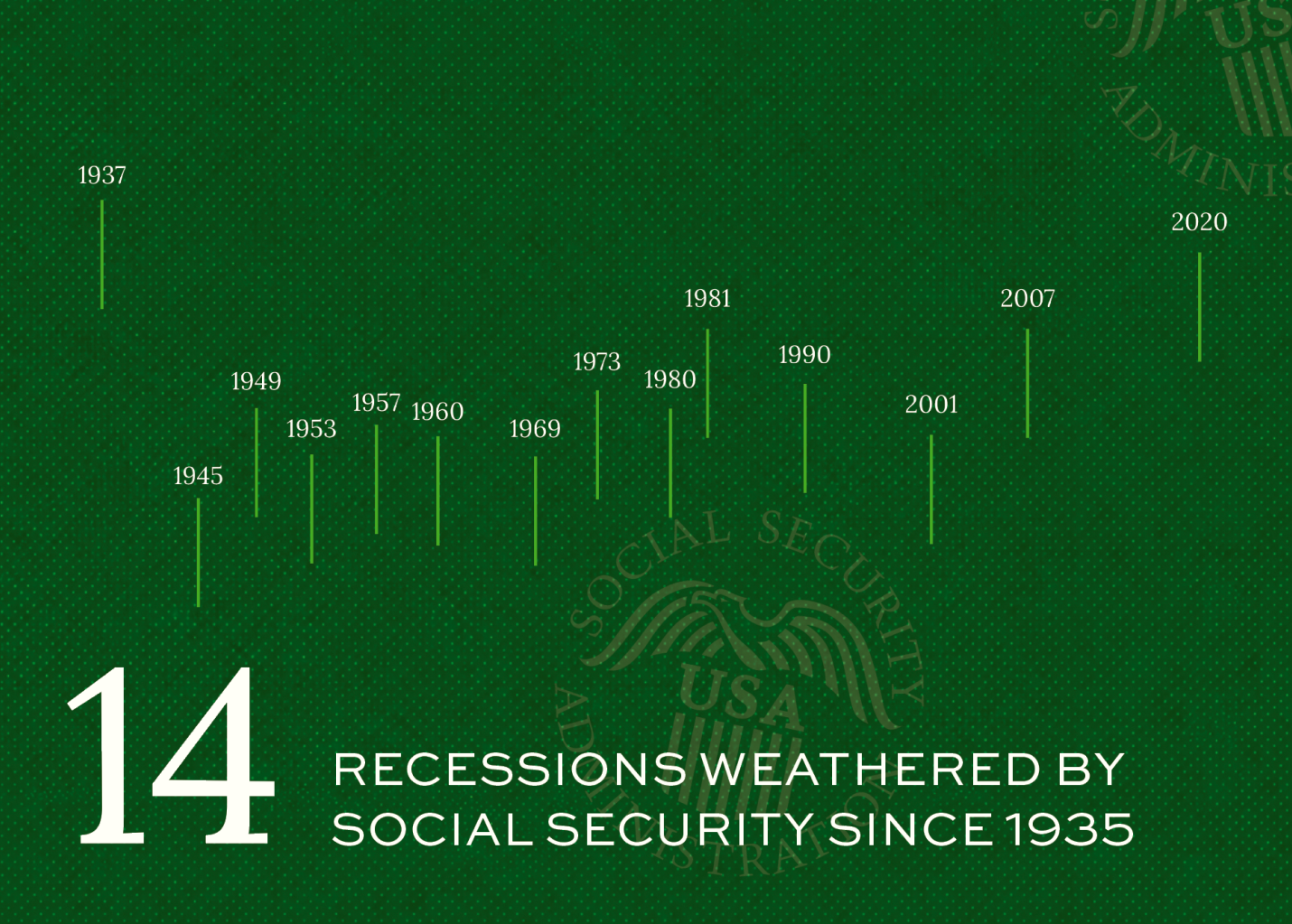
Program response. Social Security has made it through 13 recessions relatively unscathed, and in one, it came out somewhat bruised. This is proof of a fundamentally sound design. As tough as the Great Recession was to its finances, elderly poverty still fell throughout the downturn, reaching a historical low of 8.7 percent in 2011.56
What made the recession so brutal to Americans and to Social Security’s finances was long-term unemployment. Not only did millions of Americans lose jobs, but millions struggled to be rehired. In typical times, or even during a mild recession, roughly half of workers who have lost their job will find a new position within three months, and another quarter will find one within the next three months—a 75 percent reemployment rate. During the Great Recession, however, the six-month reemployment rate fell to 61 percent.57 Many workers, faced with the prospect of permanent job loss, turned to Social Security: either claiming benefits with a penalty at age 62 or applying for the disability program. Disability applications, as a rule, spike during recessions, but the severity of the 2007 recession corresponded to a historical increase in disability applications and enrollment.58 As noted previously, the US lacks any kind of long-term unemployment program, retraining, or education funding for the unemployed. For older workers, disability insurance becomes a de facto long-term unemployment program. From a Social Security financial perspective, a worker on disability represents a loss of tax receipts in exchange for additional benefits.
Social Security could be amended to add some kind of benefit for older job losers who face the prospect of a long or permanent spell of unemployment, whether that is an early retirement program, a partial retirement program, or a long-term unemployment program that includes access to job search counseling, moving funds, health insurance, or other work supports.
Policy scenarios. Future recessions will be either more or less severe than the most recent two, but the key factor for Social Security’s finances is how well those recessions are managed. One scenario is that policymakers recoil at the government intervention and borrowing necessary to sustain macroeconomic support, and respond minimally to downturns. The other is that policymakers recoil at the economic misery Americans are experiencing and respond emphatically. Even the aim of a response is no guarantee that economic loss can be minimized or that broader recovery can be hastened. But the dependence of a recession’s recovery on congressional response is in part a function of the health of existing structural support. How Congress augments unemployment benefits, for example, is different if the program is eroded and weak, as it has been for the last two recessions, or robust and well-funded, as it has been in the past. Recovery will always depend on discretionary response, to some degree, but the width of discretion could be narrowed if the existing unemployment program were stronger.
The Path Forward. The US needs a robust unemployment program that serves workers experiencing both short- and long-term spells. That requires, in the former case, robust reform to the existing program and, in the latter, standing up a new program. These programs should be designed to be automatically more generous during recessions, so that workers’ relief and the effort to stabilize the economy is not uncertain or variable. It needs to be good every time. The key to a new unemployment program’s success is that it coheres with Social Security benefits so that eligibility and administration are coordinated, especially for older workers facing long-term spells of unemployment.
Concerns

As noted previously, the bedrock of Social Security’s finances is the combination of demographics and economics, while the basis for Social Security’s long-term solvency is the ability to reasonably predict how they will evolve.
The threats of the prior section are more retrospective. There have been decades of evidence and experience regarding labor force participation, immigration, family formation, weak wage growth, and recessions. Relating that experience back to Social Security is not a stretch, nor is it difficult to identify policy scenarios that have been either long proposed at the federal level or long pursued at the state and local levels.
The concerns, in contrast, are more prospective. We know they exist, but do not have enough experience to know how they will manifest in the future and how they will affect Social Security. Yet there’s a degree to which the specifics aren’t important: Each concern carries the prospect of economic insecurity, something Social Security has deep experience with.
Concern: Climate Change
A warming planet will cause higher temperatures and more volatile, violent weather, making some geographies inhospitable to live in, others risky to live in, and some unsustainable. Natural disasters will become more frequent or more destructive, and some jobs will become increasingly unsafe at certain times of day or year. Put plainly, climate change will result in:
- destruction of property
- devaluation of property
- job interruptions
- job loss or displacement
- dangerous working conditions that could result in worker injury or death
- internal migration within the US
- migration from other countries with more affected climates
While climate change is new to humanity, none of these consequences are new to Social Security. Millions of properties were devalued during the 2007–10 foreclosure crisis.59 And trillions of dollars in wealth and savings were wiped out during the concurrent financial crisis.60 The US shed 2 million manufacturing jobs in the 20 years between 1979 and 1999, and then three times as many over the next 10 years.61 Most cities in the US have experienced some kind of boom-and-bust, in which new arrivals pour in, only to have the city figuratively and literally empty later. Internal migration is low now, but 40 percent of Americans will live outside their state of birth.62 In 2024, an estimated 15 percent of the US population was foreign-born, the highest share since 1890.
This is not to detract from the seriousness of climate change, but to frame the discussion from Social Security’s perspective: Does climate change present unique challenges or potentially more severe versions of challenges it has already faced? The answer (very likely) is the latter. If anything, climate change should motivate making the long-term financial solvency of Social Security a central focus. Social Security cannot be expected to solve climate-related risks, but it can be better prepared financially to handle them. Rather than have revenues meet outlays over a 75-year projection, for instance, Social Security’s solvency should be measured by, say, a minimum trust fund balance relative to total payouts, similar to a bank reserve ratio.
The big question, when it comes to climate change (and, as shown below, to artificial intelligence), is how adroitly the US handles these economic catastrophes as they unfold. If properties are destroyed, if parts of the country cannot support outdoor labor in the summer, if communities must be abandoned as unlivable, if there’s job displacement from a natural disaster, the US either attempts to mitigate the consequences for the Americans affected or doesn’t. Climate change will not necessarily create mass joblessness and mass homelessness, but there are certainly policy scenarios in which it could. Hence, the risk of climate change to Social Security is less the weather and more the ability and effectiveness of policymakers to handle the proverbial and literal storms.
The Path Forward. As of writing, it has been 43 years since Social Security was last reformed, and it will likely not be reformed again until 2032 when the trust fund will be depleted. A half-century between program financial and design maintenance is too long. To meet concerns like climate change, Social Security needs to stay predictable and reliable, but add agility. One way to do this is to move the benchmark. Reform now is voluntary, but motivated by the prospect of automatic benefit cuts at the end of trust fund depletion. Congress could change the law to enact automatic benefit cuts at some earlier benchmark to keep the program maintained regularly.
Social Security’s current trust fund ratio is “the reserves at the beginning of a year expressed as a percentage of the cost for the year. The trust fund ratio represents the proportion of a year’s cost that could be paid solely with the reserves at the beginning of the year.”63 It peaked for the old-age and survivors program at 400 percent in 2010, the year in which revenue fell below benefits, and is currently at 153 percent, projected to fall below 100 percent in 2028 and to 0 percent in 2032. One option is to have an automatic benefit cut if the trust fund reserve ratio falls below, say, 200 percent. Another option is to use the actuarial balance, “the difference between the summarized income rate and the summarized cost rate as a percentage of taxable payroll (or GDP) over a given valuation period.” For many years between 1990 and 2010, the negative actuarial balance of the program was just under 2 percent of payroll.
It is now 4.5 percent of payroll.64 One option is to have an automatic benefit cut if the actuarial balance falls below 1.5 percent of payroll. Whatever the benchmark chosen, the effect would be to require more regular maintenance of Social Security and, as a result, keep the program in better financial health and responsive to large developments as they come.
Concern: AI
Artificial intelligence, like most technological breakthroughs before it, will be absorbed into the workplace, assisting workers who use it effectively and hurting those who are replaced by it. Some share of the US labor force will be out of a job because AI has rendered their specific task or occupation obsolete. How large a share and how quickly they become obsolete are unknown. At the same time, some share of the US labor force will be using AI on the job, creating new tasks and occupations. How large a share and how many jobs are created is unknown. Further, it is unknown if AI-using and AI-adjacent jobs will be high-paid or low-paid. Put plainly, AI could cause:
- job loss or displacement
- job creation
- downward wage pressures (from job loss)
- upward wage pressures (from job creation)
Throughout the 20th and 21st centuries, the productivity of US workers has risen steadily, without large jumps driven by technological advances. It takes time for technology to be integrated into the workplace, and as it is integrated, it both demands new jobs and destroys old ones.65 There is no reason to think AI will be different, even if it could potentially be faster. As of writing, there is little evidence that job losses from AI have begun.66
Like with climate change, AI brings risks that Social Security has seen many times before. The program is nearly a century old, meaning that its design has been tested by the introduction of computers, the internet, GPS, cell phones, smartphones, and countless other advancements. The specter of job loss is daunting, but it’s unlikely that a technological advancement could cause job loss the way a recession can. During the 2007–09 recession, the US posted net job loss for 32 months, shedding 8.8 million jobs from the peak of employment to the trough in a brutal, multiyear contraction. During the 2020 recession, on the other hand, the US only lost jobs for two months, but shed over 22 million in that short period—one in seven jobs in the economy at the time. The US recovered from both recessions and regained the lost jobs.
Again, the critical question is not whether AI will cause job loss, but how policymakers manage it. As noted above, the US has scant support for unemployed workers: little money going to few workers, almost no protection or rights for job seekers, and almost no investment in retraining or education. AI’s impact is determined by the extent to which policymakers help affected workers reenter the workforce. That has less to do with technology and more with policymakers’ ability and effectiveness.
The Path Forward. Again, the policy conclusion is not that the program needs to be reimagined, but that it needs to be healthier and more agile in order to adequately respond to problems that could develop in the future. Regular program maintenance that supports financial security is key.

Unknowns
The lesson from the threats and the concerns is fairly clear: The biggest risk to Social Security is economic mismanagement. The threats are a parade of issues left long neglected by policymakers, whether it’s immigration reform, investments in children, protection for workers, or assistance for the unemployed. The concerns could create new ways to generate the same problems of economic destruction and harm to individuals that arise from outside their control.
The unknowns span anything practical or fantastical that’s left: a world war, miracle medical breakthroughs, severe pandemics, industrial collapse, arrival of an enlightened alien race. Social Security has seen all of these, save the last. Ultimately, they all pose the same challenge to Social Security: Can policymakers steer the economy or not? The laundry list of missed opportunities from the threats suggests that we are currently in an era of “not.” But the handling of the COVID-19 pandemic, coupled with policy experimentation and success at the state level in some of these areas, supports the idea that steering the economy is possible, even if there are gaping federal holes.
This conclusion—that every challenge to Social Security is, in fact, the same challenge of successful stewardship of the economy—offers a new lens on the question of whether the 1983 reform was successful. In the 43 years since that legislation, the economy has seen some truly incredible events, but policy leadership was minimal at best. Things like paid sick days, paid family leave, a higher minimum wage, and access to organizing at work have all been shown to increase wages and hours worked and are extremely popular—to no avail. The longevity of the 1983 reform protected Social Security from needing economic policy leadership when there was little economic policy leadership to go around.
The biggest risk to Social Security is economic mismanagement.
Same Security, Different Day
The aim of this paper is to understand what the next major reform to Social Security could miss. We know that reform is coming; the trust fund is projected to be depleted in 2032, and the alternative to reform is a steep and likely uniform benefit cut. Congress will act. What lessons does the path of Social Security since 1983 offer? One key lesson is that the longevity of reform is a function of its primary projections of demographics and economics. Hence, looking beyond 2032, the question is: What could derail those projections? It is an outwardly tough ask to basically predict the future economy, but this assessment, walking through key threats and risks to the program, comes to the same conclusion: The biggest threat to Social Security is mismanaging the economy. Put differently, reform doesn’t have to predict what the greatest specific threat is in the future, because every threat is the same threat—that something will hurt the economy, and policymakers will fail to address it.
Footnotes
- Social Security Administration, “The 2026 OASDI Trustees Report,” accessed June 15, 2026, https://ssa.gov/oact/TR/2026/index.html. ↩︎
- Center on Budget and Policy Priorities, “Understanding the Social Security Trust Funds,” updated August 28, 2025, https://cbpp.org/research/social-security/understanding-the-social-security-trust-funds-0. ↩︎
- The trust fund is held as Treasury bonds and earns interest on those bonds, which also funds the program. In addition, beneficiaries with higher income aside from their benefits can see a portion of their benefits subject to the income tax, which is then remitted back to Social Security’s trust fund. ↩︎
- Barry Huston, “Social Security: What Would Happen If the Trust Funds Ran Out?” Congressional Research Service, September 28, 2022: 9, https://congress.gov/crs-product/RL33514. ↩︎
- Social Security Administration, “Disability Insurance Trust Fund, 1957-2024,” DI Trust Fund, a Social Security Fund, accessed May 4, 2026, https://ssa.gov/oact/STATS/table4a2.html. ↩︎
- Social Security Administration, “Trust Fund Operations,” Frequently Asked Questions, accessed May 4, 2026, https://ssa.gov/history/tftable.html. ↩︎
- Congressional Research Service, “Social Security: What Would Happen If the Trust Funds Ran Out?” updated October 15, 2021, https://congress.gov/crs_external_products/RL/PDF/RL33514/RL33514.32.pdf. ↩︎
- Robert M. Ball, The Greenspan Commission: What Really Happened (Century Foundation, 2010). ↩︎
- Social Security Administration, “Summary of P.L. 98-21, (H.R. 1900) Social Security Amendments of 1983-Signed on April 20, 1983,” Office of Legislation and Congressional Affairs, November 26, 1984, accessed May 4th, 2026, https://ssa.gov/history/1983amend.html; John A. Svahn and Mary Ross, “Social Security Amendments of 1983: Legislative History and Summary of Provisions,” Social Security Bulletin 46, no. 7 (July 1983), https://ssa.gov/policy/docs/ssb/v46n7/v46n7p3.pdf. ↩︎
- Social Security Administration, “Testimony by Stephen C. Goss, Chief Actuary, Social Security Administration, before the Senate Committee on Budget,” July 12, 2023, https://ssa.gov/legislation/testimony_07122023.html. ↩︎
- Stephen C. Goss, Protecting Social Security for All: Making the Wealthy Pay Their Fair Share, testimony before US Senate Committee on the Budget, 118th Cong. (2023), https://ssa.gov/OACT/testimony/SenateBudgetComm_20230712.pdf. ↩︎
- Goss, Protecting Social Security for All, 15. ↩︎
- Office of Chief Actuary, “Social Security Actuarial Status: The 2024 Annual Report of the Board of Trustees of the OASI and DI Trust Funds,” National Academy of Social Insurance Webinar, Social Security Administration, May 15, 2024, https://ssa.gov/OACT/presentations/scgoss_20240515.pdf; Steve Goss and Karen Glenn, “What Effect Does Earnings Dispersion Have on Social Security Financing?” NBER Summer Institute 2024: Economics of Social Security, July 24, 2024, https://ssa.gov/OACT/presentations/scgoss_20240724.pdf; Steve Goss, “Mortality (Longevity): Contributing Factors in the Past and for Projections, and Implications for the Future,” Expert Forum on Demographic Transitions, January 27, 2023, https://ssa.gov/OACT/presentations/scgoss_20230127.pdf. ↩︎
- Alicia H. Munnell, “Social Security’s 75-Year Deficit Is Not Surprising,” Center for Retirement Research at Boston College, June 11, 2024, https://crr.bc.edu/social-securitys-75-year-deficit-is-not-surprising. ↩︎
- Zhe Li, “Social Security: Raising or Eliminating the Taxable Earnings Base,” Congressional Research Service, December 22, 2021, https://congress.gov/crs-product/RL32896; Congressional Budget Office, “Increase the Maximum Taxable Earnings That Are Subject to Social Security Payroll Taxes,” December 7, 2022, https://cbo.gov/budget-options/58630; Munnell, “Social Security’s 75-Year Deficit”; Social Security Administration, “2024 Trustees Report, Summary Measures, E3.1,” accessed May 4, 2026. https://ssa.gov/OACT/solvency/provisions_tr2024/charts/chart_run266.html. ↩︎
- Tiffany Bosley, “Mortality by Career-Average Earnings Level,” Social Security Administration, Office of the Chief Actuary, January 14, 2025, https://ssa.gov/OACT/presentations/tbosley_20250114.pdf; Gopi Shah Goda and Andrew Biggs, “Strengthening the Social Security Safety Net,” Stanford Institute for Economic Policy Research, April 2023, https://siepr.stanford.edu/publications/policy-brief/strengthening-social-security-safety-net. ↩︎
- Christopher J. Goodman and Steven M. Mance, “Employment Loss and the 2007–09 Recession: An Overview,” US Bureau of Labor Statistics, Monthly Labor Review, April 2011, https://bls.gov/opub/mlr/2011/04/art1full.pdf. ↩︎
- Gary Burtless, “The Great Recession and Lessons for Policymaking,” in Confronting Policy Challenges of the Great Recession: Lessons for Macroeconomic Policy, ed. Eskander Alvi (W.E. Upjohn Institute, 2017), https://jstor.org/stable/j.ctvh4zdmk.6. ↩︎
- Diane Whitmore Schanzenbach et al., “The Closing of the Jobs Gap: A Decade of Recession and Recovery,” Brookings Institution, August 4, 2017, https://brookings.edu/articles/the-closing-of-the-jobs-gap-a-decade-of-recession-and-recovery. ↩︎
- Karen Glenn, “Long-Term Dynamics of the Employment-to-Population Ratio,” NBER Summer Institute 2023: Economics of Social Security, July 26, 2023, https://ssa.gov/OACT/presentations/ocact_20230726.pdf. ↩︎
- Emma K. Tatem, “Social Security Overview,” Congressional Research Service, July 22, 2025, https://congress.gov/crs-product/IF10426. ↩︎
- Social Security Administration, “Receiving Benefits While Working,“ accessed May 1, 2026, https://ssa.gov/benefits/retirement/planner/whileworking.html. ↩︎
- Social Security Administration, “Must I Pay Taxes on Social Security Benefits?” Frequently Asked Questions, June 30, 2025, https://ssa.gov/faqs/en/questions/KA-02471.html. ↩︎
- Arindrajit Dube, “Full Employment: A Policy Choice Worth Pursuing,” Roosevelt Institute, April 29, 2025. https://rooseveltinstitute.org/blog/full-employment. ↩︎
- Will Raderman, “Establishing Unemployment Insurance as a True Worker Benefit,” Niskanen Center, accessed May 1, 2026. https://uiworkerbenefit.niskanencenter.org; National Academy of Social Insurance, “Unemployment Insurance Task Force Final Report,” July 16, 2024. https://nasi.org/2024/07/16/unemployment-insurance-task-force-final-report. ↩︎
- Francine D. Blau and Lawrence M. Kahn, “Female Labor Supply: Why Is the United States Falling Behind?” American Economic Review 103, no. 3 (May 2013): 251–56, https://aeaweb.org/articles?id=10.1257/aer.103.3.251; Bureau of Labor Statistics, “People with a Disability: Labor Force Characteristics News Release,” Economic News Release, March 3, 2026. https://bls.gov/news.release/disabl.htm. ↩︎
- Tarjei Havnes and Magne Mogstad, “Money for Nothing? Universal Child Care and Maternal Employment,” Journal of Public Economics 95, no. 11–12 (2011): 1455-1465, https://doi.org/10.1016/j.jpubeco.2011.05.016; Pierre Lefebvre and Philip Merrigan, “Child‐Care Policy and the Labor Supply of Mothers with Young Children: A Natural Experiment from Canada,” Journal of Labor Economics 26, no. 3 (July 2008), https://doi.org/10.1086/587760; Jonah, B. Gelbach, “Public Schooling for Young Children and Maternal Labor Supply,” American Economic Review 92, no. 1 (March 2002): 307–322, https://aeaweb.org/articles?id=10.1257/000282802760015748; Pauline Givord and Claire Marbot, “Does the Cost of Child Care Affect Female Labor Market Participation? An Evaluation of a French Reform of Childcare Subsidies,” Labour Economics 36 (October 2015): 99–111, https://doi.org/10.1016/j.labeco.2015.07.003; Elizabeth U. Cascio, “Maternal Labor Supply and the Introduction of Kindergartens into American Public Schools,” Journal of Human Resources 44, no. 1 (January 2009): 140–170, https://doi.org/10.3368/jhr.44.1.140; Benjamin Gurrentz, “Child Care Subsidies Help Married Moms Continue Working, Bring Greater Pay Equity,” Census Bureau, October 12, 2021, https://census.gov/library/stories/2021/10/measuring-impact-of-child-care-subsidies-on-working-moms.html; Taryn W. Morrissey, “Child Care and Parent Labor Force Participation: A Review of the Research Literature,” Review of Economics of the Household 15 (March 2016): 1–24, https://doi.org/10.1007/s11150-016-9331-3; Pierre Lefebvre, Philip Merrigan, and Matthieu Verstraete,
“Dynamic Labour Supply Effects of Childcare Subsidies: Evidence From a Canadian Natural Experiment on Low-Fee Universal Child Care,” Labour Economics 16, no. 5 (October 2009): 490–502,
https://doi.org/10.1016/j.labeco.2009.03.003; Elira Kuka and Na’ama Shenhav, “Long-Run Effects of Incentivizing Work after Childbirth,” American Economic Review 114, no. 6 (June 2024): 1692–1722, https://aeaweb.org/articles?id=10.1257/aer.20220792; Sarah A. Donovan, “Paid Family and Medical Leave in the United States,” Congressional Research Service, March 26, 2025, https://congress.gov/crs-product/R44835; Meredith Slopen, “The Impact of Paid Sick Leave Mandates on Women’s Employment and Economic Security,” Journal of Policy Analysis and Management 43, no. 4 (Fall 2024): 1129–1151, https://doi.org/10.1002/pam.22582; Blau and Kahn, “Female Labor Supply.” ↩︎ - Stephen Goss et al., “Effects Of Unauthorized Immigration on the Actuarial Status
of the Social Security Trust Funds,” Social Security Administration, Office of the Chief Actuary, Actuarial Note Number 151, April 2013, https://ssa.gov/OACT/NOTES/pdf_notes/note151.pdf. ↩︎ - Census Bureau, “U.S. Population Projected to Begin Declining in Second Half of Century,” press release, November 9, 2023, https://census.gov/newsroom/press-releases/2023/population-projections.html. ↩︎
- Immigration Reform and Control Act of 1986, S.1200, 99th Cong. (1986), https://congress.gov/bill/99th-congress/senate-bill/1200. ↩︎
- Pew Research Center, “The Number of Unauthorized Immigrants in the U.S. Grew from 2019 to 2022,” July 22, 2024, https://pewresearch.org/short-reads/2024/07/22/what-we-know-about-unauthorized-immigrants-living-in-the-us/sr_24-07-22_unauthorizedimmigrants_1. ↩︎
- Daniel Di Martino, “Only Judges Can Close the Border,” Manhattan Institute, June 5, 2025, https://manhattan.institute/article/only-judges-can-close-the-border. ↩︎
- Jeffrey S. Passel and Jens Manuel Krogstad, “U.S. Unauthorized Immigrant Population Reached a Record 14 Million in 2023,” Pew Research Center, August 21, 2025. https://pewresearch.org/race-and-ethnicity/2025/08/21/u-s-unauthorized-immigrant-population-reached-a-record-14-million-in-2023. ↩︎
- American Immigration Council, “What’s in the Big Beautiful Bill? Immigration and Border Security Unpacked,” July 14, 2025, https://americanimmigrationcouncil.org/fact-sheet/big-beautiful-bill-immigration-border-security. ↩︎
- Kathryn Anne Edwards, “That Extra ICE Funding Could Buy a Lot of School Meals,” Bloomberg, October 30, 2025, https://bloomberg.com/opinion/articles/2025-10-30/ice-funding-could-buy-a-lot-of-school-meals. ↩︎
- Wendy Edelberg, Stan Veuger, and Tara Watson, “Macroeconomic Implications of Immigration Flows in 2025 and 2026: January 2026 Update,” Brookings Institution, January 13, 2026, https://brookings.edu/articles/macroeconomic-implications-of-immigration-flows-in-2025-and-2026-january-2026-update. ↩︎
- Rachel Walsh, “Does the U.S. Have a Fertility Crisis?” Johns Hopkins Bloomberg School of Public Health, January 6, 2026, https://publichealth.jhu.edu/2026/is-the-us-birth-rate-declining; Darah Dilmaghani et al., “Decreasing Fertility Rate in the United States: Demographics, Challenges, and Consequences,” Mayo Clinic Proceedings 99, no. 11 (November 2024): 1693–1697, https://pmc.ncbi.nlm.nih.gov/articles/PMC11537490. ↩︎
- Lisa Camner McKay, “How Our Peers Influence Marriage Rates,” Federal Reserve Bank of Minneapolis, August 12, 2025, https://minneapolisfed.org/article/2025/how-our-peers-influence-marriage-rates; Pamela J. Smock and Christine R. Schwartz, “The Demography of Families: A Review of Patterns and Change,” Journal of Marriage and Family 82, no. 1 (February 2020): 9–34, https://pmc.ncbi.nlm.nih.gov/articles/PMC7329188. ↩︎
- Kathleen Romig, “Social Security Lifts More People Above the Poverty Line Than Any Other Program,” Center on Budget and Policy Priorities, February 25, 2026, https://cbpp.org/research/social-security/social-security-lifts-more-people-above-the-poverty-line-than-any-other-0. ↩︎
- Gregg A. Esenwein, “The Federal Income Tax and the Treatment of Married Couples: Background and Analysis,” Congressional Research Service, March 29, 2001, https://everycrsreport.com/reports/RL30800.html. ↩︎
- Rachel Minkin, Juliana Menasce Horowitz, and Carolina Aragão, “The Experiences of U.S. Adults Who Don’t Have Children,” Pew Research Center,July 25, 2024, https://pewresearch.org/social-trends/2024/07/25/the-experiences-of-u-s-adults-who-dont-have-children. ↩︎
- Jonathan Heathcote et al., “More Unequal We Stand? Inequality Dynamics in the United States, 1967–2021,” Review of Economic Dynamics 50 (October 2023): 235–266, https://doi.org/10.1016/j.red.2023.07.014. ↩︎
- John Haltiwanger, Henry Hyatt, and Erika McEntarfer, “Who Moves Up the Job Ladder?,” Journal of Labor Economics 36, no. S1 (January 2018), https://doi.org/10.1086/694417; Niklas Engbom, Aniket Baksy, and Daniele Caratelli, “The Long-Term Decline of the U.S. Job Ladder,” NBER Working Paper 34981 (March 2026), https://doi.org/10.3386/w34981. ↩︎
- Katharine G. Abraham and Susan N. Houseman, “What Do We Know About Alternative Work Arrangements in the United States? A Synthesis of Research Evidence from Household Surveys, and Administrative Data,” W.E. Upjohn Institute for Employment Research, September 2021, https://research.upjohn.org/reports/271. ↩︎
- Caroline Bruckner and Thomas L. Hungerford, ”Failure to Contribute: An Estimate of the Consequences of Non- and Underpayment of Self-Employment Taxes by Independent Contractors and On-Demand Workers on Social Security,” Center for Retirement and Research at Boston College, January 2, 2019, https://crr.bc.edu/failure-to-contribute-an-estimate-of-the-consequences-of-non-and-underpayment-of-self-employment-taxes-by-independent-contractors-and-on-demand-workers-on-social-security. ↩︎
- Kurt Hager, Ezekiel Emanuel, Dariush Mozaffarian, “Employer-Sponsored Health Insurance Premium Cost Growth and Its Association With Earnings Inequality Among US Families,” Jama Network Open 7, no. 1 (2024), https://jamanetwork.com/journals/jamanetworkopen/fullarticle/2813927; Gary Burtless and Sveta Milusheva, “Effects of Employer-Sponsored Health Insurance Costs on Social Security Taxable Wages,” Social Security Bulletin 73, no. 1 (2013), https://ssa.gov/policy/docs/ssb/v73n1/v73n1p83.html; Anqi Chen, Alicia H. Munnell, and Diana Horvath, “How Will Employer Health Insurance Affect Wages and Social Security?” Center for Retirement Research at Boston College, April 9, 2024, https://crr.bc.edu/how-will-employer-health-insurance-affect-wages-and-social-security. ↩︎
- Patrick Oakford, “Federal Employment Standards as the Foundation of Economic Security: Revisiting Minimum Wage, Just Cause, and Tools to Combat Wage Theft,” Roosevelt Institute, May 21, 2026, https://rooseveltinstitute.org/publications/federal-employment-standards-revisiting-minimum-wage. ↩︎
- Katherine Anne Edwards, “Worker Mobility in Practice: Is Quitting a Right, or a Luxury?” Journal of Law and Political Economy 3, no. 1 (2022), https://doi.org/10.5070/LP63159033. ↩︎
- Henry S. Farber et al., “Unions and Inequality over the Twentieth Century: New Evidence from Survey Data,” Quarterly Journal of Economics 136, no. 3 (August 2021): 1325–1385, https://doi.org/10.1093/qje/qjab012. ↩︎
- Alí R. Bustamante, “Raising Wages through Sectoral Bargaining,” Roosevelt Institute,February 15, 2024, https://rooseveltinstitute.org/publications/raising-wages-sectoral-bargaining; Clean Slate for Worker Power, “Principles of Sectoral Bargaining: A Reference Guide for Designing Federal, State, and Local Laws in the US,” Center for Labor and a Just Economy, December 2, 2022, https://clje.law.harvard.edu/principles-of-sectoral-bargaining-a-reference-guide-for-designing-federal-state-and-local-laws-in-the-u-s. ↩︎
- Equal Employment Opportunity Commission, “Prohibited Employment Policies/Practices,” accessed May 1, 2026. https://eeoc.gov/prohibited-employment-policiespractices. ↩︎
- Oakford, “Federal Employment Standards as the Foundation of Economic Security.” ↩︎
- National Academy of Social Insurance, “Social Security at 90: A Bipartisan Roadmap for the Program’s Future,” January 29, 2025, https://nasi.org/2025/01/29/social-security-at-90-a-bipartisan-roadmap-for-the-programs-future. ↩︎
- 1937, 1945, 1949, 1953, 1957, 1960, 1969, 1973, 1980, 1981, 1990, 2001, 2007, 2020. National Bureau of Economic Research, “US Business Cycle Expansions and Contractions,” Public Use Data Archive, March 14, 2023, https://wnber.org/research/data/us-business-cycle-expansions-and-contractions. ↩︎
- Eskander Alvi, ed., Confronting Policy Challenges of the Great Recession: Lessons for Macroeconomic Policy (W.E. Upjohn Institute for Employment Research, 2017), https://doi.org/10.17848/9780880996389; John Weinberg, “The Great Recession and Its Aftermath,” Federal Reserve History, November 22, 2013, https://federalreservehistory.org/essays/great-recession-and-its-aftermath; Justin Fox, “What We’ve Learned from the Financial Crisis,” Harvard Business Review (November 2013), https://hbr.org/2013/11/what-weve-learned-from-the-financial-crisis; Edwin M. Truman, “The Global Financial Crisis: Lessons Learned and Challenges for Developing Countries,” Peterson Institute for International Economics, June 16, 2009, https://piie.com/commentary/speeches-papers/global-financial-crisis-lessons-learned-and-challenges-developing; Diane Whitmore Schanzenbach et al., “Nine facts about the Great Recession and Tools for Fighting the Next Downturn,” Brookings Institution, May 23, 2016, https://brookings.edu/articles/nine-facts-about-the-great-recession-and-tools-for-fighting-the-next-downturn; Alan S. Blinder and Mark Zandi, “The Financial Crisis: Lessons for the Next One,” Center on Budget and Policy Priorities, October 15, 2015. https://cbpp.org/research/the-financial-crisis-lessons-for-the-next-one. ↩︎
- Emily A. Shrider and Christina Bijou, “Poverty in the United States: 2024, Table A3,” Census Bureau, September 2025, https://census.gov/data/tables/2025/demo/income-poverty/p60-287.html. ↩︎
- Bruce Fallick et al., “Job Displacement and Earnings Losses: The Role of Joblessness,” American Economic Journal: Macroeconomics 17, no. 2 (2025): 177–205, https://aeaweb.org/articles?id=10.1257/mac.20210329. ↩︎
- Kimberly Blanton, “Disability Applications Spike in Recession,” Center for Retirement Research at Boston College,June 9, 2020, https://crr.bc.edu/disability-applications-spike-in-recession; Nicole Maestas, Kathleen J. Mullen, and Alexander Strand, “The Effect of Economic Conditions on the Disability Insurance Program: Evidence from the Great Recession,” Journal of Public Economics 199 (2021), https://doi.org/10.1016/j.jpubeco.2021.104410; Nicole Maestas, Kathleen J. Mullen, and Alexander Strand, “Disability Insurance and the Great Recession,” American Economic Review 105, no. 5 (2015): 177–82, https://aeaweb.org/articles?id=10.1257/aer.p20151089. ↩︎
- Fernando Ferreira and Joseph Gyourko, “A New Look at the U.S. Foreclosure Crisis: Panel Data Evidence of Prime and Subprime Borrowers from 1997 to 2012,” NBER Working Paper 21261 (2015), https://doi.org/10.3386/w21261; Department of Housing and Urban Development, “Report to Congress on the Root Causes of the Foreclosure Crisis,” Office of Policy Development and Research, January 2010, https://huduser.gov/portal/publications/foreclosure_09.pdf. ↩︎
- Teresa Ghilarducci, “The Recession Hurt Americans’ Retirement Accounts More Than Anybody Knew,” The Atlantic, October 16, 2015, https://theatlantic.com/business/archive/2015/10/the-recession-hurt-americans-retirement-accounts-more-than-everyone-thought/410791. ↩︎
- Bureau of Labor Statistics, “All Employees, Manufacturing [MANEMP],” Federal Reserve Bank of St. Louis, March 30, 2026, https://fred.stlouisfed.org/series/MANEMP. ↩︎
- Ning Jia et al., “The Economics of Internal Migration: Advances and Policy Questions,” Finance and Economics Discussion Series 2022-003, Board of Governors of the Federal Reserve System, February 2022, https://doi.org/10.17016/FEDS.2022.003. ↩︎
- Social Security Administration, “II. Overview,” in The 2026 OASDI Trustees Report (June 2026), https://ssa.gov/oact/TR/2026/II_A_highlights.html. ↩︎
- Social Security Administration, “B. Long-Range Estimates,” in The 2026 OASDI Trustees Report (June 2026), https://ssa.gov/oact/TR/2026/IV_B_LRest.html#378399. ↩︎
- Bureau of Labor Statistics, “Nonfarm Business Sector: Labor Productivity (Output per Hour) for All Workers [OPHNFB],” Federal Reserve Bank of St. Louis, accessed May 1, 2026, https://fred.stlouisfed.org/series/OPHNFB. ↩︎
- Martha Gimbel et al., “Evaluating the Impact of AI on the Labor Market: Current State of Affairs,” Yale Budget Lab, October 1, 2025, https://budgetlab.yale.edu/research/evaluating-impact-ai-labor-market-current-state-affairs. ↩︎
Acknowledgments
The author would like to thank the many people she talked to in the process of putting together this report, including Kathleen Romig, Steve Goss, Wendell Primus, Elaine Maag, Josh Bivens, and Stephen Nuñez. Any errors, omissions, or other inaccuracies are the author’s alone.
Suggested Citation
Edwards, Kathryn Anne. 2026. 1983 v. 2032: The Economics of the Last and Next Social Security Reform. Roosevelt Institute.
RELATED RESOURCES
Author

Kathryn Anne Edwards
Guest AuthorKathryn Anne Edwards is a PhD economist and independent economic policy consultant.