

“Sound, Needy, and Patriotic Legislation”: Preserving the Fundamental Promises of the Social Security System
August 12, 2026
By Suzanne Kahn and Sarah Hastings

Key Takeaways
- The Social Security Act, passed in 1935, created a system of social insurance free of means testing. Workers contribute through payroll taxes and receive benefits as a protected public entitlement.
- Social Security has never been a static program. Its architects expected it to evolve, and major amendments expanded coverage, increased benefits, and adapted the program to economic conditions.
- The program has maintained three core promises: Benefits are guaranteed, lower-income workers receive greater relative protection, and access is broad and easy.
- The program supports both individual and collective economic security. Its creators understood Social Security as both protection against poverty and a stabilizing institution for the broader economy.
- Policymakers today must reform the program as others did before: by strengthening the funding base, responding to inequality and changing forms of work, and preserving the core promises of guaranteed, progressive, and accessible benefits.
Introduction
This August, Social Security marks its 91st anniversary. Before the program existed, growing old often meant depending on your children or dying poor. Frances Perkins, Secretary of Labor under President Franklin D. Roosevelt, reported that in 1930 almost half of Americans over 65 were supported wholly or in part by others. The Social Security Act, passed in 1935, changed that.
With the legislation, a national system of earned yet redistributive entitlements for the elderly became a defining feature of American life. Since 1935, the program has pooled many of the risks of everyday life—illness, disability, retirement, and death—across generations and income levels on a national level. Today, 96 percent of Americans view Social Security’s Old-Age and Survivors Insurance (OASI) program as a valuable federal program, and large majorities in both parties oppose benefit cuts, including 77 percent of Republicans and 83 percent of Democrats.
From the beginning, Social Security was understood by its creators to be an intervention in the economy in service of not only individual security but also macroeconomic stability.
The program is a distinctive balance between individual responsibility and collective protection. It operates within a market-based, incentive-driven economy, combining public provision with individual contribution without conditioning eligibility on a separate test of income or assets. Participation is compulsory for nearly all workers, and benefits are understood as earned, protected against inflation, and distributed across generations.
Across its history, Social Security has been periodically revised in response to changing economic conditions and political pressures. From the beginning, Social Security was understood by its creators to be an intervention in the economy in service of not only individual security but also macroeconomic stability. When its design has not kept pace with these goals, the program has been amended to better serve them. Arguably, the program’s core design was not settled until after a first round of amendments in 1939. Nevertheless, throughout decades of revisions, the program has kept three core promises:
- an implied guarantee that benefits will be there
- a progressive benefit structure
- broad, straightforward access free of means testing
The projected shortfall of the OASI Trust Fund reserves in the early 2030s will reopen the question of Social Security reform. If legislators fail to act, benefits could be cut by 20 percent or more. If they do act, policymakers have an opportunity not only to shore up benefits, but also to expand the program to more comprehensively meet the needs of today’s workforce and economy. What policymakers must not do is undermine the core promises of the program—promises that account for Social Security’s incredible popularity throughout its existence, even into our own era of deep division.
This brief proceeds in three parts. First, it briefly traces the economic and political developments in the United States leading up to the Social Security Act’s passage. Then, it explores the early strategic design of Social Security during the New Deal, highlighting the core promises and compromises that defined its early development. Finally, it returns to the present, reflecting on how the lessons of this history must inform policymakers’ decisions going forward.
The Elderly in Depression-Era United States
At the start of the Great Depression, there was no shared, formal concept of retirement. Instead, a web of formal and informal, private and public protections formed a patchy-at-best safety net for older Americans. For example, as workers aged, employers often shifted them to less intense roles but kept them on payroll. Likewise, families supported elderly relatives where they could (Klein 2003, 64).
In the early decades of the 20th century, many large corporations that arose with the industrial revolution—for example, railroad, oil, and utility companies—began to experiment with offering some employee pensions (Klein 2003, 57). At the same time, a movement for state-backed insurance and pension schemes arose. As governor of New York, FDR signed a state old-age pension system into law (Klein 2003, 79). Layered onto this hodgepodge of state and private retirement options was a robust system of veterans’ pensions that consumed over 20 percent of federal spending in 1932 (Skocpol 1995).
The start of the Great Depression upended this system. Companies could not afford to keep older employees on when they were cutting positions, and poorly regulated early corporate pensions failed. Families could not stretch their strained budgets further, and the holes in early state pension systems—extensive means testing, for example—were exposed (Klein 2003, 64–67). Veterans marched on Washington demanding early payout of life-insurance-style bonuses Congress had awarded them in 1924.
Out of this disaster arose a major groundswell of advocacy for public old-age pensions. In 1933 and 1934, three major grassroots movements centered on old-age pensions took off across the country. In the fall of 1933, a doctor in California named Francis Townsend proposed addressing the Great Depression with a policy giving all older Americans $200 a month on the condition that they did not work and spent the money within the month. The idea took off in the popular imagination, spawning a network of local clubs with an estimated 2 million members at its peak (Klein 2003, 68).
The following year, Upton Sinclair ran for governor of California under the banner of the End Poverty in California (EPIC) campaign, which included $50-per-month old-age pensions, twice what the existing California pension system offered (Klein 2003, 68). He lost that race, but EPIC continued as a political force. Meanwhile, across the country in Louisiana, Senator Huey Long launched a Share Our Wealth Campaign that called for pensions of $30 per month for everyone over 60.
All of these campaigns framed guaranteed economic security for the elderly not simply as a moral matter, but as an economic one. The Townsend plan, EPIC, and Share Our Wealth all viewed pensions as tools to create space in the job market for younger workers while increasing the spending power, and thus the economic security, of the elderly (Kessler-Harris 2003, 117–18).
These popular movements also shaped the priorities of the Roosevelt administration. Frances Perkins accepted the position of Secretary of Labor on the condition that FDR agree to a list of her priorities, including a 40-hour work week, minimum wage, unemployment insurance, ending child labor, and elderly pensions, among others.
In 1934, keeping his promise to Perkins, FDR announced the creation of a Committee on Economic Security (CES) to study proposals for policies to offer “security against the hazards and vicissitudes of life” (Klein 2003, 79). The Committee’s purview was wide, like Perkins’ list. Perkins herself hoped it would prioritize unemployment insurance, but the political pressure from the grassroots campaigns for old-age pensions was fierce. When it was leaked that a bill might move forward with unemployment benefits but not old-age insurance, the response was so strong that, only 10 days later, FDR had to publicly promise to move old-age insurance forward (Kessler-Harris 2003, 124–25; 129–30).
Designing and Revising Social Security: 1934–39
1. Building the Social Insurance Framework
The Committee on Economic Security was given a mere six months to develop a social insurance system for the country. The Committee’s staff director, Edwin Witte, wrote that FDR told them from the beginning that he was committed to both old-age and unemployment insurance, but he “also wanted the committee to explore thoroughly the possibilities of a unified” social insurance system affording protection against all major personal hazards that lead to poverty and dependency. FDR also set the goal of having all the programs be self-supporting outside of general tax revenues, pushing toward an insurance setup wherever possible.
By the time the CES got its mandate from FDR in 1934, it was building on an accumulated body of knowledge, administrative experience, and political momentum. The Committee drew upon observation of decades of local and state pension initiatives, professional social work, and selective study of European models (Klein 2003, 78).
According to historian Alice Kessler-Harris, the CES’s earliest proposal had three distinguishing features:
[1] its work-related contributory feature based on payroll tax to be divided between employer and employee and modestly supplemented by government funds; [2] its administrative location within the federal, rather than state, apparatus; and [3] its rather complicated calculation of benefits to take account of the needs of the poorest contributors. (Kessler-Harris 2003, 124)
These basics remained true as the plan developed and undergirded the program’s core promises from the beginning:
- First, the contributory structure ensured that people understood the program as an earned guarantee, not something that could be easily taken away.
- Second, it was always designed to have a progressive benefit structure so that those with less income derived a greater relative benefit than those with more.
- Finally, by administering it at the federal level, the program was established as an easily accessible, straightforward national benefit instead of a complicated and variable benefit mediated by the states. (This contrasted sharply to the design of other pieces of the original Social Security Act: for example, means-tested payments to women and children, which ran through states).
2. The 1935 Act: Promise and Compromise
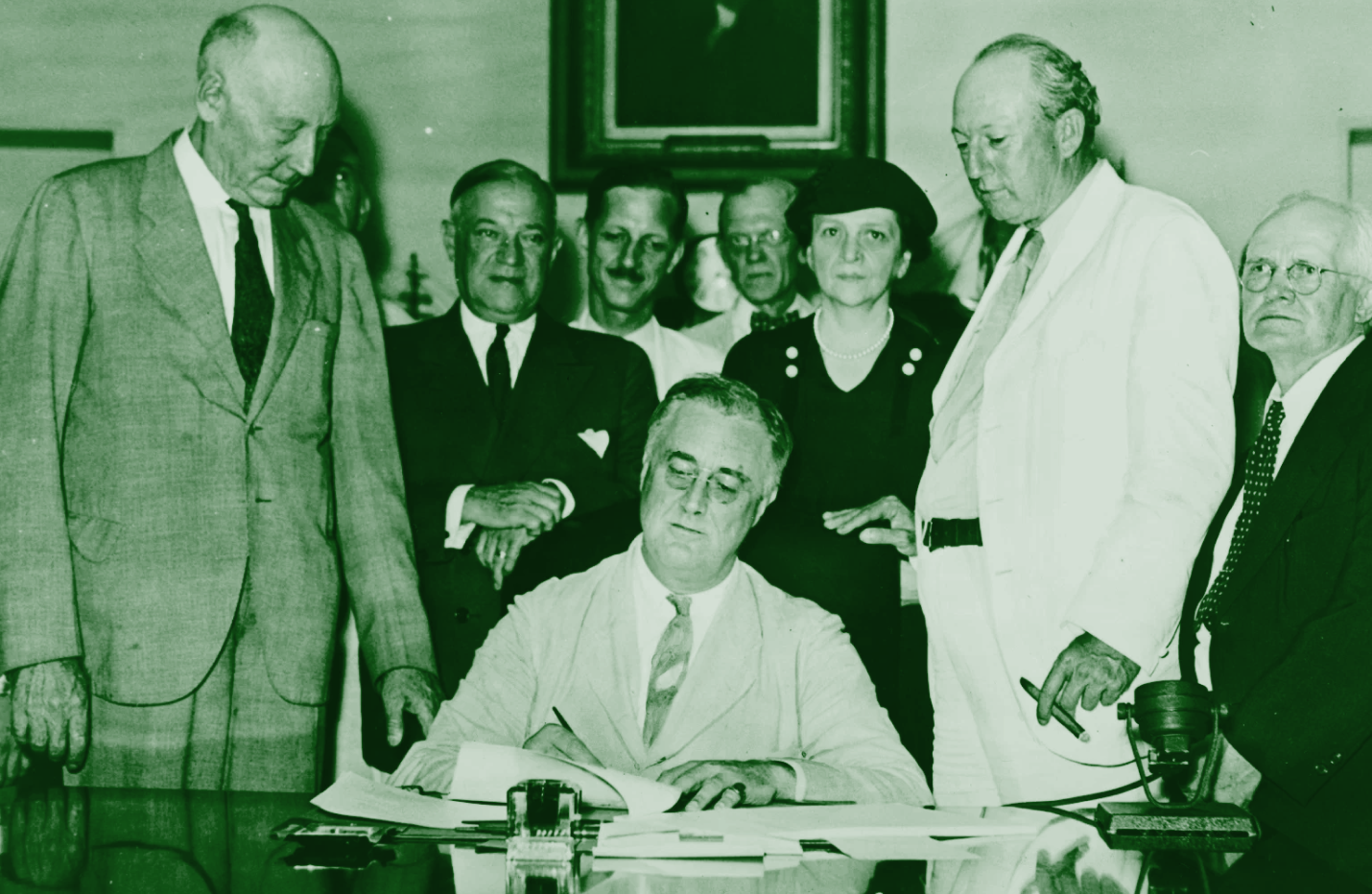
The Social Security Act, with an old-age program embodying these qualities, passed in August 1935 (the bill also included provisions for unemployment insurance and support for impoverished women and children). Upon signing the legislation, Roosevelt said,
We can never insure one hundred percent of the population against one hundred percent of the hazards and vicissitudes of life, but we have tried to frame a law which will give some measure of protection to the average citizen and to his family against the loss of a job and against poverty-ridden old age.
In signing, FDR also made clear that the Social Security Act was not just about taking “care of human needs” but, as importantly, providing “for the United States an economic structure of vastly greater soundness.” This was not just about individual security, but collective security. FDR understood the two as tightly linked. By guaranteeing the former, FDR argued the country, collectively, would be better protected from the “peaks and valleys—of deflation and of inflation” (Hacker 2008, 42).
From the moment of its passage, the architects of Social Security understood the legislation to be incomplete. What had made it through the legislative process was the product of social movement pressure, the administrative models and technical knowledge available at the time, and legislative compromise. The legislation was not as comprehensive in reach or in breadth as many had hoped.
Infamously, the final legislation earned the support of Southern Democrats by excluding professions dominated by Black workers—agriculture and domestic labor, for example—from coverage (Klein 2003, 104–7). At the time, this meant that almost half the workforce was excluded. Likewise, the antipoverty measures in the legislation were run through the states instead of the federal government, allowing Southern states to add segregationist practices to those programs (Katznelson 2006). The American Medical Association also successfully lobbied to keep health insurance out of the final legislation (Kim 2017, 45).
Roosevelt and Perkins understood these compromises as a necessary beginning on which to build the complete system they envisioned. They were clear from the start that more was to come. In a radio address given while Congress debated the legislation, Perkins told the nation, “The bill is, I believe, a sound beginning on which we can build by degrees to our ultimate goal. We cannot hope to accomplish all in one bold stroke.” FDR affirmed this in his signing statement, during which he described his program as “by no means complete” even as he celebrated the step forward.
3. The 1939 Amendments: Building Out the Promise
The first round of amendments to the legislation came even sooner than Perkins and FDR might have expected. When the Social Security legislation was passed in 1935, regular payments were set to begin in 1942. In the interim years, the fund reserves ballooned. As the Depression continued, many policymakers became concerned that, in pulling money out of the economy, the reserve fund was exerting deflationary pressure on an economy in need of stimulation (Kessler-Harris 2003, 130–34). These concerns led them to reopen the program for amendment in 1939.
The 1939 amendments made a few key moves to deal with the ballooning reserves:
- First, they moved up benefit payments to begin in 1940.
- Second, they moved the system to a pay-as-you-go plan so that instead of saving money for their own retirements, each generation financed benefits for the generations ahead of them in real time.
- Third, they added a dependent benefit, whereby men who were eligible to draw Social Security benefits under the original legislation could also claim a supplemental benefit, set at half of their original benefit, for their wives.
- Finally, Congress changed the benefit calculation formula to be based on average monthly wages instead of cumulative lifetime earnings.
The 1939 changes reinforced the 1935 eligibility choices. At the same time, the amendments once again affirmed Social Security’s core promises. They made Social Security benefits an even clearer guarantee. By separating the benefits paid from what individual workers contributed and instead having benefits paid by the next generation of recipients, the program became a clear social commitment to providing a baseline of economic security for all seniors, rather than an individual savings system (Kessler-Harris 2003, 142). Further, the new benefit formula reaffirmed that the benefit structure was intended to be progressive. It was more generous to lower-paid workers and to workers who moved in and out of covered employment than the 1935 formula was.
Social Security administrators welcomed the fact that these changes would push the program toward increasing coverage as broadly as possible. (Indeed, they recommended—but did not win—ending the domestic worker exclusion at the time [Kessler-Harris 2003, 149].) A broader tax base would also allow for greater stability in the funding base, an essential feature for the pay-as-you-go plan.
Social Security thus entered the 1940s ready to begin paying benefits and embodying a set of core promises: a guarantee of a baseline of economic security, a progressive benefit structure, and an administrative structure that promised broad-based, easy, and dignified access (albeit with serious exclusion at the time). Its architects believed these were the baseline commitments that would someday reach more Americans and on which future benefit structures would be built.
Conclusion: Drawing Lessons from Social Security History
The architects’ expectations of continued expansion and revision proved correct. Key legislation in 1950, 1952, 1954, and 1956
- added over 10 million new beneficiaries, including domestic workers, farm workers, and state and local government employees;
- increased benefits by roughly 70–100 percent;
- introduced disability coverage; and
- lowered the retirement age for women to 62.
Then, in 1965, health insurance for the elderly was added to the system through the creation of Medicare, bringing a new benefit entirely into the social insurance system and using the architecture of the Social Security Act to do it.
From its start, Social Security has been both an ambitious program and a program designed to grow. Our participation is a social commitment: As a country, we take care of the elderly when they can no longer work.
Throughout the 1960s and 1970s, expansion and amendment continued. Benefits continued to rise, and, in 1972, they became automatically inflation-adjusted. While the program never expanded to fully embody the ambitions of its creators—perhaps most notably, universal health insurance remained politically out of reach—these additions reaffirmed the core promises of Social Security’s architecture: guaranteed security, progressive benefit structures, and broad accessibility.
From its start, Social Security has been both an ambitious program and a program designed to grow. Our participation is a social commitment: As a country, we take care of the elderly when they can no longer work. Americans have made this commitment willingly from the start. In exchange, we expect the program to keep its core promises: to be there for us. Ninety-one years after its passage, we should be able to trust that Social Security will be there when we need it, that it will help make our economy more fair, and that we will not have to jump through hoops to get it.
In the next few years, policymakers must once again update the program in order to keep those core promises and bring its structure in line with the way people work almost 100 years after its founding. There is much to be done to maintain Social Security’s core promises:
- Stabilizing the program’s funding while avoiding benefit cuts is essential to maintaining its guarantee.
- Addressing how rising inequality has undermined the funding base will both help solve the funding crunch and reaffirm the program’s progressivity.
- Adjusting the program to better incorporate workers on the margins and finally recognize uncompensated care will make it more easily accessible for more Americans.
Americans should expect and demand that as policymakers address these challenges, they once again affirm the program’s core commitments rather than lose sight of them. Only then will it remain as FDR described it: “sound, needy, and patriotic legislation.”
Suggested Citation
Kahn, Suzanne, and Sarah Hastings. 2026. “‘Sound, Needy, and Patriotic Legislation’: Preserving the Fundamental Promises of the Social Security System.” Roosevelt Institute, August 12, 2026.
RELATED RESOURCES
Authors


Sarah Hastings
Graduate Humanities InternSarah Hastings is a graduate humanities intern at the Roosevelt Institute and a PhD student in environmental history at Boston University.