

Funding Social Security with More Than Just Payroll Taxes
September 9, 2026
By Jonathan Schwabish
This essay is part of the Roosevelt Institute’s Good Life Resident program, an initiative designed to develop emerging leaders and generate people-centered ideas across the Roosevelt Institute’s key economic policy priorities. Explore the full series on Social Security revenue reform.

To address Social Security’s projected trust fund depletion through changes to benefits, policymakers have typically focused on a familiar set of reform levers: changing the benefit formula—either the initial calculation or how benefits grow after claiming—or changing eligibility rules, such as the early retirement age or who qualifies for spousal and survivor benefits.
On the tax side of the policy discussion, proposed reforms typically focus on the two key pieces of the formula—the tax rate employees and employers pay, and the maximum amount of earnings that are taxable. While important to reform, these levers are unlikely to close the solvency gap on their own or provide sufficient revenue for targeted program expansion. Therefore, it’s prudent to discuss how other tax streams could help fund the system.
The current policy debate around wealth taxes and, more generally, how to tax super wealthy Americans is perhaps a leading indicator of changes in this discussion. As the millionaire and billionaire class grows, policymakers have made it easier than ever for wealthy taxpayers to shield their income from standard income and Social Security taxes. Remember, Social Security taxes are paid on earnings, not on returns from the stock market, bonds, or other forms of income. For instance, Warren Buffett, whose wealth is estimated at roughly $140 billion, famously earns a salary of $100,000, less than the current taxable maximum of $184,500.
Given the important role Social Security plays in people’s retirement and retirement planning (and, for many, life and disability insurance) and the federal government’s overall tax-spending balance, policymakers need to consider every possible option to bring Social Security (and the nation’s fiscal picture) into balance.
This paper extends the policy discussion on the revenue side of the Social Security reform debate by examining additional tax sources that could be tapped to help fund the system. However, how these forms of revenue are structured could alter the long-standing link between earnings and benefits. Social Security is built on the principle that a worker’s benefits (and those of their spouse and dependents) are an explicit function of their earnings from work. That link is not absolute, and there are adjustments at the margins: The progressive benefit formula returns a higher share of earnings to lower earners, the taxable maximum caps the relationship, and revenue from the taxation of benefits already flows into the trust funds from a non-payroll base.
Including income from investments or real estate, or other measures of wealth, in the Social Security tax base (without increasing benefit amounts) changes that link. Policymakers can, of course, change that underlying philosophy, but doing so would mark a significant shift in how the program has operated for the past 90 years—which some argue is the basis of the program’s bipartisan popularity. Yet, given the important role Social Security plays in people’s retirement and retirement planning (and, for many, life and disability insurance) and the federal government’s overall tax-spending balance, policymakers need to consider every possible option to bring Social Security (and the nation’s fiscal picture) into balance.
Although this would be a new approach for Social Security, it is not a new idea in other policy discussions. For example, a mixed revenue stream, with a payroll tax that is not capped like Social Security taxes, has always funded Medicare, yet Medicare enjoys a similar level of popularity to Social Security and is regarded as an earned benefit from work. And lawmakers have seriously discussed—under both President Barack Obama in 2010 and President Joe Biden in 2024—applying revenues from the Net Investment Income Tax (NIIT) to Medicare (though, when the NIIT was passed as an amendment to the Affordable Care Act in 2010, the funds were directed to general revenues rather than to Medicare). Policymakers should therefore consider the full menu of available revenue options for Social Security as well.
Surveying Potential Revenue
Introducing new or additional taxes would also have implications for households, firms, and the broader economy. New or higher taxes affect decisions people make about work, savings, investments, and the timing of retirement. And those decisions are not uniform across different tax types—an increase in the payroll tax or a new estate tax has different impacts on different types of people.
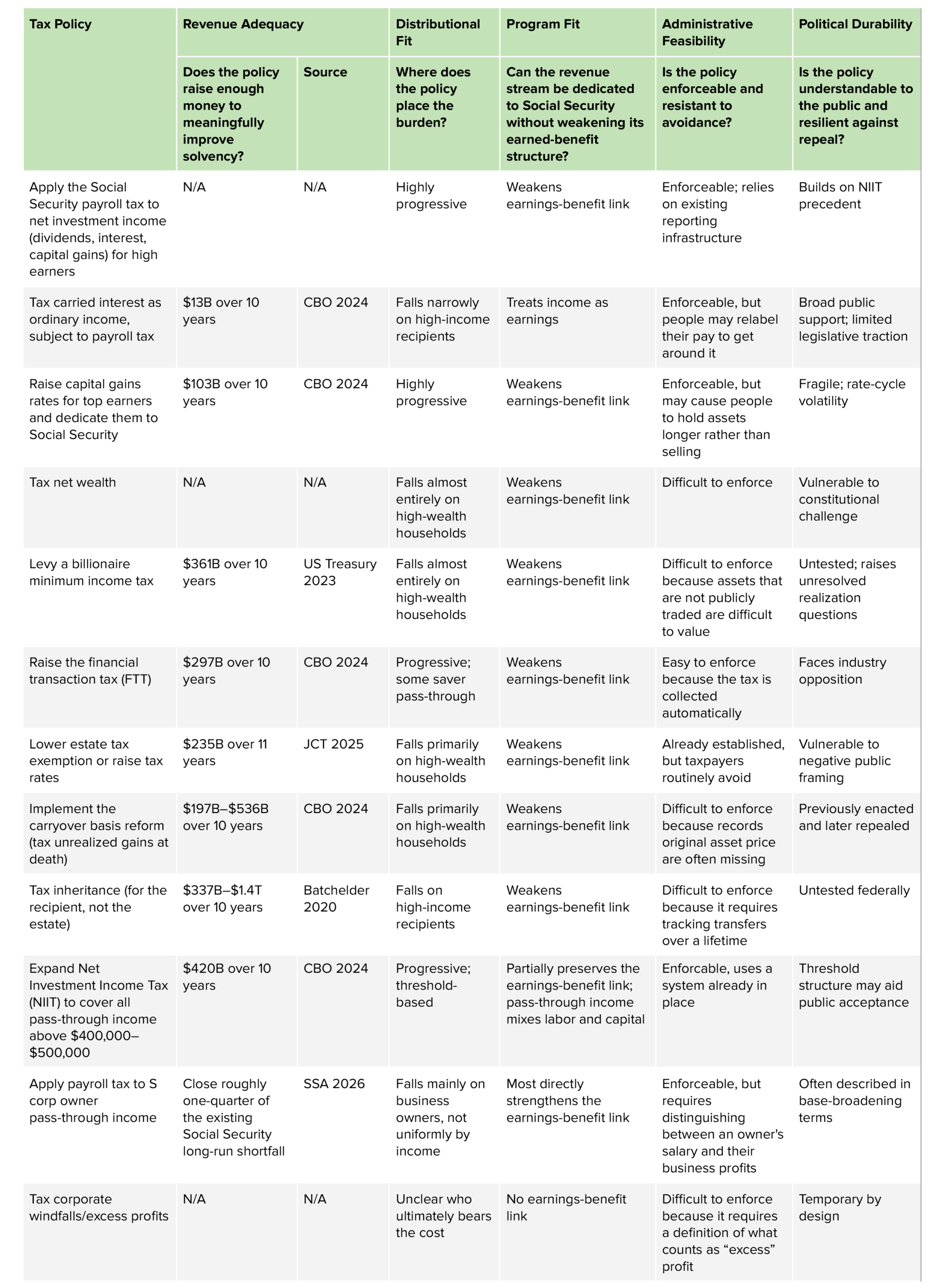
The options described below are not inherently “good” or “bad”; rather, this brief snapshot of revenue options offers a governing framework that policymakers can use to evaluate them as they debate Social Security reform. Any such decision should be weighed against several criteria, five of which are listed here:
- Revenue Adequacy: Does the policy (alone or in conjunction with others) raise enough money to meaningfully improve solvency?
- Distributional Fit: Where does the policy place the burden? Does it fall primarily on high-income/wealthy households, or on low- and middle-income workers? And how does the policy interact with existing tax policies?
- Program Fit: Can the revenue stream be dedicated to Social Security without weakening the program’s earned-benefit structure?
- Administrative Feasibility: Is the policy enforceable and resistant to avoidance?
- Political Durability: Is the policy understandable to the public and resilient against repeal?
This is not an exhaustive list, and policymakers and the public may wish to see other guideposts included. But it serves as a starting point for a broader discussion about what taxes might be changed or introduced to support Social Security. Importantly, no single option is likely to satisfy all five criteria equally well, and trade-offs among them are often unavoidable; the framework’s value lies in making those trade-offs explicit.
This snapshot also categorizes the tax options into four different revenue types that policymakers might use to fund Social Security:
- Investment and Capital Income: Apply the Social Security tax to investment income, like dividends, interest, and capital gains.
- Wealth and Asset Taxes: Apply taxes to wealth and assets to high-wealth individuals and households.
- Estate and Inheritance Taxes: Change current estate and inheritance tax laws and rates to capture a greater share of total income.
- Business Income: Apply the payroll tax to tax status corporations that use the pass-through as income, or expand other business taxes to cover pass-through incomes above some cutoff.
These revenue sources track income and wealth gains that have, in recent decades, grown largely outside the reach of the payroll tax. This is especially true for people at the top of the income distribution, whose financial assets have grown more quickly than those at the bottom. Over the past four decades, the labor share of national income has declined (which the Social Security Trustees incorporate into their projections), while household net worth has grown substantially relative to income.
Many of the policy options presented below include the total 10-year revenue estimates from the 2024 report Options for Reducing the Deficit: 2025 to 2034 from the Congressional Budget Office (CBO). Those estimates assume funds will flow into the government’s general revenue, and it is not clear how—or even if—they might differ if the revenue were dedicated to Social Security. This snapshot also does not estimate the combined or neteffects of these revenue options, including additional impacts on labor force participation or the overall economy, nor how changes to the benefit formula (if any) would impact the total revenue estimates or the distributional effects of such policies. This paper instead summarizes major revenue options that policymakers could explore to fund Social Security.
Investment and Capital Income
- Apply the Social Security payroll tax to net investment income (dividends, interest, capital gains) for high earners. This option would extend the 12.4 percent payroll tax (the level of which could be modified) to passive investment income, such as dividends, interest, and capital gains, above a high-income threshold. Under the current system, the payroll tax applies only to wages and self-employment income, so a large (and growing) share of top-earner income escapes the tax entirely. This option fits squarely within the current scope of the program and would be relatively easy to implement, as it would largely expand the definition of “earnings” for purposes of Social Security. One such recent proposal from Sen. Sheldon Whitehouse (D-RI) and Rep. Brendan Boyle (D-PA), the Medicare and Social Security Fair Share Act, would apply the 12.4 percent Social Security payroll tax to wages above $400,000 as well as to investment income for individuals with modified adjusted gross income above $400,000 (and couples with MAGI over $500,000).
- Tax carried interest as ordinary income, subject to payroll tax. Private equity and hedge fund managers typically receive two types of compensation: a fee tied to a percentage of the fund’s total assets, and a percentage of the fund’s total profits. This latter form of compensation is known as “carried interest,” named so because the managers “carry” the risk of the fund’s performance. Carried interest is taxed at long-term capital gains (0%, 15%, and 20%) rates rather than as ordinary income, where there are currently seven tax rates (i.e., brackets): 10%, 12%, 22%, 24%, 32%, 35%, and 37% (see Figure 1). This option would treat carried interest as compensation and subject it to both income and payroll taxes; thus, it is consistent with the current system and, like the previous option, would be relatively easy to implement. CBO estimates that this kind of tax could raise $13 billion in general revenue over 10 years.
Figure 1
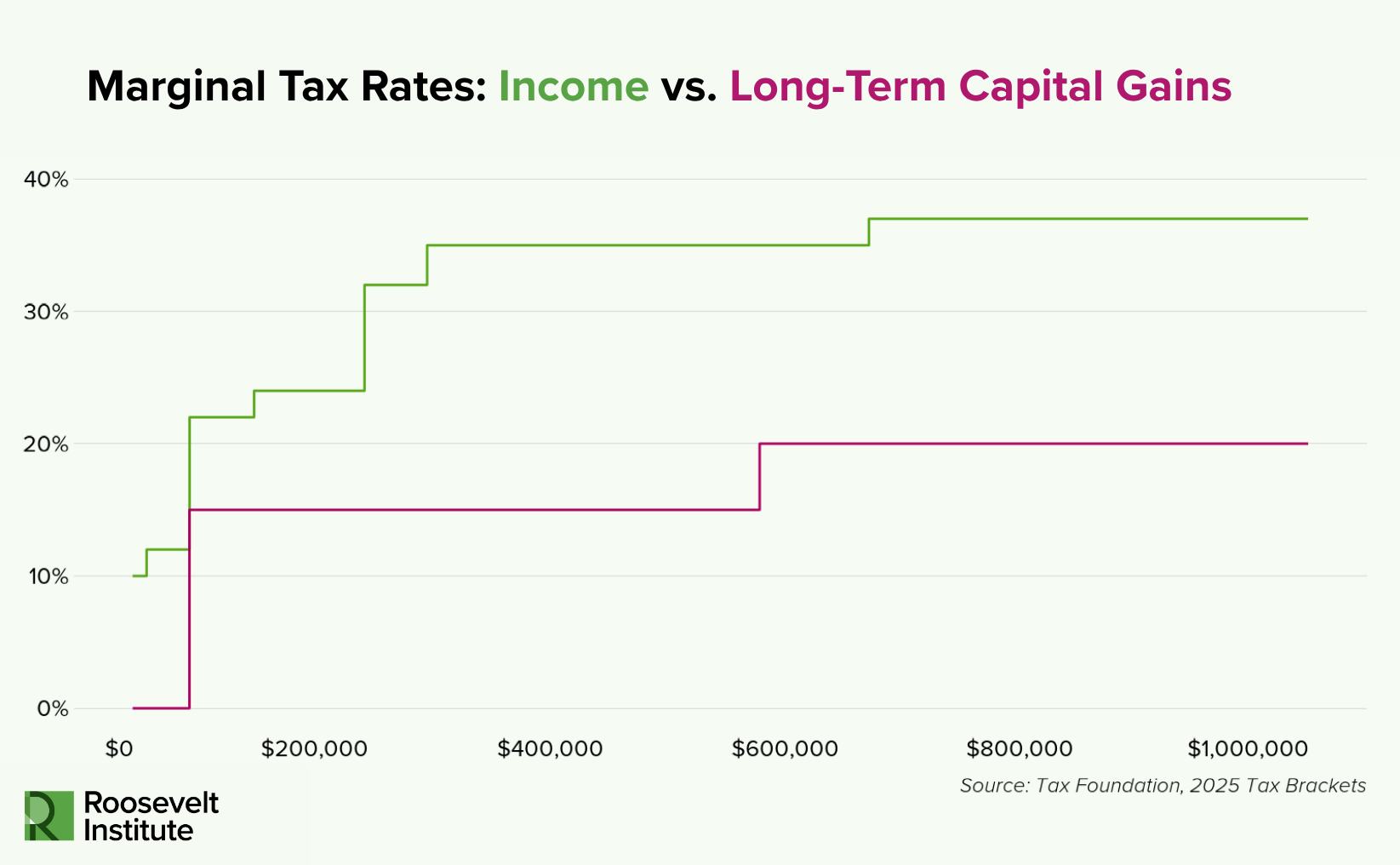
- Raise capital gains rates for top earners and dedicate them to Social Security. As noted, profits from investments held more than a year are currently taxed at 0%, 15%, or 20%, much lower than the top rate on regular incomes like wages. In other words, people who get a lot of their annual income from their wealth face much lower tax rates than people who get their income from earnings. Raising the top capital gains rate—or, alternatively, taxing gains as ordinary income for high earners—would raise substantial sums and target a major source of income for the wealthiest households. CBO estimates that raising all three long-term capital gains rates by 2 percentage points (to 2%, 17%, and 22%) would raise about $103 billion in general revenue over 10 years.
Modeling Future Social Security Finances
Precious few large-scale validated models reliably estimate the long-term finances of the US Social Security system. Existing Social Security calculators and similar tools typically take a single cross-section of US workers, reweight it to reflect projected demographic shifts, and grow earnings and incomes using projected growth rates from federal sources such as the Social Security Administration (SSA) and CBO. What these models cannot do is trace how an individual’s earnings, family structure, or health evolve over a lifetime, so they are ill-suited to questions about how specific cohorts or subgroups fare under reform. And because they often do not have measures of lifetime earnings—which are necessary to estimate the Average Indexed Monthly Earnings to calculate Social Security benefits—these models are unable to accurately project benefit receipt at the individual or family level.
Microsimulation models have the functionality and sophistication needed for these projections. The Congressional Budget Office’s Long-Term Model, the Social Security Administration’s Modeling Income in the Near Term, and the Urban Institute’s Dynamic Simulation of Income Model (DYNASIM) are some of the most prominent models that do this. These models project the finances of the Social Security system (and other long-run programs) from the perspective of an individual worker and their family. DYNASIM, for example, starts with longitudinal earnings records from the Survey of Income and Program Participation, statistically matches them to historical earnings records from longitudinal earnings data, including SSA’s public use Summary Earnings Records, the Panel Study of Income Dynamics, and the National Longitudinal Survey of Youth, and then, for each individual in the sample, simulates life events like marriage, divorce, migration, employment, retirement, and more. Some of these individual outcomes, such as immigration and fertility, are benchmarked against aggregate projections produced by SSA and CBO.
Because individual earnings and retirement behavior are the primary inputs to a Social Security microsimulation model—and are enormously complex on their own—some microsimulation models do not focus on other forms of income and wealth, such as stock and bond holdings, pensions, and housing wealth (DYNASIM is the exception). Incorporating or expanding those modeling capabilities would take time and effort to find and process the best underlying data, understand the existing literature on trends and trade-offs, and blend them into the existing individual base files. But having the capability to incorporate such measures (and behavioral responses) would be of enormous value to the research and policymaking communities. Greater investment, either from the federal government or other funders, would provide support for these models and the expanded capabilities that would make them more useful for answering policymakers’ questions.
Wealth and Asset Taxes
- Tax net wealth. This option would impose an annual percentage levy on the total net worth of the wealthiest households, including stocks, real estate, business interests, and other assets above a certain threshold. Unlike income taxes, it would reach accumulated wealth regardless of whether it generates taxable income in a given year. Several states, including California, Minnesota, and Rhode Island, are considering (or have considered) wealth tax policies in recent years. Critics have pointed to the difficulties in measuring wealth for the purposes of such taxation, while proponents argue that it could help address wealth and income inequality and generate revenue.
- Levy a billionaire minimum income tax. This would establish a minimum effective tax rate (e.g., 20–25 percent) on total income for households with wealth above some cutoff amount. The Biden administration proposed this kind of option in FY23, FY24, and FY25, which would have imposed a minimum 20 percent tax on total income—including unrealized capital gains—for all taxpayers with net worth exceeding $100 million. Like the net wealth tax, this revenue option when applied to Social Security changes the link between earnings and benefits. It would also likely be difficult to accurately measure wealth and thus taxes due. The US Treasury Department estimated that the FY23 proposal would raise $361 billion over 10 years.
- Raise the financial transaction tax (FTT)—a small percentage levied on the purchase or sale of financial assets such as stocks, bonds, and derivatives. Because trading volume is enormous, even a very low rate generates substantial revenue while having minimal effect on long-term investors. High-frequency traders and large financial institutions would likely bear most of the cost, though the increase in transaction costs could result in lower trading volume, lower liquidity, and potentially increased stock volatility. The existing US FTT is very small, at about 2 cents per $1,000 in trading volume. Because the tax already exists, this option would be relatively easy to implement to fund Social Security, but it would change the program’s underlying philosophy, which directly links earnings and benefits. Some proposals would increase the FTT to 0.01 percent, or 10 cents per $1,000 in trading volume, which CBO has estimated would generate about $297 billion over 10 years.
Estate and Inheritance Taxes
- Lower estate tax exemption or raise tax rates. The federal estate tax is a tax on property such as cash, real estate, and other assets transferred from a deceased person to their heirs. The tax is levied only on the portion of the estate’s value that exceeds a certain threshold, currently $30 million for a couple (over their lifetimes), though it was as low as $1.35 million for a couple in 2001. The tax rates range from 18 percent to 40 percent, though the average effective tax rate is estimated at 14.1 percent, well below the top marginal income tax rate of 37 percent. Lowering the exemption threshold, raising the rates, or both would significantly increase tax revenues from large intergenerational wealth transfers. But because taxpayers already routinely try to avoid it, such a tax may be difficult to administer. It’s not a perfect comparison, but the Joint Committee on Taxation (JCT) estimated that permanently extending the 2017 Tax Cuts and Jobs Act estate and gift tax cuts—which doubled the exemption amount from $5 million to $10 million in 2011 dollars (indexed for inflation)—would reduce federal revenues by $235 billion over FY 2025–35.
- Implement the carryover basis reform (tax unrealized gains at death). Under current law, inherited assets receive a “stepped-up” basis, meaning the value of the asset is adjusted to its fair market value on the date of death. For example, if a single person sold an investment in 2025 with $1 million in capital gains during their lifetime, they would owe about $166,000; if, however, they held the investment until death and passed it onto their heirs, no capital gains tax would be owed. Any capital gains accrued during the decedent’s lifetime are permanently forgiven, meaning they do not have to pay taxes on the asset’s growth over time. At least two policy options are possible: Under the first, the law would switch to the “carryover basis.” Under this approach, the inherited asset would be taxed at the decedent’s cost basis, then at the heirs’ tax rate when they sell it. CBO estimates that this policy would raise $197 billion over 10 years. Under the second policy, capital gains would be taxed at the time of the person’s death, as if the asset had been sold at death. CBO estimates that this would raise $536 billion over 10 years. The large difference in the two estimates is likely due to the price of deferral—in the second option, the government collects taxes at the time of the person’s death, while in the first, the heir pays taxes when they decide to sell, which could be many years in the future. In both cases, administering and enforcing the tax can be difficult because records with the original asset price are often missing or incomplete.
- Tax inheritance (for the recipient, not the estate). Unlike an estate tax, which is levied on the entire estate before it passes to heirs, an inheritance tax is levied on recipients based on the amount each receives and their relationship to the deceased. For example, if a Pennsylvania resident (Pennsylvania is one of five states with an inheritance tax as of 2025) left a $1 million inheritance to their adult child, the child would owe about $45,000 in inheritance tax (a 4.5 percent tax rate). No federal inheritance tax currently exists in the US, and introducing one would shift the framing from taxing death to taxing windfalls. A 2020 Hamilton Project chapter by Lily Batchelder includes Tax Policy Center estimates that show that replacing the estate and gift taxes with an inheritance tax integrated into the income and payroll tax system would raise between $337 billion and $1.4 trillion over 10 years, depending on the lifetime exemption level. Enforcing such a policy could be difficult, though Batchelder walks through a series of steps that could “substantially curtail the ability of taxpayers to temporarily and artificially deflate the value of inheritances at the time the tax liability is assessed.”
Business Income
- Expand Net Investment Income Tax (NIIT) to cover all pass-through income above $400,000–$500,000. The NIIT is a 3.8 percent tax levied on certain investment earnings of higher-income individuals, estates, and trusts. As currently structured, income generated by some types of businesses—such as limited partnerships and S corporations—may be excluded from the tax under certain circumstances. Thus, high-income taxpayers who run those kinds of businesses can avoid paying taxes on their share of the firm’s net profits. This option partially preserves the link between earnings and benefits by blending labor and capital in estimating a person’s Social Security benefit. CBO estimated that imposing the NIIT on all income derived from business activity would raise $420 billion over 10 years.
- Apply payroll tax to S corp owner pass-through income. When S corp owners classify income as “business distributions” rather than wages, they can avoid payroll taxes on the nonwage portion of their income. Similar to modifying the NIIT, this policy would require all active business income above the compensation component to be subject to the self-employment/payroll tax, which broadens the definition of earnings in the Social Security benefit formula. The Office of the Chief Actuary of the Social Security Administration estimates that this kind of policy would close a quarter of the existing Social Security long-run shortfall.
- Tax corporate windfalls/excess profits. This option would impose a surtax on corporate profits above a “normal” return threshold, such as average returns over some historical period. It is often framed as a way to target extraordinary profits earned by companies during periods of market disruption or monopoly pricing power. In 2024, Sen. Bernie Sanders (I-VT) introduced the Ending Corporate Greed Act, which would have established a 95 percent windfall profits tax on a company’s profits that exceeded their average inflation-adjusted profits from 2015–19, but neither CBO nor JCT provided an official estimate of the revenue this proposal would generate. Such a policy could be difficult to enforce because it requires defining what counts as “excess” profit.
Conclusion
Each of these options has the potential to raise meaningful revenue over the next decade, precisely as policymakers face the need to strengthen the Social Security program. Dedicating new taxes on high-end capital income, concentrated wealth, inherited wealth, or undertaxed business income to Social Security would involve a real policy choice, because other public priorities, from defense to healthcare to childcare to debt reduction, also require public investment. But that trade-off does not weaken the case for directing revenue to Social Security (especially if adjustments to the current payroll tax structure resolve much of the shortfall).
The central design question is how to modernize Social Security’s financing while preserving what has made the program durable for nearly 100 years: a dedicated revenue stream from workers and employers, broad participation across the entire country, and its earned social insurance structure. New revenue sources need not weaken that foundation. Properly designed, taxes on high-end capital income, concentrated wealth, inheritances, or undertaxed business income can reinforce Social Security’s core goals by asking those who have benefited most from today’s economy to contribute more to a system that protects workers and families against economic insecurity across their lifetimes.
Table 1. Comparing Revenue Options for Social Security
RELATED RESOURCES
Author