

The Good Life Agenda
June 2, 2026
By Elizabeth Wilkins, Suzanne Kahn, Matt Hughes, Rey Fuentes, Noa Rosinplotz

Foreword
by Paul Krugman

What should be the goal of US economic policy? It shouldn’t be to maximize GDP: Economic growth is good, but it’s a means to an end, not the end itself. Even “affordability” is too narrow a concern. It matters immensely, but it’s not the whole story.
No, economics is ultimately about people, and the purpose of economic policy should be to help people live good lives.
Franklin D. Roosevelt and his allies understood the importance of a wider, people-focused agenda. They led America out of the Great Depression and ushered in a generation of unprecedented economic growth, but their achievements went far beyond aggregate economic statistics.
Thanks to a sharp decline in income inequality, America emerged from the New Deal Era with prosperity that was more broadly shared than ever before, or, alas, since. Workers achieved both higher wages and a new level of dignity thanks to a strengthened labor movement. Seniors achieved new levels of both security and dignity thanks to Social Security. Neglected regions were brought into the modern world through rural electrification, which also brought telephone access. After the war, the GI Bill and public aid to colleges democratized higher education. And much, much more.
Not everyone shared fully in this drive to make life better. Above all, post–New Deal America was still severely tainted by racism and sexism. Yet life became far better for scores of millions of Americans.
I grew up in the America the New Deal made. It wasn’t a perfect nation by any means, but it was a vast improvement over the society we had before. Unfortunately, too many people took what America had achieved for granted, not realizing that the good lives enjoyed by many didn’t evolve by accident but were, instead, made possible by bold, effective policies.
Now the opportunity to live a good life is under threat; the New Deal’s progress against inequality, its empowerment of workers, and more have already been largely lost.
But we can, well, make American lives good again.
This report lays out an agenda for reversing America’s slide into extreme inequality and oligarchy. It offers a clear-eyed view of the structural problems that have partially reversed the New Deal’s achievements, then proposes policies for solving those structural problems. These policy ideas range from measures to improve affordability, to policies to increase economic security and improve life for families with children, to policies to restore power to ordinary Americans and limit the influence of corporations and oligarchs.
These policy ideas are supported both by serious empirical analysis and by case studies that show how they can work for real people—because, again, economics is ultimately about people, and the purpose of policy is to make lives better.
Economics is ultimately about people, and the purpose of policy is to make lives better.
None of this will be easy. On the contrary, it will be extremely hard. But let me editorialize a bit and say that the prospects for a real progressive agenda look much better to me now than they seemed even a year ago. Proclamations that we had entered a permanent era of conservative extremism and economic inequality are looking increasingly foolish. Institutions, elected leaders, and policymakers that cringed in the face of reactionaries are finding their voices and spines—or being challenged by people demanding that they take a stand against oligarchy.
So it’s time to think big about what policy can do to promote a good life. And this report makes a very good start.
Introduction
“I want to be sure that neither battles nor burdens of office shall ever blind me to an intimate knowledge of the way the American people want to live and the simple purposes for which they put me here.”
President Franklin D. Roosevelt in a 1938 Fireside Chat
As our namesake FDR understood well, the goal of governing should be straightforward: make people’s lives better.
For many of our lifetimes, people haven’t been feeling that upward trajectory. Even as policymakers trumpeted ideas that were “good for the economy,” even in moments when top-line economic metrics were stronger than they are today, people have felt like they’re on unstable ground, unable to get a fair shake in life. Like others are getting ahead at their expense while they’re left behind.
That’s been true since the 1970s, and even more so in the 2020s. In 2024, America’s 1,135 billionaires had a net worth of about $5.7 trillion, almost 20 percent of US GDP that year. The high cost of living for life’s essentials, meanwhile, has reshaped this decade’s public debate. The issue was central to President Joe Biden’s unpopularity, has been a galvanizing theme of President Donald Trump’s rhetoric, and is a defining pillar in the policy agendas of recently elected officials like New York City Mayor Zohran Mamdani and New Jersey Governor Mikie Sherrill.
Any policymaker would be wise to heed this lesson: Americans expect a relentless focus on making their lives more affordable. But since 2022, we’ve also seen that a few years of wage growth and gradually improving inflation isn’t the recipe for a good life.
When you listen closely to working people’s stories—their stark and vivid descriptions of their problems, the dreams they defer or deem impossible—a bigger lesson emerges. Our vision can’t be about affordability alone, because people want so much more than to make ends meet.
People want to feel secure throughout their lives, whether they’re graduating into a job market transformed by AI or retiring during a recession. They want the ability to set down roots. To choose if and when they have children, and how many. To start the business they’ve always wanted. They want time to spend with their loved ones, to be able to step away and enjoy the fruits of their labor, care for a sick parent, or engage in service that brings meaning to their lives.
And they’re angry that these wants feel like a luxury or impossibility while they watch the rich get richer and more powerful—and pose increasing threats to the basic functioning of our economy and democracy. It’s reasonable to be angry that the administration’s response to the housing crisis is to ask us to draw down our retirement funds, or that Elon Musk is now approaching $1 trillion in net worth after gutting consumer protection and enforcement capacity during his brief stint in government. It’s egregious that, as working people struggle to afford life’s basics, President Trump himself “has profited from his return to the presidency by an amount of money equal to 16,822 times the median US household income,” as a New York Times editorial board review showed in January 2026.
If we want to build the will for a different world, we need to channel that frustration into a positive vision, and translate the aspirations people have for their lives into results they can feel.
That’s the point of The Good Life Agenda: to show what our economy and democracy could look like if all of us had access to the building blocks of economic security and prosperity, and how we can get there. How we can change the structures that prevent us from living the lives we want (and that allow ever-bigger and ever-less-accountable corporations to undermine our choices), and what it would look like if we did. How we can reset the relationship between democracy and markets and take the steering wheel when it comes to transformative forces like AI, so that policymaking reflects the will of the people—not a small group of tech executives and shareholders. What our democracy would look like if we took the keys back from the oligarchs and handed them to those who have long lacked a voice in policymaking, ensuring workers had real power in the economy.
We know well that the hollowed-out institutions of the early 2020s, let alone the ramshackle ones of the second Trump administration, won’t be up to the task.

The Good Life Agenda first spotlights untapped tools we should be using to get the job done:
- Public options
- Taxes
- Industrial policy
- Antimonopoly policy
- Monetary policy and macroprudential tools
- Countervailing power
We then move to the building blocks of economic security and prosperity:

Addressing runaway costs* and increasing access for the basic needs that undergird a good life—like housing, care, education, and energy;

Raising incomes for workers, retirees, and those who have to step away from the workforce, including ensuring all Americans have access to good jobs, a real, accessible path to collectively bargain for better wages and working conditions, and a secure retirement; and finally

Ensuring Americans have control over our time: paid leave so we can spend time with the people we care about, shorter workweeks and predictable schedules, less time spent on the phone with customer service or filling out paperwork, and more time spent caring for our communities and ourselves.
*The distinction between rising costs and rising incomes can be fuzzy in a healthy economy, where both should rise at different rates. For the purposes of this report, the expenses identified as costs are those that have consistently risen faster than wages over a prolonged period and that make up a sizable chunk of most families’ budgets at some point, such as housing. Prices of specific goods, like eggs, can be volatile and hit people’s wallets month to month, but when individual price spikes make households feel strained, that’s more a symptom of lackluster income growth than of runaway costs.
Each is a necessary ingredient for restoring people’s trust in their democracy. If this agenda sounds strikingly similar to the 19th-century labor movement’s call for eight hours to work, eight hours to rest, and eight hours for what we will, that’s because that rallying cry has a fundamental wisdom. Winning that basic compact for many workers through the New Deal demonstrated to generations of Americans that democratic government could create the economic scaffolding that enables a good life.
But market-first policymaking eroded those New Deal promises over the last half-century, and we’ll need updated scaffolding to tackle the massive economic shifts underway—from the rapid deployment of AI, to an aging population, to the climate crisis. That’s where this good life agenda comes in.
A few notes before we begin: This report is not a granular instruction manual, but a springboard for future research and policy development. We don’t cover every policy we think is important. A livable planet, for example, is foundational to a good life but not explored in depth here. Rather, we are providing examples of the kinds of policies and policy approaches that must be at the heart of any agenda that wants to prove democracy can deliver.
We Can’t Return to a “Normal” That Wasn’t Working
The ideas policymakers touted for the last 50 years weren’t good for workers, and they weren’t good for the economy at the macro level either. As Roosevelt Chief Economist Joseph Stiglitz wrote in 2015’s Rewriting the Rules of the American Economy, the trickle-down approach we’ve seen since the ’70s has resulted in “a weakened economy in which most Americans struggle to achieve or maintain a middle-class lifestyle while a small percentage enjoy an increasingly large share of the nation’s wealth.”
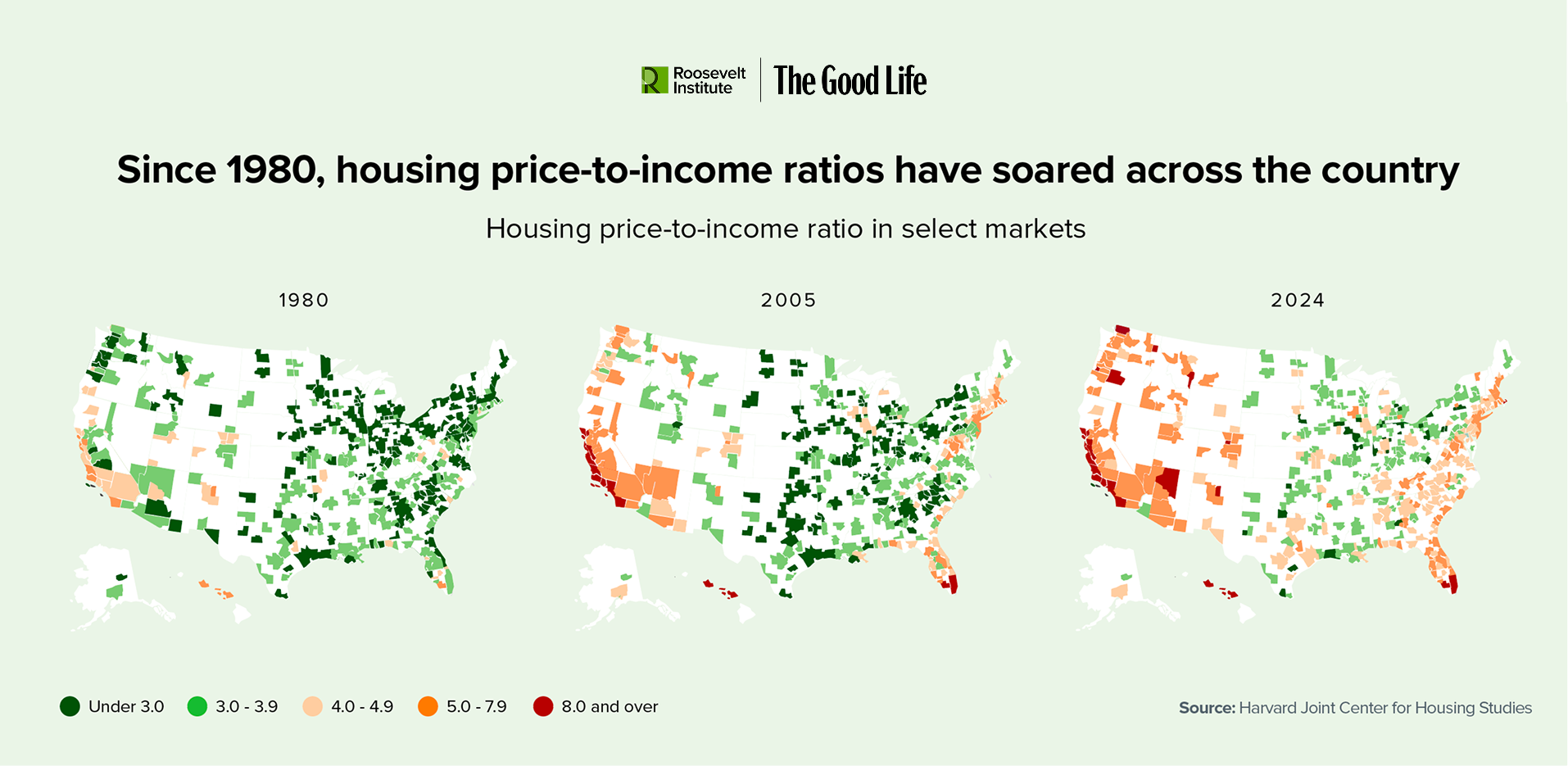
The Good Life Agenda is an active response to the fact that, for over half a century, working people have felt left behind on multiple fronts: Housing costs have radically outstripped incomes since the ’70s, as have the costs of essentials like healthcare, education, and childcare. Government programs meant to support those facing hardships due to temporary circumstances, disability, or simply old age have not kept up with the times, leaving millions in poverty.
Over the same decades, moderate inflation from the early 1980s through the COVID-19 pandemic coincided with extremely weak median personal and household income growth. Between 1999 and 2015, real incomes were below 1999 levels in 15 of 16 years. It’s little wonder, then, that when inflation did spike in the pandemic recovery, families responded with alarm. The return of income growth for lower-income households that accompanied inflation was not understood as permanent, but as a temporary blip after decades of wage stagnation. Increasing prices, on the other hand, fed into years of justified anxiety over stagnating incomes that didn’t keep up with the biggest costs in people’s lives.
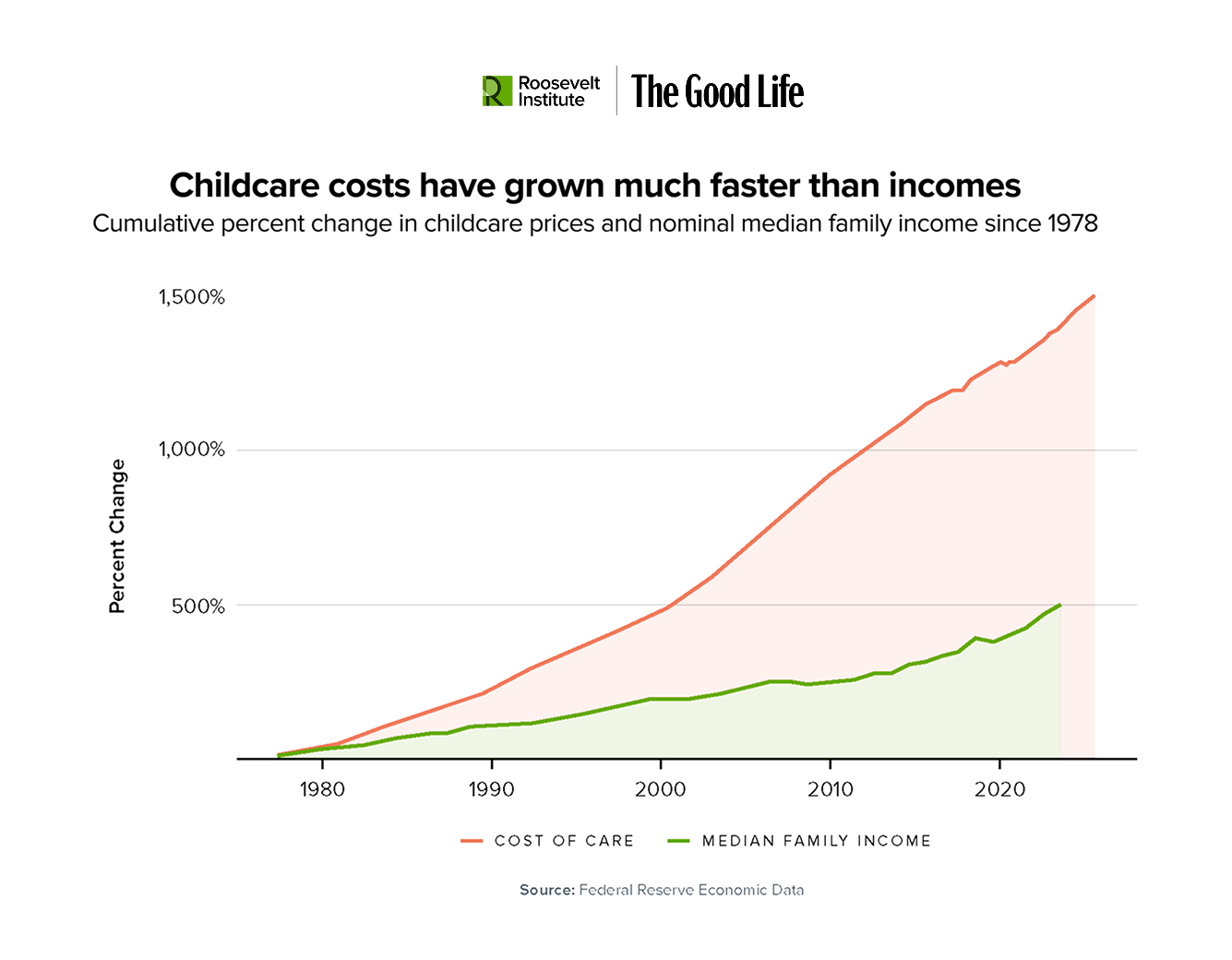
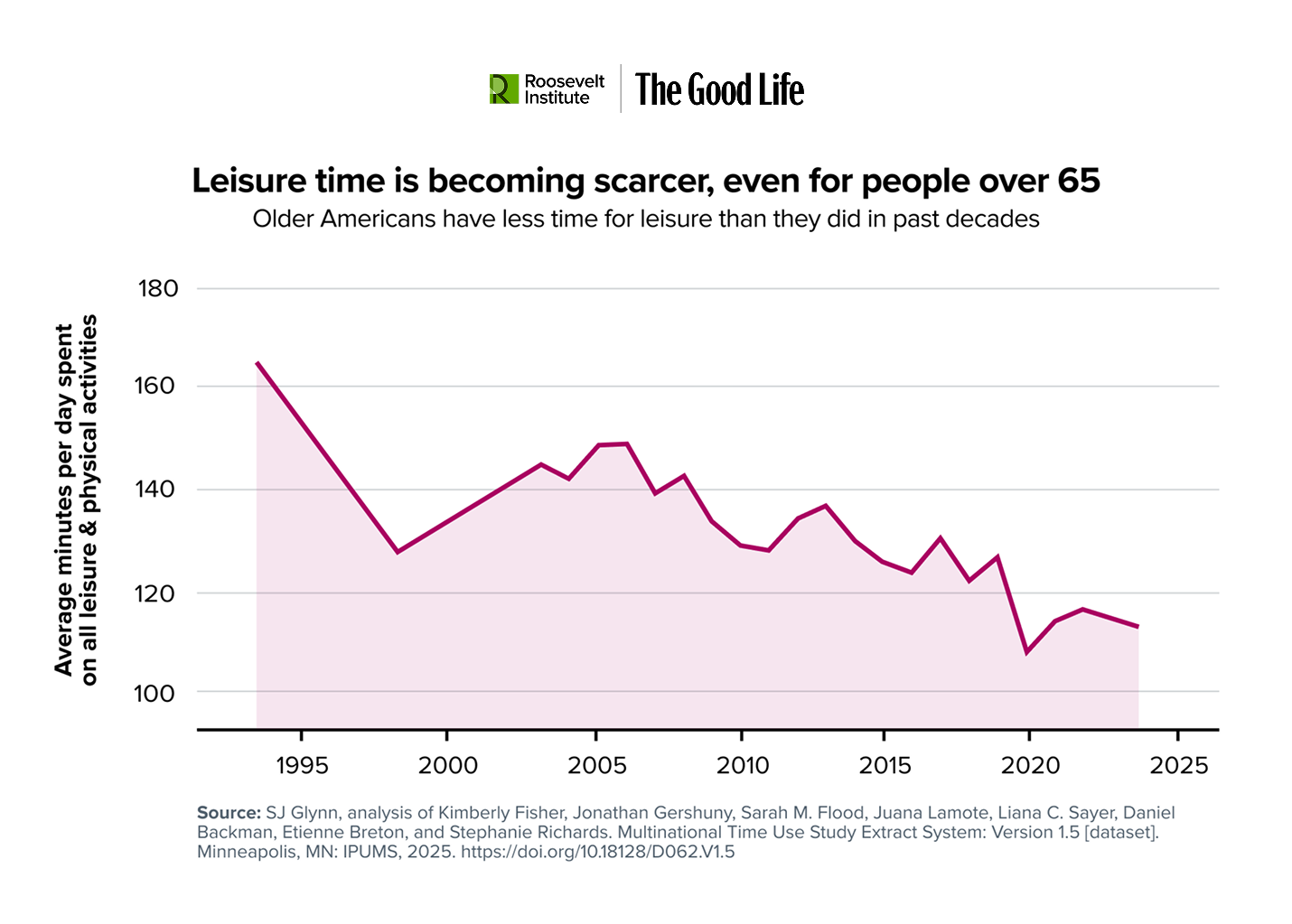
Compounding this anxiety, families have experienced increasing pressure at multiple ages and stages of life. With union density down—meaning fewer workers have a meaningful path to organize and bargain collectively—and uncertainty about AI’s future impacts up, job security feels tenuous for young and experienced workers alike. The pressure to find hours in the day has never been more intense, as caregiving falls on parents and grandparents who are also managing full-time work, unstable schedules, and long commutes. Retirement has become less secure, demanding more personal savings and forcing people who’ve worked their entire adult lives to stay in the workforce deep into old age.
Meanwhile, as working-class households struggle to keep up, inequality has soared. The ultrarich have increasingly concentrated their wealth since 1978, and today, the top 1 percent of households hold over 30 percent of the nation’s wealth, while the bottom 50 percent hold only 2.5 percent.
All these pressures are how Americans have experienced what a decade-plus of economic research has shown empirically: Market-first policymaking was failing even on its own terms. As household incomes faltered, the promised economic growth never materialized. US GDP grew by an average of nearly 4 percent a year from 1950 to 1980, but only 2.6 percent a year from 1980 to 2019. The labor market became less dynamic, and innovation and entrepreneurship declined.
In light of these trends, trying to return to the “normal” of the past half-century would be economic malpractice for working families and a grave mistake for our democracy. The economic experience of the last 50 years weakened Americans’ faith in democracy’s ability to deliver for them, as well as their connection to their government and public policy as a shared project.
We need an agenda that ensures that the economy is ours and, as FDR put it, that “government is ourselves and not an alien power over us.”
Reviving the Governing Tools and Capacities We Need
We need a policy toolbox that can overcome what decades of deregulation and trickle-down economics have done to our markets and our lives.

The Good Life Governing Toolbox
If they want to make life more affordable, guarantee strong and stable incomes, and give everyone more control over our time, there’s a lot policymakers should do.
- Public options — Government should directly provide certain goods and services to increase access, drive markets in productive directions, and create accountability within markets.
- Taxes — Legislators should use the tax code to raise revenue, structure markets for the public good, and increase trust in government.
- Industrial policy — Policymakers should deploy government resources to ensure markets reflect public priorities.
- Antimonopoly policy — Regulators should address corporate concentration with greater enforcement, alongside policies that promote structural separation, nondiscrimination and equal access, and interoperability to allow new market entrants to compete. Success here also requires a focus on antimonopsony approaches that address concentrated employer power over workers.
- Monetary policy and macroprudential tools — The Federal Reserve should manage the economy by ensuring full employment and stable prices, and by proactively deploying and developing financial stability tools.
- Countervailing power — Government agencies should proactively solicit the voices of all they serve, and deliberately foster the rebuilding of mass membership organizations—including ensuring workers have clear, accessible paths to organize, join unions, and collectively bargain—both to hold policymakers accountable to the will of the people and to provide a counterweight to corporate power and oligarchy.
This section begins with a brief history of how our government lost its muscle for these tools in the first place. That history matters, and captures the dual nature of our challenges today. First, our vision must include both the ability to deliver felt economic improvements within a governing window and the stability to tackle problems that take more than four years to solve. And second, our processes must have space for public participation and not become so inefficient that we never deliver anything in either the short or long term. Unlike Silicon Valley, which can choose whether to “move fast and break things” or “move slow and build things,” our democracy must be capable of doing all four: moving both fast and slow, building new infrastructure and breaking the parts that no longer serve us.
Designing Away Trust: How We Got Here
To tackle the biggest challenges of its day—historic unemployment, rampant poverty, rising global authoritarianism, and environmental disasters—the New Deal embraced policy experimentation and rapidly expanded our government’s capacity. It deployed new public options, stood up new agencies that could drive industrial policy, and revamped the tax code to structure a more democratic economy. The FDR administration racked up early wins alongside the inevitable failures that come from a willingness to experiment. But even with the failures, Americans saw that their government understood the urgency of their situation and was fighting for them.
The administration implemented new banking regulations in Roosevelt’s first week in office, the Civilian Conservation Corps in his first month, mortgage refinancing solutions in the weeks that followed. Many of these speedy deployments were designed to last only in the short term. The early Federal Emergency Relief Administration, for example, later became the Works Progress Administration (WPA) and then was wound down entirely when the nature of the American crisis changed from economic depression to massive global war.
New Deal policymakers built and deployed other new institutions more slowly to provide sustainable, long-term solutions. The Social Security Act, for example, was the result of decades of Progressive Era thinking and state-level experimentation, movement pressure, and a year of formal, careful economic research and political negotiations. It was implemented in 1935, and the Social Security Administration issued its first retirement check in 1940. Social Security celebrated its 90th anniversary last year, and remains the most valued government program to this day.
The Roosevelt administration’s ambitious use of public power did tremendous good for fighting poverty, building infrastructure, and restoring Americans’ faith in their democracy. But the programs implemented were imperfect, and in some cases resulted in real harm. The New Deal Era created institutions that could build but that bulldozed or redlined mostly Black neighborhoods in the process. The original Social Security Act provided crucial old-age relief but excluded agricultural and domestic workers, thus excluding nearly 65 percent of Black workers counted in the 1930 Census who fell into those categories. The initial social insurance programs and WPA work opportunities also denied access to many people with disabilities. The list goes on.
Over the course of the 20th century, progressives struggled with a key tension these problems point to. On the one hand, a more muscular federal government can tackle big problems, like poverty, health epidemics, or widespread corporate malfeasance. On the other hand, centralized power can and has been used to exclude rather than serve all Americans.
As the challenges facing Americans shifted in the postwar era, many on the Left began to question the strong New Deal state and its compact with both big business and labor. The 1970s saw the rise of advocates, led by Ralph Nader, who pursued a new vision of government that limited authority in certain domains, and purposefully diffused power away from the federal government into local communities. The hope was that slowing down the government could ensure that policy design better considered all stakeholders and their needs. It made sense to act with more care in some circumstances, to acknowledge the country no longer faced the same kinds of problems we had during the New Deal Era and thus did not always require the same centralized, speedy response.
But those good intentions were quickly co-opted by wealthy interests, corporations, and a rising conservative movement that held distrust of government and market supremacy as its core values. Rather than empowering local communities, this conservatism empowered new corporate behemoths to control ever-larger swaths of public life, and pushed to privatize more and more government services.
While the long-term goals of government skeptics on the Right and Left differed, their shared skepticism produced, if not alignment, at least grudging consensus around an increasingly narrow set of policy tools designed to contain government in the name of efficiency. From the 1970s on, policymakers increasingly pursued public goals through private intermediaries, tax incentives, and deregulation—all of which were easily molded by powerful actors to suit their private ends. Capacity inside government came to be treated as a cost to be contained rather than a capability to be cultivated. The promise was efficiency and flexibility. But the shift ultimately produced slower growth, greater instability, and widening inequality, alongside a steady thinning of public institutions.
Americans were left with a government that is by design fundamentally inconsistent and uneven in its ability to deliver. In some cases, the privatized delivery of government services has failed the public and blocked the neediest from relief while enriching the companies the government entrusted those programs to. Private corporations operating as government contractors or intermediaries can and do administer programs including Medicaid, the Supplemental Nutrition Assistance Program (SNAP) and other food benefits, Temporary Assistance for Needy Families, and even tax filing—which determines eligibility for key safety net programs like the Earned Income Tax Credit. They determine eligibility for the programs, deny or grant benefits, and place hefty fees on recipients. In other cases, the diffusion of power into local authority has obstructed needed development. You can see this play out at city planning commission meetings, where efforts to democratize too often disproportionately magnify the voices of wealthy homeowners who oppose new housing. No wonder trust in government has been falling for decades.
The second Trump administration has taken advantage of Americans’ disillusionment with government to sledgehammer already weakened institutions and used the remaining tools of governance to enrich its allies. For example, President Trump’s 2025 megabill, “the largest one-time upward redistribution of income in US history,” has contorted the tax code to build inequality into our economy while starving our government of the funds needed to deliver on its duties.
If we are serious about delivering for the American people, the answer to the current administration’s excesses cannot be abandoning the public power it is deploying for ill. We cannot retreat back to the cramped policy landscape of the last 50 years. Rather, we need to understand the full range of tools available so that we can use them to serve all Americans instead of a select few. We need to prove that a strong government can deliver the foundations of a good life, that it can balance efficiency and necessary public accountability, and that democracy can be as effective at meeting the crises of our day as it was at meeting those of FDR’s.
Tools for Good Life Policymakers
If they want to solve market failures, and get the kind of results people rightly expect, policymakers must expand their tool kits, and government capacity to execute must significantly increase. Here, we explore essential sets of policies that should compose that expanded tool kit.
The tools explored in this section both reinforce and require the mission of Hannah Garden-Monheit and Tresa Joseph’s Building a More Effective, Responsive Government, which calls on policymakers to reject “the incrementalism and risk-aversion that has long been the government’s default mode of operating.” For maximum impact, policymakers must commit to the priorities laid out by Garden-Monheit and Joseph: for example, modernizing government personnel policy, from hiring to retention; reforming antiquated regulatory infrastructure that slows down impact; and ending programs that are not currently serving their purpose. Further, as Garden-Monheit and Joseph argue, our leaders need to confront the extreme imbalances in our judicial system and our dysfunctional legislature to unlock the full potential of the tools below, and of our democracy more broadly.

Public Options
Public options are goods or services provided directly by the government. They don’t replace private options for the same, but they ensure that everyone has access to the goods they need, sometimes by providing a good directly and sometimes by reducing the market risks that prevent private actors from adequately providing the goods in question. They also set a quality floor for those goods and make markets more competitive.
Many different kinds of public options exist in the United States today—from public schools and libraries to Medicare and Medicaid to federally backed home loans. And research comparing public options to privatized alternatives shows that direct public investment in core infrastructure tends to be more visible, more reliable, and easier to administer than their private-sector equivalents.
To deliver a good life for all Americans, our public servants must relearn the different ways to design and deploy public options to address specific problems.
Public option policy tools can be organized by the problems they’re attempting to solve:
- Access: Ensuring everyone has access to high-quality essential goods and services is an important public value. Public options can provide this access directly, like public schools, or by providing public insurance options that allow private providers to create the access, like Medicare or federally backed home loans.
- Public value: Markets don’t always deliver the essentials we need for collective well-being, or not on the timeline we need them. With public options, policymakers can drive markets in productive directions, as they have in the past with public investment funds such as the Greenhouse Gas Reduction Fund and direct production agencies like the Tennessee Valley Authority.
- Accountability: Public options create accountability within markets and should themselves be held accountable to using public dollars responsibly. Many forms of public oversight, including bodies such as school boards and strict performance requirements like Davis-Bacon wages, help ensure this.
We can and should blend these goals together. For example, accountability tools are essential whether we’re building a public option that solves an access problem or drives public value.
By delivering reliably and broadly, well-designed public options build trust in democratic institutions. For instance, Direct File, the public, free e-filing service the Internal Revenue Service (IRS) launched in 2024, competed with private tax preparers by providing a high-quality, free alternative to the private sector. The program was incredibly popular for saving families significant time and money. One study found the program increased users’ trust in the IRS by 85 percent in its first year. Nevertheless, the Trump administration ended the program, funneling money back to an industry that profits from making taxes complicated and obscure. A new administration could flip the switch back on, lowering costs, giving Americans back time, and providing a crucial positive touchpoint to the government for millions of Americans.
We can and should blend these goals together. For example, accountability tools are essential whether we’re building a public option that solves an access problem or drives public value.

Taxes
The tax code is one of our best tools for restructuring the economy against concentrated wealth and power and toward shared prosperity. Taxes not only fund public priorities but can also incentivize productive commercial behavior and disincentivize extractive commercial behavior. As with public options, we can define tax policy tools by the core problems they seek to address:
- Revenue: The good life agenda we propose will cost money, but there is ample room to raise the necessary revenue. The tax code should provide the revenue we need to fund public goods, help people when they need it most, and invest in our shared future.
- Structure: The tax code should structure markets for the public good and address specific market distortions, from excessive executive compensation to pollution. We can start by eliminating preferential treatment for the forms of income held predominately by the wealthiest people and ensuring dynastic wealth cannot be passed from one generation to another.
- Trust: Taxes are a shared touchpoint between most Americans and our government. In making our tax code easy to comply with and making it easy to see how our tax dollars are improving our lives, we bind ourselves closer to one another and our shared democratic project.
Importantly, all three of these goals work together. Tax provisions that would fund the good life agenda would have a positive impact on the economy overall. Tax law expert Brian Galle, for example, proposes a fair share tax on investments and inheritances that shows the power of taxes to restructure the economy while raising revenue. Galle’s tax would target only the ultrarich and yet could raise at least $1–$3 trillion. Just as vitally, it would dilute their ability to consolidate money and power across generations.
Similarly, a large share of corporate profits are “excess” profits gained through market power, and taxing them can raise revenue without sacrificing economic growth. Indeed, one estimate suggests that American households today pay $5,000 more per year in higher costs, lower wages, and lost growth than they would if markets were as competitive as they were before 1980. A pro-competition corporate income tax system, therefore, would be both progressive and efficient—clawing back revenue we’ve needlessly conceded to those who need it least, and putting it to better use.
A good life–oriented government will recognize that progressive revenue-raising not only enables good policy, but is good policy in and of itself.
The Tax Toolbox
The tax code is designed to help pay for the things government does. But it’s also one of the clearest statements we make about who the economy is supposed to serve. Today, the code gives too many advantages to wealth, inheritance, and corporate profits. We asked a group of experts where Congress should begin if it wants to change that. Their answers point to a tax agenda that starts by narrowing the gap between wealth and work, then moves to corporations, inherited fortunes, and the basic question of whether the IRS has the tools to enforce the rules already on the books.
End the tax code’s preference for wealth over work
“Tax income from wealth at the same rate as earnings from work. A rapidly increasing share of fortunes comes from capital income, not labor. Taxing labor and capital at the same rate would encourage a more level playing field in the market, discourage rent extraction and tax system gaming, and boost worker power.”
Jacob Hacker, Yale, Professor of Political Science
“Our tax system must begin treating labor and capital income on an equal footing. Equally outrageous, and just as expensive, is the decline of the estate tax. Even in death, property is given preference over labor, which puts economic power in the hands of asset owners over everyone else.”
Beverly Moran, Roosevelt Senior Fellow
“Congress should prioritize instituting a minimum tax on the ultra-wealthy that reduces their outsized power to shape the rules of our economy in their favor, in ways that undermine America’s working and middle class.”
Indivar Dutta-Gupta, Roosevelt Fellow
Stop wealth from passing tax-free across generations
“Taxpayers who can afford to hold on to their assets until death never have to pay income tax on the growth in their assets’ value during their lifetimes. Eliminating this loophole would make it more difficult for the very rich to avoid income taxes while accumulating vast sums of wealth.”
Jacob Goldin, University of Chicago Law School and American Bar Foundation
“Congress should close the ‘stepped-up basis’ loophole for capital gains at death. Ending it would make it harder for large fortunes to become dynastic and rebalance power in the economy.”
Zachary Liscow, Yale Law School
Strengthen corporate and business taxation
“Congress should prioritize increasing the corporate tax rate, along with increasing high-net-worth individual taxation. This not only rebalances power, but would generate trillions in revenue that we can use for collective investment in the well-being of our communities.”
Sarah Pray, Better Taxes for a Better America
“Reforming corporate tax will also improve efficiency, market competition, and enhance progressivity, all of which have broad benefits. And we must also address the offshoring and profit-shifting incentives baked into the US tax code.”
Kimberly Clausing, UCLA School of Law
“Congress can rebalance the economy by growing the public sector, which is why the primary goal of tax reform should be raising more revenue. Increasing the corporate rate and transforming the corporate tax code into something closer to a comprehensive business tax—e.g., broadening the corporate tax base, addressing the tax treatment of large pass-throughs, and strengthening international tax rules—would be promising first steps.”
Aviva Aron-Dine, Brookings Hamilton Project
Make fair taxation enforceable
“We should ensure the IRS can enforce the tax laws fairly, no matter how complicated the strategies they’re up against, and provide excellent service to honest filers. Real reform should close a raft of gaps in the tax system to not only raise more revenue to support public programs and push back against inequality, but also ensure compliance.”
Chye-Ching Huang, the Tax Law Center at NYU Law

Industrial Policy
The last five decades have shown that letting private markets decide which industries thrive can lead to far-from-optimal outcomes. Markets haven’t prioritized clean air, for example, and failed on both the public health and national security fronts during the pandemic, as shortages of protective equipment and semiconductor chips showed. In response to these experiences, industrial polices—policies that ensure markets reflect public priorities—are now back in the conversation across ideologies.
Given the major economic shifts underway, and those we can’t predict today, it’s important that policymakers understand the range of policy levers available to them and the guardrails they need to use them responsibly. Industrial policy tools can be organized around four market problems:
- Inputs and supply: We can address the level of production by adjusting the availability of inputs and supply, from labor to capital. This might include strategic tariffs on raw materials, buffer stocks of key commodities and energy, or worker training to increase the supply of workers who can produce a needed good.
- Markets for outputs: We can also address the level of production by shaping the market for a product. This might include consumer-side subsidies or advance purchase commitments so that manufacturers are confident they will be able to sell their product.
- Governance and ownership: We can use government investments to shape corporate decision-making by attaching regulations or by giving the government an ownership stake, for example through an equity stake or a golden share in a company.
- Coordination failures: By strategically deploying funding and regulatory incentives or by exempting companies from certain forms of regulation, policy can grow industries and speed production. This might look like development banks investing in needed industries.
As this list shows, these tools are not new. Even before the visible experimentation of the last five years, US industrial policies and initiatives laid the groundwork for breakthrough technologies in computing and communications, nurtured production of vast energy resources, and cultivated a network for biomedical research and development. But industrial policy need not be restricted to these technically complex, material productive processes. Industrial policy choices—whether we acknowledge them or not—shape our access to everything from housing to medical care to good jobs.
Smartly deploying industrial policy is a must for building trust in government and ensuring that markets create what a good life actually requires. For instance, industrial policies should shape the investment, development, and implementation of AI systems as they grow in scale, complexity, and societal consequence. Critically, policymakers will need to be ready to accompany these policy tools with oversight structures crafted to prevent industrial policy from serving as an opportunity for corruption and self-dealing.

Antimonopoly Policy
Allowing corporate and financial power to concentrate for half a century has had predictably dire outcomes: distorting prices, wages, and even politics. It has suppressed innovation and limited our choices—about where we work, what we can buy, and how we use our time. If we want to enable a good life for all, we’ll have to tackle that concentration head-on, so that markets and companies serve the public interest not out of a sense of altruism but because our legal structures demand they do so.
To do so successfully, we’ll need a stronger antimonopoly tool kit. As with the public options, tax, and industrial policy tool kits, antimonopoly policies can be categorized by their goals:
- Structural separation: These are policies designed to require the separation of certain lines of business to reduce conflicts of interest and self-dealing. These policies can preemptively ban certain kinds of business integration or require case-by-case approval of mergers, acquisitions, and emergent vertical integrations. The classic example is the Glass-Steagall Act, which required commercial banks to spin off or divest from investment banks.
- Nondiscrimination and equal access: Antitrust laws have long recognized that sometimes concentration within a market is unavoidable, even desirable. In these cases, policymakers can and should compel fair pricing and equal access to a good or service. Our physical power grid is a natural monopoly (it would not make sense to duplicate the physical infrastructure), so utility companies owning transmission lines are required to provide open, nondiscriminatory access to independent power generators. Net neutrality rules similarly sought to treat broadband like a public utility with equal access rules.
- Interoperability: Sometimes the best way to ensure competition and innovation is to make it easier for new market entrants to compete by requiring certain infrastructure be shared. The Biden administration funded a new national network of electric vehicle charging stations, for example, with rules mandating that all vehicle types could use the chargers, with common systems and adapters for all makes and models.
- Enforcement: Along with rules of the road, robust enforcement programs from all agencies with authority to do so are crucial to maintaining competitive industries. Merger enforcement is the first line of defense against increased concentration, while suits to remedy anticompetitive conduct ensure that firms in already concentrated markets can’t abuse their market power.
Many of these powers already exist at enforcement agencies. What has been lacking is a widespread willingness to use them. That said, enforcement of existing policies will not be sufficient. New bright-line rules to ban unfair corporate practices—such as forcing workers to sign unreasonable noncompetes—are also essential components of the antimonopoly tool kit.
We’ll have to confront corporate concentration throughout our economy, and there’s no better place to start than with our financial system, which undergirds so much of our economic infrastructure. Over the past 50 years, too-large financial institutions have served Americans poorly, allocating less and less capital to productive enterprises—firms that compete to produce better and cheaper products and services.
Short-term financial returns have displaced other measures of business success, and short-term extraction has replaced long-term value creation. For example, banks that once served as support infrastructure—providing loans and working capital to manufacturers and service providers—now operate as technology companies and retailers, competing directly in markets they once financed. Policymakers should begin to address this by taking a hard look at the many functions banks now perform and revising what functions should be structurally separated by law—for example, banning banks from acting as advertising firms, using customers’ financial data to market other products.
Antimonopsony
Corporate concentration also affects employers’ power in the labor market. Just as monopolies give sellers power over consumers, labor market monopsony (i.e., when one or only a few employers dominate) allows employers to exploit workers’ limited mobility and keep wages and workplace standards low. Tools that break up dominant employers can address this issue, but, as Suresh Naidu and Eric A. Posner argue, antitrust policies alone are insufficient. This is because the limits on workers’ bargaining power relative to employers stem from multiple sources of friction—from limited geographic mobility, to relationships with colleagues, to family scheduling obligations. To that end, a wider range of tools is necessary to reduce employers’ power in the labor market, including wage and hour standards and enforcement as well as bans on noncompete agreements and expanded workforce training programs that give workers more choice across employers.

Monetary Policy and Macroprudential Tools
The Federal Reserve is empowered with economic management tools that reach deep into people’s daily lives—giving them more or less power in everything from negotiating the job market to buying a home or groceries. The Fed focuses on two core problems:
- Balancing of costs and incomes: The Fed’s long-standing mandate requires it to ensure maximum employment and stable prices. That requires a full-employment labor market that generates real wage growth—a baseline precondition for the myriad other policies discussed below, which can and should address market failures and other power imbalances that constrain people’s agency.
- Financial system stability: The Fed is responsible for staving off financial crises that are far beyond an everyday person’s control but that nonetheless too often force a good life beyond reach. The Fed is uniquely positioned to independently identify small and large shocks in the financial system and adjust banking regulations (and the real economy) in real time—even more so now than it was in the 20th century. A Fed that understands its role as fostering the conditions of a good life for all Americans must proactively develop and deploy financial stability tools, such as more aggressive stress testing and enforcement of rules appropriate to the size of growing banks.
From the 1970s onward, the Fed and policymakers across the political spectrum prioritized keeping inflation and government spending low, even at the expense of job creation. We saw the result of this prioritization in the stagnant postrecession economy of the 2010s, in which workers with and without jobs struggled for a foothold. Persistently high unemployment rates depressed wages and decreased worker power, with particularly pernicious effects on Black and brown and younger workers. The effects weren’t contained to the job market alone. Prolonged slack weakened bargaining power, permanently lowered incomes, destabilized Social Security finances, and eroded confidence in economic institutions more broadly.
The approach policymakers took to the pandemic recession flipped this script, prioritizing strong jobs recovery over limiting government spending. The result was a record recovery, with unemployment seeing the “largest calendar year decline” in US history. Additionally, real wages grew much faster at the bottom end of the income distribution—chipping away at inequality that had widened for decades.
As is well known, Americans also experienced their first rapid rise in inflation in decades during this time, the result of a mixture of stimulus, supply chain crises, and the Russian invasion of Ukraine. Americans’ experience of this inflation would have been more catastrophic if workers had not been empowered by a tight labor market to demand higher wages. Importantly, the Fed was able to address both sides of its dual mandate during this period to bring inflation down without ending job growth.
Research from the National Bureau of Economic Research finds that the unusually tight labor market during this period reduced employer market power and increased competition for workers, particularly in lower-wage sectors. An economy where employers were competing for labor instead of the other way around empowered workers, not only driving up wages but contributing to a historic wave of labor activism, better job matching, and higher productivity across industries.

Tools to Build Countervailing Power
Good life policymakers must build their agenda with the people they serve.
Too often, we see a narrower approach: Government agencies tasked to serve certain sectors of the public end up serving only the most powerful and well-resourced within that sector. To avoid this, agencies must proactively solicit the voices of those who need their services but may face barriers to participation.
Mass membership organizations, including labor unions and other worker-centered organizations, have historically streamlined such engagement and provided a reliable counterweight to corporate influence over politics and policy decisions. These organizations force policymakers to listen and hold them accountable. As Kate Andrias and Benjamin I. Sachs argue, they “aggregate the political resources and political power of people who, acting as individuals, are disempowered relative to wealthy individuals and institutions.”
This is why the dramatic decline in mass membership organizations over the last five decades has been so harmful. In their absence, government stands alone as a public power counter to corporate power—and as we’ve seen from public policy’s growing tilt toward the wealthy and corporations, that dynamic is insufficient.
To start reversing that imbalance, we need our government to be more plugged in and responsive to people’s concerns and aspirations. Garden-Monheit and Joseph propose that agency public engagement should be designed as a continuous process, informing which issues policymakers prioritize, which solutions they pursue, and how agencies are held accountable for mistakes. They recommend reforms that support policymakers regularly receiving unscripted public input, for instance through listening tours or open-ended complaints, as well as reforms to allow policymakers to more effectively use surveys and focus groups to ensure that public comment is truly representative. They also recommend that policy teams include personnel with organizing backgrounds, who can organize on-the-ground coalitions and build relationships at the state and local levels.
But creating more opportunities for policymakers to listen to individuals is not sufficient to build true power. Andrias and Sachs suggest that government should deliberately foster the rebuilding of the mass membership organizations that provide a true counterweight to the wealthy and connected by:
- explicitly granting collective rights (for example, the right for all workers to bargain collectively or for tenants to organize);
- explicitly creating “reliable, administrable, and sustainable” streams of funding and access to other resources (for example, membership dues);
- guaranteeing free spaces (digital and physical) where organizing can take place without surveillance;
- actively removing barriers to participation by banning retaliation and easing material obstacles to participation;
- explicitly creating processes that empower mass membership organizations to bargain with other institutions; and
- protecting the right to protest.
In practice, these policies would be legislated for specific segments of the public—for example, laws to encourage the formation of mass membership organizations of tenants or seniors. Policies with other primary aims can also incorporate these tools. Scholars have shown that universal benefits can encourage the organizing of benefit recipients into a mass membership organization. Policymakers should welcome this dynamic and help the process along by granting collective rights to recipients when they create a new benefit. For example, a new universal childcare program should not only gather feedback from parents and providers but empower both to organize to bargain with the government.
Critics may argue that empowering stakeholders to organize collectively will slow down policymakers. On the contrary, democratically organized, collective membership organizations are distinctly well positioned to ensure policymakers are getting relevant stakeholder inputs while efficiently delivering the programs that members are also, definitionally, invested in. True mass membership organizations are meaningfully different from lobbying organizations, which claim to represent population segments but do not answer to a formal base. They are uniquely able to help our government navigate competing priorities efficiently and to ensure the policy process translates to the political process. Fostering these organizations will be essential to hold policymakers accountable for their primary task: making people’s lives better.
The following sections offer examples of how policymakers can apply these tools to help everyday Americans solve some of the biggest challenges they face and build good lives. Some of the tools appear more frequently than others in the discussion as we move forward, but this is not because they are more or less important. Rather, some of these tools are better for targeted interventions, while others form a crucial baseline. Successful tax and monetary policies, for example, are preconditions for the success of the other tools we discuss.

Making Life’s Essentials Affordable
A good life requires more than simply fulfilling basic needs. But when those needs—like housing, education, and care for loved ones—are unaffordable, it’s hard to think beyond them.
Our agenda for affordable essentials establishes the foundation we need to have agency in our lives. We should be able to live near the people we love, not struggling to secure an apartment a hefty commute away, at rents that leave little left for saving. We should have more time to consider what makes our place feel most like home, rather than whether we can afford to heat it.
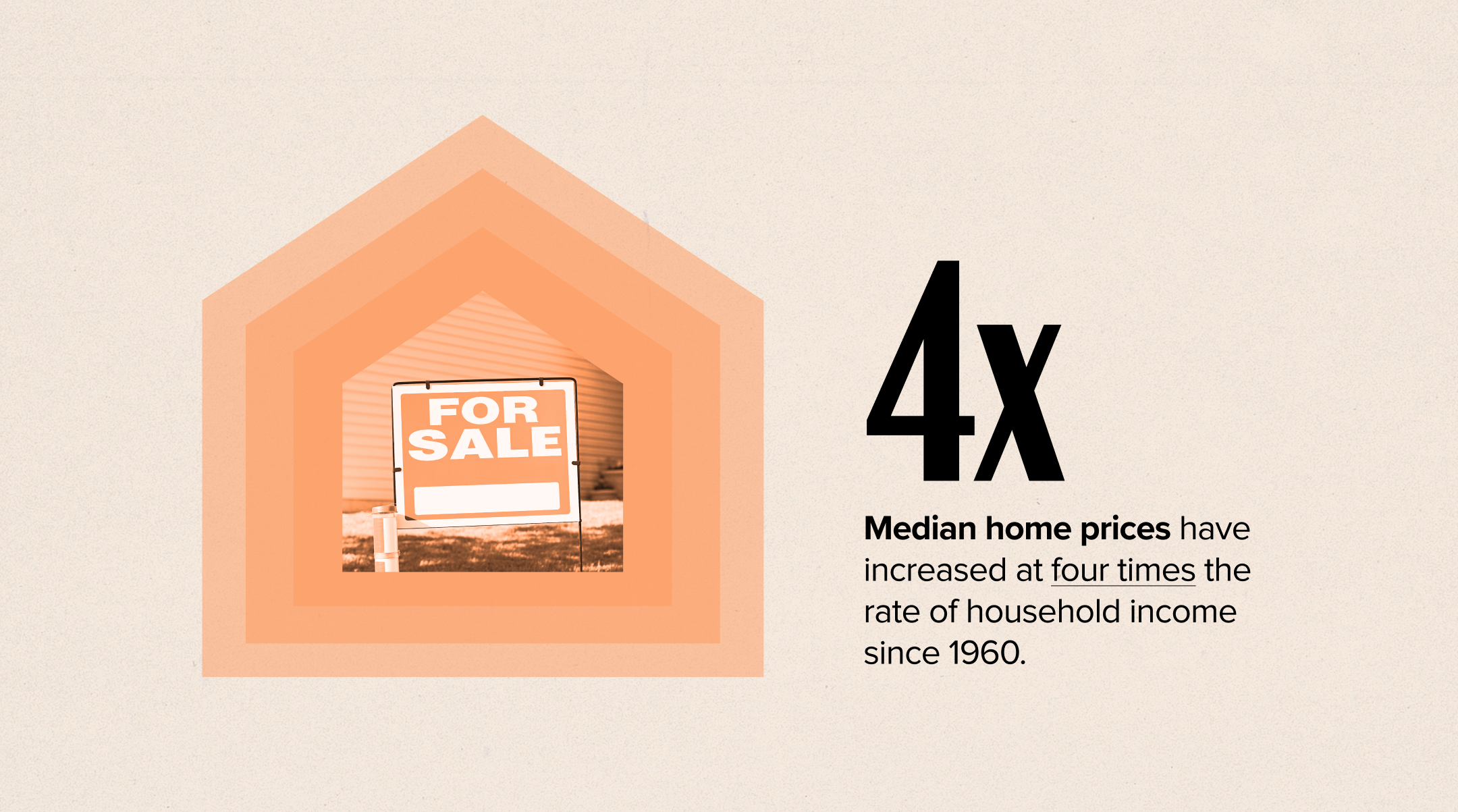
For the past 50 years, the costs of the most essential goods in our lives have risen too quickly relative to wages and remained too high. Renter cost-burden rates have been rising steadily since the 1970s, and median home prices have increased at four times the rate of household income since 1960. Inflation-adjusted out-of-pocket healthcare spending doubled between 1970 and 2023. Childcare costs have more than tripled since 1990, outpacing nearly every other family expense and far outpacing wage growth. The elderly and people with disabilities face further costs from the rising costs of medications, assistive technologies, and basic accessibility modifications needed to survive and fully participate in society.
Even as inflation cooled post-pandemic and the prices of consumer goods started to normalize, these key expenses continued to rise. The persistent strain of paying for essentials like medical care and housing makes it hard to enjoy the benefits of cheaper consumer goods. TVs may be less expensive than they used to be, but you can’t live inside a TV.
All the while, we’ve watched corporate profits continue to soar. The pandemic only exacerbated this trend: In 2021, corporate markups and profits reached their highest levels since the 1950s, and the money corporations brought in from those markups mainly enriched CEOs and wealthy shareholders.
This section focuses on expenses that have consistently risen faster than wages over a prolonged period and that make up a sizable chunk of most families’ budgets at some point in their lives—housing, medical care, childcare, higher education, and energy.
Surveys regularly show that Americans are most worried about these major costs. One January 2026 poll found that over half of respondents feel that the costs of housing and education have gotten so high that they have become unaffordable. Over 40 percent said the same about healthcare costs and the cost of supporting a family.
This is far from a comprehensive list of where and how the government should take action to lower and stabilize costs. Grocery prices, for instance, have become increasingly volatile, straining family budgets (and particularly squeezing low-income families). Meanwhile, the rise of surveillance pricing makes basic purchases feel like a battle to avoid being ripped off, as companies use increasingly detailed consumer information to squeeze us for every last dollar. If these price spikes were coming after a decade of strong income growth, families might be able to weather them. But although the labor market has improved in some respects since 2020, the preceding decades of stagnant wages and the very real fear of job loss in a low-hire economy mean that unpredictable costs contribute to a sense of deep anxiety.
It’s time to stop leaving the cost of essentials entirely at the mercy of markets, especially where markets fail. Here, we spotlight how muscular public-sector action—through industrial policies, public options, antimonopoly tools, and more—can help control costs. Importantly, these tools will do more for affordability with a Fed that takes seriously its dual mandate and successfully balances price stability and the steady, broad-based wage growth that comes from full employment.
It’s time to stop leaving the cost of essentials entirely at the mercy of markets, especially where markets fail.
Housing
The choice of where to live is one of the most important we make. Our homes determine where our children go to school, who our neighbors are, where we work, and where we plant roots. When we worry less about how much housing costs, we can make that choice based on what really matters to us.
A January 2026 poll found that across nearly every demographic group—with the exception of those over 65—people’s biggest affordability concern is housing. In 2024, one-third of households—half of renter households, and a quarter of homeowner households—were cost-burdened, spending more than 30 percent of their monthly income on housing. For Black and Hispanic households, those percentages are even higher.
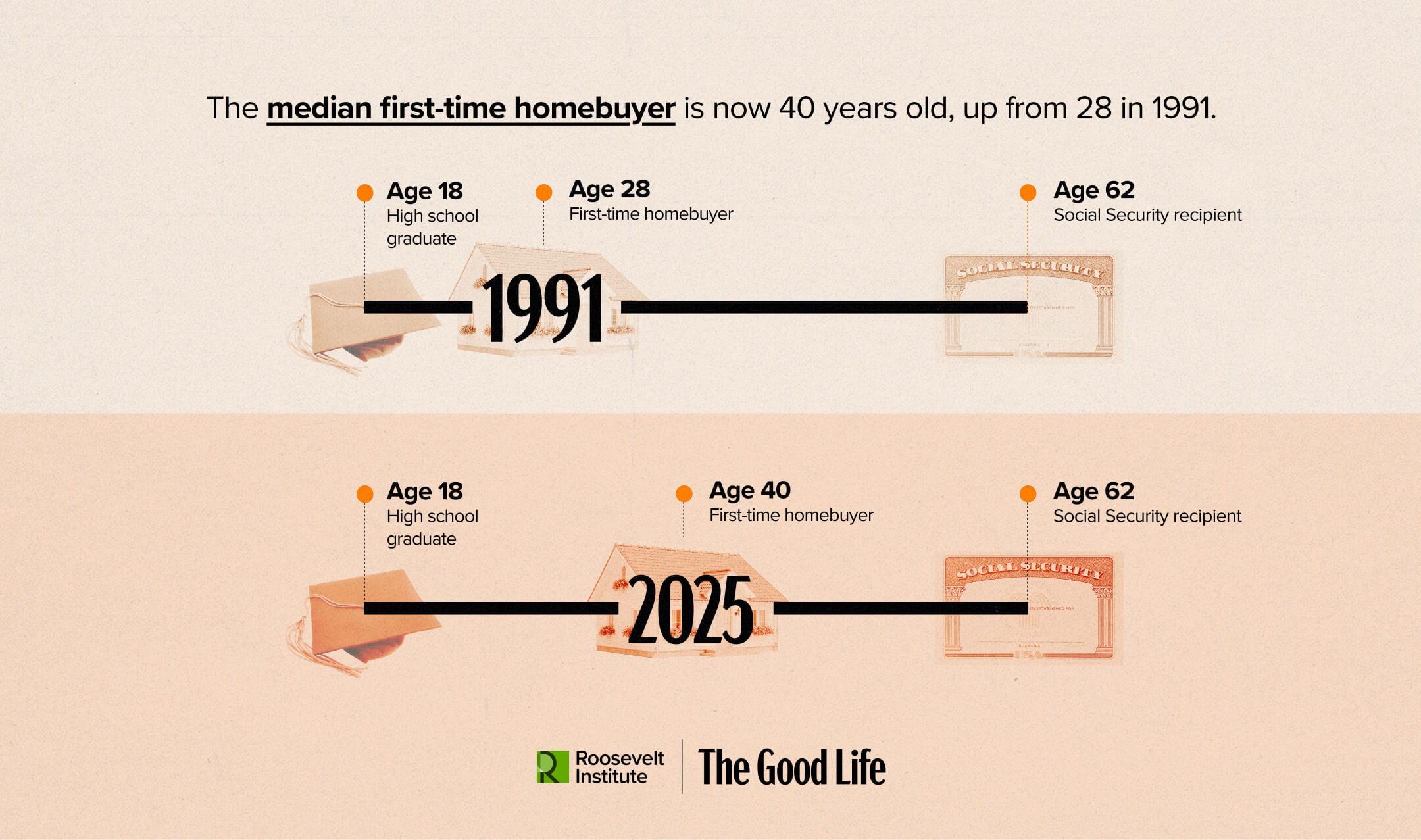
At the same time, the median first-time homebuyer is now 40 years old, up from 28 in 1991; one estimate suggests that those born in the 1990s will reach retirement with a homeownership rate nearly 10 percentage points lower than that of their parents’ generation.
And as homeowners and renters alike face unworkable costs, housing assistance wait lists grow longer, spilling into an ever-worsening homelessness crisis. The entire economy has suffered as a result. Without affordable housing in high-productivity cities, many workers can’t live in them, creating a spatial misallocation that economists estimate reduced GDP growth by over one-third between 1964 and 2009.
The solution to the housing crisis won’t be one silver bullet, but will require a broad slate of reforms, including:
- Industrial policy: Industrial policy can be creatively mobilized to address the supply crisis. For example:
- A national construction financing fund to stabilize housing production. Investment in housing construction follows national business cycles of expansion and recession, even when business cycles do not accurately reflect demand for housing (especially since housing construction is a time-consuming process). As financing for new housing construction gets more expensive, it becomes a bottleneck in expanding the housing supply. A national fund could back construction loans, driving a construction financing market that lowers the cost of building more affordable, multifamily buildings in particular. Smoothing construction across business cycles could also preserve jobs for construction workers during economic downturns.
- Federal subsidies leveraged to incentivize local zoning reform. Decades of research show that strict local zoning laws and land-use regulations limit construction. Policymakers could tie eligibility for competitively awarded federal infrastructure funds to states and localities that adopt pro-density zoning laws, incentivizing badly needed reforms that would make it easier to build out housing supply.
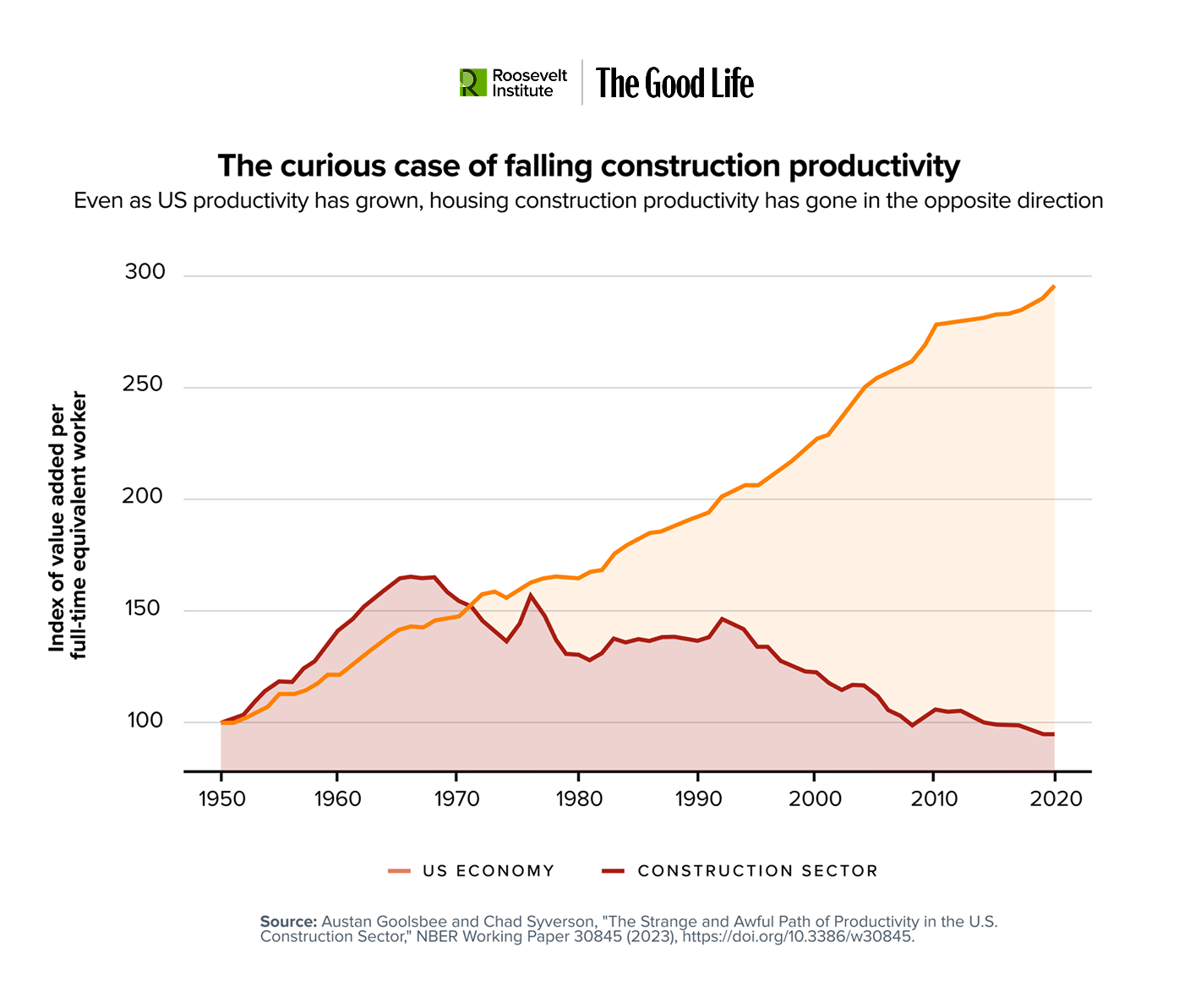
- Federal research funding to increase housing construction productivity. Construction productivity has declined relative to the rest of the US economy since the 1970s. Policymakers could deploy federal funding to support research on increasing productivity, including through innovation in new materials and construction methods.
- Countervailing power: Any exercise of industrial policy in the housing market must engage not only housing developers, but also labor and tenant unions:
- Tenant unions: Organized tenants can address affordability and quality issues at the site level and pressure policymakers to take broader action. In recent years, we’ve seen promising efforts to organize tenants in places like Kansas City.
- Construction unions: Construction unions can help ensure that federal investments lead to good jobs and are carried out by well-trained workers. Despite a persistent narrative that construction unions slow construction and drive up prices, evidence on this is mixed at best. Good local evidence shows that policymakers can engage labor in ways that both deliver on time, at-cost projects and build membership.
Importantly, even a better-functioning housing market—one fostered through active industrial policy, with empowered tenants and workers—will require other policy tools. For example, we’ll need not only more robust housing subsidies, but also public options for people who can’t afford housing at market prices and antimonopoly tools to ensure points of concentration in the housing industry don’t lead to exploitative pricing.
Housing in Montgomery County, MD
Since it became the first county to pass a mandatory inclusionary zoning law in the 1970s, Montgomery County, Maryland (just outside of Washington, DC) has led the charge in innovative, mixed-method housing reform. Most notably, in 2021, the county established the Housing Production Fund (HPF) via an initial $50 million municipal bond (later doubled to $100 million). This fund allows the county to build affordable housing without relying on scant federal subsidies, and at minimal cost to taxpayers.
The HPF is what’s called a revolving loan fund, because the money it loans to affordable housing projects is returned to the fund when projects are finished. During the construction phase of a project, the county’s Housing Opportunity Commission (HOC) uses the HPF to invest in projects as a majority owner. Once housing is built, the HOC finds permanent financing to replace its investment, freeing up the money for new projects while maintaining an ownership stake. Over the life of the bond, the HOC expects to produce around 6,000 new units, nearly a third of them affordable in perpetuity to renters earning around 50–65 percent of area median income.
In the past five years, the county has already used the fund to create high-quality, mixed-income public housing, where residents don’t have to worry about rent skyrocketing once private developers have fulfilled short-term affordable housing requirements.
Stable, inclusive housing is a win in its own right, but it has downstream effects, too. Economically integrated housing means economically integrated public schools, improving students’ academic outcomes. And mixed-age housing that accounts for the needs of people with disabilities is itself a form of long-term care.
Montgomery County’s ideas are gaining traction: In the past few years alone, dozens of cities and at least three states have established their own revolving loan funds for construction financing. A revolving loan fund at the national level could speed fair housing construction across the country.
Montgomery County isn’t a perfect model. It’s a high-income county with a lot of resources, and it continues to face a housing shortage. But it shows that, with willpower and creativity, local innovation can lead the way in addressing the housing crisis.
Our homes are more than where we sleep at night. With more affordable housing, we have not only more money to spend each month, but more time and agency: evenings spent at home with loved ones rather than on long commutes, the choice to live alone or with others, and communities built on lasting relationships with our neighbors.
Medical Costs
Affordable, high-quality healthcare is fundamental to a good life. Good health is strongly linked to higher earnings, increased happiness, social connection, and economic mobility. Unfortunately, the American healthcare system fails to deliver on its most basic duties.
There is perhaps no greater example of the limits of market-first ideology than America’s dysfunctional and fragmented healthcare system. The American healthcare system is far from a free market, but our system is full of policies that try to pretend it is. By approaching health services as commodities rather than rights and prioritizing corporate profit extraction over patient care, our policies have built a healthcare system riddled with consolidation and market power, perverse incentives, and a tangled web of financial interests among providers, insurers, and middlemen.
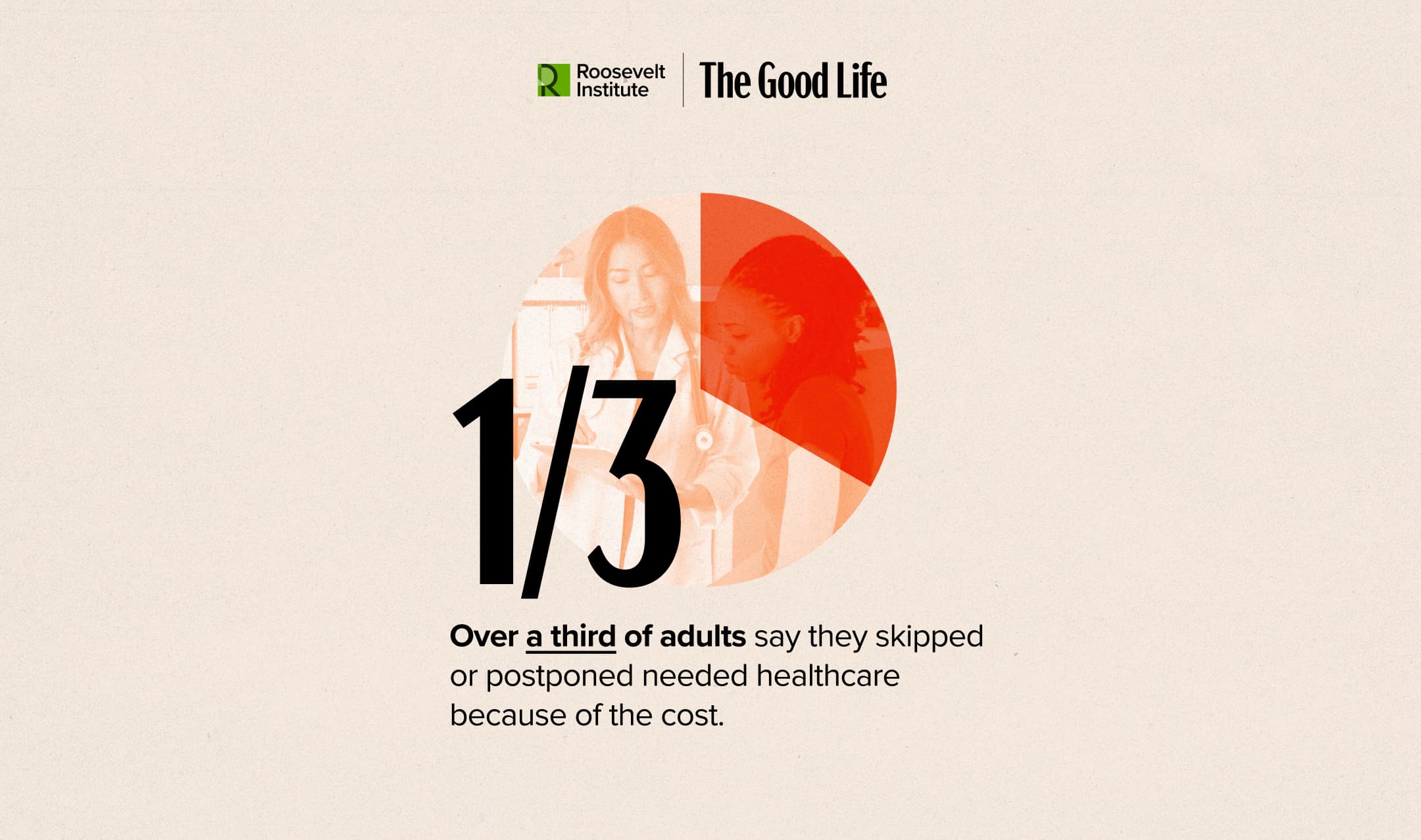
The consequences for the public are severe. A majority of Americans struggle to afford medical care and medications. Medical bills are a top financial worry and a leading cause of bankruptcy. In April 2026, over a third of adults said they had skipped or postponed needed healthcare because of the cost in the past 12 months. And in 2022, over 40 percent of adults, a disproportionate share of them Black and Hispanic, said they held medical or dental debt. Even for those with coverage, burdensome insurance processes, opaque pricing, profit-seeking middlemen, and a scarcity of primary care providers make it difficult to get needed care.
Comprehensively shifting how Americans get and pay for healthcare will require a coordinated slate of reforms to address the fundamental drivers of cost—an effort that will likely require deploying the full good-life policy toolbox. This includes but is not limited to:
- Antimonopoly policy: Barriers to horizontal and vertical integration, stronger merger reviews, and price regulation. The leading driver of rising insurance premiums is rising hospital prices, largely due to mergers that have allowed 21 percent of hospitals to effectively become monopolies. In addition to greater antitrust enforcement to address hospital consolidation, policymakers should seriously consider breaking up vertically integrated entities like UnitedHealth Group, where the roles of insurer, pharmacy benefit manager, and care provider are combined under a single corporate umbrella. In the absence of new legislation, agencies should conduct stronger merger reviews to confront rampant industry consolidation and the resulting conflicts of interest. Where consolidation and market power already exist, regulation can stop anticompetitive behavior. For example, Indiana passed a landmark law in 2025 requiring nonprofit hospitals to maintain average inpatient and outpatient prices at or below the statewide average or risk losing their valuable nonprofit tax status.
- Public options: Public health insurance and/or direct delivery. A public option for health insurance could drive down healthcare costs and offer an affordable alternative. Various iterations of public options are under consideration—from opening up Medicare to younger populations, to offering a public option to compete with plans on the Affordable Care Act marketplace, to moving toward a single-payer, Medicare for All system. Each of these proposals aims to create a viable coverage competitor to the private sector, forcing private insurers to lower premiums, reduce administrative waste, and negotiate better provider contracts. Less discussed but equally important, policymakers should also consider the ways a public option could deliver (not just finance) healthcare. For instance, policymakers could invest more resources into Federally Qualified Health Centers, community clinics, regional public hospitals, and Veterans Affairs–style networks—all of which serve essential functions in offering care, especially to vulnerable populations.
- Countervailing power: Patient organizing. The US has a rich history of patient organizing to reclaim power from a commercialized healthcare system. Groups like the AIDS Coalition to Unleash Power (ACT UP) successfully forced the Food and Drug Administration and National Institutes of Health to reform the drug approval process and give patients a role in research. Just this year, the Patients Union was established to build solidarity, support, and power among patients and others harmed by “healthcare delays, denials, debt, and impossible choices.” Public policy expanding access to healthcare should deliberately foster the building of membership organizations as a long-term counterweight to corporate power in the medical industry, ensuring that the healthcare ecosystem can finally be held accountable for delivering affordable, high-quality care.
Despite spending significantly more on healthcare compared to our counterparts, the US has among the lowest life expectancy among peer nations, the highest death rates for avoidable or treatable conditions, and the worst maternal and infant mortality rates. We can’t ensure a good life for all as long as we allow dismal statistics like these to persist.
Childcare
Decades of studies show that stable, high-quality childcare is good for children and their parents, whether those parents are in the workforce (69 percent of households with children have all parents in the paid workforce) or stay home with their children.
Yet on average, childcare costs more than housing for most families in the country. In all 50 states plus Washington, DC, the price of center-based care for two children exceeded average annual rent payments. In every state, families making the median income are paying far more for care than the threshold the US Department of Health and Human Services defines as unaffordable, with childcare costs exceeding 7 percent of income. The problem of finding affordable childcare persists after children enter school, as parents must scramble to cover summers, after-school hours, and holidays.
The price of care has driven many women fully out of the workforce. Indeed, it is difficult to estimate the true extent of the childcare affordability crisis in part because low-income families, often unable to afford care at all, must reduce their work hours rather than pay for care. Sociologist Jessica Calarco found that only 7 percent of stay-at-home moms had household incomes over $100,000, a full 75 percent of them lived in households with yearly incomes under $50,000, and half had yearly household incomes under $25,000. It is therefore not surprising that 70 percent of stay-at-home parents said they would take up more paid work if more affordable childcare was available.
And even families with stay-at-home parents need some amount of external care. There are demands on full-time caregivers’ time outside of the care they provide—including, in many cases, some paid work—just as there are life demands on full-time paid employees’ time. A 2024 survey by Capita found that the majority of stay-at-home parents needed external childcare several times each month, and a full third reported needing external childcare weekly or daily.
As Treasury Secretary Janet Yellen said, childcare, like medical care, is a classic example of a market failure. The cost of childcare is driven by staff pay, but the people we pay to watch our youngest children typically make some of the lowest wages in the workforce. About 20 percent of childcare workers are immigrants, and the vast majority are women, making this workforce especially vulnerable to exploitation. Margins are small despite low wages, and operation costs are high, especially for infant and toddler care, where the staff-child ratio must be much lower for obvious safety and quality reasons. Meanwhile, raising prices to raise wages or profits is impossible for most childcare providers because current costs are already bleeding families dry. As a result, staff turnover is high, and there are not enough childcare slots to meet demand in many regions of the country.
The only way to solve this Gordian knot and build a functional universal childcare system is through sustained and significant public investment. A universal, public option for childcare would give parents and their children access to the care they need while ensuring workers make a family-sustaining wage. It would also provide important competition to the private-equity backed childcare centers that are increasingly consolidating power in the industry. A universal program should also be structured with tools that intentionally build countervailing power among workers and parents; indeed, Head Start already does this through collective bargaining with staff at many sites (represented by the American Federation of Teachers, the Service Employees International Union, and other locals like District Council 37 in New York City) as well as designated parent committees for oversight.
The build-out of a universal public option must follow some key principles to ensure it is creating the conditions for families and workers to build good lives:
- Care must be free or available for a nominal base fee (e.g., $10/day) for all families.
- Care must be offered universally.
- The system must be streamlined to support implementation and expansion.
- Workers must be paid fairly and have a path toward union representation. (The payment model in the system must support the true cost of care.)
- The system must emphasize inclusive and culturally competent care.
- Care must be safe and high-quality.
- Any new system must be implemented with plans to justly transition the current workforce into a new comprehensive system that includes a pathway to a union.
While this report does not go into depth on other parts of the care economy, a public option for long-term care for the elderly and people with disabilities and chronic conditions is also an essential component of a good life agenda. Many of the same market failures that define the childcare industry also define the long-term care industry, failing both consumers and workers. Further, many of the same families struggling with childcare also struggle to afford long-term care. An estimated quarter of US adults are part of the “sandwich generation,” caring for aging parents and young children at the same time.
Currently, Medicaid is the largest insurer of long-term care. Fifty-eight percent of Americans incorrectly believe that Medicare covers long-term care, when Medicare actually only has limited and short-term coverage for ongoing care needs. Because Medicaid is the dominant insurer, people who need long-term care often must impoverish themselves to receive it, or are surprised to find they do not qualify for it when they begin needing care. This is not a sustainable option.
Building straightforward and universal public care options has an added benefit: By eliminating the complicated and expensive administrative obstacles that define the current care economy, we can turn a consistent pain point into a more positive touchpoint with government.
Higher Education
As they manage the logistics and expenses of caring for young children and elderly parents, many parents must also begin thinking about and saving for what comes after their children’s graduation. A good life requires having choices, and the choice to pursue higher education—one which not everyone will make—should not require two generations of long-term financial planning.
While higher education can be the right decision for many, years of studies show that wages stagnated for decades even as employers’ demand for degrees rose. At the same time, average tuition at both public and private four-year institutions nearly doubled between 1995 and 2025, even after accounting for inflation. Simultaneously, beginning in the 1990s, for-profit college enrollment skyrocketed under a business model that preyed on students through aggressive recruiting tactics, siphoned their federal aid, and left them with high levels of debt (and often, no degree). This process intersected with the Great Recession to drive up millennial student debt rates so that in 2024, years after most graduated from college, millennials still held almost 40 percent of all outstanding student loan debt. Soon, many millennials still paying down their own student loans will start to see their children enter the cycle themselves.
Millennials’ large student debt load drove a movement for mass student loan cancellation that ultimately reached the Supreme Court, which struck down the Biden administration’s attempt to meet this popular demand. But student debt cancellation was only ever one small part of the policy solution required. A functional higher-education system requires deploying a range of good-life governing tools:
- Public option: A free college system. Establishing a free college option is essential long-term. The federal government must begin by investing in tuition-free public institutions. Such an investment could take many forms, from state partnerships to direct federal provisioning to a radically expanded public grant system. Public options for higher education must include technical and community colleges, where for-profit institutions also take advantage of students, alongside four-year institutions. These investments should also include public funding for registered apprenticeships and partnerships that preserve wage standards and worker voice.
- Industrial policy: Oversight boards. As long as government-backed student loans and grants are helping fund higher education, policymakers should create oversight boards to set strict rules about what colleges and universities can charge. Funding requirements should also limit the power of wealthy trustees, who can pose as much of a threat to free speech on campus as federal actions. These kinds of guardrails are common in other industries that receive government investment and can ensure that public funding does not end up lining the pockets of exploitative for-profit higher education institutions.
- Countervailing power: Empowering student and faculty stakeholders. New federal funding streams can provide a counterweight to the power of trustees by incentivizing engagement and organizing by a wide variety of stakeholders in university governance, from students to faculty.
In recent years, the Trump administration and state governments have weaponized public higher education funding to exert control over curriculum and speech at universities. Yet there is no way to build a more permanently accessible system without public funding. We must consider how to use such funding to make our institutions more resilient to attacks on free speech, so they can serve their primary functions—educating young people, training future workers, and producing critical research—without fear of private or state coercion. And higher education institutions must be accessible to everyone, not just the elite and their children, in order to truly serve those functions.
Energy
When families are planning their budgets, they shouldn’t have to choose between heating a home, filling a gas tank, or putting food on the table. And yet that’s what our current energy policies, and our overreliance on volatile fossil fuels, have forced some to do.
Energy cost shocks are unusually difficult to absorb because families have almost no ability to adjust their usage patterns, meaning energy costs pass almost undiluted to family budgets. Most Americans drive to work, and often have no other option. Few parts of the country have significant mass transit infrastructure, and the lack of affordable housing, particularly in cities, means the average one-way commute time is nearly 30 minutes.
As many of our international peers show us, it doesn’t have to be this way. US energy policy is a global outlier: We have a large domestic fossil fuel sector, but minimal state involvement. As a result, even as the US produces more oil and gas than any other country in the world, it generates less public income and does less to manage domestic costs than its energy-rich peers. As Americans have witnessed in Russia’s invasion of Ukraine and the Hormuz crisis this year, domestic oil production does not prevent spikes in American gas prices. The price families pay at the pump is set on a global market, whether they are filling their tanks with gas from Alaska or Azerbaijan. And there is little that government can do to compel more production in a turbulent fossil fuel sector that acts on behalf of shareholders.
While oil drives the most dramatic energy shocks, the broader energy picture was already worrisome before the latest international crisis. Cost pressures in the energy sector aren’t going anywhere. Wildfires, extreme weather, and aging infrastructure are raising the cost of maintaining a reliable electric grid, while the growth of the US liquefied natural gas export industry has begun putting upward pressure on electricity and natural gas heating rates. And data centers are already beginning to spike US electricity demand, with wide-ranging projections and few concrete plans for meeting future energy use needs.
Yet for all the complexities of the energy sector, the solutions to energy cost shocks in the long run are straightforward in practice. The United States must produce more energy domestically, and it must be in forms that limit negative climate impacts and are protected from the shocks that come from global politics. If policymakers make full use of the governing tools available to them, a wide range of policies can effectively move such an agenda forward:
- Industrial policy: Public funding for clean energy technology. The US has so much potential energy production that industrial policies can have outsize benefits. Public funding to encourage the development and scaling of clean energy technologies will generate lower and more predictable costs for families alongside better-paying and more stable jobs. Because these technologies are not subject to fuel cost shocks, they can both reduce energy prices and make those prices less vulnerable to global events. While we grow clean energy, we can also invest in and actively manage US energy storage to stabilize domestic prices against global shocks.
- Public options: A public stake in domestic fuel production. As long as fossil fuel production remains a part of our energy policy, policymakers should seriously consider how to publicly manage the industry to more directly benefit Americans. By following the lead of countries like Norway and taking a significant stake in domestic fuel production, the US could stabilize prices and wind down its reliance on fossil fuels while maintaining production capacity necessary to shape markets and national security. At the same time, taking such a stake would ensure that the returns on energy profits would be broadly shared.
- Antimonopoly policy: Utility regulation. In an era of growing electricity demand, policymakers should consider the full range of antimonopoly tools to regulate utilities that control access to electricity. For example, federal as well as state regulators should use their authorities to reconsider the rate of return that utilities receive for capital expenditures to reduce those returns closer to the cost of capital. Further, utilities should be compensated not just for total capital expenditures but for investments that lower consumer costs by improving performance, and integrating diverse transmission technologies and sources of energy. The federal government should also be very skeptical of mergers that further consolidate utilities. Additionally, utilities that own power lines and generate electricity can too easily exert monopoly power by expanding their regulated electricity distribution monopolies to advantage the unregulated power plants they own. Breaking these functions up completely offers a path to a more efficient, cleaner, and more competitive electric system at lower cost.
These are just a few examples of how a new governing tool kit could lower energy costs in the short and long term. Energy conservation, management, and generation are complementary to each other: Stabilizing energy costs, and building an energy grid that can withstand current and future demands, will require them all. With a stable, sustainable energy grid, families will not have to budget for global upheaval they have no way of predicting, and future generations will be in safer hands.

Boosting Incomes Throughout Our Lives
If we want to ensure stability and raise incomes, our policymakers must also account for what FDR famously called the “hazards and vicissitudes of life.” Markets rise and fall. Families face illness and unexpected costs. Economic security has to include times when work is not possible.
A Fair Labor Market
Workers’ ability to get a good job depends not only on their skills or effort, but on the labor market they find themselves in. We should be able to choose jobs that work for us, not have to fight for a toehold in any job at all.
Under the neoliberal paradigm, policymakers often assumed they were governing a labor market where workers and employers were on an equal playing field, experiencing perfect competition. Now we know that workers and employers do not meet as equals; concentrated power among employers gives them a structural advantage. To maximize workers’ agency in the labor market, policymakers need to use a range of policy tools to level the playing field and set baselines across industries and employers. Unfortunately, they’ve left a lot on the table, and both public policies and corporate practices have suppressed workers’ wages in the US for decades. Too infrequent periods of tight labor markets have produced real gains, but not enough to offset decades of wage stagnation and rising essential costs.
Effectively deploying a good-life tool kit can reset workers’ experience and expectations in the labor market:
- Monetary policy: Full employment. Prioritizing full employment is the most successful approach to raising incomes. Workers not only earn higher wages when the labor market is competitive and full employment holds, but they can also find jobs that better fit their skills and needs, making workers and the businesses that employ them more productive and fueling economic growth.
- Antimonopsony policy: Minimum wage and overtime laws. Instead of allowing employers to compete by driving pay below a decent standard of living, these policies set a national floor and push business models toward greater productivity, higher retention, and higher-quality jobs. Because only 1 percent of hourly workers earn at (or below) the federal minimum wage of $7.25 per hour, unchanged since 2009, it no longer functions as a meaningful floor. As a result, employers can set wages woefully short of what is necessary for workers to maintain a minimum standard of living. Congress should set a national wage floor closer to a living wage for the typical single worker without children, making the final steps from a federal minimum wage to a living wage less of a leap and ultimately more achievable for state legislators, workers, and unions across the US. That means a minimum wage of at least $20 per hour in 2030 and set to keep rising. Policymakers should reinforce this increase by eliminating subminimum wages for certain disabled and tipped workers, as well as by raising and then regularly updating overtime salary thresholds. (The following section discusses overtime laws at more length.)
- Public option and taxes: Public healthcare, retirement savings options, and portable benefits. The US is relatively unusual in encouraging workers to access both a secure retirement and healthcare through their employers. Tax incentives encourage this pattern, which at best reduces employee mobility and, worse, in our increasingly fissured and gigified economy, limits many workers’ access to these benefits. Creating public retirement savings and healthcare options (both discussed further in other sections) or encouraging the funding of portable benefits through the tax code could set a baseline of security for workers, allowing them more freedom of movement in the labor market.
Other public options could also play a key role in shaping the labor market. For instance, building national employment programs and national service pathways could address youth unemployment and worker displacement.
Worker Power
The best jobs are ones that give us not just economic security but a say in how and under what conditions we do our work. Historically, unions have been the most effective pathways to these quality jobs, raising wages, improving benefits, reducing inequality, and strengthening workplace safety.
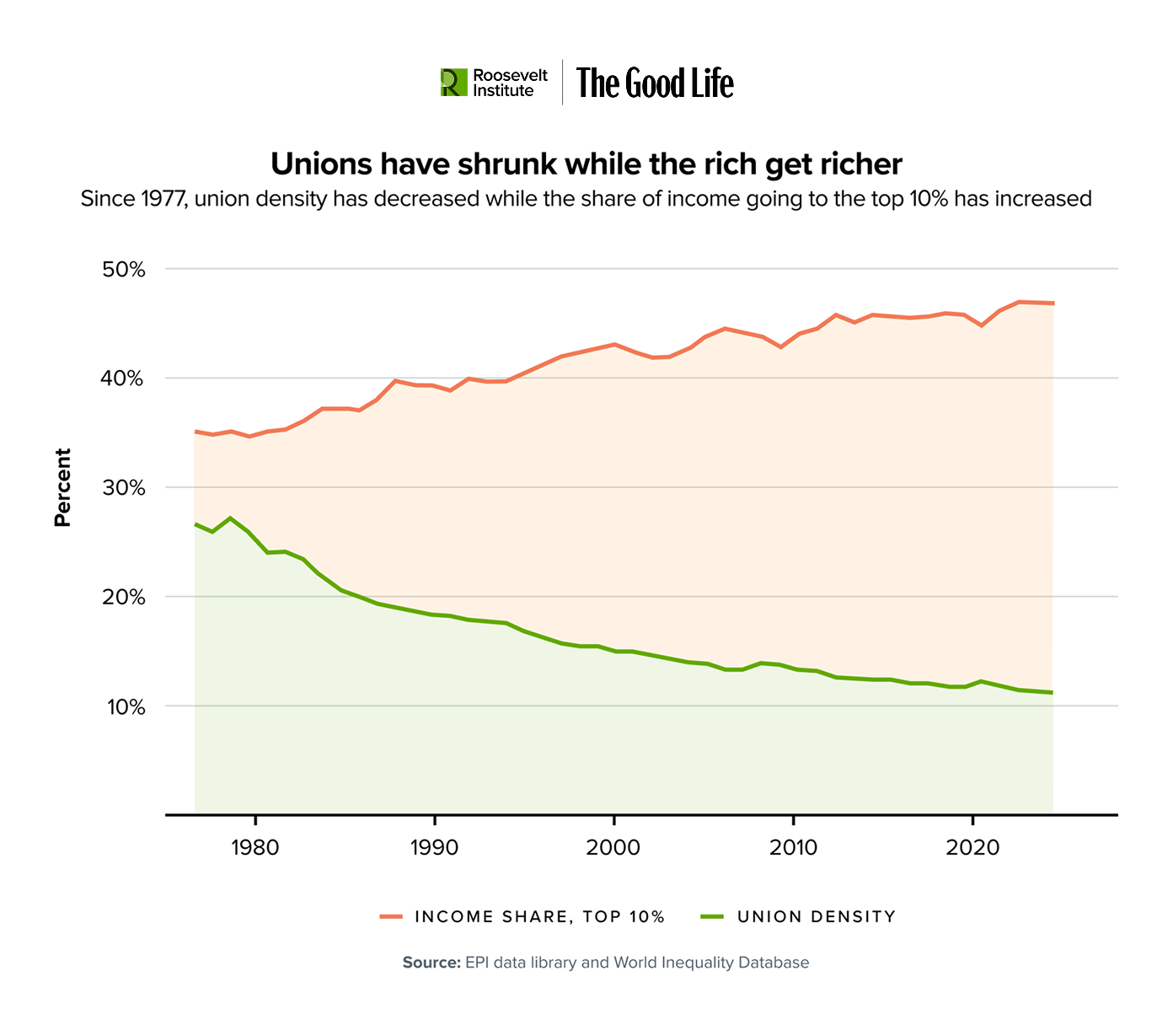
It’s a policy failure, then, that despite historically high public support for unions, less than 6 percent of private-sector workers now belong to one—the result of a half-century of weakening the laws that support labor organizing. All the while, public-sector collective bargaining rights are uneven across states, due to legal restrictions on organizing and persistent attacks by federal leaders.
The election-and-litigation model administered by the National Labor Relations Board (NLRB) was not built for today’s market structure. Workers now organize in markets defined by concentrated firms with extreme power in the labor market. Further, today’s labor market is shaped by part-time and gig work mediated by emerging technologies that weaken workers’ leverage and complicate traditional bargaining. Even when workers win union elections—often facing retaliation and obstruction—many struggle to secure a first contract. Policymakers should take immediate steps to strengthen penalties and streamline elections within the existing structures of our labor law. But these moves will not, on their own, rebalance power as needed, especially at a moment when the independence and effectiveness of the NLRB have been systematically eroded.
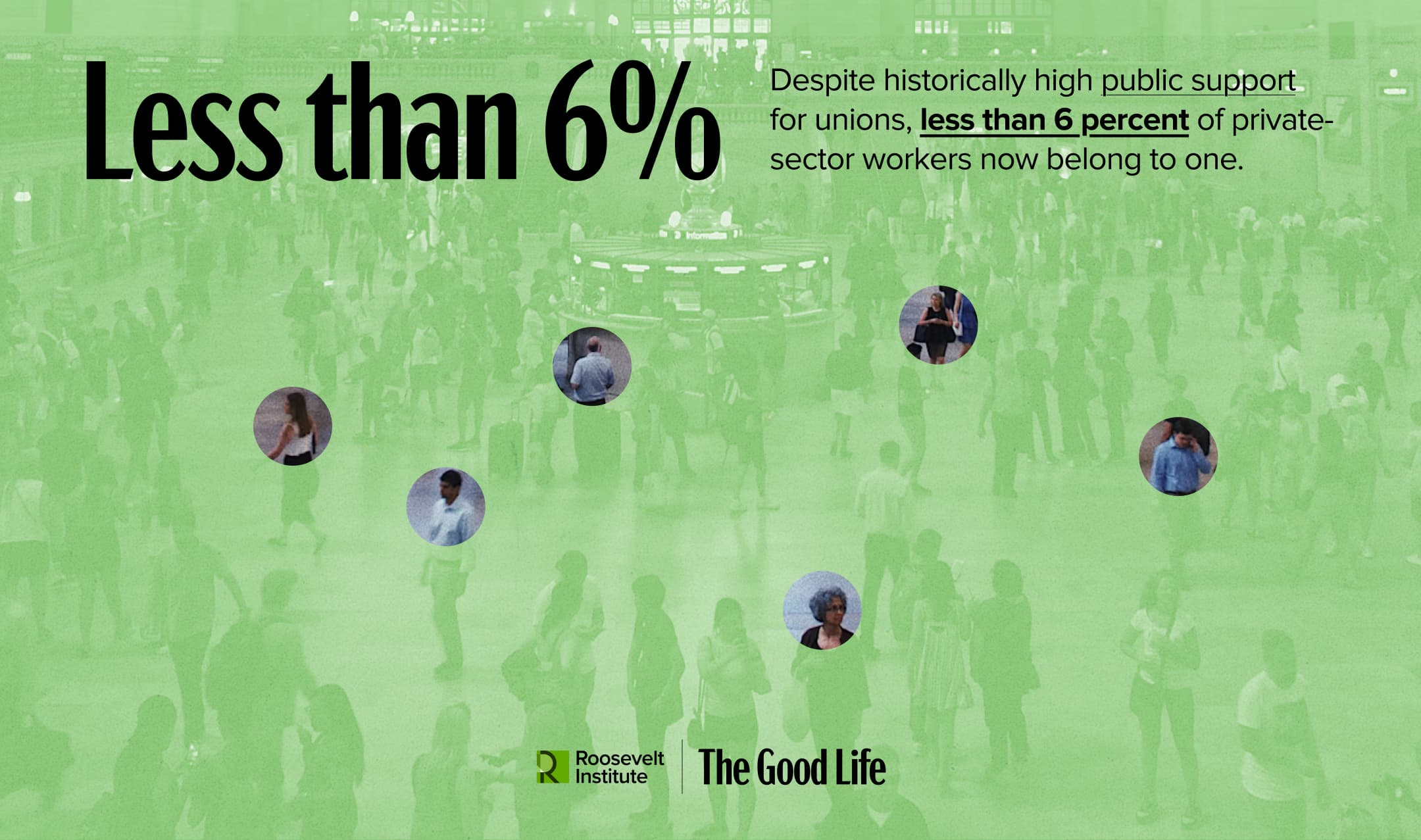
We should do everything we can to support worker organizing and ensure every worker has a real path to collective bargaining, rebuilding that countervailing power. The goal shouldn’t be to recreate an imperfect past. Even at its peak, when roughly one-third of private-sector workers were union members, the US lagged peer nations in collective bargaining coverage. We need a bargaining framework suited to our modern markets, shaped by these tools:
- Countervailing power: Sectoral bargaining laws. Reimagining labor law more expansively requires expanding bargaining beyond individual workplaces. Sectoral bargaining policies allow workers, including those outside of traditional employment (such as workers on digital platforms), to set baseline labor standards. These standards lower the incentive for firms to cut wages or undermine working conditions in order to compete. Effective designs build worker power, rather than simply acting as advisory wage boards detached from organizing. These laws should also be crafted to allow workers to bargain across sectors over shared concerns, including the use of AI, workplace surveillance, and other technologies that now shape jobs across the economy.
- Antimonopoly and antimonopsony policies: A ban on employer practices that distort labor markets. We have ample evidence that increasingly concentrated corporate power in labor markets weakens workers’ wages, agency, and ability to organize. When a small number of companies control a sector, firms can trap workers with opaque pay, restrictive contracts, fissured employment, and other deliberate attempts to reduce worker power. In addition to using enforcement tools to encourage competition within sectors, policymakers should deploy bright-line tools that push back on these coercive corporate practices. For example, federal agencies should clarify enforcement standards that prevent misclassification in fissured industries. Lawmakers should eliminate noncompete agreements and similar restrictive agreements that trap workers in place, along with pay secrecy practices, all of which keep workers from moving to better jobs and bargaining on an equal footing. In addition, eliminating mandatory arbitration and strengthening private rights of action would make rights usable in practice.
As corporate power has risen and unionization fallen, the gap between rights on paper and bargaining power in reality has widened. Policymakers need to creatively expand workers’ formal rights, deploying tools from across a good-life governing toolbox, but regulators must also immediately strengthen labor law enforcement. Biden-era coordination between the NLRB, the Federal Trade Commission (FTC), and other agencies shows that parts of this agenda can move quickly when policymakers across government prioritize building workers’ labor market power.
Addressing the Challenges of AI
There is real uncertainty about how AI will impact the labor market. Some economists see a sweeping transformation, while others expect a slower adjustment. No matter how large the disruption turns out to be, history shows that even when employment recovers from shocks, workers caught in a transition often experience long-term income loss and instability.
The possibility of significant AI impacts on the labor market makes the good-life income agenda all the more pressing. If workers are to benefit from this technological transition, baseline policy conditions for a healthy labor market are a prerequisite, but they’re also insufficient.
Employers decide whether to use AI to augment labor, supervise performance, or eliminate roles entirely. Over the past several decades, many firms have used new technologies to intensify monitoring, discipline workers without transparency, and weaken bargaining leverage. AI can accelerate those patterns if policymakers fail to act.
To combat this trend, workers should have a real seat at the table when employers introduce AI systems. Worker protections should include aspects like notice when AI tools change job duties, and a right to an explanation and mechanisms to challenge the outcomes if AI influences hiring, pay, or discipline. A broader response should also include limits on surveillance and data collection and accountability for discriminatory outcomes. These rights should apply even if workers don’t belong to a union. But it is critical that workers be able to bargain over how AI is introduced and used on the job.
Yet, even under a well-governed system, some workers will lose jobs during this transition. Congress should establish AI adjustment insurance, modeled in part on Trade Adjustment Assistance. However, TAA was often too narrowly targeted and too dependent on long retraining periods. A better approach would deliver faster income protection and optional high-quality training, with real mobility assistance for those engaged. This could be combined with a digital-sector tax to fund transitional income for those who don’t qualify for unemployment insurance and wage insurance for those who come back to work at lower pay.
When disruption hits a region or occupation, policymakers should also be prepared to create direct public job pathways tied to care, climate resilience, public health, and community modernization to ensure that AI-generated wealth supports the public good.
Policymakers should also consider a national service pathway aligned with technological transition. Such a structured service program could place young people and displaced workers in community-led projects centered around infrastructure development or public-interest technology roles. The program would create a new civic bridge between school and long-term employment that converts a period of transition into an investment in democratic life.
The point is not to slow technological progress, but to govern it so that productivity growth strengthens worker power rather than widening inequality.
Story from the Field: Facing AI Challenges in the Fashion Industry


In 2023, Taiwanese-American fashion model Shereen Wu walked an LA runway for designer Michael Costello, working for free in exchange for visibility, as many young models do. Then AI literally entered the picture—changing everything.
After the show, Costello posted a photo of Wu’s body, digitally altering her face to appear as a white woman. As Wu put it in a piece she wrote for Fast Company, “With a single swipe, he erased not just my identity but the hours of work invested by the makeup artist, hair stylist, photographer, and me.”
Wu is now part of the Workers Council at the Model Alliance, an organization that advocates for fashion workers’ rights through legislation and sectoral bargaining—a kind of collective bargaining that sets wages, benefits, and standards for all workers in an industry, unionized or not. In 2024, the alliance championed the Fashion Workers Act (FWA), New York state legislation that regulates model management companies and provides additional protections for models considered independent contractors. The FWA was enacted in 2025, and one of its key provisions established models’ ownership of any digital replicas of their image and likeness when working in New York; it requires clear, written consent for the creation or alteration of digital replicas and explicitly prevents agencies from holding power of attorney over a model’s digital replica.
Madisyn Ritland, a former model and filmmaker who also works with the Model Alliance, says that preventing agencies from holding power of attorney over digital replicas and models themselves would have made a huge difference in her modeling career. “A major agency’s CFO told me that there was ‘no way’ I’d understand my contract and that I should ‘just sign it’ without reading it,” she said. “I ended up signing after added pressure from other agents and threats of dropping me. I didn’t realize that contract gave them power of attorney and stripped me of significant control over my own work.”
Now Ritland is working to ensure the FWA works by engaging with other models, ensuring they understand their rights, and providing support to hold industry power to account. “At the time, I didn’t have the language or support to name and stand up against the exploitation I was facing on the job. I stayed silent when I was with other professional models. But now that we’ve won the legal protections we’ve been fighting for, I’m organizing with fashion professionals so the workers today know their rights and don’t have to put up with harassment, abuse, or coercion to sign away control of their image.”
The fashion industry is not the first to struggle with the power of AI—and it certainly won’t be the last. The labor market fallout from AI isn’t about technology so much as it is about power. Policies that promote transparency in industry practices and place more decision-making power in workers’ hands are essential.
Social Security
We should all have the ability to retire with dignity, without fear that our savings could run out if we have the privilege to grow old. And people with disabilities should have access to both economic security and real choices, including the ability to save money or get married without fear of losing benefits.
Before Social Security, retirement security was nearly unheard-of for working-class Americans, with most nonworking elderly adults dependent on others for support. Since the passage of the Social Security Act of 1935, the program has formed the foundation of retirement and disability security in the United States. Formally known as Old-Age, Survivors, and Disability Insurance (OASDI), the program provides monthly benefits to retired workers, surviving family members, and workers who become disabled. Its reach is nearly universal. The overwhelming majority of retirees earn income through Social Security. Without Social Security benefits, roughly 37 percent of adults age 65 and older would fall below the poverty line. As such, Social Security is probably America’s best-known public option.
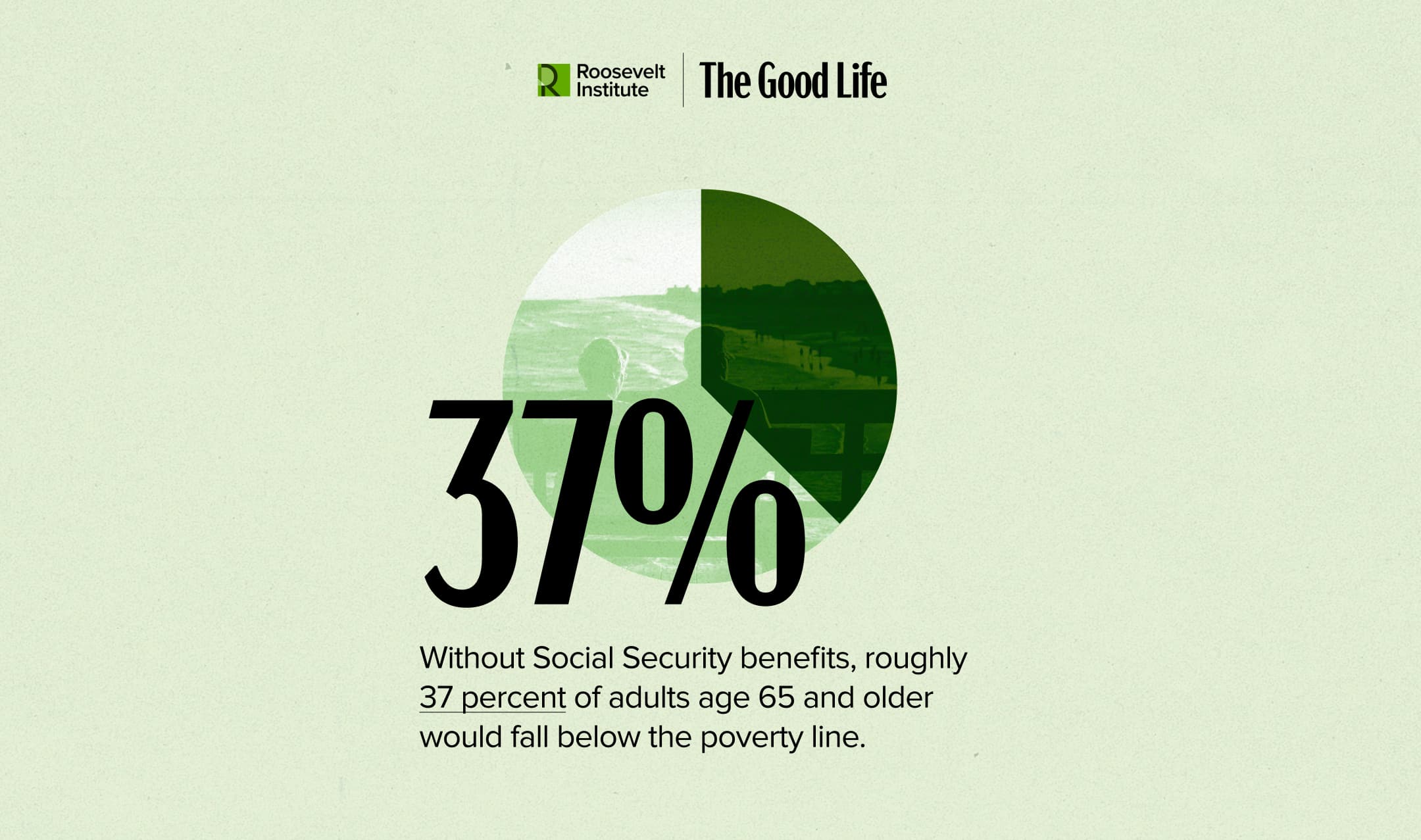
Alongside Social Security, the Supplemental Security Income (SSI) program provides an income floor for older adults and people with disabilities. Yet most SSI recipients live below the poverty line, based on program design choices that have failed to keep up with economic reality.
Put together, these programs represent what should be a core democratic promise: that aging or developing a disability should not mean destitution. But that promise now faces two related challenges.
First, due in large part to growing wage inequality and the economic stagnation following the Great Recession, Social Security’s Old-Age and Survivors Insurance trust fund is projected to face reserve depletion in the early 2030s unless Congress takes action. This is an important reminder that the successful use of monetary policy tools impacts critical public options. If Congress does nothing, incoming payroll tax revenue would still cover a substantial share of benefits, but automatic cuts would materially harm current and future beneficiaries.
Second, the Social Security Administration (SSA) has endured years of underinvestment and, more recently, political attacks on its staffing and operations. Staffing shortages and service delays have weakened public trust. The response, however, should not be privatization. A well-funded SSA should build trust in government and serve as a model of what competent public administration can deliver: reliable service to tens of millions of Americans.
We need to address Social Security’s finances now, well before reserve depletion approaches. And we should see it as an opportunity to reaffirm a few key principles that have always defined the program:
- Social Security benefits are progressive. While Social Security is and was designed as social insurance, with workers and employers contributing through payroll taxes and earning a defined benefit in retirement, the benefit has always replaced a higher share of income for lower-wage workers. The program thus pools risk within and across generations.
- Social Security is a guarantee. The fact that workers receive a defined benefit from Social Security, one that is even tied to inflation, makes it meaningfully different from most retirement income, which fluctuates with market returns. Workers don’t have to worry that the benefit won’t be there or that it might be worth less than expected.
- Social Security is a broadly shared and easily accessible benefit. Social Security is not a universal benefit, but it also doesn’t require jumping through the hoops that so many other government benefits do, nor does it carry the stigma others do. Indeed, because the vast majority of workers are automatically enrolled, its very structure has helped build countervailing power by encouraging seniors to organize to defend it.
We have to refresh Social Security for the modern age as well, updating what the program considers work and how it approaches today’s labor markets. Doing so can further expand its reach and bring it closer to universality. For example, millions of Americans leave the labor market every year to temporarily care for children, aging parents, or family members with disabilities. Those caregiving years can reduce lifetime earnings, which then lowers retirement benefits. A modern Social Security system should credit caregiving toward benefit calculations, recognizing this unpaid labor as socially valuable work.
Policymakers must also modernize SSI in the near term. Benefits are too low, the program’s asset limits are outdated, and in-kind support rules penalize families who get community support. If SSI is to function as a true floor beneath Social Security, it must provide adequate support for older adults and people with disabilities.
There’s a reason Social Security is one of the most broadly supported public programs in the country. The program’s progressivity and defined benefits have protected families for nearly a century. That popularity is a reminder that when our government delivers tangible economic security at scale, it strengthens public trust. Strengthening the program will preserve its promise for decades to come.
Story from the Field: Retirement Security
Retirement Security: Guaranteeing Long-Term Dignity
Based on interviews from The People Say, a public-interest platform sharing older adults’ perspectives on policy. Full-width video links here: Jennifer, Debbie
In video testimonials shared with The People Say, an online research hub covering the issues that matter most to older Americans, many seniors think about the impact of Social Security and what could be done to expand its effectiveness.
Debbie, a Social Security recipient from urban Louisiana, has spent her life in demanding and unconventional jobs. According to her, she became the first female tire mechanic in the state and the first woman to work as a glazer on high-rise buildings, jobs she worked despite the pushback she received from her mostly male coworkers.
Today, around age 70, she’s still deeply active in her community, volunteering, mentoring young people, and participating in civic and political organizations. She does all of this while managing serious health challenges and the everyday responsibilities that come with keeping up her home.
Social Security provides the stability that allows Debbie to live independently and remain involved in her community. For her, the program is the furthest thing from a handout. It more closely resembles a long-overdue recognition of the decades of labor she put in.
“The people who are getting Social Security . . . earned this. We earned it,” she says.
But Social Security was never meant to be retirees’ only source of income. In addition to modernizing and expanding Social Security benefits, policymakers should ensure seniors have access to better retirement options to supplement Social Security.
Jennifer works with an elderly community in rural South Dakota, helping seniors who live alone or far from family with everyday needs such as groceries, medical appointments, and bills. Many of the people she works with live on farms or in small towns, sometimes miles from the nearest store or doctor, and she helps them navigate the day-to-day challenges that come with that distance and isolation. But without other retirement savings and support from family and neighbors, most of the rural seniors Jennifer works with struggle to afford the basics. “Trying to live on Social Security [alone] is impossible. If they don’t have private savings or haven’t accessed all the social networks that’s available, it’s bad, because we don’t have the resources [of] bigger communities.”
“People should be able to retire with dignity and not worry about paying this bill and having power turned off, or pay this bill and not have a phone,” says Jennifer. “If you’ve worked your whole life, you should have the expectation of being able to live a comfortable retirement.”
Private Retirement Savings: Pensions and 401(k)s
Social Security provides a stable foundation of retirement security in the United States, but it was never meant to be the entirety of retirees’ income. Yet approximately 14 percent of Social Security recipients 65 and older rely on Social Security for over 90 percent of their income. The private retirement savings system that the majority rely on as a supplement was built on top of Social Security. Alarmingly, that system has become increasingly insecure in recent decades. Many employers that once offered defined benefit pensions—programs that guaranteed a stable monthly payment in retirement—have chosen to give them up. Those plans were largely replaced by defined contribution accounts, such as 401(k)s, which require workers to contribute their own earnings while shouldering investment risk.
Research has documented how this shift transferred risk from institutions to households. Instead of pooling lifespan and market risks, the current system asks individuals to navigate them on their own. Even when markets rise, gains have not created broad financial security. A downturn at the wrong moment can wipe out years of savings.
What’s more, nearly a third of working-age households have no retirement accounts at all, and many workers cannot afford to contribute regularly. Younger adults are especially unlikely to have tax-preferred retirement accounts or pensions and are less likely to say their retirement savings are on track.
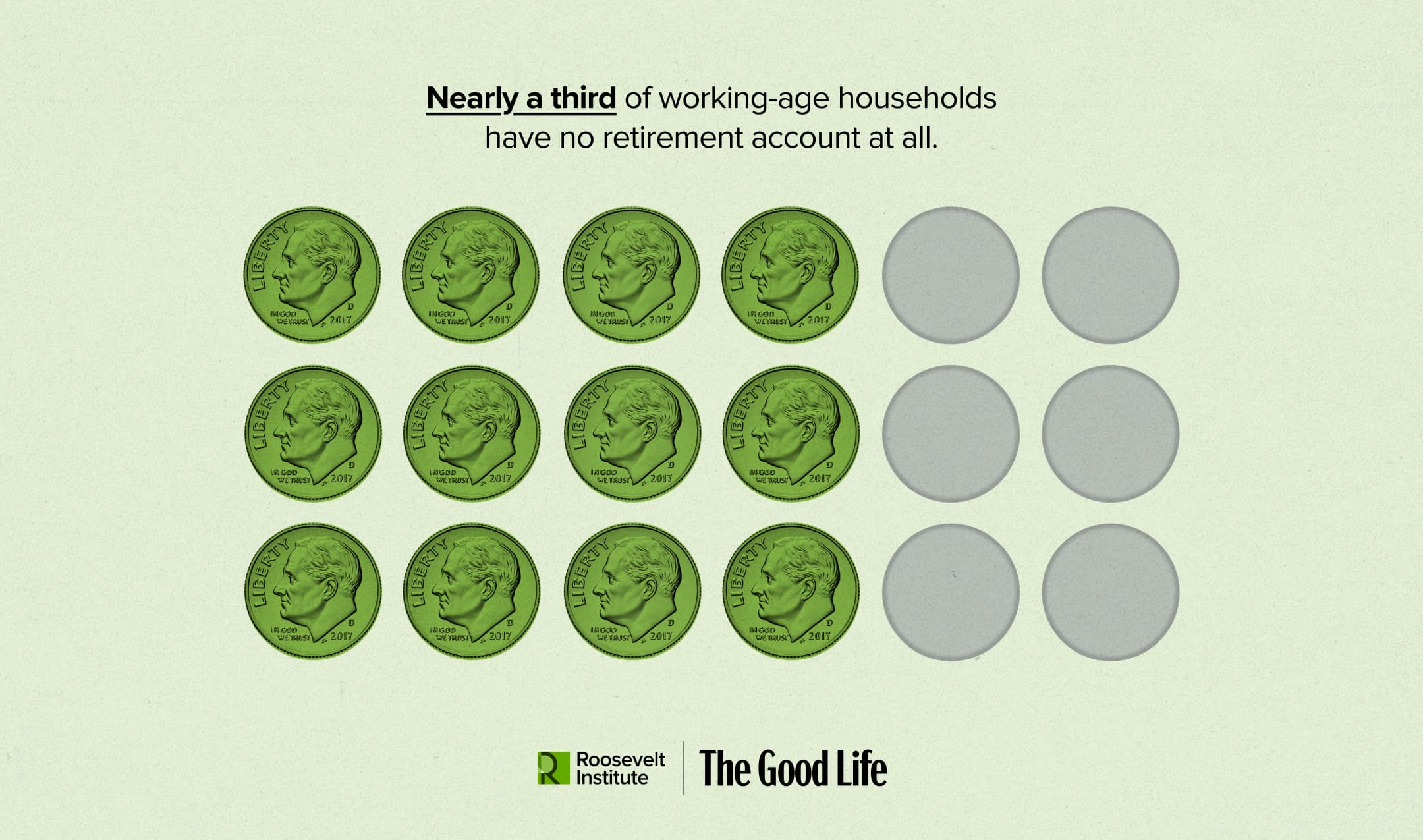
Getting Americans’ retirement savings back on track will require multiple tools from the good-life toolbox:
- Public option:
- A public asset manager. Our current private system channels savings through layers of private asset managers. These asset managers do everything they can to squeeze profits from workers’ investments, resulting in workers losing up to an estimated one-third of their retirement investment returns to fees. Creating a public asset manager option would allow workers to entrust their investments to an entity that does not extract profits from their savings and could drive investment in the public interest—for example, toward green energy production and away from fossil fuels.
- A public retirement savings plan. A low-fee, portable, publicly backed savings option would give workers a secure and low-cost way to save. The Thrift Savings Plan that federal workers can invest in demonstrates what such an option might look like. Pairing access to such a plan with public matches would further incentivize worker savings.
- Antimonopoly policy: Regulation to protect retirement savings. Too many firms, like Blackstone, see workers’ retirement savings as a new frontier for the private market and are advocating expanding retirement accounts into private equity, private credit, and cryptocurrency markets—seeking to expand financialized investment markets far beyond any possible justified need in service of increased extraction. Policymakers should establish bright-line rules banning any moves that expose workers’ savings to extremely volatile, lightly regulated alternative assets. These proposals would force workers to rely on speculative markets at the very moment when they need stability.
A secure retirement system shouldn’t require workers to time markets or decipher complex financial products. Social Security should remain the anchor. Expanding and fully funding it is the most direct way to ensure a stable, inflation-adjusted income in retirement. Beyond Social Security, complementary systems must correct the flaws of today’s employer-dependent accounts to minimize risk to the fruits of a life’s work.

Reclaiming Time for What Matters
The average middle-class American couple with children works a combined 600 paid hours a year more today than they did in 1975. This means that in the last 50 years, Americans have essentially added over four months of paid work a year to their calendars without any similarly significant shift in the kind of support that families receive
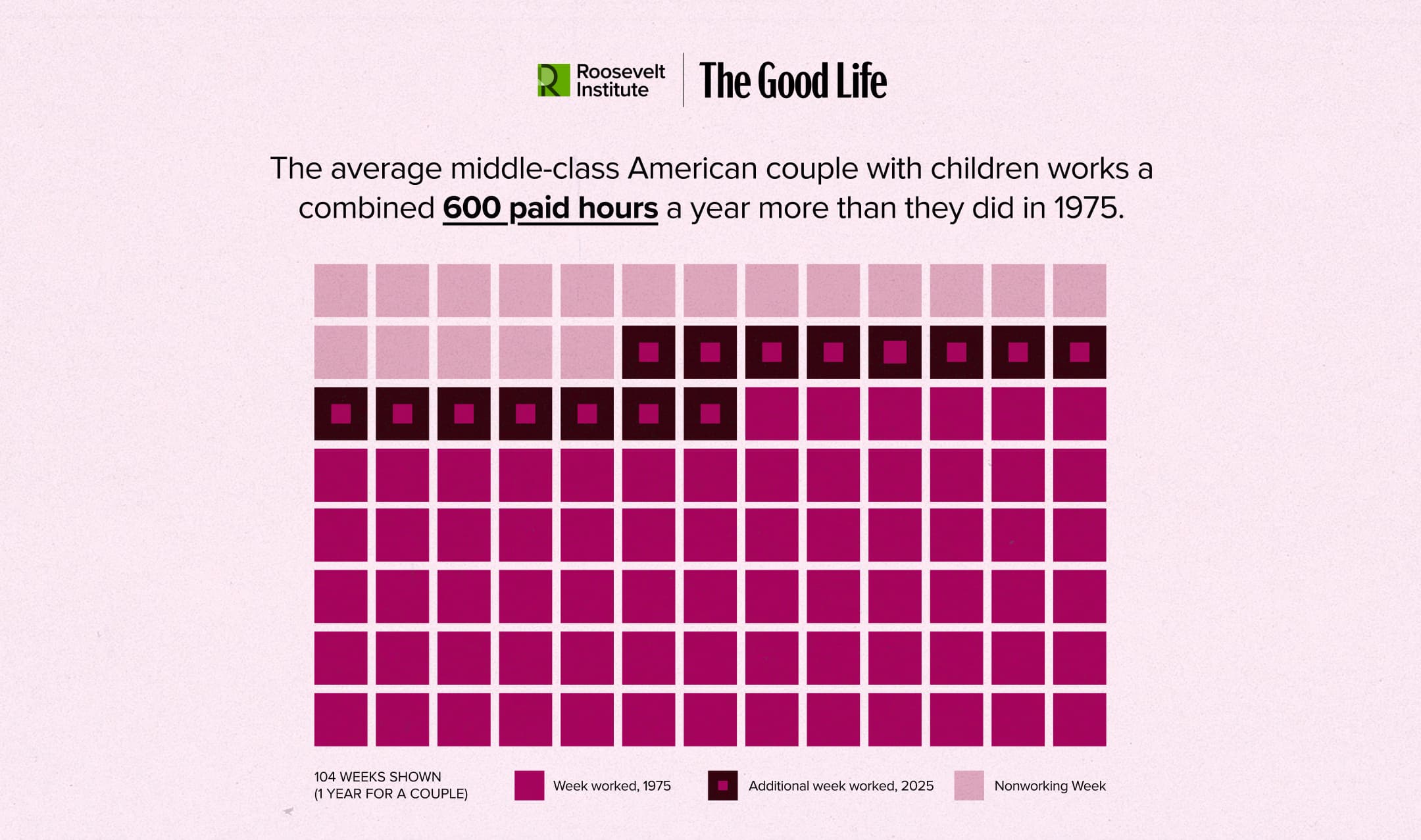
We haven’t meaningfully subsidized childcare or eldercare. We haven’t implemented paid leave. We haven’t extended school hours. We haven’t reduced commutes. It’s no wonder that it feels harder to lead a good life, rich with community and gathering. Who has the time?
If policymakers want to deliver for working people, they have to prioritize supporting more flexible time so we can all enjoy the fruits of our labor. We want a world where workers don’t have to miss their child’s big game because they didn’t get their schedule until that morning. We should live free of worry that we won’t have the personal time off to care for a parent who’s suffered a fall. We shouldn’t feel so crunched for time that going to debate about a local ordinance of importance to us or having dinner with friends and family feels like a luxury rather than an expected part of a rewarding life.
As it happens, creating more time for these things also drives stronger productivity and economic growth, as we show below.
Much of the time families have lost to paid work has followed from women entering the workforce more permanently. Reversing that trend is not the answer. Women’s increased workforce participation has not only broadened the life choices of women across the country but increased their families’ economic security. It also spurred economic growth and innovation when both were otherwise slowing—as happens when racial, gender, and other forms of discrimination are reduced.
In other countries, this shift caused a less dramatic loss of time for activities outside of paid work. Their experience shows that, with intentional policymaking to support two-earner families, parents don’t have to sacrifice their sanity in the form of hundreds of hours of lost time a year.
For millions of Americans, the answer to increasing time at work has been paying for care—childcare for young children and for school-age children during nonschool hours, long-term care for elderly relatives and those suffering from short- and long-term disabilities. As discussed above, this care often comes at a very steep price that eats away at family budgets. Many Americans find the price too steep and instead rely on complicated schedules and informal arrangements to cover their care obligations, leaving them with insufficient time with their loved ones and little leisure time at all. This is why a public option for childcare, discussed in our costs section, is just as important for our time agenda.
While we’re 50 years late in reacting to one seismic shift in workforce composition, we have the chance to get the next one right. As AI changes the nature of both work and the workforce, policymakers should be targeting this human outcome: giving Americans the time they have needed for decades, the time that lets all of us care for our loved ones and communities and make meaning in our lives.
This section outlines a handful of policies that would help meet this goal efficiently and inclusively for families. Further, we spotlight policies that will enable people to spend some of that unlocked time building agency and connection. The menu of policies discussed here is far from a comprehensive time agenda, which should include efforts to build housing density to reduce commute times, policies to encourage more flexible work arrangements, and other creative solutions.
While we’re 50 years late in reacting to one seismic shift in workforce composition, we have the chance to get the next one right. As AI changes the nature of both work and the workforce, policymakers should be targeting this human outcome: giving Americans the time they have needed for decades.
Childcare in New Mexico
In September 2025, New Mexico announced that it will become the first state in the nation to provide no-cost universal childcare for all its residents. This program promises to save New Mexican families money and time. Some of the most exciting elements of the proposed program reflect Roosevelt’s principles for a universal childcare system:
- Universal program, targeted rollout: New Mexico plans to begin the roll out of the new program focused on infants and toddlers, as well as low-income families and children with special needs. Our research highlighted the need to combine the principle of true universality with a rollout that prioritizes children and families with the highest needs.
- Supply-side investments to ensure sufficient spots: New Mexico also announced dedicated funding to construct, expand, and renovate childcare facilities. To date, US childcare policy has primarily focused on demand-side interventions like tax credits and subsidies, but supply-side investments are necessary to improve access as well as affordability.
- Investing in the workforce: The state plans to address the workforce shortage through a statewide campaign to recruit licensed home providers, higher reimbursement rates to reflect the true cost of care, and an additional incentive rate for programs that commit to paying entry-level staff a minimum of $18 per hour. Increasing wages for childcare workers is essential to building a system with less turnover and more available, stable, quality care.
New Mexico was able to fund the full expansion to universal childcare largely through tax revenue from oil and gas production, but other revenue-raising efforts have led to this point. The state created a permanent endowment dedicated to childcare in 2020, and in 2024, it closed a loophole for capital gains deductions for high-income earners and set a flat rate for corporate tax to increase corporate tax revenue. And in the most recent legislative session, the state’s Early Childhood Education and Care Department received a budget increase of $113 million.
New Mexico has been creative and innovative in its funding strategies, but most states don’t have this level of funding base available, and states cannot deficit spend. And early on in its implementation, New Mexico has hit hurdles to implementation—namely, around the struggles of expanding supply with the funding it does have. In order to fully expand supply to meet universal demand, the amount of funds needed to supplement wages to retain and recruit the necessary staff is steep. Childcare provider wages are so shamefully low all over the country that small increases simply won’t be enough; in other words, $18 an hour may not sufficiently increase the supply of labor. What is needed is significant public investment in wage increases, which are difficult for states and localities to sustainably fund on their own. The federal government must step up: Both the popularity of universal childcare proposals from states like New Mexico and the barriers it and others face in funding demonstrate the need for a national system of public childcare for all.
Paid Leave
Paying for care is often not the option families want or need. Whether after the birth of a child or in the face of illness or disability, caregivers often want to be just that—the people providing the care to their loved ones. Yet too few can afford to take the time off from work to do so. To that end, a paid leave program is an essential prerequisite for an agenda that takes families’ need for more time seriously.
The United States is a deep outlier in its lack of such programs. We are one of only seven countries (and the only high-income country) to not guarantee paid maternity leave, one of only a few countries in the Organisation for Economic Co-operation and Development (OECD) to not guarantee paid paternity leave, and one of only two OECD countries without paid sick leave. The federal Family and Medical Leave Act guarantees 12 weeks of unpaid, job-protected leave to eligible workers for qualifying family and medical reasons, but the law exempts many workplaces and types of workers, and even eligible workers are unlikely to be able to afford to take unpaid time off. Thirteen states have already recognized this deficiency and moved forward with their own paid leave plans, but that leaves millions of Americans out of any system. Those who do get coverage—largely through employers—tend to be higher-income to begin with; workers in the highest wage deciles are eight times more likely to have access to a paid family leave policy.
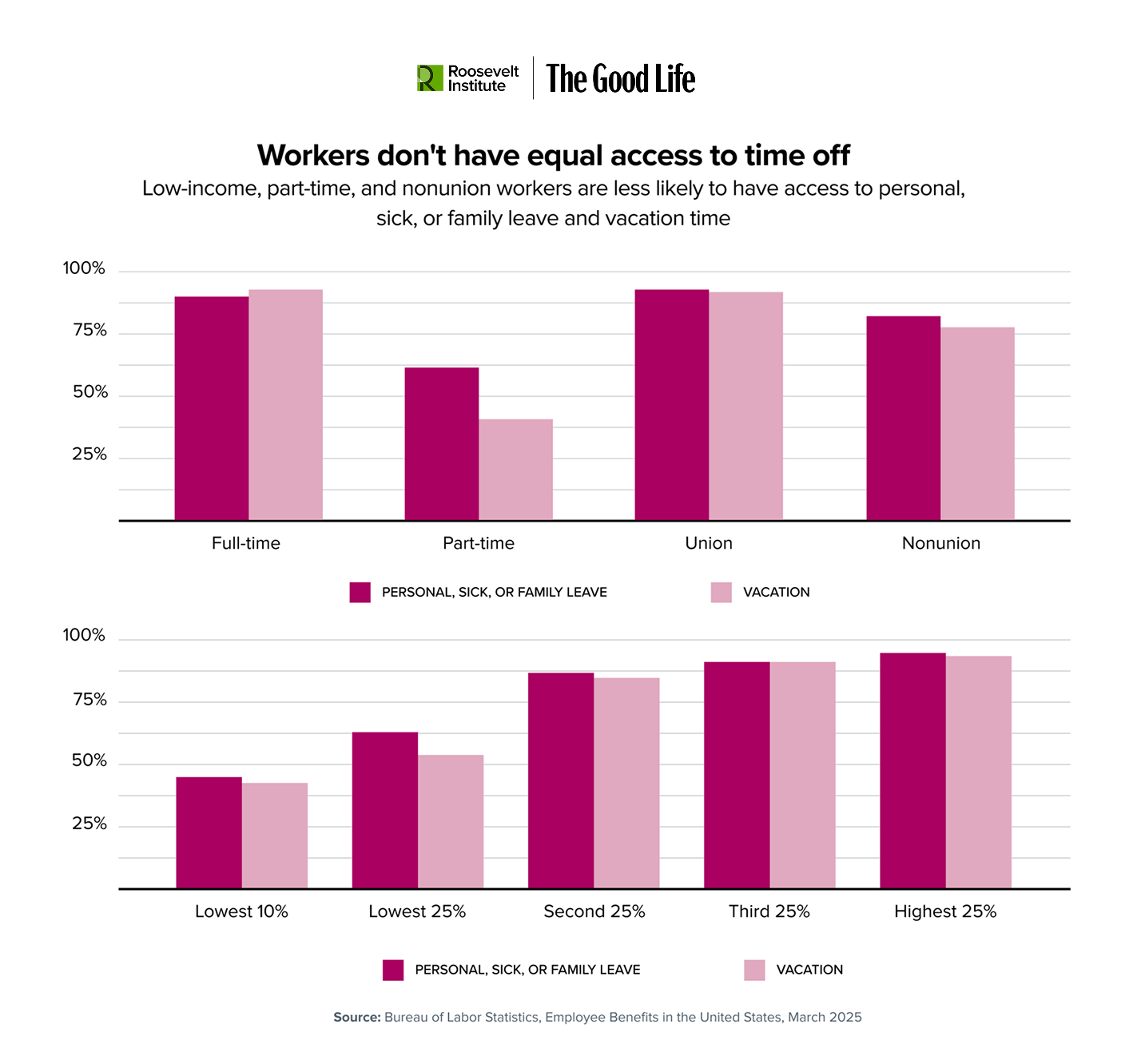
Providing truly equitable access to paid leave requires standing up a public option. Fortunately, the experiences of other countries give us a wide evidence base to draw on when structuring such an option. Some clear principles emerge from these studies:
- Access to paid leave should be universal; in particular, a new policy must eliminate the limits on employer size and hours worked that are in the Family and Medical Leave Act and attach compensation to its time-off provisions.
- Paid family leave should be distributed among all parents with a “use it or lose it” provision so that men are incentivized to take it and the program does not increase gender imbalances in the workforce.
- Paid family leave should be understood as part of a comprehensive childcare package that moves together legislatively. In almost every country with a public universal childcare system, a generous parental leave policy lessens the need for childcare for the very youngest children, who are the most expensive to care for outside the home.
Beyond giving Americans more time, these policies would spur economic growth. One recent, credible analysis estimated that paid leave and universal childcare would “grow economic activity by 4 percent of GDP—then nearly $1 trillion—from 2023 to 2032.”
During the pandemic, the US rapidly stood up a temporary paid sick leave program that mandated two weeks of fully paid sick leave and reimbursed employers for the expense. The program had many flaws that led to both limited coverage and uptake, but it shows that we can implement a real paid leave program quickly. We should draw on this model as we build a permanent paid leave program into our social insurance system.
Shorter Workweeks
The US is so far behind peer countries on the basic policies that give people more control over their time that it can be hard to imagine truly transformative policies like a substantially shorter workweek. Nevertheless, especially at a moment of fear about increased productivity from AI leading to job displacement, a shorter workweek should be on the table.
A few policymakers and advocates have already made this case. Senator Bernie Sanders introduced 32-hour workweek legislation in 2024, and the United Auto Workers union included a 32-hour workweek demand in its initial contract negotiations in 2023.
These proposals are backed by real-world experiments. In the last decade and especially since the pandemic, a number of high-profile cities, countries, and companies have adopted shorter workweeks. In Iceland, labor unions have been bargaining for shorter workweeks for the last six years; almost 90 percent of the country now works 36-hour weeks or has the right to do so. Tokyo gave municipal employees a four-day workweek last year. Researchers have also been working with companies to pilot shorter workweek experiments in the UK, the US, Canada, and elsewhere. The results have been promising: Many of the trials found that productivity actually increased for companies after they introduced a four-day workweek; few companies saw significant enough productivity losses to end the trial.
To encourage shorter workweeks, the US should mobilize industrial policies and public options:
- Antimonopsony policy: Overtime protections. The standard workweek is set through overtime rules, so shortening it would mean shifting the point at which overtime kicks in. We should accompany this shift with broadening the coverage of these rules—restoring and extending overtime protections so salaried workers can’t lose time-and-a-half pay through narrow exemptions. Federal regulators must also commit to regularly updating overtime salary thresholds.
- Public options and taxes: Benefits decoupled from employment. Public options are also an important tool in making shorter workweeks a reality. Our tax code encourages an employer-based insurance system that incentivizes employers to limit the number of employees who work over 30 hours and to encourage all those who clear that bar to work even longer hours. Public options that decouple benefits from employment, and accompanying shifts in the tax code, would thus ease the transition to shorter workweeks.
The US hasn’t reduced its formal workweek since 1940. In that time, productivity has risen more than 90 percent. Hourly pay has not kept pace—rising only about 33 percent in the same time period—and time worked has risen. Regardless of AI’s eventual impact on productivity, we are overdue to revisit our standard workweek. And, if AI does lead to rapid increases in productivity, shorter workweeks can help us spread work across more workers and thus may quickly become one of the best tools we have for a fair transition to this new economic era.
Story from the Field: The Four-Day Workweek
4C Health—an Indiana-based integrated mental health care center—is open and available 24/7, but almost all 4C’s employees work only 32 hours a week, while still receiving full-time wages and benefits.
Community Mental Health Centers like 4C Health are a policy response to the growing need for mental wellness support, especially in rural areas. Supported by federal grants and reimbursed through Medicaid, these centers help people with no other insurance access therapy, and they offer support with substance abuse and for children with behavioral struggles in school.
The seven Indiana counties that 4C Health serves are considered provider deserts. In response to rising employee burnout, 4C Health implemented a four-day workweek in 2022. The change helped the organization grow and cover more counties. With a few exceptions, including the executive team, every employee has a three-day weekend every week, and they split into separate coverage teams for Mondays and Fridays.
Implementing the four-day workweek was a way for 4C Health to give everyone something that is invaluable: “time back to live life outside of work,” as Chief Revenue Officer Lisa Willis-Gidley put it. The shift led to a highly intentional and efficient workplace, higher wages, better employee well-being, and more free time. The extra day off every week has been especially important for employees who have gone back to school to further their professional development.
“The flexibility of the schedule ensures that I can get my required hours in on the day I am not working at 4C,” said Benson Smith, who started at 4C Health as an undergraduate student and has leveraged the four-day workweek to dedicate time to school.
“This also allows us to show what good self-care looks like as a clinician and demonstrate how to prevent burnout,” said Letecia Timmel, a licensed clinical social worker who oversees student employees.
The four-day workweek has also helped 4C Health recruit more providers, including those who provide licensed remote therapy. Surveys show that younger workers value a balance between their work and their personal lives. “Too many workplaces waste time on things that don’t add value; you must be intentional with the time spent in the workplace,” said Willis-Gidley. “But the four-day workweek provides immediate opportunities for people to pour into their hobbies, chaperone a field trip with their kids, and go to the doctor.”
As the old saying goes, time is money. But American workers know that it is much more than that. Money pays the bills, covers the rent, puts food on the table, and fills the car with gas. But it is time that unlocks access to a good life.
Scheduling
Thus far, the proposals in this section have required major changes and investments in the structure of our economy. These are essential to rebuilding a functional, democratic economy that can enable the conditions of a good life for all. That said, structural change can take time. While there is no time to lose in moving these programs forward—and while we believe a committed government could do so swiftly—smaller, faster reforms would also have a big impact on people’s lives and build trust that larger structural changes are on their way. Topping this list of solutions is helping Americans gain control over their work schedules.
The days of finding a job with a consistent and steady schedule no longer exist for millions of workers in the US, particularly those in the service sector. Instead, workers’ schedules span irregular hours and different days from week to week despite businesses themselves being open and operating on a regular schedule. Many companies in the service sector have adopted just-in-time scheduling practices that result in unstable and unpredictable schedules for workers, with significant harmful consequences for their economic and family stability.
According to research by the Shift Project, 60 percent of workers in the service sector report receiving less than two weeks’ notice of their schedule. This makes planning basic life events challenging, including arranging consistent childcare, knowing whether you can attend a parent-teacher conference, or helping take care of an aging parent. Even after workers receive short notice of their schedule, a majority report having to deal with last-minute changes—either getting called in when they weren’t expecting it or a shift they were counting on getting canceled.
Good-life policy tools can tackle this issue:
- Antimonopsony policy: Fair scheduling laws. Today, 10 cities and the state of Oregon have labor-market-shaping laws that generally require companies to provide advance notice to workers of their schedules and compensate employees when their shifts are canceled at the last minute. Congress should pass federal legislation to ensure that, even in industries that have long or irregular hours of work, employees have reasonable notice and certainty of work. Further, Congress should attach fair scheduling requirements to industrial policy investments in private-sector companies.
- Countervailing power: Worker organizing. Workload is a classic topic for labor negotiations. Empowering more workers to organize—whether they’re nurses negotiating staffing ratios or steel workers negotiating 14 days advance notice on scheduling—helps them gain more control over their time.
The impacts of scheduling go far beyond logistical challenges and mental stress for workers. Researchers have also found that just-in-time scheduling has negative consequences on children’s sleep and behavioral problems. These scheduling practices have all but eliminated any line between work and home life, and they’ve unduly shifted businesses’ burdens and risks to workers; 65 percent of workers report that employers require them to keep their schedules “open and available” for work. A good life should ensure that you can step away from work and fully and meaningfully engage in the other aspects of your life, including spending time with family and in your community.
The Annoyance Economy and Time Taxes
If we’re lucky, we find meaning in the work we do caring for our loved ones and in our paid employment. But even when this is the case, we all want and deserve more time for the other pieces of a rich and textured life. In contrast, none of us find meaning in the time-consuming annoyances of daily life: time on the phone with customer service, time filling out tax returns, time applying for student loans or Medicaid. Giving Americans back time should include tackling these irritants, which add up to something more than irritation. Doing so is another opportunity to build trust in government as it confronts the larger structural challenges that take time out of Americans’ lives.
The Groundwork Collaborative recently released a report coining the term “Annoyance Economy” to describe the hassles that corporations scatter throughout our days. They calculate that these annoyances—from time waiting for the doctor to onslaughts of robocalls—cost Americans “at least $165 billion in wasted time and lost money” each year. This hasn’t always been true, and it’s getting worse as corporations have more freedom to profit from the time taxes they impose on us all. The same Groundwork study reports that time spent on the phone with customer service has risen 60 percent in the last 20 years.
It’s not just private companies that suck time out of Americans’ lives. The federal government itself forces unnecessary paperwork and process on Americans trying to access benefits, from federal student and small business loans to SNAP and the Earned Income Tax Credit. Work requirements like those added to Medicaid eligibility in the One Big Beautiful Bill Act create significant paperwork barriers to access and limit uptake of benefits.
And if that weren’t bad enough on its own, this administrative labyrinth also funnels massive profits to private contractors. Equifax and Deloitte, for example, have gained dominance in income verification and Medicaid eligibility software, respectively, and racked up federal and state government contracts worth billions of dollars. As Luke Farrell, former senior advisor for technology and delivery on the White House Domestic Policy Council, wrote earlier this year, Georgia has spent “twice as much on Deloitte consultants and administrative costs as on healthcare for people” since implementing work requirements for Medicaid in 2020.
Giving back the time stolen by time taxes and the annoyance economy requires creative use of these good-life governance tools:
- Antimonopoly policy: Enforcement against corporate abuses. The Biden administration used its enforcement power to take on corporate abuses. The Consumer Financial Protection Bureau, for example, targeted junk fees and went after companies with particularly egregious customer service practices. The FTC required companies like Credit Karma to pay money to customers whose time they wasted through deceptive practices—for example, so-called preapproved credit cards people didn’t actually qualify for when they applied. In order to reduce the monopoly power of contractors like Equifax and Deloitte, the federal government should at minimum use its negotiating and enforcement powers to ensure that agencies and states are not getting fleeced and double-charged.
- Public options: Universal and streamlined programs. Lawmakers sometimes weigh down public programs with requirements that make participation difficult at best. Creating the universal public options advocated earlier in this report in ways that minimize requirements for access reduces time taxes significantly. Other public options at the point of service, like the IRS’s Direct File program, offer streamlined ways for Americans to interface with their government, removing middlemen that cost time and money.
When compliance is made easier—for example, when Women, Infants, and Children benefit certification appointments became virtual during COVID—uptake increases. Congress should reduce government time taxes by creating an “affirmative obligation for agencies to maximize uptake of service and benefits, achieving the full legislative intent of programs, including requiring automatic enrollment wherever possible.” Legislation should also facilitate data-sharing across agencies to allow for more automatic enrollment and streamline the process of filling out forms.
Leisure, Community, and Democratic Practice
Shorter workweeks, fewer irritants, and meaningful care options will give working people time not only to rest but to exercise real agency in other areas of their lives. Some of the freed up hours will go to caring for loved ones, tending to doctor’s appointments, and shopping for groceries, but there will also be more time for going to the movies, taking a hike, joining a club, or running for local office—whatever gives each individual life meaning and a sense of belonging. Giving people that agency requires more than giving them the hours; it also requires building the options.
FDR understood this imperative. He believed the point of an expanded economy was not only more “security and employment” but also “more education,” “more health,” and “more recreation.” To that end, the infrastructure that the New Deal put people to work on included not only power lines and post offices but playgrounds, athletic fields, and national parks. A time agenda should renew a national effort to build this kind of public leisure infrastructure, places where people can cool off or warm up in extreme weather while socializing with their neighbors.
One model worth learning from is Bogotá’s care blocks. Launched in 2020, the Care Block program began with the creation of 10 city-operated blocks across the city where caregivers can access a host of resources all at once. The blocks include buildings that provide care to caregivers’ charges, buildings that offer services to caregivers themselves—from laundry and medical care to legal service and educational courses—and recreational facilities. Importantly, these physical spaces build community for people who often feel isolated. One early study of the program found that it fostered caregivers’ “sense of purpose, enjoyment and resilience.”
Of course, the kind of services that would be included in these physical spaces will vary across countries and communities. But the idea of creating physical spaces that offer care, provide recreational and community infrastructure, and give people more time is inspiring and universally applicable.
Ideally, people would choose to spend some of that time engaging more with their communities and participating in renewed and more efficient democratic processes. As discussed above, a reimagined government needs to engage people differently in policymaking. One reason current processes for community engagement in policymaking often favor elites and the elderly is because those are the people who have the time to voluntarily engage.
Giving people more slack in their schedules is thus a critical first step toward the ultimate democratic goal: policy cocreated by the public. The next steps are building institutions that can efficiently engage everyday people in the policymaking process. That includes the federal government, as explored in Hannah Garden-Monheit and Tresa Joseph’s Building a More Effective, Responsive Government, but also extra-governmental organizations that build countervailing power, like labor and tenants unions.
Good-life governing tools to this end include:
- Public options:
- Public infrastructure and national service. Those governing for a good life should follow FDR’s lead and build out public pools, libraries, and parks. Further, a robust national service program could put young people to work on these projects, just as the New Deal once did. Such a program would foster national community in and of itself, while building spaces that would do that work into the future.
- Public infrastructure that saves time. New public facilities should colocate resources in the style of Bogotá’s care blocks. This effort could build on existing public infrastructure like libraries, childcare centers, and even the network of American Job Centers, which could be transformed to connect workers to training, income supports, and organizations that defend workplace rights.
- Countervailing power: Paid civic leave. Policymakers should consider a policy to allow workers to earn paid civic leave from work. One proposal to this end would let workers earn an hour of protected paid time off for a broadly defined set of civic activities for every 80 hours worked. Such a program could close the gap in civic participation between low- and high-earners.
Conclusion
Decades of evidence tell us that policies that help working families build good lives make our economy and our democracy stronger and more innovative.
Yet, over the last five decades, we’ve seen policy move in the other direction. Billionaires and corporations have wielded the power of government to self-serving effect, even more brazenly so in the second Trump administration. Its flagship One Big Beautiful Bill Act marks the largest upward transfer of wealth in our country’s history, while slashing food support and healthcare subsidies for those most in need.
Rebuilding Americans’ trust in democracy and our governing institutions requires a vision that people can see themselves in, and a different kind of government than we’ve seen before. Our government must be clear-eyed about its mission: to deliver the building blocks of a good life to all, while empowering working people to have a leading role in shaping our economy and public policy. That won’t be possible if we don’t curb the power of corporations and concentrated wealth, which have constrained some of the most important choices in our lives.
Our government must be clear-eyed about its mission: to deliver the building blocks of a good life to all, while empowering working people to have a leading role in shaping our economy and public policy.
It’s incumbent on policymakers to show the American people they’re doing everything they can to address costs. But a good life is about so much more than staying afloat.
The full range of what people want out of life—affordable essentials, strong and stable incomes, more control over our time—is deeply reasonable. But the distortions in our economy and democracy are deep, and we’ll need to be bold and stay resolute in our efforts to right them. Achieving these goals is doable, but only if policymakers break with the limited imagination of what government can deliver, what tools are available, and how they can be wielded. With this agenda, we show what that could look like, spotlighting long-dormant tools that can deliver.
Some of the policies in this agenda will require a long-term commitment to come to fruition. Many others could move quickly, including fair scheduling laws, zoning reform, and paid leave. By acting on these at the first opportunity, policymakers could both transform people’s day-to-day lives and build trust that bigger changes are on the way.
As FDR reminds us, “action, and action now” to create a better economy is the best case we can make for our democracy.
The Good Life Agenda Poll
New polling conducted by Impact Research for the Roosevelt Institute (released June 2, 2026) finds that while most people are struggling financially and have lost confidence in government to deliver results, they are ready for bold action from their policy leaders.
The Good Life Agenda speaks directly to this moment, and to something deeper: Americans’ desire for security, freedom, and time for themselves and with the people they love. Those were among the phrases that resonated most when people read the agenda, generating broad, intense support across every demographic group tested, including among the most disillusioned with government.
People surveyed also show strong support for bold policies that only the government can deliver on, including expanding healthcare, wages, housing, and retirement security.
Read a short brief, view a summary presentation, and explore the crosstabulations, which offer insight into what Americans need and who they believe is responsible for delivering upon this vision.
Acknowledgments
This report was written with key contributions from:
Bilal Baydoun, Lena Bilik, Katherine De Chant, Hannah Groch-Begley, Brad Lipton, Meredith MacKenzie de Silva, Michael Madowitz, Stephen Nuñez, Patrick Oakford, Shahrzad Shams, Michelle Sternthal, Todd N. Tucker, Aastha Uprety, Abiah Weaver, Allison Zelman
With research assistance from:
Oskar Dye-Furstenberg, Toyosi Odusola, Ijeoma Ogbonna
Additional thanks to the entire Roosevelt Institute staff for supporting the development of this report.
The authors would like to thank a range of thinkers who provided feedback and collaborated on big ideas:
Yohannes Abraham, Alex Aghdaei, Aviva Aron-Dine, Sharon Block, Nikolas Bowie, Sky Cambron, Sophia Castillo Rosser, Avinash Chivakula, Molly Coleman, Luke Corless, Andrea Dehlendorf, Stefanie DeLuca, Joel Dodge, Cristin Dorgelo, Indivar Dutta-Gupta, Douglas Farrar, Ted Fertik, Jessica Forden, Radhika Fox, Seth Frotman, Hannah Garden-Monheit, Lisa Gilbert, Jacob Goldin, Nick Graetz, Erin Graham, Jacob Hacker, Angela Hanks, Carlos Hernandez Tavares, Luke Herrine, Alexander Hertel-Fernandez, Sarah Heydemann, Daniel Hornung, Jen Howard, Chye-Ching Huang, Elisabeth Jacobs, Nicole Jorwic, Jamie Keene, Bobby Kogan, Jacob Leibenluft, Michael Linden, Zachary Liscow, Dorian Lofton, Ioana Marinescu, Mary Beth Maxwell, Michael McCarthy, Katherine Michelmore, Beverly Moran, Taryn Morrissey, Rajesh Nayak, Osita Nwanevu, Laura Padin, Lenore Palladino, Brent Parton, Beth Pearson, Shilpa Phadke, Sarah Pray, Sabeel Rahman, Bharat Ramamurti, Ned Resnikoff, Eva Rosen, Mike Schmidt, Daniel Schneider, Regina Seo, Anika Singh Lemar, Aaron Sojourner, Harry Stein, Matt Stoller, Louisa Terrell, Elena Wierich, Miranda Yaver
Any errors, omissions, or other inaccuracies are the authors’ alone.
RELATED RESOURCES
Authors




Reynaldo Fuentes
Director, Strategic InitiativesAs the director of special initiatives, Reynaldo Fuentes works across the program areas of the think tank to strategically drive Roosevelt’s research and policy agenda.
Noa Rosinplotz
Senior Research AssociateAs a senior research associate at the Roosevelt Institute, Noa Rosinplotz supports think tank staff and fellows in their research.